
HS Codes for Hair Transplant Instruments and Supplies
A heading-level HS/CN classification reference for the hair-restoration product basket: instruments, consumables, equipment and hair-care products, with the pitfalls that cause misclassification.
Sourcing & import
The commercial mechanics of importing hair restoration instruments — customs, MOQs, samples, payment terms and how to evaluate a supplier before committing.
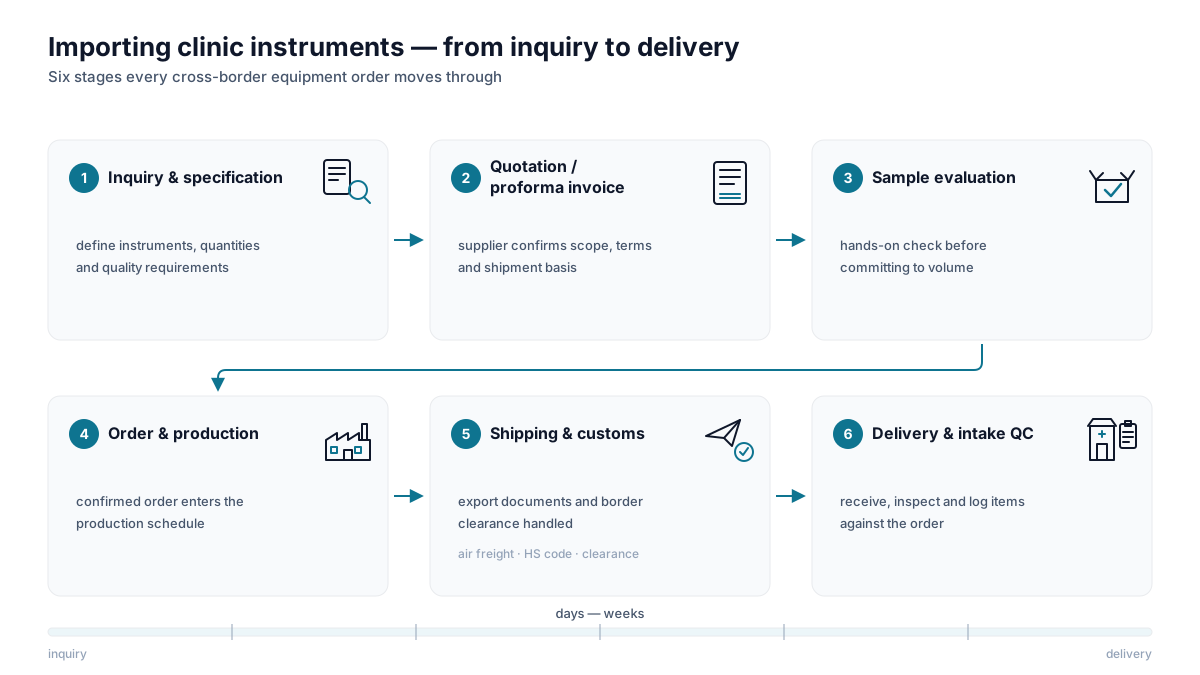
Most clinics and many distributors buy hair restoration instruments across a border, because the manufacturers are concentrated in a handful of countries and the buyers are everywhere. The instruments themselves are covered in this platform's other hubs; this one covers the commercial machinery around the purchase — the part that determines whether a good instrument arrives on time, at the cost you calculated, from a supplier who will still answer in a year.
Start with classification, because everything downstream hangs on it. Internationally traded goods carry an HS code (Harmonized System), and surgical instruments generally fall under chapter 90 — heading 9018 covers instruments and appliances used in medical or surgical sciences. The code determines the duty rate and import requirements in your country, so confirm the classification for your specific products with your customs broker before the first order, not after the first shipment sits in customs. On the same first call, settle who does what at import: in most arrangements the buyer is the importer of record, a freight forwarder or courier handles clearance, and the landed cost is unit price plus freight, insurance, duty and import VAT — a number worth computing per SKU before comparing suppliers on unit price alone.
MOQs — minimum order quantities — are where negotiation actually happens. Manufacturers set them because production runs, packaging and export paperwork have fixed costs; they differ by product and by how standard your specification is. Two practical truths: published MOQs are usually the opening position, especially for a buyer who credibly represents repeat business, and structure often moves further than volume — mixed-SKU orders, first-order exceptions and stocking arrangements are all normal asks.
Samples come before every meaningful order. Serious manufacturers expect sample requests and typically charge something for them — a token price or shipping cost is normal and mildly reassuring, since free everything attracts unserious buyers and unserious suppliers alike. Evaluate samples of the exact SKUs you intend to buy, under your real working protocol, and treat the sample transaction itself as data: how fast it shipped, whether documentation was clean, whether questions got competent answers.
Payment terms follow a standard ladder. First orders usually run against a proforma invoice — the supplier's binding pre-shipment invoice stating goods, prices, terms and bank details — with payment in advance or split (a deposit at order, balance before shipment). As trust builds, terms typically loosen toward balance-against-shipping-documents or open account for established relationships. Letters of credit exist for large transactions where neither side wants to move first; they are bank-heavy and cost fees, so they make sense above a certain order size, not for a clinic's quarterly consumables. Whatever the term, the discipline is the same: pay against documents and clearly identified goods, never against urgency.
Supplier evaluation is mostly the patient accumulation of small evidence: does the company answer technical questions specifically or generically; are quotations complete and consistent; do lot labels, invoices and packaging tell the same story; can they name references in your region; does quality hold from sample to first order to third order? Regulatory documentation for your market exists and belongs on your checklist — verify what your jurisdiction requires directly with the supplier and your own advisors. And treat implausible pricing as information: markets with strong brands attract counterfeit and grey-market product, and an instrument at a fraction of the normal price, from a seller with no traceable factory, is usually exactly what it appears to be.
The guides in this hub take each of these topics to working depth. If you want to shortcut the supplier search itself, the wholesale page starts a direct catalog conversation, and the distributor program covers territory-level partnerships.
Import mechanics, distribution structure and payment customs differ by jurisdiction. The country guides cover them market by market: Germany, the United Kingdom, France, Spain, Italy, the Netherlands, Austria, Switzerland, Belgium, Poland, the United Arab Emirates and Saudi Arabia. A second set covers Portugal, Greece, Qatar, Kuwait, Oman, Bahrain, Egypt, Jordan, the United States, Mexico, Colombia and Brazil. Each names the responsible authority, walks the customs reality for that border, and describes how buyers there actually order and pay.
For the handful of cities that function as industry hubs in their own right, dedicated snapshots cover the cluster mechanics: Istanbul, Dubai, Riyadh, London, Düsseldorf, Berlin, Madrid, Milan, Paris, Amsterdam and Warsaw.
Surgical instruments generally classify under HS heading 9018 (instruments and appliances used in medical or surgical sciences), with the full national code depending on your country’s tariff schedule. Confirm the exact classification with your customs broker before ordering — the code drives duty rate and import requirements.
It varies by product and manufacturer, and published figures are usually negotiable — especially in structure. Mixed-SKU orders, reduced first-order quantities against a stated reorder intention, and phased deliveries are all normal requests. A supplier’s flexibility on a first order is itself a useful signal.
Usually yes — a token price or at least shipping. That is normal practice and mildly reassuring, since it filters unserious parties on both sides. What matters is evaluating the exact SKUs you intend to buy under your real protocol, and reading the sample transaction itself as evidence of how the supplier operates.
A binding pre-shipment invoice stating the goods, quantities, prices, delivery terms and bank details. It is the standard basis for advance or split payment on early orders, and for your import paperwork. Check it line by line — it is the document your money and your customs entry will both reference.
For large transactions between parties without an established relationship, where neither wants to move first. Banks on both sides charge fees and demand precise documentation, so LCs are rarely economic for routine consumable orders — advance or split payment against a proforma invoice is the usual path there.
Buy from the manufacturer or an authorized channel, insist on consistent lot labeling and documentation, and treat implausible pricing as a warning rather than a bargain. If the seller cannot show a traceable factory relationship, assume the discount is explained by something you would not accept knowingly.
A heading-level HS/CN classification reference for the hair-restoration product basket: instruments, consumables, equipment and hair-care products, with the pitfalls that cause misclassification.
Clinics can and routinely do import directly from instrument manufacturers. The trade: lower unit prices and full catalog access in exchange for importer responsibilities, freight and customs work.
Counterfeit and grey-market instruments concentrate exactly where hair restoration buys: small, branded, high-margin consumables ordered online. The tell-tales that expose fakes — packaging, laser marks, lot logic, price and channel — and the verification and documentation habits that keep them out of the clinic.
Why Turkey became a manufacturing base for hair-restoration instruments, and the practical import mechanics — Incoterms, customs documents, duty and VAT logic — for buyers in the EU, UK and Gulf.
The honest answer on dropshipping medical devices: why the model conflicts with what device distribution actually requires, where the practical risks bite — lot control, complaints, customs — and the legitimate low-capital alternatives.
Country buyer guides, clinic-opening guides and city snapshots — each written for buyers working in or with that market.
Everything a professional buyer needs to evaluate FUE punches: geometry, materials, disposable vs reusable economics, and how to source them well.
The full equipment stack of a hair transplant clinic, from operating table to autoclave — written for founders specifying their first operating room.
A professional buyer’s guide to DHI implanter pens — needle gauges, mechanism quality, packaging and the workflow decisions that follow from them.