
Buying & Distributing Hair Transplant Instruments in Kuwait
Kuwait's instrument trade flows through a compact tier of established trading houses: a handful of medical-import firms hold the registrations, the relationships and the shelf space, so winning their attention is the real market-entry task.
In Kuwait, the doors into the market are few, known and already busy. Medical imports flow through a compact tier of established trading houses — many of them divisions of long-standing family commercial groups — that hold the device registrations, employ the salespeople who visit every clinic, and carry portfolios spanning dozens of manufacturers. For a foreign instrument supplier the strategic problem is therefore not finding a distributor but earning genuine attention inside one: the difference between a Kuwaiti agent who actively builds your brand and one who merely lists it is the difference between a real market and a dormant contract.
Key takeaways
- Kuwait's medical-import trade is concentrated in a small number of established trading houses, so agent attention — not agent existence — is the scarce resource.
- The Ministry of Health regulates medical devices, and registration requirements apply before instruments reach the market.
- Commercial agency arrangements carry legal weight in Kuwait, making pre-signature diligence on the distribution agreement essential.
- Private clinic growth is the demand story: aesthetic and dermatology practices in and around Kuwait City are steadily adding hair-restoration services.
- The Kuwaiti dinar is pegged to a currency basket rather than the dollar alone, and it is among the highest-valued currency units in the world.
Who regulates
Medical devices in Kuwait are overseen by the Ministry of Health, which administers the registration requirements that apply before instruments are placed on the market. Registration is handled through locally established companies acting for the foreign manufacturer. Requirements evolve, so verify the current position with the ministry and your prospective agent before committing to timelines.
The agent tier: few firms, many portfolios
The defining structure of Kuwaiti distribution is its shape: a short list of serious medical-import firms, most embedded in diversified family trading groups whose commercial history often predates the oil era. These houses did not grow by specialising narrowly — they grew by accumulating agencies, and a typical medical division represents everything from imaging equipment to consumables across many manufacturers at once. That breadth is their strength and your risk. Their registration expertise, ministry relationships and clinic access are genuinely hard to replicate; but a portfolio of dozens of brands means your instruments compete for salesperson time and management focus before they ever compete against a rival punch or implanter in a clinic.
The practical test of a Kuwaiti partner is therefore internal, and worth structuring your diligence around.
| Question to ask | What a strong answer sounds like |
|---|---|
| Who, by name, will carry our line? | A named salesperson with aesthetic-sector clinics already on their route |
| What else is in that person's bag? | Complementary products, not competing instruments |
| What did you launch last year and how? | Specific clinics, training events, first-order volumes |
| What do you need from us to prioritise this? | Concrete asks — training, demo stock, marketing support — not vague enthusiasm |
A second structural fact deserves respect before signature: commercial agency arrangements in Kuwait carry legal weight, and registered agency relationships can be genuinely difficult to unwind. That is not a reason to avoid the market — it is a reason to negotiate performance thresholds, territory scope and termination mechanics with unusual care while you still have leverage. The clause-by-clause groundwork in our guide to distribution agreement terms applies with extra force here, and a supplier weighing what a committed local partner should bring to the table will find the counterpart perspective in becoming an instrument distributor clarifying.
Private clinics on the rise
Demand rests on the private side of Kuwaiti healthcare. The state system dominates general medicine, but aesthetic treatment is private-pay territory, and the private clinic sector — dermatology practices, cosmetic-surgery centres and polyclinics in and around Kuwait City — has been expanding steadily as licensed capacity grows. Hair restoration fits a familiar Gulf pattern: a young, affluent, appearance-conscious population, historically strong outbound patient flows to Turkey for high-graft procedures, and a domestic clinic scene progressively capturing the segment of patients who will pay more to be treated at home, discreetly, with local follow-up.
Buying behaviour reflects clinic ownership. Most aesthetic practices are physician-owned, so purchasing is surgeon-led and preference-driven — the doctor who trained on a particular implanter system specifies it, and the agent's salesperson who knows that doctor gets the order. Documentation expectations are professional but lighter than hospital procurement; what moves decisions is clinical reputation, peer recommendation between Kuwaiti physicians (a tightly networked community), and confidence that consumables will be on the shelf next month. Supply reliability is a live differentiator: clinics remember which brands their agent kept in stock and which required six-week waits.
Import mechanics
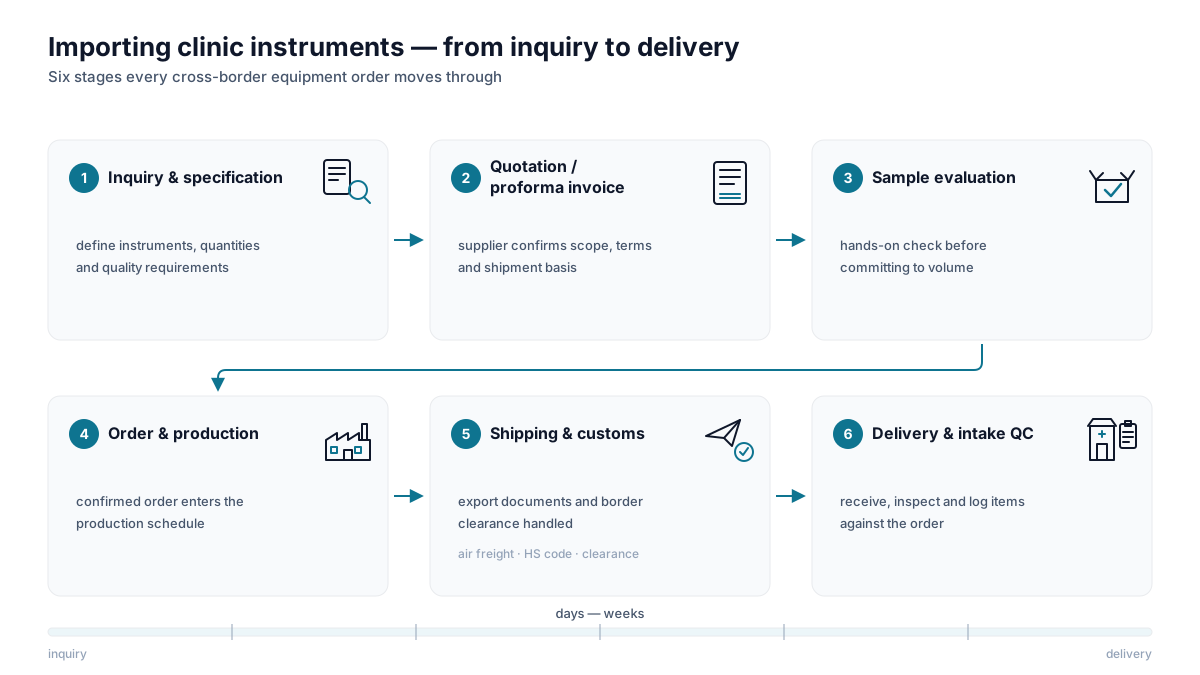
Physical importing is straightforward by regional standards. Sea freight arrives principally through Shuwaikh Port, with air cargo through Kuwait International Airport, and Kuwait applies the Gulf bloc's common external tariff at first point of entry as a customs-union member. The regulatory linkage is the operative constraint: the consignee needs proper local standing, which is one more function your agent performs and one more reason direct-to-clinic selling from abroad remains rare. Your role as exporter is clean paperwork — invoices, classification and product identification that match the registration file. Start classification from our HS code reference, and if your production or consolidation point is Turkey, as it is for much of this industry, the export-side sequence in our importing from Turkey guide maps directly onto a Kuwait delivery.
From first meeting to first order
The courtship with a Kuwaiti trading house follows a recognisable sequence, and knowing it saves months. It usually opens with an exploratory meeting — often at a regional exhibition rather than in Kuwait itself — where the house's medical-division manager assesses whether your line fills a gap in the portfolio. If interest is real, the second phase is documentary: they will ask for the full technical file, quality certificates, reference customers in comparable markets and your price structure, and they will evaluate registration effort before committing commercial enthusiasm. Only then comes negotiation of the agency terms, and only after signature does registration begin — which means revenue sits a long way downstream of the first handshake, and a realistic Kuwait plan builds that lag in from the start.
Two accelerants consistently shorten the sequence. The first is a visible clinical champion: if a respected Kuwaiti dermatologist or surgeon has used your instruments abroad — during training in London, at a conference workshop, in a Turkish clinic partnership — the trading house's risk assessment changes overnight, because their salespeople can open doors with a local name rather than a foreign catalogue. The second is launch support in writing: a committed training programme, demonstration stock on consignment terms, and co-funded participation in the regional exhibitions where Kuwaiti physicians actually gather. Houses here have seen many foreign suppliers sign agreements and then go quiet; the ones who arrive with a launch plan attached to the contract are treated as a different category of partner.
It is also worth understanding what you displace. A Kuwaiti clinic adopting your punches or implanters is usually not buying its first set — it is switching from an incumbent brand its agent also once championed. Switching happens at identifiable moments: a new surgeon joins, a clinic expands its graft capacity, quality problems erode patience with the current supplier, or the incumbent's local stock reliability slips. A good agent knows where each clinic stands in that cycle; a good manufacturer asks.
The dinar and how money moves
Kuwait is the Gulf's currency outlier. The dinar is pegged not to the US dollar but to an undisclosed basket of currencies, and it is among the highest-valued currency units in the world — prices that look tiny to an unaccustomed eye are not. In practice the basket peg keeps the dinar stable and cross-border contracts are still usually denominated in dollars or euros, so the commercial effect on a foreign supplier is modest; the point is to price and quote deliberately rather than assume the dollar-peg reflexes that work elsewhere in the region.
Payment customs follow the conservative Gulf arc: advance payment or letters of credit on early stock orders, migrating to negotiated open-account terms as the relationship proves itself. Kuwaiti trading houses are financially substantial and generally reliable payers, but they negotiate terms firmly and expect annual reviews to reopen them. Domestically, the agent finances clinic credit — part of the bundled service that keeps the intermediated model dominant. Plan around the Sunday-to-Thursday working week, the deep slowdown of Ramadan and the summer exodus, and the reality that relationship maintenance here means visits: the supplier who appears in Kuwait City once or twice a year, sits through the majlis-style long meetings and knows the family behind the trading house is the one whose products the salespeople carry enthusiastically. Broader frameworks for qualifying and managing export-market partners sit in our sourcing and import hub.
Frequently asked questions
How many potential distributors are there for instruments in Kuwait?
Realistically, a short list. Medical importing concentrates in a small tier of established trading houses with medical divisions, so the selection task is less about finding candidates than about securing genuine priority for your line inside one of them.
Who registers medical devices in Kuwait?
The Ministry of Health administers device registration, which applies before instruments are marketed, and locally established companies handle applications on behalf of foreign manufacturers. Confirm current requirements with the ministry and your agent.
Is it easy to change agents in Kuwait if the first one underperforms?
Harder than in most markets. Commercial agency arrangements carry legal weight in Kuwait and registered relationships can be difficult to unwind, which is why performance obligations and termination mechanics deserve exceptional care before signature.
Is the Kuwaiti dinar pegged to the US dollar?
No — uniquely among its Gulf neighbours' major currencies, the dinar is pegged to an undisclosed basket of currencies. It remains highly stable, and cross-border supply contracts are typically denominated in dollars or euros regardless.
Where does clinic demand for hair-restoration instruments come from in Kuwait?
From the growing private aesthetic sector in and around Kuwait City — physician-owned dermatology and cosmetic practices adding hair-restoration services, competing for patients who would otherwise travel to Turkey and who pay a premium to be treated at home.
What makes a Kuwaiti agent actually push a new instrument line?
Internal priority: a named salesperson with aesthetic-clinic relationships, no competing products in the same bag, and manufacturer support in training, demo stock and marketing. Without those, a signed agreement can simply sit dormant in a large portfolio.
Related articles
Sourcing & Import: Buying Medical Instruments Across Borders
The commercial mechanics of importing hair restoration instruments — customs, MOQs, samples, payment terms and how to evaluate a supplier before committing.
How to Become a Hair Transplant Instrument Distributor
A practical guide to building a distribution business in hair restoration instruments: how the revenue model actually works, how to build a starting portfolio, which manufacturer relationship to choose and how the first customers are won.
Distribution Agreement Terms: The Clauses That Decide Whether the Deal Works
A clause-by-clause walk through medical device distribution agreements: territory and exclusivity, minimum commitments, pricing structure, marketing obligations, IP use, termination and the post-term provisions most first-time distributors overlook.