
Buying & Distributing Hair Transplant Instruments in Egypt
Egypt is a volume market with a value price point: a huge domestic population, a dense Cairo clinic cluster and growing regional patient inflows — reached through registered importers who navigate permits and hard-currency cycles that shape every order.
Egypt is the volume story of the region: a country of over a hundred million people, a dense and hungry Cairo clinic cluster, and a procedure price point low enough to pull patients in from across Africa and the Middle East. For an instrument supplier, the commercial opportunity is real and the operational homework is equally real — imports run through registered local importers, permits and pre-shipment filings apply, and the availability of hard currency has moved in cycles that any serious supply relationship has to be built to survive.
Key takeaways
- Egypt is a cost-sensitive, high-volume market: clinics compete hard on procedure price and buy consumables with a cost-per-case calculator in hand.
- The Egyptian Drug Authority (EDA) regulates medical devices, and registration requirements apply before instruments are placed on the market.
- Imports flow through registered local importers, with permit and advance cargo-filing requirements that make the local partner's paperwork competence decisive.
- Hard-currency availability in Egypt has fluctuated in recent years — structure payment terms and stock planning around that reality, not around the best-case scenario.
- Cairo anchors a growing regional procedure hub serving African and Middle Eastern patients at value price points, which keeps instrument volumes rising.
Who regulates, in brief
Medical devices in Egypt fall under the Egyptian Drug Authority, the EDA, which consolidated regulatory responsibility for medicines and medical devices under one roof. Device registration requirements apply before instruments are marketed, and recognised international approvals are commonly referenced in applications without replacing the national process. Confirm current requirements with the EDA and your Egyptian importer before committing stock, because procedures and timelines are updated periodically.
Import permits and the currency question
Two operational realities distinguish Egypt from most markets a European or Turkish exporter will have supplied before, and both deserve honest treatment.
The first is the import machinery itself. Egyptian imports are handled by registered importers — a foreign manufacturer does not simply ship to a clinic — and shipments are subject to advance cargo information filings through Egypt's single-window system before goods depart origin. Filed correctly, clearance is routine; filed late or inconsistently with the commercial documents, cargo waits. This is why the practical quality of an Egyptian partner shows up first in its paperwork: an importer who files early, matches every document to the tariff classification, and knows its clearance agents personally is worth a margin premium. Classification follows the same six-digit Harmonized System base as everywhere else — our HS code reference covers the typical instrument basket — with Egypt's national tariff applied on top.
The second is currency. The Egyptian pound has devalued in steps over recent years, and access to hard currency for import payments has tightened and loosened in cycles — there have been periods when banks rationed foreign exchange and import payments queued. The honest consequences for a supplier: denominate contracts in dollars or euros; expect your importer to plan purchases around its foreign-currency access, not only around clinic demand; treat a partner's request to front-load stock in good FX windows as rational planning rather than over-ordering; and secure payment before shipment until a long track record justifies anything else. Our guide to supplier payment terms covers the mechanics of structuring that protection without insulting a good customer. None of this makes Egypt unworkable — large volumes of medical goods enter the country every week — but suppliers who price and plan as if Cairo were Copenhagen get hurt in the first FX squeeze.
A volume market at value price points
Egypt's procedure market runs on scale. Domestic demand is enormous in absolute terms simply because the population is, and hair restoration in Egypt is priced for that population: procedures cost a fraction of Western European rates, clinics compete openly on price, and the business model is built on throughput. For instrument suppliers this sets the buying logic. Egyptian clinics are among the most cost-per-case-focused buyers anywhere — a punch or blade line wins on delivered unit economics at consistent quality, and loses the moment lot variability forces re-work or wasted grafts. Premium positioning exists, but it is a narrow tier; the centre of gravity is value.
The geography is concentrated. Greater Cairo dominates clinic density, distribution offices and the medical-conference circuit, with Alexandria as the clear second city and the rest of the country served thinly from those two bases. A supplier's Egyptian coverage question is therefore simpler than in geographically fragmented markets: get Cairo right and most of the market is within reach of a same-day delivery.
What makes the volume durable is the regional dimension. Cairo has been building a position as a value-priced procedure destination for patients from across Africa and the Arab world — patients who might once have defaulted to Istanbul weigh Egypt's lower prices, language accessibility and flight connections, and a tier of Cairo clinics has organised itself around that inbound flow with Arabic-, English- and French-speaking coordinators. This hub trade matters to suppliers because it decouples instrument demand from domestic purchasing power alone: clinics earning in effect in hard currency from foreign patients keep buying through pound-devaluation cycles that squeeze purely domestic operators. When evaluating an Egyptian distributor's clinic list, ask which of its accounts serve international patients — those are the volume anchors.
Distribution structure and payment customs
The channel is intermediated, and structurally so. Because importation requires registered-importer status and device registration favours an established local holder, foreign instruments reach Egyptian clinics through medical-supply importers and distributors who combine the regulatory standing, the customs experience and the clinic relationships in one company. Cairo's distributor scene is competitive and commercially sharp: expect hard negotiation on price, genuine expertise in landing costs, and loyalty that follows reliability of supply more than brand sentiment. Turkey is a major sourcing origin for the Egyptian trade — proximity, price and familiarity all help — so the export mechanics in our importing from Turkey guide describe a corridor many Egyptian importers already run daily; a European supplier is competing against that benchmark on landed cost.
Language and documentation sit somewhere between the Gulf and Europe. Commercial negotiation happens comfortably in English at the importer level, and English-language technical documentation is accepted in the trade, but the clinic floor works in Arabic — so a distributor's ability to train nurses and technicians in Arabic, and to produce Arabic-language instructions where needed, is part of the value it adds. Cairo's medical-conference calendar provides the natural meeting points for introductions, and face time matters: Egyptian business culture is warm, personal and negotiation-loving, and a supplier who visits, sits through the long first meetings and returns is extending exactly the signal of commitment the market reads before it commits registrations and stock to a new line.
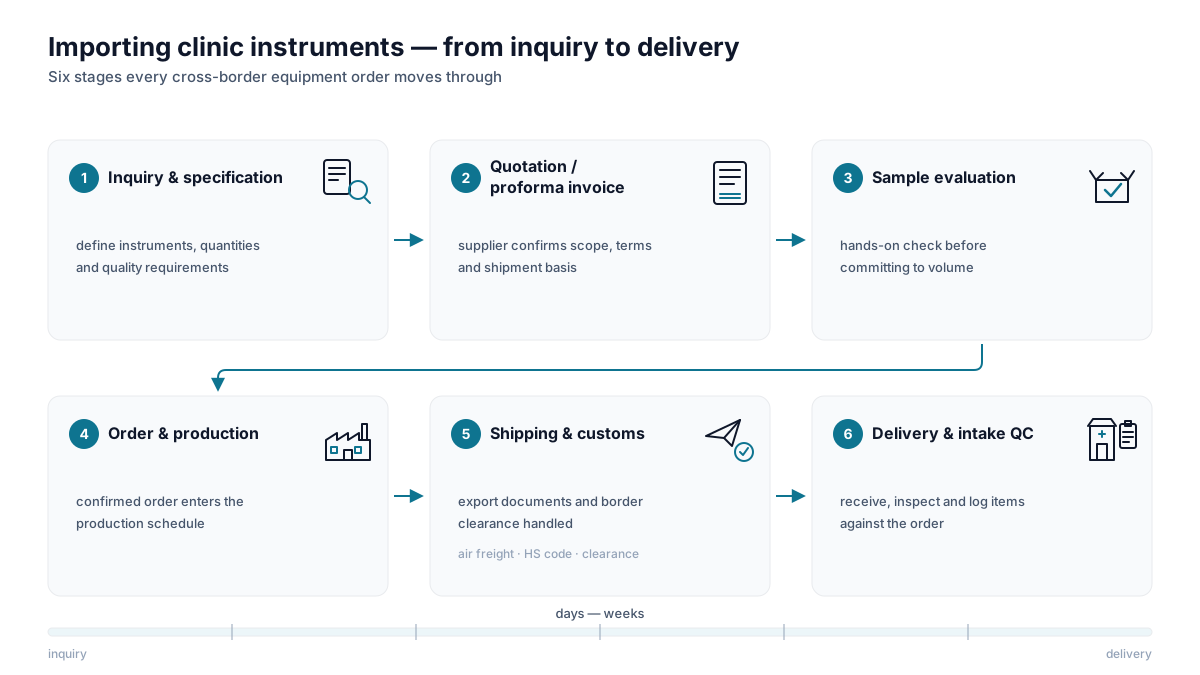
Payment customs follow from the currency chapter. Cross-border, advance payment against proforma is the standard opening arrangement, with letters of credit appearing on larger orders; open-account terms are earned slowly and remain unusual with newer relationships. Domestically, distributors sell to clinics in pounds and extend credit carefully, which is one more reason the local partner — not the foreign supplier — carries the market's working-capital load. Price lists move when the pound does; build repricing mechanics into any distribution arrangement upfront rather than renegotiating in a crisis.
A realistic planning sequence for supplying Egypt:
| Step | Why it matters |
|---|---|
| Confirm the regulatory status of each product line with the EDA via your importer | Registration determines what may be marketed, and who holds it |
| Verify the partner's importer registration and clearance track record | Permits and advance filings are where inexperienced partners stall |
| Agree tariff classification per line before first shipment | Prevents document-mismatch holds at clearance |
| Denominate in USD/EUR and fix payment security terms | Insulates the relationship from FX-cycle stress |
| Plan stock depth around FX windows and lead times, not just demand | Egyptian importers buy when currency access allows |
The general groundwork of structuring international supply — proformas, Incoterms, samples, minimums — applies here as everywhere and is collected in our sourcing and import hub.
What good looks like in this market
The suppliers who do well in Egypt share a pattern: they treat the value price point as an engineering constraint rather than an indignity, keeping quality consistent while stripping cost out of packaging, logistics and payment friction; they pick one committed importer with proven clearance competence instead of scattering the market across rivals; and they hold their nerve through currency cycles, because the demand — domestic and regional — has kept growing underneath every one of them. Egypt rewards patience and punishes suppliers who treat it as a dumping ground for seconds; clinics here run high volumes precisely because they know what a good punch feels like.
Frequently asked questions
Can a foreign manufacturer sell directly to Egyptian clinics?
Not realistically. Importation runs through registered Egyptian importers, device registration favours an established local holder, and clinics buy in pounds from distributors who carry stock and credit. The working model is a committed local importer-distributor with the foreign supplier shipping against secured payment.
Who regulates medical devices in Egypt?
The Egyptian Drug Authority (EDA), which holds consolidated responsibility for medicines and medical devices. Registration requirements apply before instruments are placed on the market, and current procedures should be confirmed with the EDA and your local importer.
How serious is the hard-currency issue for instrument imports?
Serious enough to plan around, not serious enough to stay away. Foreign-exchange availability has tightened and loosened in cycles, so experienced importers time purchases around FX access and suppliers denominate in dollars or euros with payment secured before shipment. Clinics serving international patients provide the most devaluation-resistant demand.
Is Egypt only a low-price market?
The centre of gravity is firmly value-priced, and cost per case decides most purchases. But volume is the compensation: clinic throughput is high, the Cairo cluster is dense, and regional patient inflows keep instrument consumption growing. A small premium tier exists, mostly among clinics marketing to international patients.
Why do patients travel to Egypt for hair restoration?
Price, language and access. Cairo offers procedures at rates below most alternatives including Turkey, with Arabic-speaking care that suits patients from across the region and flight connections that serve Africa and the Middle East well. That inbound flow supports a tier of high-volume clinics with hard-currency-linked revenues.
What payment terms are normal with Egyptian importers?
Advance payment against proforma invoice is the standard start, with letters of credit on larger orders. Open-account terms come slowly, if at all, in newer relationships — which experienced Egyptian buyers understand and do not take personally. Build FX-linked repricing into the agreement from the beginning.
Related articles
Sourcing & Import: Buying Medical Instruments Across Borders
The commercial mechanics of importing hair restoration instruments — customs, MOQs, samples, payment terms and how to evaluate a supplier before committing.
Importing Hair Restoration Instruments from Turkey: A Practical Guide
Why Turkey became a manufacturing base for hair-restoration instruments, and the practical import mechanics — Incoterms, customs documents, duty and VAT logic — for buyers in the EU, UK and Gulf.
HS Codes for Hair Transplant Instruments and Supplies
A heading-level HS/CN classification reference for the hair-restoration product basket: instruments, consumables, equipment and hair-care products, with the pitfalls that cause misclassification.
Payment Terms with Medical Instrument Suppliers: Proforma, T/T and LC
How payment actually works when buying instruments internationally: the proforma invoice flow, common T/T split structures, when a letter of credit earns its cost, and the red flags that should stop a transfer.