
Buying & Distributing Hair Transplant Instruments in Jordan
Jordan is a compact, quality-oriented instrument market built on Amman's decades-old reputation as a regional treatment destination: a small circle of importer-distributors, well-trained surgeons, a dollar-pegged dinar and buying decisions made on trust.
Jordan punches above its size in regional medicine, and that is the key to reading it as an instrument market. Amman has drawn patients from across the Arab world for decades on the strength of its doctors and hospitals, and hair restoration has grown inside that established medical-tourism tradition — a compact clinic scene with genuinely high clinical standards, supplied by a small circle of importer-distributors who carry broad portfolios and guard their reputations carefully. The market will never reward a supplier with huge volumes, but it rewards the right supplier with stable, quality-led business and a credible regional showcase.
Key takeaways
- Amman's long-standing role as a regional treatment destination gives Jordan a procedure market larger and more sophisticated than its population alone would suggest.
- The Jordan Food and Drug Administration (JFDA) regulates medical devices, with registration requirements applying before market placement.
- Distribution runs through a small number of established importer-distributors carrying broad multi-line portfolios — the agent model is the norm.
- Quality orientation is real: Jordanian surgeons are widely internationally trained and buy on clinical merit and trust more than on the last percentage of price.
- The Jordanian dinar is pegged to the US dollar, which keeps cross-border pricing stable and simplifies contract currency choices.
Amman's medical-tourism inheritance
Long before hair restoration became a category, Jordan was where patients from Iraq, Yemen, Libya, Sudan, Palestine and the Gulf travelled for surgery they could trust. That inheritance shapes today's market in three concrete ways. First, clinical standards: Jordan trains and exports physicians across the region, its surgeons commonly hold Western fellowships, and a clinic scene built to serve discerning foreign patients cannot afford visible corner-cutting — which extends to the instruments on the tray. Second, demand composition: a meaningful share of hair-restoration patients in Amman come from abroad, mostly from neighbouring Arab countries, giving clinics revenue streams that are not purely tied to the domestic economy. Third, competitive self-image: Jordanian medicine markets itself on quality rather than on being the cheapest option — regional patients seeking rock-bottom prices have other destinations — so clinics position themselves, and equip themselves, accordingly.
For a supplier, that means Jordan behaves less like a small emerging market and more like a miniature mature one: buyers know instruments, ask precise technical questions, and change suppliers reluctantly once trust is established.
Who regulates, in brief
Medical devices in Jordan are regulated by the Jordan Food and Drug Administration, which oversees medicines and medical devices nationally, and registration requirements apply before devices are placed on the market. Recognised international approvals commonly support applications within the national process. Verify current requirements with the JFDA and your local partner rather than relying on precedent, as procedures are periodically updated.
Importing into a compact market
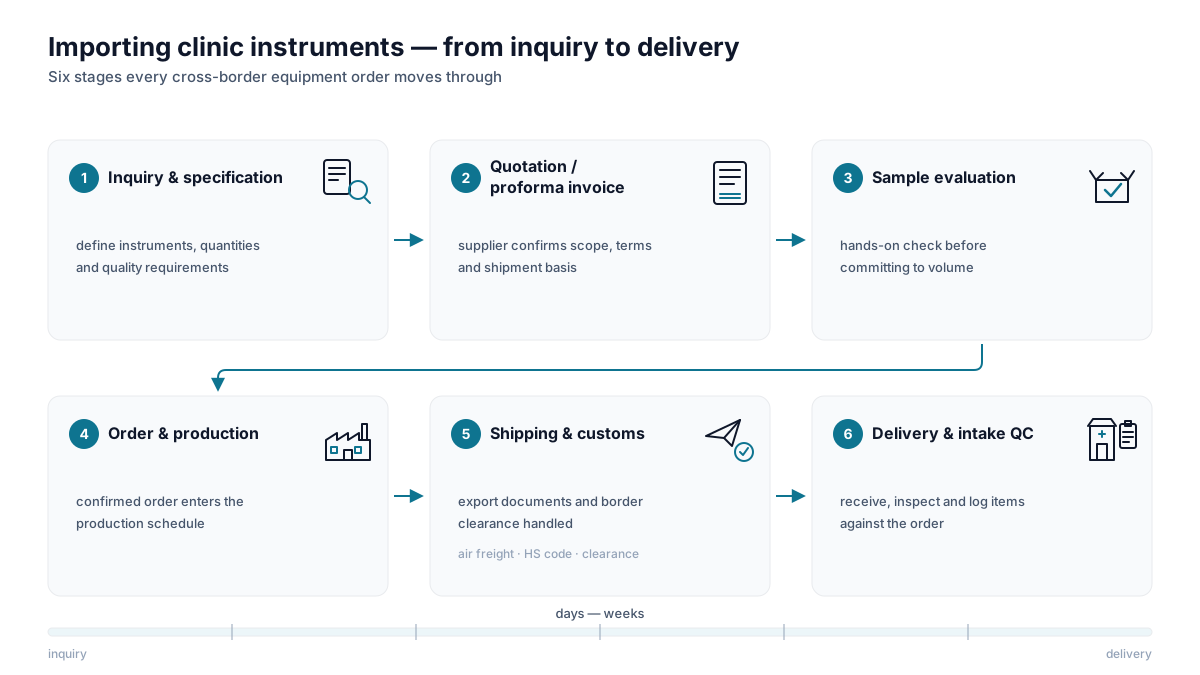
Jordan's import logistics are simple to describe: instruments overwhelmingly arrive as air freight into Amman, with the Red Sea port of Aqaba — the country's only seaport — relevant mainly for heavy equipment and consolidated sea cargo. Clearance runs through customs brokers as elsewhere, and the practical constraint is not complexity but scale. Order volumes in a market this size are modest, which pushes freight economics toward consolidation: the established importers group multiple product lines into scheduled shipments so that fixed clearance and freight costs spread across a sensible base. A foreign supplier should understand this rhythm before judging a Jordanian partner's ordering pattern — quarterly consolidated orders are not weak commitment, they are rational logistics for the market's scale, and the right response is helping the partner plan them well. Guidance on aligning order sizes with commercial reality is in our MOQ guide, and the broader mechanics of structuring international supply are collected in the sourcing and import hub.
Jordan's position also gives it a quiet re-export dimension. Amman's trading houses have historically supplied harder-to-serve neighbouring markets, and medical importers are experienced in the documentation that regional onward trade requires. This is opportunity and caution in one: a Jordanian partner may genuinely open doors in the Levant and Iraq, but each destination has its own regulatory pathway, so keep territorial scope and responsibilities explicit in the agreement.
The agent model: few hands, broad portfolios
Distribution in Jordan concentrates in a small circle of established medical importer-distributors, most of them family-rooted companies with decades of history, hospital relationships and multi-line portfolios spanning far more than aesthetics. In a market this compact, no distributor survives on one niche — a hair-restoration instrument line will sit in a portfolio alongside other surgical and clinical categories, and the relevant questions for a supplier are how much attention the line will actually receive and who inside the company will champion it. Ask to meet the specific product manager, not only the principals.
The concentration cuts both ways. Fewer potential partners means the search is short and reputations are easy to check — everyone in Amman's medical trade knows everyone — but it also means exclusivity requests come early and carry weight, because a serious Jordanian agent invests personal credibility when introducing a new line to surgeons it has served for years. Treat that request with respect and structure it properly: clear performance expectations, defined territory, honest exit terms. Our guides to distribution agreement terms and becoming an instrument distributor map both sides of that negotiation.
| Entry route | Fit for Jordan |
|---|---|
| Exclusive national agent | The default and usually correct choice; matches market scale and local expectations |
| Two parallel distributors | Rarely sustainable — the market is too small and the trade too interconnected |
| Direct sales from abroad | Occasional single-clinic transactions happen, but no service layer means no durable position |
Where the buyers actually sit
Jordan's hair-restoration purchasing splits across three settings, each with its own rhythm. Dedicated private hair clinics in Amman — the core of the market — buy through their distributor on short cycles, care about instrument feel and consistency because their surgeons perform daily, and represent the accounts where a good line builds its reputation. Amman's private hospitals, several of which carry regional name recognition from the medical-tourism decades, run aesthetic and dermatology departments that add hair restoration to broader service lines; they buy more formally, through procurement processes that want documentation in order and a locally accountable supplier, and they move slowly but renew reliably. Finally, dermatology and aesthetic practices adding transplant services form the market's growth edge — smaller initial orders, more hand-holding on instrument selection, and disproportionate long-term value for the distributor who educates them well from the first tray onward.
A supplier evaluating a Jordanian partner should ask for reference customers across all three settings, because coverage of only the first is common and only tells part of the story.
Quality culture and the buying decision
Jordanian clinic buyers reward technical substance. Surgeons here read specifications, compare punch geometries seriously, and probe a supplier's answers against their own experience — superficial sales talk is noticed and quietly filed. The corollary is that demonstration and trial matter: a well-run evaluation with a respected Amman surgeon does more for a line than any volume of marketing, because in a market where the professional community is small and tightly networked, one credible clinical endorsement propagates fast. Word of mouth is the dominant medium; there is no advertising route around it.
Price still matters — Jordan is not a Gulf-style premium market and clinics watch costs — but it operates as a qualifier rather than the decision driver. A fairly priced instrument of consistent quality with responsive local service beats a cheaper line with variable lots, and Jordanian buyers have long memories in both directions.
Currency and payment customs
The dinar's long-standing peg to the US dollar removes exchange-rate volatility from the commercial relationship: contracts with foreign suppliers are typically written in dollars, conversion is frictionless, and price lists do not need the FX-adjustment machinery that neighbouring markets require. Payment behaviour is conservative and reliable by regional standards — advance payment or documentary terms open new relationships, with a measured migration toward open-account terms as history accumulates. Domestically, distributors extend credit to clinics and hospitals as part of their service, and manage it carefully in a market where everyone's payment behaviour is common knowledge. B2B communication runs comfortably in English, with Arabic the language of the clinic floor; documentation in English is standard and accepted.
One planning note deserves separate mention: because order volumes are consolidated and shipment frequency is low, a stockout in Jordan takes longer to repair than the market's sophistication would suggest. Suppliers who help their agent hold sensible safety stock on fast-moving consumables — and who ship replacement lots by air without ceremony when something goes wrong — earn a loyalty in Amman's small professional circle that no pricing concession can buy.
Frequently asked questions
How large is the opportunity in Jordan realistically?
Modest in volume, above-average in quality and stability. Jordan is a small country whose medical-tourism tradition supports a more sophisticated procedure market than population alone would predict. Suppliers should expect measured, consolidated orders from a committed partner rather than large volumes — and unusually loyal business once established.
Who regulates medical devices in Jordan?
The Jordan Food and Drug Administration (JFDA), which oversees medicines and medical devices nationally. Registration requirements apply before devices are marketed, and current procedures should be confirmed with the JFDA and your local partner.
Do I need a local agent to sell instruments in Jordan?
In practice yes. Distribution runs through established importer-distributors who hold the regulatory standing, run the imports and own the surgeon relationships. The market is compact enough that one well-chosen exclusive agent typically covers it, and parallel distribution rarely works.
What currency should contracts with Jordanian partners use?
US dollars, almost always. The dinar has been pegged to the dollar for decades, so dollar contracts carry no practical exchange risk for either side and match how the Jordanian medical trade prices imports.
Where do Jordan's hair-restoration patients come from?
A mix of domestic patients and a meaningful inflow from neighbouring Arab countries — a continuation of Amman's decades-old role as a regional treatment destination. That regional demand supports clinic revenues beyond the domestic economy and reinforces the market's quality orientation.
Can a Jordanian partner cover other Levant markets too?
Logistically and commercially, Amman's trading houses are experienced in regional onward trade, so sometimes yes. But regulatory approval is national in each destination, so treat multi-country coverage as separate regulatory projects and define territories explicitly in the distribution agreement.
Related articles
Sourcing & Import: Buying Medical Instruments Across Borders
The commercial mechanics of importing hair restoration instruments — customs, MOQs, samples, payment terms and how to evaluate a supplier before committing.
How to Become a Hair Transplant Instrument Distributor
A practical guide to building a distribution business in hair restoration instruments: how the revenue model actually works, how to build a starting portfolio, which manufacturer relationship to choose and how the first customers are won.
Distribution Agreement Terms: The Clauses That Decide Whether the Deal Works
A clause-by-clause walk through medical device distribution agreements: territory and exclusivity, minimum commitments, pricing structure, marketing obligations, IP use, termination and the post-term provisions most first-time distributors overlook.
Minimum Order Quantities for Medical Instruments: A Buyer's Guide
Why MOQs exist in instrument manufacturing, what typical minimums look like by product category, which negotiating levers actually move them, and why a supplier with no minimum at all deserves scrutiny.