
Buying & Distributing Hair Transplant Instruments in the United Kingdom
What instrument buyers and distributors need to know about the United Kingdom: MHRA oversight, the UKCA/CE marking picture, third-country customs mechanics since Brexit, and how the private-pay clinic market actually buys.
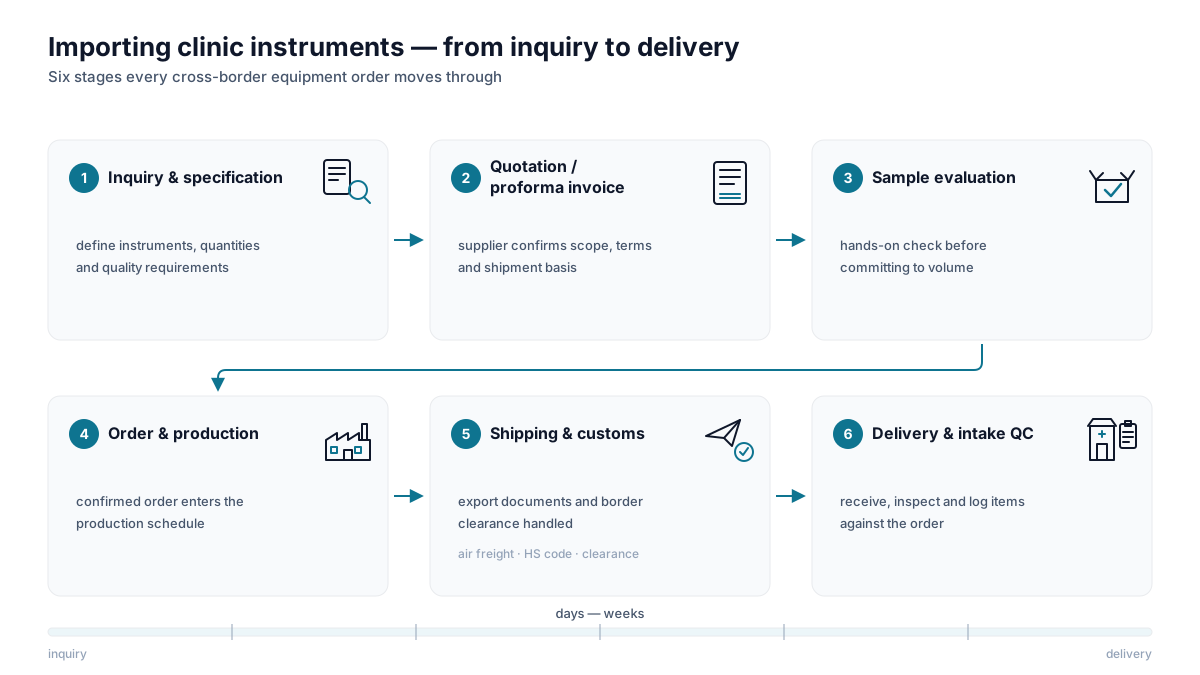
The United Kingdom is a large, mature, entirely private-pay hair restoration market that now sits outside the EU customs and regulatory system: every shipment from the continent or from Turkey crosses a full third-country border, with import declarations and import VAT to manage, and the regulatory reference point is the MHRA rather than an EU authority. For a supplier or would-be distributor, the practical consequence is that the UK behaves like its own corridor — its own tariff, its own conformity-marking regime, its own paperwork — layered on top of a clinic landscape that is commercially sophisticated, brand-aware and concentrated in London's private sector.
Key takeaways
- The UK is a third country for customs purposes: goods from the EU and Turkey alike need a customs declaration, a GB EORI number and import VAT handling on every commercial shipment.
- UKCA is the domestic conformity mark, with CE marking accepted for many devices under transitional arrangements — check current MHRA guidance before committing stock.
- Hair restoration in the UK is private-pay: NHS pricing culture does not apply, and clinics buy on clinical reputation, service and consistency rather than tender price.
- Postponed VAT accounting turns import VAT into a bookkeeping entry for registered businesses, which keeps the cash-flow cost of the border manageable.
- English-language B2B and a direct-import habit mean UK clinics buy from overseas manufacturers more readily than most European markets — but a UK-based responsible person and local stock still win accounts.
Who regulates, and what mark applies
Medical devices placed on the market in Great Britain fall under the MHRA, the Medicines and Healthcare products Regulatory Agency, which also runs the registration system for devices and their UK responsible persons. The domestic conformity mark is the UKCA mark, while CE-marked devices remain accepted for many categories under transitional arrangements whose deadlines have shifted more than once — state of play should always be confirmed against current MHRA guidance rather than assumed. Requirements apply to instruments and consumables in this category; the registration pathway itself is a separate topic beyond this guide's scope.
The border: what Brexit means for your shipments
The single most important structural fact about the UK market is that the frictionless EU pipeline no longer exists. Whether your goods come from a German warehouse, an Istanbul factory or a Dutch consolidation hub, they arrive as third-country imports into Great Britain: a customs declaration is filed, the UK Global Tariff applies unless a trade agreement provides preference, and import VAT is due at the standard rate on most goods in this category.
Three mechanics keep the border workable in practice. First, any business importing commercially needs a GB EORI number — obtained quickly online, but a hard prerequisite. Second, postponed VAT accounting lets VAT-registered importers declare and recover import VAT on the same VAT return instead of paying at the border, which removes most of the cash-flow sting. Third, trade agreements matter line by line: the UK's agreement with Turkey provides preferential treatment for qualifying originating goods, evidenced by an origin declaration on the invoice — relevant because so much of this product category ships from the Istanbul cluster, as covered in the import from Turkey guide. Classification follows the same harmonized logic as everywhere else; the HS code reference maps the instrument basket at heading level, with final codes confirmed by your UK broker.
Northern Ireland follows its own arrangements under the Windsor Framework and effectively remains aligned with EU goods rules — a detail worth flagging to your logistics partner if you serve clinics there, and one to resolve with professional advice rather than assumption.
A practical import file for a UK consignment looks like this:
| Item | UK-specific note |
|---|---|
| GB EORI number | Required before the first commercial import; separate from any EU EORI you hold |
| Customs declaration | Filed by your broker or forwarder into the UK's customs system per consignment |
| Commercial invoice + packing list | Line-level values in a stated currency; GBP invoicing simplifies later resale accounting |
| Origin evidence | Origin declaration under the UK–Turkey agreement or EU–UK TCA where goods qualify; otherwise UK Global Tariff rates apply |
| Import VAT treatment | Postponed VAT accounting for registered businesses; otherwise paid at the border and recovered later |
Market character: private-pay, brand-aware, London-anchored
Hair restoration in the UK is almost entirely a private-pay category. The NHS does not fund cosmetic hair transplantation, so the price-conscious procurement culture associated with British public healthcare simply does not shape this market — clinics compete on surgeon reputation, results and patient experience, and they buy instruments accordingly. The commercial centre of gravity is London, with the Harley Street medical district still functioning as the symbolic and practical anchor of the private surgical scene, surrounded by a broader ring of private clinics and chains across Manchester, Birmingham, Leeds and Glasgow.
Two dynamics define demand. Domestically, established surgeons and a growing tier of dedicated hair clinics sustain steady procedure volume with high expectations for instrument consistency — a UK surgeon who has standardised on a punch geometry expects every reorder to match the retained reference. Internationally, the UK is one of Europe's most significant outbound medical-tourism sources for hair transplantation, with a large patient flow to Turkey. That outbound flow shapes the supply market in a subtle way: UK clinics position themselves explicitly against the low-cost abroad option, selling safety, follow-up and accountability — which hardens their preference for documented, traceable instruments and reputable supply chains they can stand behind in marketing and in complaint handling.
Quality expectations sit at the premium end. British clinics are used to dealing in English with manufacturers worldwide, are comfortable auditing specifications, and will drop a supplier over inconsistent sterile packaging or slipped delivery promises faster than over price.
Distribution structure and payment customs
The UK's English-language business environment and long import tradition make direct purchasing from overseas manufacturers more common than in most continental markets — a London clinic will happily order from an Istanbul or Asian manufacturer directly if samples, documentation and courier logistics hold up. That said, the post-Brexit paperwork burden has strengthened the case for UK-based distribution: a distributor holding stock domestically spares clinics the declarations, the import VAT mechanics and the multi-week replacement cycle, and the regulatory structure — which expects a UK responsible person for overseas manufacturers — naturally pushes toward committed local partners. For a manufacturer, an established UK distributor with clinical relationships and same-week delivery is often the difference between sporadic direct orders and a durable market position; the commercial framework for such a partnership is covered in distribution agreement terms.
Payment customs are straightforward by international standards. B2B payment is by bank transfer, with 30-day invoicing common between established parties and proforma payment the norm for new relationships and imports. Pricing is expected in pounds sterling — quoting in euros or dollars to a UK clinic adds a currency-risk conversation you do not want in the sales process — and credit terms are earned over a trading history, not assumed. UK buyers tend to be direct communicators: specification questions arrive in detail, and a supplier who answers them precisely and in writing builds trust quickly.
Practical notes for entering the UK market
Decide where your stock sits before you quote. The border question shapes every UK commercial model. Serving British clinics from an EU warehouse means either the clinic imports (and inherits declarations, VAT mechanics and delay risk) or you sell delivered-duty-paid and absorb the paperwork on every order — workable for occasional shipments, wearing for a busy account. Holding stock in Great Britain, whether through your own entity, a fulfilment partner or a distributor, moves the border crossing to your inbound replenishment runs, where one consolidated entry covers months of clinic orders. Most suppliers who get traction in the UK end up in the second model, and it is worth modelling honestly before pricing the market.
Start with courier-borne samples. At parcel level the UK border is undramatic — the courier files the declaration and charges the import costs through — so a sample phase tests both the product and the paperwork at trivial stakes. British clinical buyers respond well to a structured sample protocol with written evaluation criteria; it matches how they already think.
Price in sterling and hold the price. Because UK buyers can see EU and Turkish price levels easily, they notice currency games. A GBP price list that stays stable across a reasonable horizon, with exchange-rate risk visibly absorbed by the supplier, reads as commitment to the market; per-order conversion from euros reads as a supplier who has not decided whether the UK is worth the trouble.
Expect written, specific, fast-moving procurement. UK clinic purchasing runs over email at a brisk clip: specification questions arrive in batches, decisions follow within days when answers are crisp, and slow or vague responses quietly end conversations. There is less relationship ceremony than in Southern Europe — which cuts both ways, since accounts won on responsiveness can be lost the same way.
For suppliers weighing the UK against continental entry points, the European market overview places the UK's post-Brexit position in its wider regional context, and the sourcing and import hub collects the underlying procurement guides.
Frequently asked questions
Do I need UKCA marking to sell instruments in the UK?
UKCA is Great Britain's domestic conformity mark, but CE marking remains accepted for many device categories under transitional arrangements whose dates have been extended more than once. The only reliable approach is to check current MHRA guidance for your specific device class before committing stock or signing distribution terms, and to confirm with the manufacturer which markings their documentation actually supports.
How is importing into the UK different from importing into the EU?
The mechanics are parallel but separate: the UK has its own EORI numbering (GB EORI), its own tariff (the UK Global Tariff), its own trade agreements and its own customs declarations. An EU clearance gets goods nowhere in Great Britain — a shipment from Rotterdam to London needs a full import entry just as one from Istanbul does. Import VAT applies, softened for registered businesses by postponed VAT accounting.
Do UK buyers purchase directly from overseas manufacturers?
More readily than most European markets — English-language B2B and a long import habit make direct relationships natural, especially for clinics with procurement experience. But post-Brexit paperwork and the value of same-week replacement stock have strengthened UK-based distributors, and the regulatory expectation of a UK responsible person for overseas manufacturers pushes the same direction.
Is the UK hair restoration market price-sensitive?
Less than its reputation suggests. Hair restoration is private-pay, so NHS procurement culture is irrelevant here; clinics compete on surgeon reputation and results against the visible low-cost alternative of treatment abroad, which makes documented quality and supply reliability stronger selling points than headline unit price. Price matters at the consumable-volume end, but consistency wins accounts.
How does the UK–Turkey trade agreement affect instrument imports?
Qualifying goods of Turkish origin receive preferential tariff treatment under the UK–Turkey agreement, evidenced by an origin declaration rather than the A.TR certificate used in EU trade. Whether a given line qualifies depends on origin rules per HS code, so confirm treatment with your customs broker — and remember import VAT applies regardless of duty preference.
What payment terms do UK clinics and distributors expect?
Bank transfer is standard, with proforma payment normal for new relationships and imports, moving to 30-day invoice terms as trading history builds. Quote in pounds sterling: GBP pricing removes currency risk from the buyer's side of the conversation and signals that you are set up to serve the market seriously rather than opportunistically.
Related articles
Sourcing & Import: Buying Medical Instruments Across Borders
The commercial mechanics of importing hair restoration instruments — customs, MOQs, samples, payment terms and how to evaluate a supplier before committing.
Importing Hair Restoration Instruments from Turkey: A Practical Guide
Why Turkey became a manufacturing base for hair-restoration instruments, and the practical import mechanics — Incoterms, customs documents, duty and VAT logic — for buyers in the EU, UK and Gulf.
HS Codes for Hair Transplant Instruments and Supplies
A heading-level HS/CN classification reference for the hair-restoration product basket: instruments, consumables, equipment and hair-care products, with the pitfalls that cause misclassification.
Distribution Agreement Terms: The Clauses That Decide Whether the Deal Works
A clause-by-clause walk through medical device distribution agreements: territory and exclusivity, minimum commitments, pricing structure, marketing obligations, IP use, termination and the post-term provisions most first-time distributors overlook.