
Buying & Distributing Hair Transplant Instruments in Qatar
Qatar is a premium micro-market: a small number of well-funded Doha clinics, per-capita healthcare spending among the highest anywhere, and economics that reward margin and service depth over volume.
Qatar asks a question most market-entry plans never confront: can your business model work where the customer list is short but every customer spends like a flagship account? The clinic base is small and concentrated almost entirely in Doha, yet per-capita healthcare spending is among the highest in the world, purchasing standards are exacting, and the buyers expect the same product tier a Zurich or London clinic would order. Suppliers who treat Qatar as a volume play misprice it; those who plan it as a margin-and-service market often find it one of the most profitable lines on the regional ledger.
Key takeaways
- Qatar is a micro-market by clinic count but a premium market by spend: plan for margin per account, not volume.
- The Ministry of Public Health (MOPH) regulates medical devices, and registration requirements apply before instruments are marketed.
- Distribution runs through local agents, and one well-connected Doha partner can realistically cover the entire country.
- Hamad Port and Doha's air cargo links give Qatar direct import routes, so shipments need not transit neighbouring hubs.
- The riyal is pegged to the US dollar; contracts are typically dollar-denominated and payment terms conservative at the outset.
The micro-market math
Start with the arithmetic, because it drives every other decision. In a large European market a distributor can amortise registration work, stock holding and service visits across hundreds of clinic accounts; in Qatar the entire addressable clinic base for hair-restoration instruments is closer in scale to a single European city district. That does not make the market unattractive — it changes what "attractive" means. Revenue depends on depth per account: full-portfolio supply rather than single-SKU sales, consumables flowing on a steady rhythm, training and service bundled into the relationship, and pricing set at the premium level the market genuinely sustains.
| Dimension | Large-market logic | Qatar reality |
|---|---|---|
| Account strategy | Broad coverage, tiered service | Few accounts, each served at flagship depth |
| Portfolio | Lead product first, expand later | Full range from the start — breadth pays the fixed costs |
| Pricing | Competitive benchmarks, volume discounts | Premium tier holds if quality and service justify it |
| Stock | Central warehouse, scheduled replenishment | Small local buffer; airfreight top-ups are routine |
| Partner search | Several candidates per region | One or two credible Doha agents cover everything |
The corollary is that fixed costs need discipline. Registration effort, minimum order quantities and dedicated stock must all be sized to a market that will never produce continental volumes. Suppliers who negotiate flexible production runs — the thinking laid out in our sourcing and import hub — protect their margin here better than those who ship pallet quantities against optimistic forecasts.
MOPH in brief
Medical devices in Qatar fall under the Ministry of Public Health, which operates the registration system that applies before instruments are placed on the market. Applications are handled through locally established companies, and recognised international approvals are commonly referenced as supporting evidence. Confirm current requirements with the MOPH and your local representative rather than extrapolating from a neighbouring market's rules.
Doha is the market
Geography simplifies planning: Doha and its immediate surroundings contain effectively all of the country's aesthetic-medicine activity. The clinic scene mixes private dermatology and cosmetic-surgery practices, aesthetic departments inside larger private hospital groups, and a small number of dedicated hair-restoration providers. Facilities skew new and well-capitalised, reflecting the country's broader investment in healthcare infrastructure, and the clinical workforce is largely internationally recruited — surgeons trained in Europe, the Levant, South Asia or North America bring their instrument preferences with them, which means brand recognition earned elsewhere transfers unusually directly.
Patient demand has a dual character. The resident population is small but affluent, appearance-conscious and accustomed to buying premium services at home; at the same time, many Qatari and expatriate patients still travel to Istanbul for high-graft procedures at lower prices. Local clinics compete on privacy, convenience and perceived safety rather than on cost, which reinforces the premium positioning of everything they buy — a clinic charging several times the Istanbul price cannot be seen using commodity instruments. For a supplier, outbound medical tourism is therefore less a threat than a filter: the procedures that stay in Doha are precisely the ones bought on quality.
Agents, imports and the port question
Market access runs through local agents and distributors, as it does across the Gulf, and in Qatar the practical implication is concentration: a single well-connected Doha partner — often a trading group with an established medical division — can hold the registrations, import as consignee of record and personally know every relevant clinic buyer. That makes partner selection nearly binary. There is no second-city fallback, so the agreement deserves particular care on performance obligations and exit terms; our guide to distribution agreement terms covers the clauses that matter before signature.
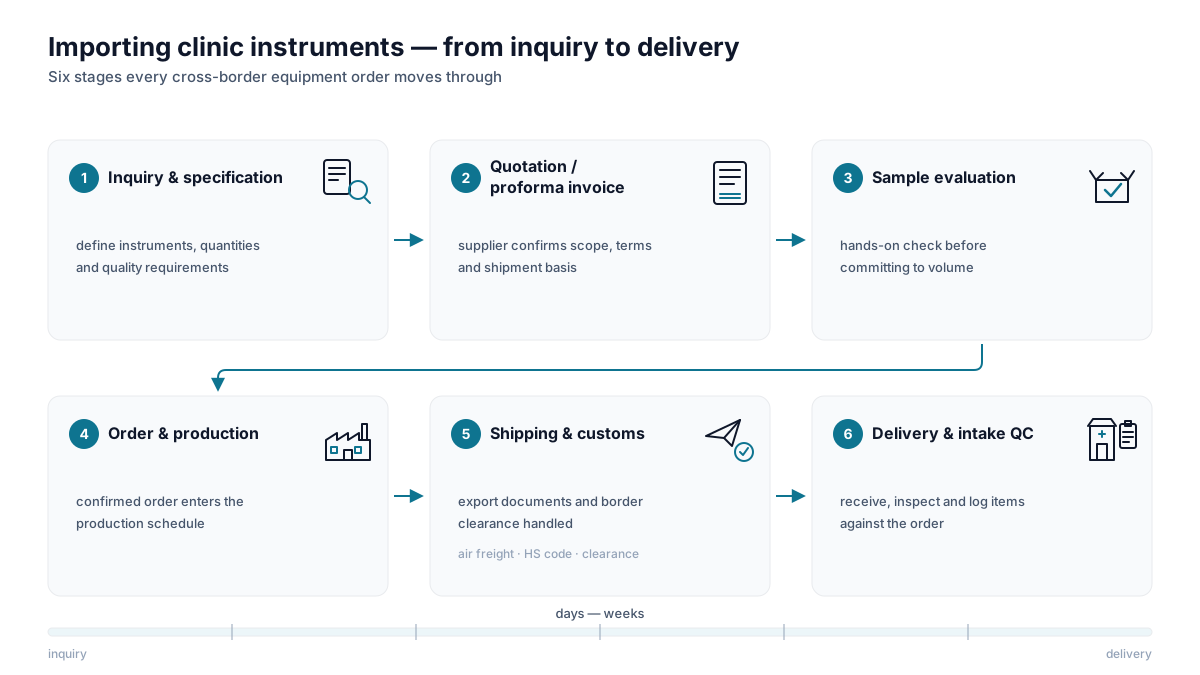
On logistics, Qatar's position has a recent history worth knowing. The blockade years of 2017 to 2021 pushed the country to build direct shipping and air-cargo routes of its own, with Hamad Port and Doha's air hub now handling imports without transiting neighbouring countries, and a common external tariff applying at the Gulf bloc's frontier under the GCC customs framework. Day to day, clearance is orderly for a properly documented consignee: correct classification — see our HS code reference — plus clean invoices are the levers that matter. Since much of the world's hair-restoration instrumentation ships from Turkey, the export-side mechanics in our importing from Turkey guide pair naturally with a Doha delivery; the direct Istanbul–Doha air link makes small, frequent replenishment shipments genuinely practical, which suits the micro-market's preference for shallow local stock.
Pricing power and its limits
Qatar's per-capita healthcare spending is among the highest in the world, and the private aesthetic sector reflects it: buyers pay for quality, expect flawless presentation and documentation, and rarely open negotiations on price alone. But premium tolerance is not price blindness. Doha's clinic managers are internationally experienced, benchmark against Dubai and European suppliers, and will quietly compare your landed cost against what their peers pay elsewhere in the Gulf. The sustainable position is a defensible premium — justified by product quality, responsive service and short resupply times — rather than an opportunistic one. A supplier caught padding Qatar pricing simply because the market is rich loses the account and, in a market this compact, the reputation damage travels to every other buyer within weeks.
What flagship depth means in practice
If the micro-market math says each account must be served at flagship depth, it is worth spelling out what Doha buyers understand by that. First, training: clinics here expect instrument suppliers to arrive with structured onboarding — hands-on sessions for technicians, punch-selection guidance for surgeons, documented reprocessing instructions the clinic can file with its own quality paperwork. Second, responsiveness: with no local manufacturer base and thin distributor stock, the answer to "when can you replace this?" is a competitive weapon, and the suppliers who win keep a 48-to-72-hour airfreight promise credible. Third, presentation: Qatari institutions are meticulous about documentation packs, certificates of conformity and professional-grade labelling, and a supplier whose paperwork looks improvised will be judged by it regardless of what is inside the box.
The institutional layer deserves its own note. Qatar's healthcare build-out over the past two decades produced an unusually well-resourced public estate alongside the private clinics, and while hair restoration itself is overwhelmingly private-pay, the public sector sets the tone: procurement formality, vendor-registration habits and documentation standards migrate from the big institutions into private purchasing culture. Expect even a three-chair private clinic to run its buying with a formality that would surprise a supplier calibrated on Southern European practices. The regional exhibition circuit matters too — Doha hosts its own medical and aesthetic events, and Qatari buyers travel readily to the Dubai shows — so a supplier's exhibition presence is noticed and remembered in a market where everyone attends the same few gatherings.
The riyal, invoicing and payment rhythm
The Qatari riyal has been pegged to the US dollar for decades, so cross-border contracts are almost always denominated in dollars and currency risk is negligible. Payment behaviour is conservative early: advance payment on opening orders is normal, with letters of credit appearing on larger initial stock purchases, and open-account terms arriving only as the relationship matures. Domestically, your agent extends credit to clinic customers as part of the service bundle — one more reason the intermediated model persists even where direct sales might look feasible on paper. Expect the business calendar to compress around Ramadan and the summer months, when decision-makers travel; the working week runs Sunday to Thursday, and proposals timed for the autumn-to-spring high season get materially faster answers.
Frequently asked questions
Is Qatar's market big enough to justify a dedicated distributor?
By clinic count it is small, but per-account spending is high and one Doha-based agent can cover the whole country. The model that works is full-portfolio supply at premium pricing through a single committed partner, not broad-coverage volume distribution.
Who regulates medical devices in Qatar?
The Ministry of Public Health (MOPH) operates the medical-device registration system, which applies before instruments are marketed. Applications run through locally established companies, and current requirements should be confirmed with the MOPH and your local representative.
Do shipments to Qatar have to route through other Gulf hubs?
No. Since the blockade period, Qatar has built direct sea and air import routes, and Hamad Port plus Doha's air cargo hub handle inbound freight directly. Direct air links from Istanbul and Europe make small, frequent replenishment shipments practical.
Will CE marking get my instruments onto the Qatari market?
Not by itself. Qatar operates its own MOPH registration system, though recognised international approvals such as CE marking are commonly used as supporting evidence in applications. The local registration is the credential that counts.
How price-sensitive are Qatari clinic buyers?
Less than almost anywhere, but not indifferent. Premium pricing holds when quality, documentation and service justify it, yet buyers benchmark against Dubai and Europe, and opportunistic overpricing damages a reputation quickly in such a compact market.
What payment terms should I expect from a Qatari agent?
Dollar-denominated contracts with advance payment on early orders, letters of credit on larger opening stock, and a gradual move to open-account terms as trust builds. The riyal's dollar peg removes practical currency risk from the relationship.
Related articles
Sourcing & Import: Buying Medical Instruments Across Borders
The commercial mechanics of importing hair restoration instruments — customs, MOQs, samples, payment terms and how to evaluate a supplier before committing.
Distribution Agreement Terms: The Clauses That Decide Whether the Deal Works
A clause-by-clause walk through medical device distribution agreements: territory and exclusivity, minimum commitments, pricing structure, marketing obligations, IP use, termination and the post-term provisions most first-time distributors overlook.
Importing Hair Restoration Instruments from Turkey: A Practical Guide
Why Turkey became a manufacturing base for hair-restoration instruments, and the practical import mechanics — Incoterms, customs documents, duty and VAT logic — for buyers in the EU, UK and Gulf.