
Buying & Distributing Hair Transplant Instruments in Saudi Arabia
Saudi Arabia pairs the Gulf's largest and fastest-growing procedure demand with its most structured market access: SFDA registration, an entrenched local-agent culture, and import controls that reward preparation.
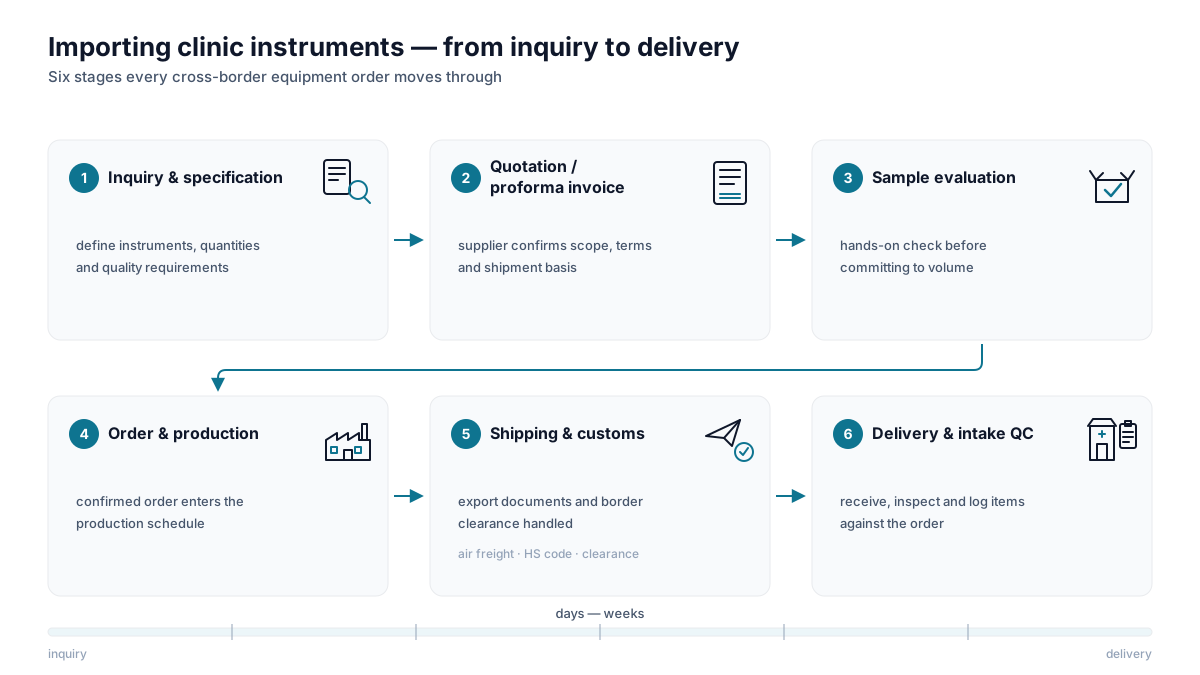
Saudi Arabia is the Gulf market that rewards preparation over speed. Demand is the strongest in the region — a young, large population, growing private aesthetic-medicine capacity in Riyadh and Jeddah, and a private-health sector expanding under the Vision 2030 reform programme — but access is structured: the SFDA regulates devices with real rigour, import clearance is tied to regulatory standing, and commerce runs through local agents who expect to own the market relationship. Suppliers who arrive with their documentation in order and a carefully chosen Saudi partner find a deep, brand-receptive market; those who improvise find the border doing their quality control for them.
Key takeaways
- The SFDA regulates medical devices in Saudi Arabia, and device registration applies before instruments reach the market.
- Import clearance is linked to regulatory standing, so the local agent's paperwork discipline directly determines your delivery reliability.
- Local-agent culture runs deep: Saudi partners expect exclusivity, invest in relationships, and act as importer, registration holder and credit provider.
- Riyadh and Jeddah anchor demand, with the private aesthetic sector expanding quickly and receptive to recognised international brands.
- The riyal is pegged to the US dollar; expect dollar-denominated contracts, prepayment or letters of credit early on, and mandatory electronic invoicing domestically.
The SFDA, in brief
Medical devices in Saudi Arabia are regulated by the SFDA, the Saudi Food and Drug Authority, whose remit spans food, drugs and medical devices nationally. SFDA device registration applies before instruments are placed on the Saudi market, and foreign manufacturers operate through a locally established authorized representative under the SFDA's framework. There is no Saudi conformity mark equivalent to the CE mark; the registration itself is the market-access credential, and current requirements should be confirmed with the SFDA and your local partner.
Import controls: where regulation meets the border
What most distinguishes Saudi importing from its Gulf neighbours is how tightly customs clearance is coupled to regulatory status. Shipments of medical goods are checked against the consignee's standing and the products' registration position, which means the practical quality of your Saudi partner's regulatory housekeeping shows up directly in your lead times: a well-maintained file clears smoothly, a sloppy one strands inventory. Plan conservatively on timelines for first shipments, and treat pre-shipment document review — invoice details, product identification, consistency with what the authorities expect to see — as a standing discipline rather than a one-off task.
Above the national layer sits the GCC customs union context, with its common external tariff at the bloc's border. Correct classification matters for costing and clean declarations alike; the tariff lines in our HS code reference for hair-transplant supplies are the starting point for your broker. And because a large share of the world's hair-restoration instruments ships out of Turkey, the export-side mechanics in our importing from Turkey guide pair naturally with the Saudi entry requirements on the receiving end.
Market character: scale, growth and rising standards
Saudi Arabia is, qualitatively, the Gulf's largest and fastest-growing procedure market. Demographics do much of the work — a big, young, appearance-conscious population with rising disposable income — and policy does the rest: the Vision 2030 programme's push to expand the private health sector has channelled investment into hospitals, day-surgery centres and aesthetic clinics. Riyadh and Jeddah are the two anchors, with Riyadh's growth especially visible as the capital absorbs investment and talent; the Eastern Province cities add a third, smaller cluster.
Demand is also broadening in composition. Aesthetic medicine in the Kingdom has expanded well beyond its traditional base — female participation in the aesthetic market is growing alongside wider social and economic change, dermatology and cosmetic practices are adding hair-restoration services to existing patient relationships, and clinics increasingly bundle transplant work with adjacent offerings such as PRP and medical-grade aftercare. For suppliers, that widening mix favours a portfolio conversation over a single-instrument pitch.
Historically many Saudi patients travelled abroad for hair restoration, Turkey above all, and that outbound flow continues. The strategic story, though, is domestic capacity catching up: new clinics, returning Saudi specialists and international operators are progressively giving patients reasons to treat at home. For instrument suppliers this is the attractive dynamic — a market building clinical capacity, buying equipment as it does so, and calibrating its standards against the international centres its surgeons trained in. Saudi buyers respond to recognised brands and documented quality; the market's price sensitivity is real but sits below its intolerance for supply failures, because a clinic that has promised world-class treatment cannot explain a stock-out to its patients.
How buying decisions are made
Purchasing behaviour splits along institutional lines, and a good market plan respects the split. In the private clinic segment — the heart of hair-restoration demand — decisions are owner-led and surgeon-driven: the practising physician specifies the instruments, the owner (often the same person) approves the spend, and the distributor's relationship with that individual carries the account. Decisions here can be quick once trust exists, and brand reputation plus a colleague's recommendation outweigh formal tender mechanics entirely. In hospital groups and the larger private-health operators, by contrast, procurement is committee-shaped: vendor registration, documentation review and structured quotation rounds are normal, timelines stretch, and the consultant surgeon acts as internal champion rather than final decision-maker. Institutional buyers also expect their supplier's local partner to manage the administrative burden — a distributor unfamiliar with formal vendor onboarding will lose those accounts regardless of product quality.
The practical consequence for a foreign manufacturer is that segment coverage is a real test of a prospective agent. Ask which hospital groups have accepted them as a registered vendor, and which private surgeons they can put you in front of within a month; strong answers to both questions describe a partner who can actually reach the whole market rather than one corner of it.
Local-agent culture
The Saudi route to market runs through local companies, and the culture around agency is among the most established in the region. A serious Saudi distributor expects to be the registration holder or coordinate closely with the manufacturer's authorized representative, to import as consignee of record, to hold stock, to extend credit to clinic customers, and — critically — to be the face of the brand in the Kingdom. Exclusivity is the default expectation, and the counterpart investment a good agent makes in registrations, inventory and relationships is genuine, so the negotiation is less about resisting exclusivity than about defining performance: sales obligations, service standards, regulatory maintenance duties and exit mechanics all belong in writing. Our guide to distribution agreement terms maps those clauses in detail.
Relationship style matters as much as contract text. Saudi business runs on personal trust built over repeated contact: visits to Riyadh, patience through a longer courtship than European deals require, and respect for hierarchy in your counterpart's organisation. Decisions may take time and then move quickly; the supplier who has stayed present through the slow phase is the one positioned for the fast one. Note also the practical rhythms of the Saudi calendar — the working week runs Sunday to Thursday, and activity slows markedly during Ramadan — when planning launches and shipment schedules.
Payment customs and currency
The riyal's peg to the US dollar makes currency mechanics simple: cross-border contracts are typically denominated in dollars, occasionally euros, and conversion risk is negligible. Early-stage payment behaviour is conservative in both directions — foreign suppliers usually require advance payment or letters of credit on opening stock orders, and Saudi partners consider that normal; mature relationships migrate toward open-account terms with negotiated credit windows. Domestically, Saudi Arabia has pushed hard on digitalisation of commerce, and electronic invoicing is mandatory for VAT-registered businesses under the national e-invoicing regime, so expect your partner's ordering and invoicing processes to be more systematised than the relationship-driven sales culture might suggest. Structuring instalments, credit checks and remedies for late payment across borders is covered in our supplier payment terms guide.
Readiness checklist before your first Saudi shipment
| Item | Why it matters |
|---|---|
| SFDA registration status confirmed for every SKU shipped | Clearance is checked against registration; unregistered lines risk being stranded |
| Authorized representative and importer roles agreed in writing | Defines who maintains the regulatory file and answers the authorities |
| HS classification and invoice details reviewed pre-shipment | Clean, consistent documents are the main lever on clearance time |
| Payment instrument settled (advance or LC) with dollar denomination | Avoids first-shipment disputes; matches Saudi banking practice |
| Distribution agreement covering exclusivity, performance and exit | Agency relationships are sticky; terms are far easier to set than to unwind |
A supplier who can tick all five rows has done the unglamorous work that separates a smooth Saudi launch from an expensive lesson. The wider groundwork on qualifying partners and structuring export markets sits in our sourcing and import hub.
Frequently asked questions
Do I need SFDA registration before selling instruments in Saudi Arabia?
Yes — SFDA medical-device registration applies before instruments are placed on the Saudi market, and foreign manufacturers work through a locally established authorized representative. Confirm current requirements with the SFDA and your local partner rather than relying on another market's approvals.
Does CE marking give my instruments access to Saudi Arabia?
Not by itself. Saudi Arabia operates its own SFDA registration system rather than accepting the CE mark as a market-access credential, although international approvals form part of the evidence a registration draws on. The SFDA registration is what the border and the market recognise.
Can I sell into Saudi Arabia without a local agent?
In practice, no. Import and registration mechanics require locally established parties, and the commercial culture is built around Saudi distributors who hold stock, extend credit and own clinic relationships. Partner selection is effectively your market-entry decision.
How long should I plan for a first shipment to clear Saudi customs?
Longer than for a comparable European delivery. Clearance is linked to the consignee's regulatory standing and the shipment's documentation, so first shipments deserve conservative planning and a pre-shipment document review; well-prepared repeat shipments then clear substantially faster.
What payment terms are typical with Saudi distributors?
Dollar-denominated contracts settled by advance payment or letter of credit early in the relationship, moving toward negotiated open-account terms as trust builds. Domestically, electronic invoicing is mandatory for VAT-registered businesses, so administrative processes are more digitised than newcomers expect.
Where is instrument demand concentrated in Saudi Arabia?
Riyadh and Jeddah anchor the private aesthetic and hair-restoration sector, with Riyadh growing fastest as investment concentrates in the capital, and the Eastern Province forming a smaller third cluster. Expansion of private healthcare under Vision 2030 is broadening that base.
Related articles
Sourcing & Import: Buying Medical Instruments Across Borders
The commercial mechanics of importing hair restoration instruments — customs, MOQs, samples, payment terms and how to evaluate a supplier before committing.
Importing Hair Restoration Instruments from Turkey: A Practical Guide
Why Turkey became a manufacturing base for hair-restoration instruments, and the practical import mechanics — Incoterms, customs documents, duty and VAT logic — for buyers in the EU, UK and Gulf.
Payment Terms with Medical Instrument Suppliers: Proforma, T/T and LC
How payment actually works when buying instruments internationally: the proforma invoice flow, common T/T split structures, when a letter of credit earns its cost, and the red flags that should stop a transfer.
Distribution Agreement Terms: The Clauses That Decide Whether the Deal Works
A clause-by-clause walk through medical device distribution agreements: territory and exclusivity, minimum commitments, pricing structure, marketing obligations, IP use, termination and the post-term provisions most first-time distributors overlook.