
Buying & Distributing Hair Transplant Instruments in the Netherlands
Why the Netherlands punches above its weight as an instrument market: a modest domestic clinic base, but Europe's most efficient import infrastructure, English-fluent procurement, and a VAT regime built for traders.
The Netherlands is a small procedure market attached to an outsized piece of trade infrastructure. Its domestic hair-restoration clinic base is modest, but Rotterdam and Schiphol are two of the EU's principal freight gateways, Dutch import-VAT rules are unusually trader-friendly, and procurement conversations happen in fluent English with little ceremony. For an instrument buyer or distributor, that combination makes the Netherlands two things at once: a compact, quality-conscious sales territory, and one of the most practical places in Europe to land, clear and redistribute stock.
Key takeaways
- The Dutch clinic market is compact and concentrated in the Randstad, but the country's logistics role makes it a natural EU entry point for instrument stock.
- CE-marked devices circulate freely; the IGJ supervises the market, with the CIBG handling registrations.
- The Article 23 import-VAT deferment licence is the reason so many importers clear goods in the Netherlands — no cash outlay for VAT at the border.
- Dutch procurement is direct, English-fluent and price-transparent: expect short negotiations, clear specifications and prompt SEPA payment on invoice.
- Many suppliers serve the Netherlands directly from abroad; local distributors typically cover the whole Benelux rather than the Netherlands alone.
Who oversees the market
Medical-device oversight in the Netherlands sits with the IGJ, the Health and Youth Care Inspectorate, which supervises manufacturers, importers and distributors operating on the Dutch market; registration formalities run through the CIBG, an executive agency of the health ministry. Devices carry the CE mark under the EU MDR, and instruments lawfully placed on the market elsewhere in the EU circulate in the Netherlands without further national conformity marking. Requirements apply to economic operators trading here, so confirm your own obligations with the IGJ before you start selling.
The gateway logic: Rotterdam, Schiphol and Article 23
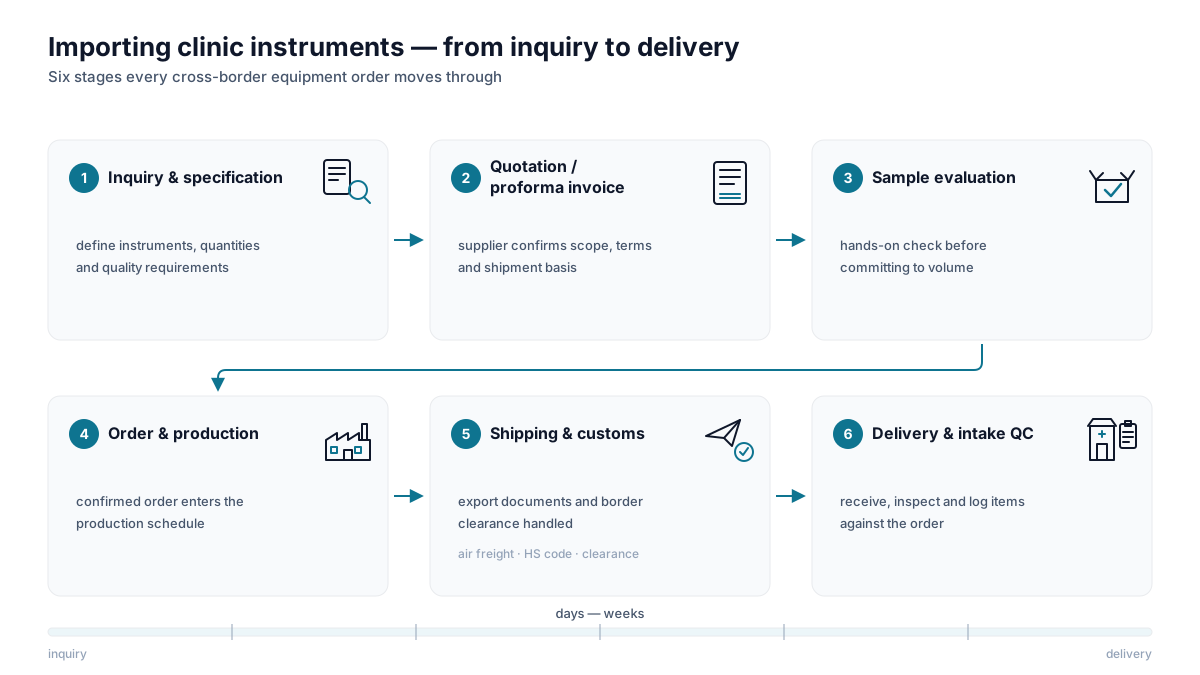
Most buyers meet the Netherlands first as a port of entry rather than a sales territory. Rotterdam is Europe's largest seaport and Schiphol one of its busiest cargo airports, and both are surrounded by a dense ecosystem of customs brokers, bonded warehouses and fulfilment providers that clear goods quickly and cheaply. If you import instruments from outside the EU — from Turkey, for example, where much of the industry's manufacturing sits — clearing them in the Netherlands and then moving them across the single market is a well-worn route. Our guide to importing from Turkey covers the document flow, and the HS code reference helps you classify punches, blades and implanters correctly before your broker files the entry.
The distinctly Dutch advantage is fiscal. Importers established in the Netherlands can apply for an Article 23 licence, which shifts import VAT from a payment at the border to a line item on the periodic VAT return — a reverse-charge mechanism that removes the cash-flow hit of paying VAT on landing and reclaiming it weeks later. Foreign companies can reach the same result by appointing a Dutch fiscal representative. This is why trading companies with no Dutch customers at all still choose to clear EU-bound stock here; if you plan to hold inventory for several EU markets, it is worth pricing the Dutch route against clearing in your home country.
The ecosystem around the gateways matters as much as the gateways themselves. Dutch third-party logistics providers are unusually experienced with regulated goods: lot-level traceability, temperature and humidity discipline where products require it, and returns handling that keeps documentation intact are standard offerings rather than premium extras. A supplier holding instrument stock in a Dutch fulfilment centre can realistically promise next-day delivery to clinics across the Benelux and western Germany, and one- to two-day service to most of the rest of the single market — a service level that becomes a genuine sales argument when clinics compare you against a competitor shipping ad hoc from further away. Customs brokerage is a competitive, commoditised service here, which keeps clearance fees low and turnaround predictable; most brokers will also run your product classifications past you before the first entry rather than discovering problems at the border.
Within the EU itself there is nothing to clear: instruments bought from a German, Spanish or Belgian supplier arrive as an intra-Community acquisition with no customs formalities, and VAT is handled through your own return.
What the Dutch market itself looks like
Set the logistics aside and the domestic market is genuinely small. Hair-restoration procedures are elective and privately paid, and the clinic base is concentrated in the Randstad — Amsterdam, Rotterdam, The Hague, Utrecht — with a thinner spread across the rest of the country. A meaningful share of Dutch patients travels abroad for treatment, particularly to Turkey, which caps how large the domestic procedure market can grow; the clinics that thrive at home tend to compete on medical reputation, follow-up care and convenience rather than price.
That shapes what those clinics buy. Dutch practices are quality-conscious and specification-literate, but they are also famously unsentimental purchasers: they compare offers, expect transparent pricing, and switch suppliers when service slips. Loyalty is earned through consistent delivery and honest communication rather than relationship rituals. For a supplier, this is a market where a well-organised web shop, clear technical documentation and reliable three-day delivery beat a large field sales team.
The outbound patient flow has a second-order effect worth noticing: Dutch clinics see a steady stream of patients returning from treatment abroad who need follow-up, corrective work or structured aftercare. That sustains domestic demand for consumables, aftercare product lines and the instruments used in smaller revision procedures even where the headline transplant volume travels elsewhere — a subtler demand profile than a simple procedure count would suggest, and one that favours suppliers with a broad consumables basket over single-product specialists.
The buying conversation itself is easy for foreigners. English fluency in Dutch professional life is among the highest in Europe, and clinics will happily review English-language quotations, IFUs and technical files — though patient-facing material and some clinic documentation will still need Dutch, so a supplier with Dutch-language support has an edge at the margin rather than a gate to pass.
Distribution structure and payment customs
Because the market is small and import-literate, direct supply from abroad is common: many Dutch clinics order instruments straight from manufacturers or foreign specialist suppliers without a domestic intermediary. Where distributors do operate, they typically cover the Benelux as a single territory — a Dutch or Belgian company serving the Netherlands, Belgium and Luxembourg together — because none of the three national markets alone justifies a dedicated organisation. If you are structuring a territory as a manufacturer, treat Benelux as one unit; if you are a Dutch buyer weighing channels, the practical choice is usually between a Benelux distributor's stock and service versus direct import at better unit pricing, a trade-off explored in our sourcing and import hub.
Payment customs are straightforward. Business invoices are settled by SEPA transfer, standard terms run around thirty days, and payment discipline is good by European standards — chasing Dutch clinics for overdue invoices is the exception, not the rule. Electronic invoicing is widely used and increasingly expected. New trading relationships often start on proforma or partial prepayment, moving to open account quickly once a pattern is established; Dutch buyers accept that sequence but will expect the shift to invoice terms to actually happen after the first few clean transactions. Currency risk is a non-issue for eurozone counterparties, and Dutch firms trading internationally are comfortable invoicing and paying in euros against foreign suppliers' terms.
Route comparison for landing stock
| Route | Customs formalities | VAT treatment | Best suited to |
|---|---|---|---|
| Buy from an EU supplier | None — intra-Community acquisition | Self-assessed on your VAT return | Clinics and small buyers wanting simplicity |
| Import from outside the EU, clear in NL | Full import declaration at Rotterdam/Schiphol | Deferred via Article 23 licence or fiscal representative | Distributors landing stock for several EU markets |
| Buy via a Benelux distributor | Handled upstream by the distributor | Domestic Dutch invoice with VAT | Buyers prioritising local stock, service and Dutch-language support |
The third column is the quiet differentiator: for identical goods, the Dutch route can be materially kinder to working capital than clearing in a member state without a deferment mechanism.
Practical notes for suppliers entering the market
Two habits serve foreign suppliers well here. First, quote completely: Dutch buyers respond poorly to drip-fed costs, so a quotation that already includes freight, packaging and any minimum-order logic — see our MOQ guide for how to structure that — reads as professional rather than padded. Second, be direct about what you cannot do. Dutch commercial culture treats a fast, honest "no" as a mark of reliability, and suppliers who over-promise on lead times lose accounts faster here than in most markets.
For distributors considering the Netherlands as a base, the calculation is rarely about domestic demand alone. The realistic model is a Dutch logistics and clearance footprint serving clinics across the single market, with the home market as a stable but modest first territory.
Frequently asked questions
Do I need to speak Dutch to sell instruments to Dutch clinics?
For the B2B relationship, no — English-language quotations, negotiations and technical documentation are routine, and Dutch professionals are comfortable working in English. Dutch-language support helps for patient-facing materials and day-to-day service, but it is an advantage rather than a requirement.
Why do so many importers clear EU-bound goods in the Netherlands?
Speed and cash flow. Rotterdam and Schiphol offer fast, competitively priced clearance, and the Article 23 licence lets licensed importers defer import VAT to their periodic return instead of paying it at the border. For stock destined for several EU markets, that combination often beats clearing elsewhere.
Is there customs duty when a Dutch clinic buys from a supplier in another EU country?
No. Purchases from suppliers in other EU member states are intra-Community acquisitions: there are no customs formalities or duty, and VAT is self-assessed through the buyer's own Dutch VAT return rather than paid at a border.
Who regulates medical devices in the Netherlands?
The IGJ (Health and Youth Care Inspectorate) supervises the Dutch medical-device market, with registration formalities handled by the CIBG. Instruments carry the CE mark under the EU MDR, and no additional Dutch conformity mark exists.
How do Dutch clinics usually pay suppliers?
By SEPA bank transfer against invoice, typically on terms of around thirty days, with good payment discipline. New relationships commonly start on proforma or partial prepayment and move to open account after the first few smooth transactions.
Is the Netherlands a big enough market to justify a dedicated distributor?
Rarely on its own. The domestic clinic base is compact, so distributors almost always cover the Benelux as a single territory. The stronger Dutch play is using the country's logistics and VAT advantages as a base for wider EU supply.
Related articles
Sourcing & Import: Buying Medical Instruments Across Borders
The commercial mechanics of importing hair restoration instruments — customs, MOQs, samples, payment terms and how to evaluate a supplier before committing.
Importing Hair Restoration Instruments from Turkey: A Practical Guide
Why Turkey became a manufacturing base for hair-restoration instruments, and the practical import mechanics — Incoterms, customs documents, duty and VAT logic — for buyers in the EU, UK and Gulf.
HS Codes for Hair Transplant Instruments and Supplies
A heading-level HS/CN classification reference for the hair-restoration product basket: instruments, consumables, equipment and hair-care products, with the pitfalls that cause misclassification.
Minimum Order Quantities for Medical Instruments: A Buyer's Guide
Why MOQs exist in instrument manufacturing, what typical minimums look like by product category, which negotiating levers actually move them, and why a supplier with no minimum at all deserves scrutiny.