
Buying & Distributing Hair Transplant Instruments in Bahrain
Bahrain is the Gulf's smallest instrument market and one of its most open: a dedicated health regulator, a liberal commercial climate, and a Manama clinic scene sustained partly by patients crossing the causeway from Saudi Arabia.
Bahrain will never top a market-size ranking, and it does not need to: its value to an instrument supplier lies in how easy it is to enter and what it connects to. A dedicated health regulator with a reputation for clarity, one of the region's more liberal commercial and licensing climates, and a Manama clinic scene fed partly by weekend patients driving across the causeway from Saudi Arabia's Eastern Province make the kingdom a low-friction first Gulf foothold — small in absolute terms, but strategically placed and unusually straightforward to work in.
Key takeaways
- Bahrain pairs the Gulf's smallest market with one of its most open operating climates — low friction is the selling point, not volume.
- The NHRA, a dedicated health regulatory authority, oversees medical-device requirements and licenses the facilities and professionals who use them.
- The King Fahd Causeway links Manama's clinics to patient demand from Saudi Arabia's Eastern Province.
- Foreign-business conditions are comparatively liberal, and distribution arrangements can be structured more flexibly than in neighbouring markets.
- The dinar is pegged to the US dollar and divided into 1,000 fils; payment practices are bank-centred and orderly in this long-established financial hub.
A regulator, not a ministry desk
Bahrain's institutional arrangement is genuinely distinctive in the region: health regulation sits with the NHRA, the National Health Regulatory Authority, a dedicated regulatory body separate from the Ministry of Health's service-delivery role. The NHRA licenses healthcare facilities and professionals and administers the requirements that apply to medical devices before they reach the market, with recognised international approvals commonly referenced in the process. Current requirements should be confirmed with the NHRA and your local partner.
For suppliers, the practical texture of this setup is what matters: a single, identifiable authority with a regulatory mandate tends to mean clearer answers, published processes and a shorter path from question to ruling than a ministry department juggling regulation alongside running hospitals. Bahrain's small scale amplifies the effect — the regulatory community is compact enough that experienced local partners know it personally.
The liberal-climate advantage
Bahrain built its modern economy on being easier to do business in than its neighbours — first as the Gulf's banking centre, later as a services and logistics hub — and that heritage shows in the commercial conditions an instrument supplier encounters. Foreign ownership rules are comparatively permissive across many activities, company formation is quick by regional standards, and the agency culture, while present, is less rigid than in markets where a registered local agent is a near-immovable fixture. A supplier can realistically consider structures here that would be impractical elsewhere in the Gulf: a non-exclusive arrangement while the market is tested, a regional office of its own, or a hybrid in which a local firm handles regulatory and logistics functions while the manufacturer keeps commercial control. The trade-offs between those models are exactly the territory of our guide to exclusive versus non-exclusive distribution — and Bahrain is one of the few Gulf markets where the non-exclusive column is a live option rather than a theoretical one.
The honest counterweight is scale. The clinic base is the smallest in the Gulf, and no structure, however elegant, changes the size of the addressable market. Bahrain rewards suppliers who value optionality and low entry cost; it disappoints those who mistake openness for volume.
Manama, the causeway and the weekend patient
Clinic demand centres on Manama and its contiguous urban belt — Seef's commercial district, the private hospitals, and a spread of dermatology and aesthetic practices serving a cosmopolitan, largely English-speaking patient base. What distinguishes the demand pool is that it does not stop at the shoreline: the King Fahd Causeway puts Saudi Arabia's populous Eastern Province within a drive of Manama, and Saudi visitors have long crossed for weekends, dining and services — medical appointments included. Bahraini clinics price and schedule with that cross-border patient in mind, and aesthetic providers in particular treat Eastern Province demand as part of their natural catchment.
For an instrument supplier this cross-border layer changes the arithmetic of a small market: clinic purchasing reflects a patient base meaningfully larger than the resident population alone, and the aesthetic segment is correspondingly better developed than headline demographics would predict. It also means Manama's clinics compete with Saudi and Dubai providers simultaneously, keeping quality expectations — and instrument standards — pinned to the regional premium benchmark rather than drifting toward small-market complacency.
A proving ground, honestly assessed
Bahrain's openness, English-speaking business environment and compact scale make it a tempting first Gulf market, and the logic is partly sound — but only partly. It is worth being precise about what a Bahrain entry can demonstrate and what it cannot.
| A Bahrain launch can show you | It cannot show you |
|---|---|
| Whether your products, pricing and training model resonate with Gulf clinic buyers | How your economics survive a large market's registration and stock demands |
| How your documentation performs against a clear regional regulator | How slower, more layered authorities elsewhere will treat the same file |
| Whether a Gulf service relationship suits your team's working rhythms | Whether a rigid exclusive-agency market will accept your preferred structure |
| Real reference customers visible to the regional medical community | Volume forecasts transferable to Saudi Arabia or the UAE |
Used with those limits in mind, the kingdom serves well as a controlled, affordable first exposure — a place to earn Gulf references and refine an offer before committing to the region's larger and more demanding markets. Each neighbouring market remains its own regulatory project; nothing registered in Bahrain travels with the goods.
Who buys, and how
The buyer landscape is compact enough to map completely, which is itself a luxury few markets offer. At the top sit a handful of private hospital groups with aesthetic and dermatology departments; they buy through small but professional procurement functions, expect vendor registration and full documentation, and reward suppliers whose local representative handles administration without friction. The middle tier — the commercial heart of the instrument market — is the independent dermatology and cosmetic clinics of Manama and its suburbs: physician-owned, quick-deciding, surgeon-preference-driven, and highly connected to one another, since Bahrain's medical community is small enough that most specialists know each other personally. A third strand is the medical arm of the kingdom's wellness and hospitality positioning, where aesthetic services attach to a broader premium-leisure offer aimed partly at visiting Gulf clientele.
Purchasing style across all three tiers is direct and unceremonious by Gulf standards. Meetings are easy to obtain, English is the default working language, decisions come faster than in the larger neighbouring markets, and the elaborate relationship choreography that governs commerce elsewhere in the region is present here only in a lighter form. That accessibility is genuine, but it has a discipline of its own: because everyone talks to everyone, your pricing, service record and how you handled your last complaint circulate freely. In a market this transparent, consistency is the marketing strategy — the supplier who quotes the same fair terms to every clinic and fixes problems without argument builds a reputation that does the selling.
Logistics, the dinar and getting paid
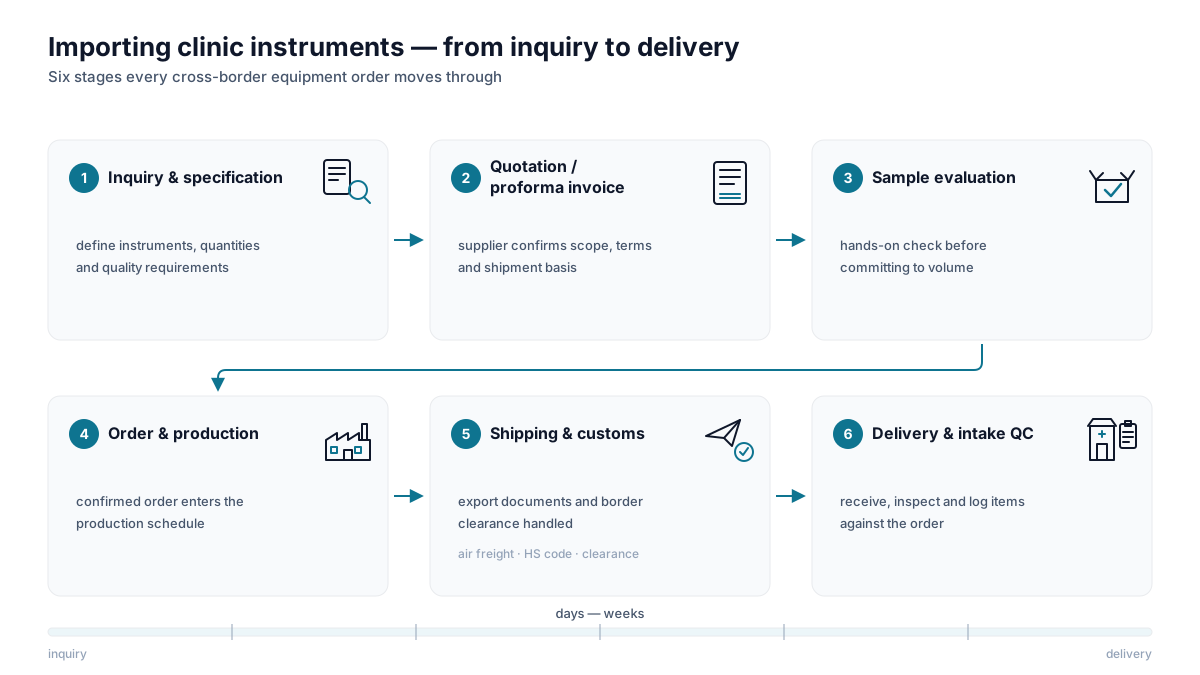
Freight arrives by three doors: Khalifa Bin Salman Port for sea cargo, Bahrain International Airport for the air shipments that suit high-value instruments, and the causeway itself for trucked goods moving within the Gulf, with the bloc's common external tariff settled at the first point of entry. Clearance through a properly established local consignee is efficient, and the compact geography means delivery to any clinic in the country is a same-day matter. Classification homework still pays — the tariff lines in our HS code reference apply to Bahraini declarations as elsewhere — and the wider sequence for structuring export shipments is laid out in our sourcing and import hub.
Money is Bahrain's home turf. The dinar has been pegged to the US dollar for decades and divides into 1,000 fils, banking infrastructure is deep for the country's size, and B2B payment behaviour is orderly: dollar- or dinar-denominated invoices, bank transfers as the norm, advance payment on opening orders giving way to open-account terms with familiar speed once a relationship is established. The working week runs Sunday to Thursday and Ramadan slows commercial tempo, but the overall administrative experience — in payments as in regulation — is among the lightest a supplier will meet anywhere in the region. Credit checks on prospective partners are also easier to run here than in most neighbouring jurisdictions, a small mercy of the financial-hub heritage that first-time Gulf exporters learn to appreciate quickly: the counterparty information that takes weeks of informal enquiry elsewhere is often a straightforward request in Manama.
Frequently asked questions
Why enter Bahrain if it is the Gulf's smallest market?
For low-friction access and strategic position rather than volume: an approachable dedicated regulator, liberal commercial conditions, flexible distribution structures, and a Manama clinic scene enlarged by Saudi patients crossing the causeway. It suits suppliers seeking a controlled first Gulf foothold.
Who regulates medical devices in Bahrain?
The National Health Regulatory Authority (NHRA), a dedicated regulatory body separate from the Ministry of Health's service-delivery role. It administers device requirements and licenses healthcare facilities and professionals; confirm current specifics with the NHRA and your local partner.
Do I need an exclusive local agent in Bahrain?
Not necessarily. Bahrain's commercial climate is more liberal than most Gulf markets, and non-exclusive arrangements, hybrid structures or even a supplier's own local presence are realistic options — though a capable local partner still speeds regulatory and logistics work considerably.
Does the Saudi causeway traffic really matter to Bahraini clinics?
Yes. The King Fahd Causeway places Saudi Arabia's Eastern Province within driving distance, and cross-border visitors form an established part of the patient base for Manama's aesthetic and medical providers, effectively enlarging the market beyond Bahrain's resident population.
Can a Bahrain registration be used to sell into Saudi Arabia or the UAE?
No. Regulatory approval is national throughout the region, so each market requires its own pathway and locally established parties. Bahrain can supply Gulf references and operational experience, but not transferable registrations.
How do payments typically work with Bahraini partners?
Through a mature banking system, in dollar- or dinar-denominated invoices settled by bank transfer — advance payment on early orders, moving to open-account terms relatively quickly. The dinar's long-standing dollar peg removes exchange-rate concerns from the relationship.
Related articles
Sourcing & Import: Buying Medical Instruments Across Borders
The commercial mechanics of importing hair restoration instruments — customs, MOQs, samples, payment terms and how to evaluate a supplier before committing.
HS Codes for Hair Transplant Instruments and Supplies
A heading-level HS/CN classification reference for the hair-restoration product basket: instruments, consumables, equipment and hair-care products, with the pitfalls that cause misclassification.
Exclusive vs Non-Exclusive Distribution: Which Model Actually Serves You?
An honest comparison of exclusive and non-exclusive distribution rights: what each model really grants, when each one wins, the hybrid structures in between, and the performance clauses that make an exclusive territory earn its keep.