
Warsaw: The CEE Distribution Decision Center and Its Patient-Inflow Economy
Warsaw is where Central and Eastern Europe's medical-trade decisions get made: regional head offices, distributor headquarters and the regulator's seat share the city with a clinic scene priced for Western patient inflow.
If you want to sell instruments anywhere between the Baltic and the Balkans, sooner or later you take a meeting in Warsaw. The city is Central and Eastern Europe's commercial control room for medical trade: the place where regional head offices sit, where the distributors covering CEE territories keep their headquarters, and where the national device regulator has its seat. Around that corporate core runs a second, very different economy — clinics filled by patients flying in from Western Europe — and the two together give the capital a commercial character no other city in the region matches.
Key takeaways
- Warsaw functions as CEE's distribution decision center: territory rights, portfolio strategy and partner selection for markets far beyond the city are negotiated in Warsaw offices.
- The distributor headquarters based here typically run warehouses in cheaper logistics parks outside the city — the address you visit and the address that ships are rarely the same.
- Warsaw's clinics run a patient-inflow business: direct flights deliver Western European patients into practices whose costs are local, and purchasing reflects that margin structure.
- Device oversight is national, with the regulator URPL seated in Warsaw — convenient for in-person regulatory affairs, but no separate city licensing exists.
- Recurring healthcare trade exhibitions in the capital, including WIHE, are the practical venue for meeting CEE distribution partners — verify editions with organisers.
Why the decisions concentrate here
Warsaw's cluster is corporate before it is clinical. When multinational medical and device companies organise Central and Eastern Europe, they overwhelmingly run the cluster — Poland plus some combination of the Baltics, Czechia, Slovakia, Romania, Ukraine and the Balkans — from a Warsaw office, drawing on the city's regional-headquarters infrastructure, its multilingual commercial workforce and its flight connections across the territory. The domestic trade mirrors the pattern: the medical-device distributors that matter for aesthetic and surgical lines keep their head offices, product managers and key-account teams in the capital, even where their warehouses sit in logistics parks along the motorways outside it, where space costs a fraction of a city address.
For an instrument manufacturer, the consequence is leverage. A single well-prepared Warsaw trip can cover conversations that would otherwise demand five capitals: the distributor deciding whether to carry your punches in Poland is often the same organisation — or shares a building with the organisation — weighing your line for Vilnius, Prague or Bucharest. Suppliers who treat Warsaw as merely Poland's biggest city consistently underprice the access it offers; the sharper framing is that Warsaw is where a CEE strategy either finds its champions or quietly dies in a first meeting. How to structure those partnerships — territory scope, targets, exit rails — is ground covered in our guides to distribution agreement terms and becoming an instrument distributor, both of which read differently once you realise the counterparty may be negotiating for six markets at once.
The cluster has a history worth one paragraph, because it explains its durability. When Western medical companies expanded eastward after EU accession opened the region, they needed one seat from which to serve a dozen small-to-mid-sized markets, and Warsaw won that competition on fundamentals: the region's largest domestic economy directly outside the office door, a deep bench of commercially trained, multilingual professionals, and improving air links to every capital the cluster covered. Two decades of that choice compounding has produced self-reinforcing infrastructure — the region's medical-trade lawyers, market-access consultants and specialist recruiters are now themselves Warsaw businesses, which makes the next arriving company's decision easier still. Clusters built on compounding services do not relocate quickly; a supplier can invest in Warsaw relationships with reasonable confidence the city's role will outlast any single partner.
The regulator completes the picture. URPL, the national authority for medical devices, is seated in Warsaw, which keeps the city's regulatory-affairs consultants, notified-body liaison people and compliance lawyers within tram distance of the institution they deal with. Oversight itself is entirely national — CE marking under the EU MDR, standard economic-operator obligations, no municipal device regime — but the professional ecosystem that helps foreign suppliers navigate it is a Warsaw industry.
The patient-inflow economy
The city's second engine runs on aircraft. Warsaw is served by two airports — Chopin close to the centre and Modlin to the north — with dense direct connections to the UK, Germany, Scandinavia and the Benelux, and a share of the passengers on those routes are travelling for medical procedures. Hair restoration fits the model precisely: a patient can fly in on a morning flight, be treated the same day, and the price still undercuts a home-market quote by a wide margin. Warsaw clinics have professionalised around this arithmetic, with international patient coordinators, English- and German-language consultation tracks, airport transfers and treatment packages built for a forty-eight-hour visit.
The economics behind that service layer are what matter to a supplier. Inflow clinics carry local costs — staff, premises, consumables priced into a PLN cost base — while quoting patients in euros and pounds, and the spread between the two is the margin the whole model defends. That produces a distinctive buying posture: these clinics are simultaneously price-disciplined, because undercutting Western prices is their entire pitch, and quality-anxious, because a visible corner cut in front of a patient who compared clinics in three countries destroys the premium the coordinator worked to build. What they reward is exactly the middle of that tension — instruments with credible, documentable quality at a cost that respects the spread. Sterile single-use lines and presentation-grade instrument trays sell well into this segment; unexplainable premiums do not.
The clinics themselves are a more varied population than the inflow marketing suggests. Purpose-built hair-restoration practices cluster in the central business districts and the affluent southern neighbourhoods, where an address patients can walk to from a hotel is part of the product; around them operate dermatology and aesthetic-medicine practices that added FUE services to an existing patient base, and a growing layer of multi-site aesthetic groups running Warsaw as the flagship of a national footprint. Each buys differently — the purpose-built clinics chase procedure-specific instrumentation and will trial new lines, the dermatology practices buy conservatively around established routines, and the groups negotiate like the small corporations they are — so a supplier's Warsaw pipeline is really three pipelines wearing one postcode.
There is also a rhythm to notice. Inflow clinics schedule internationally, filling treatment calendars weeks ahead against flight bookings, so their consumable ordering is comparatively forecastable — and their tolerance for supply failure is near zero, because a missing implanter cannot be resolved by rebooking a patient who flew in from Manchester. Reliability, more than price, is what moves a supplier from tested to trusted in this city.
Licensing in brief
There is nothing city-level to comply with. Devices circulate under the CE mark of the EU MDR, supervision and registration formalities are administered nationally by URPL, and a seller's obligations in Warsaw are identical to those anywhere else in the country. Confirm the current state of operator duties with the authority or a local regulatory adviser rather than relying on secondhand summaries.
Recurring events
The capital's exhibition calendar is a working tool for market entry. WIHE — the Warsaw International Healthcare Exhibition — recurs as a general healthcare trade fair where regional distributors walk the aisles specifically to scout new lines, and the city also hosts recurring national congresses in dermatology and aesthetic medicine whose exhibition floors reach clinic decision-makers directly. Editions, venues and scopes shift, so verify the current calendar with organisers before building a travel plan around any single event; our industry events calendar sets out how to sequence trade-fair participation efficiently.
Who buys, and how supply flows in
Warsaw's demand side has three distinct buyer types, and they purchase differently.
| Buyer | What they decide in Warsaw | How goods reach them |
|---|---|---|
| Distributor head offices | CEE portfolio and territory commitments | Stock shipped to out-of-town warehouses, road-freighted onward |
| Clinic groups' central procurement | Standardised instrument lists for multi-city operations | Consolidated deliveries to a central point or per-site drops |
| Independent inflow clinics | Their own consumable and instrument sourcing | Courier parcels, often direct from foreign suppliers |
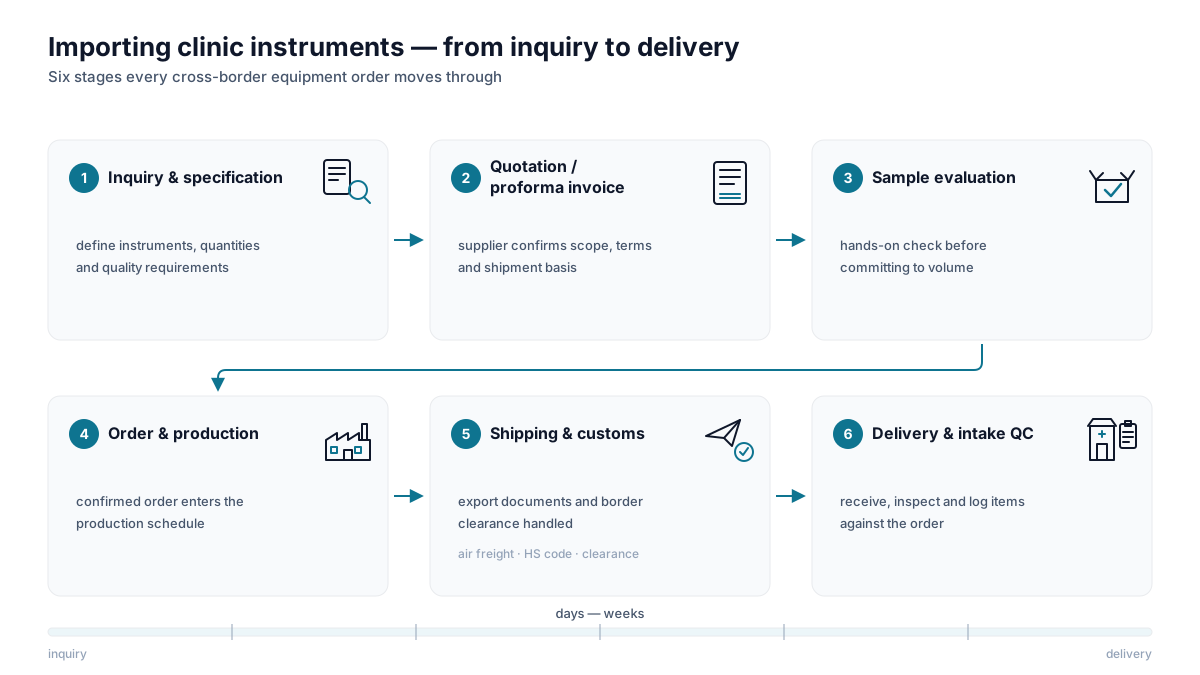
The middle row deserves emphasis, because it is easy to miss from outside: several clinic operations run sites in multiple Polish cities while concentrating procurement in a Warsaw office, so a single capital-city relationship can pull instrument volume from practices the supplier never visits. Physical logistics, meanwhile, are unglamorous and effective — most inbound stock arrives by road from Western European hubs with no customs formalities inside the single market, while urgent and high-value consignments fly into Chopin's cargo terminal. Suppliers weighing whether to serve the city direct or through a regional partner will find the structural trade-offs laid out in our sourcing and import hub; the Warsaw-specific twist is that the partner conversation and the customer conversation frequently happen in the same square kilometre.
Payment behaviour in the capital tracks the buyer type rather than a single city norm: corporate and distributor counterparties run formal purchase-order and bank-transfer processes with negotiated terms, while independent clinics settle smaller orders quickly, and both sides expect early-relationship prepayment to relax once a delivery record exists.
Frequently asked questions
Why is Warsaw treated as the entry point for all of Central and Eastern Europe?
Because the decision-makers cluster there. Regional head offices covering CEE, the headquarters of distributors carrying device lines across several countries, and the regulator's seat are all in Warsaw — so territory and portfolio decisions for markets from the Baltics to the Balkans are frequently made in the capital.
Does Warsaw have its own medical-device licensing requirements?
No. Device rules are national: CE marking under the EU MDR with URPL as the competent authority. URPL happens to be headquartered in Warsaw, which is convenient for in-person regulatory matters, but the city adds no separate licensing layer.
How does Western patient inflow change what Warsaw clinics buy?
Inflow clinics earn in euros and pounds against local costs, and their pitch depends on both a lower price and visible quality. They buy accordingly: documented, presentation-ready instruments and sterile single-use lines at costs that protect the margin — and they drop suppliers whose delivery failures threaten a scheduled international patient.
Should I visit distributor warehouses or head offices when entering via Warsaw?
Head offices. Warsaw distributors typically keep decision-making teams in the city and warehouses in logistics parks outside it. Portfolio, territory and pricing conversations happen at the capital address; the warehouse visit is due diligence for later.
Which trade events in Warsaw are useful for finding CEE partners?
The recurring WIHE healthcare exhibition draws regional distributors scouting new lines, and national dermatology and aesthetic-medicine congresses in the capital reach clinic buyers directly. Confirm current editions and venues with the organisers before planning around any of them.
Do I need Polish to do business in Warsaw's medical-trade scene?
Not at the decision level — the regional-HQ and distributor community works comfortably in English. Polish-language instructions and materials still matter once products reach clinic staff, so plan localisation for the rollout even though the negotiations run in English.
Related articles
Sourcing & Import: Buying Medical Instruments Across Borders
The commercial mechanics of importing hair restoration instruments — customs, MOQs, samples, payment terms and how to evaluate a supplier before committing.
How to Become a Hair Transplant Instrument Distributor
A practical guide to building a distribution business in hair restoration instruments: how the revenue model actually works, how to build a starting portfolio, which manufacturer relationship to choose and how the first customers are won.
Distribution Agreement Terms: The Clauses That Decide Whether the Deal Works
A clause-by-clause walk through medical device distribution agreements: territory and exclusivity, minimum commitments, pricing structure, marketing obligations, IP use, termination and the post-term provisions most first-time distributors overlook.
Hair Restoration Industry Events: The Congresses and Trade Fairs That Matter
A working map of the recurring events that matter in hair restoration — the scientific congresses, the aesthetic industry meetings and the supply-chain fairs — and a practical method for getting real sourcing value out of them.