
Importing Hair Restoration Instruments from Turkey: A Practical Guide
Why Turkey became a manufacturing base for hair-restoration instruments, and the practical import mechanics — Incoterms, customs documents, duty and VAT logic — for buyers in the EU, UK and Gulf.
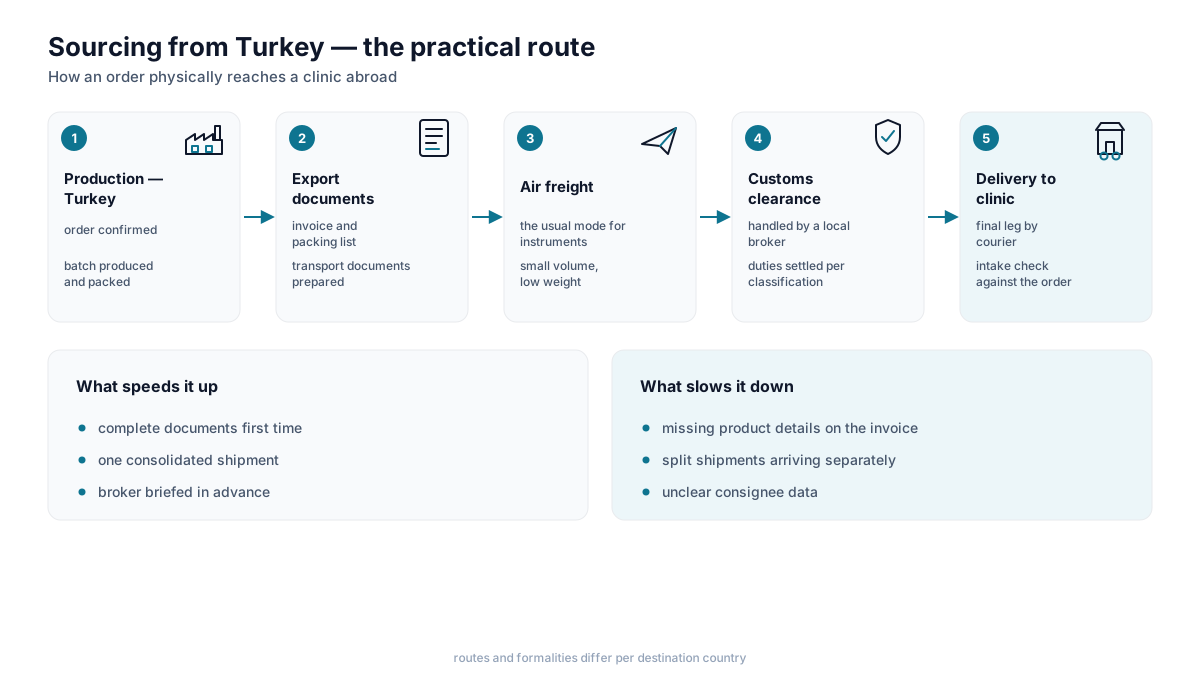
Turkey became a serious source for hair-restoration instruments for structural reasons: the country hosts one of the world's largest hair-transplant treatment markets, which built a dense local ecosystem of instrument makers, consumable suppliers and clinical know-how around it, on top of an established surgical-instrument manufacturing base and a cost structure well below Western Europe's. For an EU, UK or Gulf buyer, importing from Turkey is procedurally routine — a proforma-and-bank-transfer purchase, a courier or forwarder shipment, and a customs entry your broker files — and the practical work is in choosing the right Incoterm, preparing clean documentation, and understanding how duty and VAT will treat your product basket.
Key takeaways
- Turkey's position is demand-driven: an enormous domestic hair-transplant sector created specialised instrument and consumable manufacturing around it, with export pricing that reflects local cost structures.
- For EU buyers, the EU–Turkey Customs Union means many industrial goods travel duty-free with an A.TR movement certificate — but import VAT is still due, and product rules still apply.
- Choose Incoterms by capability: FCA or FOB when you have a forwarder you trust, DDP only when you understand what the seller is charging you for the convenience.
- A clean customs file is five documents: commercial invoice, packing list, transport document, origin/movement certificate, and correct HS codes per line.
- Start with samples by courier, then scale to consolidated freight — the courier phase tests the supplier and the paperwork at parcel cost.
Why Turkey, honestly
The cluster logic matters because it predicts what you will find when sourcing. Istanbul in particular hosts a globally outsized concentration of hair-transplant procedures, and that treatment volume created intense, specification-literate local demand for punches, implanters, blades and the full consumable basket. Suppliers who serve hundreds of high-volume clinics at home develop product ranges and iteration speed that generic surgical-instrument exporters do not — the products are shaped by daily feedback from working practitioners.
Underneath the specialty layer sits a broader base: Turkey has long-standing metalworking and medical-manufacturing capability, competitive labour and operating costs, and logistics that put Istanbul two to four flight-hours from most European and Gulf capitals. For EU buyers there is also a structural trade advantage — the EU–Turkey Customs Union, covered below — that removes customs duty on most industrial goods moving in free circulation.
The honest caveats belong in the same paragraph. The cluster contains everything from disciplined manufacturers to opportunistic trading companies, and the export-facing layer is not always the factory layer; supplier qualification matters more, not less, in a crowded cluster. The evaluation process in how to evaluate an instrument manufacturer and a sample-first sequence per the sample orders guide are the tools that separate the layers.
Incoterms: who does what, where risk passes
Incoterms allocate cost, risk and paperwork between buyer and seller. Four cover most instrument transactions; the right one depends on your freight capability, not on which sounds most convenient.
| Term | Seller handles | Buyer handles | When it fits |
|---|---|---|---|
| EXW (Ex Works) | Makes goods available at the factory | Everything: pickup, export clearance, freight, insurance, import | Buyers with a Turkish forwarder relationship; otherwise deceptively cheap and administratively heavy |
| FCA / FOB | Delivers goods cleared for export to your carrier (FCA) or on board at the port (FOB) | Main freight, insurance, import clearance, duty and VAT | The sensible default once you ship regularly — you control freight cost and carrier choice |
| CIF / CIP | Freight and minimum insurance to the destination port or place | Import clearance, duty, VAT, onward delivery | Occasional buyers who want the seller to arrange transport but keep import control |
| DDP (Delivered Duty Paid) | Everything to your door, including import clearance and duties | Receiving the goods | First orders and small shipments — convenient, but you pay a margin on every service and lose visibility of the customs entry |
Two practical notes. Air freight and courier dominate this category — instruments are high value per kilogram — so FCA at an Istanbul airport is more common than classic sea-freight FOB. And on DDP, ask explicitly how the seller is handling import VAT in your country; "duty paid" arrangements that leave VAT ambiguous produce unpleasant surprises at delivery.
The import flow, step by step
Order and documents. The commercial sequence — proforma invoice, split payment, document checks — is covered in detail in the supplier payment terms guide. For import purposes, insist that the commercial invoice and packing list are consistent with each other and with reality: line-level descriptions, quantities, unit values, currency, Incoterm, and the supplier's and your full legal details.
Classification. Every line on the entry needs an HS code, and the code drives duty rate, VAT treatment and inspection likelihood. Instruments, consumables, hair-care products and equipment scatter across very different chapters — our HS code reference for hair transplant supplies maps the basket at heading level, with final codes confirmed by your broker.
EU buyers. Under the EU–Turkey Customs Union, most industrial goods in free circulation move duty-free against an A.TR movement certificate that the exporter arranges. Import VAT remains due at your national rate, calculated on customs value plus any duty and freight components per your country's rules; VAT-registered importers typically recover or account for it through their normal returns. You will need an EORI number, and a customs broker or your forwarder's clearance service files the entry.
UK buyers. The UK–Turkey trade agreement provides preferential tariff treatment for qualifying originating goods, evidenced by an origin declaration rather than an A.TR. You need a GB EORI, and import VAT is handled through postponed VAT accounting for most registered businesses, which turns the cash-flow question into a bookkeeping line.
GCC buyers. Gulf states apply their common external tariff — with many medical goods attracting low or zero rates, subject to each state's tariff schedule — and import procedures run through each country's electronic customs platform, typically requiring a certificate of origin, often legalised, alongside the invoice and packing list. Local importer registration requirements vary by state; established freight forwarders in the corridor handle the mechanics daily.
Receiving. Plan the arrival before the goods move: confirm who will be reachable for the broker's questions, where the shipment will be unpacked, and who signs off the incoming inspection. Book the shipment into an inspection step, not straight into stock: count, check lot labels and packaging against the documents, and compare units against your retained samples before the goods enter clinical circulation. The delivery audit is the second half of every sampling process, and cross-border replacement is slow enough that you want discrepancies found in week one.
Choosing the freight mode
Three modes cover the corridor, and the right one changes as volume grows. Courier (the integrated door-to-door carriers) wins for samples, documents and urgent top-ups: days-fast, tracked, with customs brokerage bundled into the service. The bundling is also its weakness at scale — per-kilogram pricing climbs steeply, and the courier's automated customs entry gives you little control over classification on a mixed invoice. Consolidated air freight through a forwarder takes over from courier somewhere in the tens-of-kilograms range for most buyers: you pay for chargeable weight (the greater of actual and volumetric weight — relevant for light, bulky consumables like drapes), clearance is filed by your own broker with your agreed HS codes, and per-unit freight cost drops meaningfully. Sea freight rarely earns its month in transit for high-value instruments, but can make sense for heavy, non-dated basket items — furniture, bulk non-sterile consumables — once volumes reach pallet scale. Whichever mode carries the goods, insure shipments at invoice value plus freight; the premium is small against the concentration of value in a single instrument carton.
Working with a customs broker
A broker files your entries, but a good one is closer to a classification partner, and the relationship is worth setting up deliberately. Choose one with visible experience in medical and laboratory goods — the classification instincts differ from general cargo — and send them the draft commercial invoice, packing list and your proposed HS codes before the first shipment moves, not when it lands. Agree standing instructions per product line: code, origin treatment, any certificates expected with each shipment. Ask them where classification is genuinely ambiguous in your basket and whether a binding ruling is worth obtaining for the contested lines. And keep your own copy of every entry they file; the declarations are made in your name, the duty liability is yours, and a tidy import file per shipment is both your audit defence and your evidence base if a quality or shortage claim ever reaches a dispute. Brokerage fees are among the smallest lines in the landed cost — paying slightly more for a broker who asks questions is the cheapest risk reduction in the whole chain.
The customs documentation checklist
A clean file clears without questions; a sloppy one invites inspection and storage fees. Per shipment, assemble: the commercial invoice (line-level, valued, Incoterm stated); the packing list (cartons, weights, dimensions, contents per carton); the transport document (air waybill or bill of lading); the movement or origin certificate (A.TR for EU-bound industrial goods; origin declaration for the UK; certificate of origin, often legalised, for the GCC); and HS codes per line, agreed with your broker before the first shipment rather than improvised at the border. For sterile products, ensure lot numbers on the packing list match the physical cartons — a mismatch is both a customs friction and a traceability failure. Keep the full file per shipment; import records must be retained for years under most customs regimes, and a well-kept file also anchors any later quality claim.
One paragraph on regulation, deliberately brief: medical instruments and related products are regulated goods in the EU, UK and GCC, and placing them on your market carries documentation and registration obligations for the importer that exist independently of customs clearance. Confirm with the manufacturer which markets a product is documented for, and take advice for your jurisdiction before first sale; a deeper treatment of regulatory frameworks is outside this guide's scope.
Costing a Turkish order realistically
Landed cost, not unit price, is the comparison number. Build it per SKU: goods value, plus international freight and insurance amortised over the shipment, plus duty where applicable after preferences, plus brokerage and handling fees, plus the financing cost of stock bought at MOQ-shaped quantities — import VAT usually nets out for registered businesses but affects cash flow between entry and recovery. Two structural habits keep the number honest: consolidate orders so fixed shipment costs spread across more units, and start the relationship with courier-shipped samples so the first real freight movement happens with a supplier whose paperwork you have already seen. The sourcing and import hub collects the deeper guides on each component, and buyers scaling a regular corridor should price both consolidated air freight and, for less time-sensitive consumables, the sea option — the instrument category's value density means air wins more often than in most medical trade.
Frequently asked questions
Do EU buyers pay customs duty on instruments from Turkey?
Mostly no. Under the EU–Turkey Customs Union, industrial goods in free circulation — which covers most instruments and equipment in this category — enter duty-free against an A.TR movement certificate arranged by the exporter. Import VAT is still due at your national rate, and product categories outside the Customs Union's industrial scope follow their own rules, so confirm treatment per HS code with your broker.
Which Incoterm should a first-time importer choose?
For a first order, DDP or courier terms are legitimate training wheels: the seller handles the chain and you learn the documentation at low stakes — just ask explicitly how import VAT is being handled. As volume grows, move to FCA with your own forwarder: you take over freight choice and cost visibility while the seller still handles export clearance, which is the balanced position for a regular corridor.
How long does shipping from Turkey take?
Courier parcels from Istanbul reach most EU, UK and Gulf destinations in roughly two to five days door to door; consolidated air freight typically runs about a week to ten days including clearance; sea freight is slower and rarely worthwhile for high-value, low-weight instruments. Production lead time before shipment — days for stocked items, weeks for made-to-order or sterile runs — usually dominates the calendar, so plan around the factory, not the flight.
What documents does my customs broker need from the Turkish supplier?
Commercial invoice, packing list, transport document, and the movement or origin certificate appropriate to your market — A.TR for EU industrial goods, an origin declaration under the UK–Turkey agreement, or a certificate of origin (often legalised) for GCC states — plus agreed HS codes per line. Send the broker draft documents before the shipment moves; fixing an invoice line in an email costs nothing, fixing it at the border costs storage days.
Is it safe to buy from a supplier I found online in Turkey?
The cluster contains excellent manufacturers and pure trading companies side by side, and websites do not distinguish them. Qualify the supplier the same way you would anywhere: verify the legal entity, ask who actually manufactures each line, test production-lot samples against a written protocol, pay against a proforma to the company's own account, and size the first order small enough to audit thoroughly. The process guides on this site walk through each step.
Should I order samples before a bulk import from Turkey?
Always, and the corridor makes it easy: sample parcels move by courier in days at modest cost, and the sample transaction doubles as a rehearsal of the supplier's paperwork — invoice quality, labelling, responsiveness — before real money and freight are involved. Evaluate against written criteria, retain reference units, and audit the first bulk delivery against them piece by piece.
Request the wholesale catalog
If you are building an import basket from Turkey — instruments, consumables or the full clinic range — request the current wholesale catalog with specifications and export terms, and we will include the documentation details your broker will ask about.
Related articles
HS Codes for Hair Transplant Instruments and Supplies
A heading-level HS/CN classification reference for the hair-restoration product basket: instruments, consumables, equipment and hair-care products, with the pitfalls that cause misclassification.
Payment Terms with Medical Instrument Suppliers: Proforma, T/T and LC
How payment actually works when buying instruments internationally: the proforma invoice flow, common T/T split structures, when a letter of credit earns its cost, and the red flags that should stop a transfer.
Minimum Order Quantities for Medical Instruments: A Buyer's Guide
Why MOQs exist in instrument manufacturing, what typical minimums look like by product category, which negotiating levers actually move them, and why a supplier with no minimum at all deserves scrutiny.
Sourcing & Import: Buying Medical Instruments Across Borders
The commercial mechanics of importing hair restoration instruments — customs, MOQs, samples, payment terms and how to evaluate a supplier before committing.