
Dropshipping Medical Devices: An Honest Assessment of a Bad Fit
The honest answer on dropshipping medical devices: why the model conflicts with what device distribution actually requires, where the practical risks bite — lot control, complaints, customs — and the legitimate low-capital alternatives.
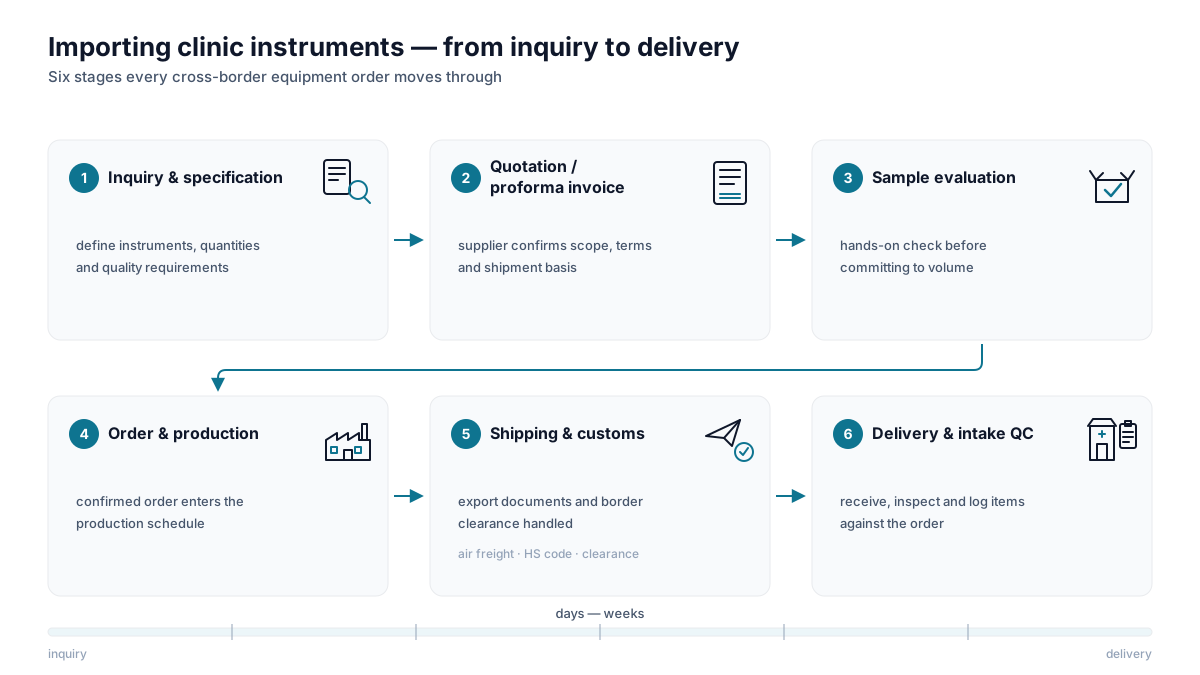
The honest answer first: dropshipping — selling medical devices you never see, hold or inspect, shipped by a third party directly to your customer — is a poor fit for this industry, and the reasons are structural rather than bureaucratic. The model deliberately removes the seller from the physical flow of goods, but in medical devices the physical flow is precisely where a distributor’s value and responsibilities live: verifying what was shipped, tracing which lot went to which customer, handling complaints against retained records, and standing behind delivery. A seller who cannot touch the goods cannot do any of that. This article walks through why the conflict is fundamental, where the practical risks bite hardest, and which legitimate low-capital models achieve what dropshipping promises without its failure modes.
Key takeaways
- Dropshipping removes the seller from the physical flow of goods — but in medical devices the physical flow is where a distributor’s duties and value live.
- The practical risks are concrete: no incoming inspection, no lot-level traceability of your own, no real complaint handling, and customs surprises landing on your customer.
- The model’s appeal is real — low capital, no inventory — but the same leanness can be achieved legitimately through agency and referral structures.
- A commission agent, a manufacturer-referral partnership or a deliberately narrow stocking model all scale down honestly; dropshipping scales down by cutting what matters.
- Professional buyers recognise the difference immediately: a supplier who has never held the product cannot answer the questions clinics actually ask.
What dropshipping means here, precisely
In the e-commerce sense, dropshipping means listing products you do not own; when an order arrives, a supplier — often the manufacturer, often abroad — ships directly to your customer, and your business consists of marketing, order routing and the margin in between. For t-shirts and phone cases the model is merely competitive; the goods are simple, failures are cheap and returns are trivial. The question this article answers is what happens when the same structure is applied to FUE punches, sapphire blades, implanter needles or PRP tubes — products that are sterile, lot-controlled, technically specified and destined for use on patients.
It is worth being precise about what the dropshipper does not have: no incoming inspection, because the goods never arrive at their premises; no stock, so no ability to check what a customer received against a retained sample; no shipping records of their own beyond a tracking number; and no packaging control, since box, labeling and documentation are whatever the upstream shipper chose. Every one of those absences becomes a concrete failure mode below.
On the regulatory side, the summary can stay short because the practical side already decides the question. In most jurisdictions, businesses that make medical devices available on the market carry defined distributor obligations — broadly, verifying that products are correctly labeled and accompanied by required documentation, ensuring appropriate storage and transport conditions, maintaining traceability records, and operating a complaint and recall process. A seller who never sees the goods cannot perform most of these duties in any meaningful way, which is the structural conflict in one sentence. How these obligations apply to any specific setup is jurisdiction-dependent and belongs with qualified advice in the target market — this article deliberately stays general.
Where the model actually breaks
Lot control and traceability. Ask the decisive question: a manufacturer notifies you of a problem with a specific lot — which of your customers received it? A stocking distributor answers from records built at goods-in and goods-out. A dropshipper has a list of orders and a stack of third-party tracking numbers; the connection between customer and lot exists, if at all, in someone else’s system in another country. The same failure runs forward: a clinic reports a defect and asks whether their other deliveries came from the same batch, and the dropshipper simply does not know.
Quality and incoming inspection. Serious buyers inspect incoming goods against retained reference samples — edge condition, dimensions, packaging integrity, sterility indicators, documentation. A dropshipper performs no inspection, retains no references, and discovers quality drift only when a customer complains. In effect, the clinic becomes the dropshipper’s quality department, unpaid and uninformed. In a market where reputation moves between surgeons faster than any marketing, that arrangement has a short life expectancy.
Complaints, returns and recalls. When a delivery is wrong, damaged or defective, a stocking supplier swaps it from shelf today and argues with the factory afterwards — that sequence is much of what the distributor margin pays for, as the comparison of manufacturer versus distributor buying lays out from the clinic’s side. The dropshipper can only relay the complaint upstream and hope; they hold no replacement stock, control no returns address in the customer’s country, and in a recall would be forwarding other people’s emails while the clock runs.
Customs and the import position. Cross-border dropshipping quietly makes the customer the importer: the clinic receives a parcel from abroad and with it, potentially, the customs formalities, import charges and border delays the seller’s website never mentioned. Professional buyers notice who actually shipped, from where, and who handled the border. Everything a real importer manages deliberately — documentation, classification, landed cost, broker relationships, all covered in the import from Turkey guide — the dropshipping model leaves to chance and to the buyer.
The commercial verdict of buyers. Set regulation aside entirely and the model still fails on sales grounds. Clinics ask suppliers concrete questions: how this punch’s edge holds across a session, which gauge pairs with which grafts, what the delivery time is when stock runs out mid-week. A seller who has never held the product, visited the factory or run an evaluation answers none of them convincingly. The knowledge deficit is audible in the first serious conversation — and the first serious conversation is where medical supply relationships are won or lost.
Why the model tempts anyway — and the honest alternatives
The appeal deserves an honest statement rather than a sneer: dropshipping promises market entry without inventory capital, without warehouse operations and without import complexity — and for a founder testing demand, those are rational things to want. The error is not the goal of leanness; it is the method, which achieves leanness by silently deleting the responsibilities that make a medical supplier trustworthy. The good news is that legitimate structures deliver most of the same leanness with none of the deletion.
| Model | How it works | Who holds stock and duties | What it suits |
|---|---|---|---|
| Dropshipping | You sell; a third party ships direct to your customer | Formally unclear in practice — the core problem | Poor fit for medical devices on every axis examined here |
| Commission agency | You broker orders openly in the manufacturer’s name for a commission | The manufacturer, transparently | Low-capital entry that converts sales skill into income honestly |
| Referral partnership | You introduce qualified buyers; the manufacturer transacts directly | The manufacturer | Consultants and content-led businesses monetising reach without trading |
| Narrow stocking distribution | You stock a deliberately short list deeply and fulfil from your own shelf | You, at small and controlled scale | Founders committed to building a real distribution business |
The commission agency is dropshipping’s honest sibling. You represent a manufacturer openly, develop customers, and earn commission on orders the manufacturer fulfils and invoices directly — the goods flow is transparent, duties sit visibly with the party holding the goods, and your capital requirement is essentially your selling time. Many durable distribution businesses started exactly here, converting to stocking distribution once commission income proved the demand.
The referral partnership goes one step lighter: you introduce qualified buyers to a manufacturer and are compensated for introductions, with no role in the transaction. It suits consultants, trainers and content platforms with clinic reach, and it is a clean way to monetise trust without pretending to be a supplier.
The narrow stocking model attacks the capital problem from the other side: instead of eliminating inventory, shrink it. A dozen SKUs of proven fast movers, stocked deeply, from one evaluated manufacturer, serving one customer segment — that is a real distribution business at minimal scale, with real inspection, real traceability and real accountability. The build sequence — niche, supplier evaluation, capital sized to the payment gap, evaluation-led first customers — is described step by step in the related guide to starting a medical supply business, and the sourcing mechanics live in the sourcing and import hub.
The buyer’s side: recognising dropshipped supply
Clinics and purchasing teams reading this from the other side of the counter can screen for the model with a few practical checks, because dropshipped supply announces itself to anyone looking. The shipping pattern is the first tell: goods that arrive direct from a foreign sender under a different company’s name, with the seller appearing nowhere on carton or paperwork, mean your supplier never touched the delivery. Documentation is the second: a stocking supplier can produce lot records tied to your deliveries and answer, quickly, which batch you received last quarter — hesitation or silence on that question is informative. The sample and evaluation posture is the third: a supplier who cannot offer a structured sample process, discuss specification details from first-hand knowledge, or name their own incoming-inspection criteria is reselling blind. And the catalog shape is the last: implausibly broad ranges at implausibly low prices, spanning categories no small company could stock, describe a listing operation rather than a warehouse.
None of these checks requires confrontation — they are ordinary due-diligence questions any professional supplier answers comfortably, which is precisely what makes them useful. Asking them costs one email and sorts the market cleanly; a buyer who asks them of every new supplier will rarely be surprised by a delivery again.
Choosing honestly
The choice between these models is really a choice about what business you are building. If the goal is income from sales ability without capital, be an agent and say so — manufacturers value good agents and clinics respect the transparency. If the goal is a durable trading company whose margin is defended by service and reliability, start stocking at whatever scale your capital honestly supports, and grow the list as reorders fund it. What does not work is the middle position: presenting yourself to clinics as their supplier while being, operationally, a forwarding service for goods you have never seen. The market identifies that position quickly, and in a specialty this small it is identified permanently. Lean is a legitimate strategy; hollow is not.
Frequently asked questions
Is dropshipping medical devices illegal?
This platform does not give legal advice, and the answer genuinely varies by jurisdiction and setup. The reliable general statement is structural: most markets place duties on device distributors — labeling verification, traceability, complaint handling — that a seller who never possesses the goods cannot meaningfully perform. Whether a specific arrangement is lawful in a specific market is a question for qualified local advice.
Why does dropshipping work for consumer goods but not medical devices?
Because the risk asymmetry is different. A defective consumer gadget costs a refund; a defective sterile instrument reaches a patient procedure. Medical supply therefore runs on inspection, lot traceability and accountable complaint handling — exactly the functions dropshipping is designed to eliminate. The model’s efficiency comes from cutting what this industry cannot do without.
What is the cheapest legitimate way to enter medical device sales?
A commission agency or referral partnership: represent a manufacturer transparently, develop customers, earn commission on orders the manufacturer fulfils directly. Capital requirement is close to zero, the goods flow is honest, and the customer relationships you build convert naturally into a stocking distribution business later if you want one.
Can I dropship just to test demand before investing in stock?
Test demand without shipping products you cannot stand behind: run a commission or referral arrangement with the manufacturer fulfilling transparently, or presell against a small first stock order of one or two SKUs. Both give you real demand data. Testing with dropshipped medical devices means testing on customers who believe they have a supplier — and discovering otherwise at the first problem.
How much stock does a minimal real distribution setup need?
Less than founders fear: a deliberately short list — often a dozen or so SKUs of fast-moving consumables from one evaluated manufacturer — stocked deeply enough to promise availability to a small first customer group. The point is not volume but control: goods you receive, inspect, store and ship yourself, with records that let you answer the lot question.
Do manufacturers agree to agency and referral models?
Many do, particularly with partners who bring genuine customer access in a defined segment. Manufacturers gain market reach without appointing an unproven stocking distributor; you gain income and market learning without inventory risk. The terms belong in writing — commission basis, customer ownership, territory — like any distribution relationship.
Related articles
How to Start a Medical Supply Business: A Realistic Guide
A realistic guide to starting a medical supply business: why the niche decides everything, why supplier relationships come before customers, what working capital the model really consumes, and the failure modes that end most attempts.
Buying Direct from a Manufacturer vs a Distributor: An Honest Comparison
A clinic buyer's comparison of direct-from-manufacturer and distributor purchasing: where the price gap really comes from, what distributors genuinely add, and the volume point where direct sourcing starts to win.
Importing Hair Restoration Instruments from Turkey: A Practical Guide
Why Turkey became a manufacturing base for hair-restoration instruments, and the practical import mechanics — Incoterms, customs documents, duty and VAT logic — for buyers in the EU, UK and Gulf.