
HS Codes for Hair Transplant Instruments and Supplies
A heading-level HS/CN classification reference for the hair-restoration product basket: instruments, consumables, equipment and hair-care products, with the pitfalls that cause misclassification.
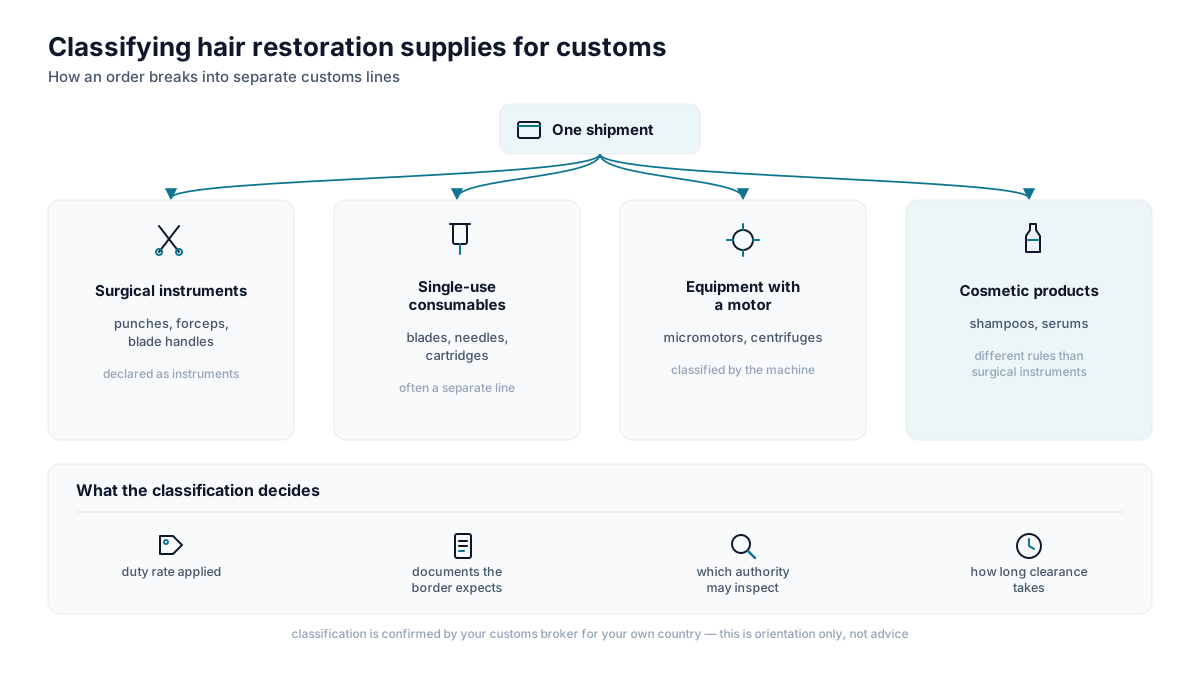
Most hair-transplant instruments — punches, implanters, forceps, surgical blades — classify under HS heading 9018 (instruments and appliances used in medical or surgical sciences), typically subheading 9018.90, while the wider clinic basket scatters across a dozen other headings: centrifuges in 8421, sterilisers in 8419, gloves in 4015, drapes in 6307, hair-care products in 3305 and supplements in 2106. The table below maps the basket at the 4–6-digit level that is harmonised internationally. Final classification is set at 8–10 digits by your national tariff (the Combined Nomenclature in the EU, national schedules elsewhere) and must be confirmed with your customs broker before the first shipment.
Why the code matters
The HS code on each invoice line determines the duty rate, feeds the import VAT calculation, drives risk profiling (how likely the shipment is to be inspected), gates preferential treatment under trade agreements, and populates the trade statistics your regulators see. A wrong code is not a formality error: underpaid duty is recoverable with penalties years later, and a code that misdescribes goods can void the preference claimed under an origin certificate. Classification is legally the importer's responsibility — the exporter's code on the invoice is a starting point, not an authority.
Reading a code is simple: the first two digits are the chapter (90 — optical, measuring, medical instruments), four digits the heading (9018 — medical instruments and appliances), six digits the internationally harmonised subheading (9018.90 — other instruments and appliances). Beyond six digits, countries diverge: the EU's Combined Nomenclature adds two digits (CN, 8 digits) plus TARIC measures at 10, and other jurisdictions maintain their own splits. That is why this table stops at six digits — everything beyond is national, and exactly the conversation to have with your broker.
Classification table
Source: WCO Harmonized System nomenclature (HS 2022); EU Combined Nomenclature. Headings verified at chapter/heading level; subheadings shown are the typical classification for the product as described.
| Product group | HS heading | Typical subheading | Notes |
|---|---|---|---|
| FUE punches (manual and motor-compatible) | 9018 | 9018.90 | Medical instruments, "other"; applies to sterile disposable and reusable punches alike |
| Sapphire and steel incision blades (surgical) | 9018 | 9018.90 | Dedicated surgical blades classify as medical instruments, not as knives of Chapter 82 |
| DHI implanter pens | 9018 | 9018.90 | Complete pens; spare implanter needles may fall under 9018.32 as tubular metal needles |
| Syringes, with or without needles | 9018 | 9018.31 | Includes irrigation and injection syringes used chairside |
| Injection and tubular metal needles | 9018 | 9018.32 | Cannulas and needle consumables |
| PRP blood-collection tubes | 9018 | 9018.39 | Classification contested in practice — see pitfalls below; rulings also exist under glassware (7017) and plastic labware (3926) |
| Centrifuges (PRP preparation) | 8421 | 8421.19 | Centrifuges "other" — laboratory-type units |
| Autoclaves and medical sterilisers | 8419 | 8419.20 | Medical, surgical or laboratory sterilisers have a dedicated subheading |
| Operating tables, treatment chairs, clinic furniture | 9402 | 9402.90 / 9402.10 | Medical furniture; chairs with adjustment mechanisms (barber-type) under 9402.10 |
| Surgical and examination luminaires | 9405 | — | Luminaires; national splits vary widely — confirm with broker |
| Surgical gloves, rubber | 4015 | 4015.12 | HS 2022 created a dedicated line for medical-use rubber gloves; plastic gloves fall under 3926.20 |
| Drapes and gowns, nonwoven textile | 6307 | 6307.90 | Made-up textile articles; single-use nonwoven sets commonly here |
| Drapes and covers, paper/cellulose | 4818 | 4818.90 | Paper-based disposables classify in Chapter 48, not 63 |
| Gauze, dressings, wadding | 3005 | 3005.90 | Dressings put up for medical/surgical use |
| Post-transplant shampoos | 3305 | 3305.10 | Preparations for use on the hair — shampoos |
| Hair serums, lotions, sprays (cosmetic) | 3305 | 3305.90 | Other hair preparations; cosmetic classification assumes cosmetic claims |
| Hair vitamins and food supplements | 2106 | 2106.90 | Food preparations n.e.s.; high-purity single vitamins can shift to 2936 |
| General-purpose scissors and hand tools (non-surgical) | 8213 / 8205 / 8214 | — | Only for genuinely non-medical tools; instruments made for surgical use belong in 9018 |
Common misclassification pitfalls
Everything is not 9018. Because 9018 often carries favourable duty treatment, the temptation is to sweep the whole shipment under it. Customs authorities know this pattern; gloves, drapes, furniture, shampoos and centrifuges each have their own homes, and a mixed invoice classified entirely as 9018.90 is an inspection trigger.
PRP tubes are genuinely ambiguous. Evacuated blood-collection tubes have attracted divergent rulings — as medical appliances (9018.39), as laboratory glassware (7017), or as plastic labware (3926) depending on construction and jurisdiction. Ask your broker whether a binding tariff ruling exists in your market; for regular volume, obtaining one yourself is cheap insurance.
Kits and sets. An aftercare kit combining shampoo, serum, spray and a printed guide is classified under the general rules for sets — usually by the component giving the set its essential character — not item by item. The same question arises for surgical kits. Agree the treatment with your broker before, not after, the first entry.
Claims change chapters. A serum marketed with therapeutic claims can slide from cosmetics (3305) toward medicaments (Chapter 30), with different duty, VAT and regulatory consequences. Classification follows the product as presented — labels, claims and packaging included.
Codes for your likely basket in hand, the practical import mechanics — Incoterms, documents, duty and VAT flow — are covered in the import from Turkey guide, the commercial sequence in the supplier payment terms guide, and the wider procurement context in the sourcing and import hub.
Frequently asked questions
What HS code covers FUE punches and hair transplant instruments?
Heading 9018 — instruments and appliances used in medical or surgical sciences — with most hand instruments falling under subheading 9018.90. Syringes classify under 9018.31 and tubular metal needles under 9018.32. The final 8–10-digit code depends on your national tariff and should be confirmed with your customs broker.
Are the 6-digit codes in this table the same in every country?
Yes — the Harmonized System is internationally standardised to six digits, so heading and subheading match worldwide. Beyond six digits each jurisdiction adds its own splits (the EU's Combined Nomenclature at 8 digits, TARIC at 10, national schedules elsewhere), and duty rates attach to those national lines, which is why broker confirmation is essential.
Who is legally responsible for the HS code on an import?
The importer of record — not the exporter whose code appears on the invoice. If a code is wrong, the importer answers for underpaid duty, penalties and any voided preference claims, typically with a multi-year look-back. Treat supplier-provided codes as a useful draft and have your broker validate the basket once, in writing, before the first shipment.
How can I get certainty for a product that could fit two codes?
Request a binding ruling from your customs authority — in the EU, Binding Tariff Information (BTI), with equivalents in the UK and most GCC states. A ruling fixes the classification for that product for several years, is usually free or inexpensive, and is worth obtaining for any ambiguous, high-volume line such as PRP collection tubes.
Request the wholesale catalog
Building an import basket and want specifications alongside the customs data? Request the wholesale catalog — product specs, packaging formats and export documentation details for the full instrument and consumable range.
Related articles
Importing Hair Restoration Instruments from Turkey: A Practical Guide
Why Turkey became a manufacturing base for hair-restoration instruments, and the practical import mechanics — Incoterms, customs documents, duty and VAT logic — for buyers in the EU, UK and Gulf.
Sourcing & Import: Buying Medical Instruments Across Borders
The commercial mechanics of importing hair restoration instruments — customs, MOQs, samples, payment terms and how to evaluate a supplier before committing.
Payment Terms with Medical Instrument Suppliers: Proforma, T/T and LC
How payment actually works when buying instruments internationally: the proforma invoice flow, common T/T split structures, when a letter of credit earns its cost, and the red flags that should stop a transfer.