
Buying & Distributing Hair Transplant Instruments in the USA
The United States is the world's largest hair-restoration procedure market — but it behaves like fifty adjacent markets with two strong channels, and its litigation-and-insurance culture makes documentation a core part of the product.
The United States is the largest hair-restoration procedure market in the world, and the first thing its size does is mislead. There is no single American market to enter: practice rules, business structures and buying behaviour shift from state to state, purchasing splits between vigorous direct channels and equally vigorous distribution, and the one truly national constant is a documentation culture — shaped by litigation and insurance — that turns paperwork quality into a genuine competitive feature. Suppliers who plan for plurality do well here; suppliers who arrive with a single national playbook discover they have brought one key for fifty different locks.
Key takeaways
- Medical devices in the US are regulated by the FDA, and applicable clearance and registration requirements precede market entry.
- The practice landscape is state-fragmented: who may own clinics and perform procedures varies, so clinic types and buying patterns differ by state.
- Direct sales and distribution are both strong channels — many US clinics happily buy from manufacturers online, while others buy only through established distributors.
- Litigation and insurance culture drives documentation expectations: traceability, IFUs, certificates and vendor paperwork are evaluated, not filed.
- Payment runs fast by global standards — cards and ACH dominate — but vendor onboarding at larger buyers can be slow and form-heavy.
Who regulates what
Medical devices in the United States fall under the FDA, the federal Food and Drug Administration. Applicable FDA requirements — including device classification and premarket clearance where required — apply before instruments are placed on the US market, and suppliers should confirm their obligations with regulatory counsel rather than by analogy to CE marking. The practice of medicine, by contrast, is governed at state level, and that split shapes the commercial landscape far more than most foreign suppliers expect.
Fifty practice environments, not one
State law decides who may own a medical practice, how physicians may employ or supervise clinical staff, and what non-physician practitioners may do. Several states enforce corporate-practice-of-medicine doctrines that keep clinic ownership physician-centred; others permit structures that look almost retail. The result is real variety in who your end customer is: solo surgeon practices, dermatology groups running hair restoration as a service line, franchise-style restoration brands operating across multiple states, and med-spa-adjacent businesses whose scope depends entirely on local rules.
For a supplier this is market-sizing information, not trivia. The states with the deepest clinic scenes — with large metropolitan clusters in the Northeast, Florida, Texas and California — differ in clinic composition, and a distributor strong in one region may have no footprint in another. Territory maps in US distribution agreements deserve unusual scrutiny for exactly this reason; our guide to distribution agreement terms covers how to define coverage in performance terms rather than geography alone.
Two channels, both real
Most markets profiled in this series lean clearly toward either direct sales or intermediated distribution. The US genuinely runs both at scale. On one side, American clinics are the world's most comfortable direct buyers: ordering instruments from a manufacturer's e-commerce store, by email quote or through a sales rep is unremarkable, and smaller practices routinely purchase this way on a credit card. On the other side sit distributors — from national medical-surgical houses for commodity consumables to specialty aesthetic and hair-restoration distributors whose reps own deep clinic relationships — and many group practices and franchise brands buy exclusively through them, valuing consolidated invoicing, next-day logistics and a single accountable vendor.
Between those poles sits a third structure that barely exists in Europe: the independent sales rep. American aesthetic and surgical sales runs to a significant degree on commission-based independent reps and small rep agencies who carry several complementary lines into the clinics they know, without taking ownership of inventory. For a foreign manufacturer, rep networks can be a capital-light way to get feet on the ground in a target region before committing to a stocking distributor — though reps sell what sells easily, so a line that needs missionary work and training will still need your own investment behind it.
The practical consequence: channel strategy in the US is an "and" decision, not an "or" decision, and the design question is conflict management. Set clear rules about which accounts are house accounts, keep pricing coherent across channels, and expect your distributors to notice — quickly — if your direct channel undercuts them. The trade-offs are mapped in our comparison of buying from manufacturers versus distributors, which is equally useful read from the seller's side.
| Buyer type | Typical channel | What wins the account |
|---|---|---|
| Solo and small practices | Direct online or specialty distributor | Ease of ordering, fast shipping, card payment |
| Dermatology and surgical groups | Distributor, some direct | Vendor onboarding competence, documentation, consolidated supply |
| Multi-state restoration brands | Negotiated direct or national distributor | Pricing at volume, uniform supply across sites, contract terms |
The litigation dividend: documentation as product
America's malpractice-litigation and insurance environment shapes purchasing in a way that surprises suppliers from gentler jurisdictions. Clinics document defensively as a matter of habit, and they expect their suppliers to make that easy. In practice this means lot-level traceability on sterile goods, clean and current IFUs, certificates of conformity or analysis available on request, clear sterility labelling, and — for larger buyers — supplier questionnaires, certificates of insurance and W-9 tax forms before the first purchase order can even be issued. None of this is exotic, but it is checked: a missing document stalls an order in a way a price difference would not. Our sterility and packaging guide covers the labelling and documentation layer that US buyers scrutinise most closely.
Treat vendor onboarding at group buyers as its own sales stage with its own timeline. The clinic may love the product in week one and issue the first PO in week ten, after procurement, compliance and accounts payable have each had their turn. This is normal, not a lost deal.
Where demand actually forms
American hair-restoration purchasing is unusually education-driven. The specialty's professional life runs through societies, congresses and hands-on workshops — ISHRS meetings being the best-known gathering point — and the surgeons who teach at those events shape instrument preferences across the market to a degree no advertising budget matches. A punch or implanter that a respected workshop faculty member uses in front of forty attending physicians has just done its year's marketing. For suppliers this sets a clear priority order: presence at the specialty's meetings, relationships with teaching surgeons, and instruments in the hands of fellowship and training programmes come before display advertising, and usually before distributor recruitment too.
The same logic extends to content. American clinic buyers research seriously before purchasing — comparing specifications, reading independent material, asking peers in private forums — and a supplier whose technical documentation answers real questions earns trust that a brochure cannot. This is a market that rewards being genuinely useful in public.
Import, money and the pace of payment
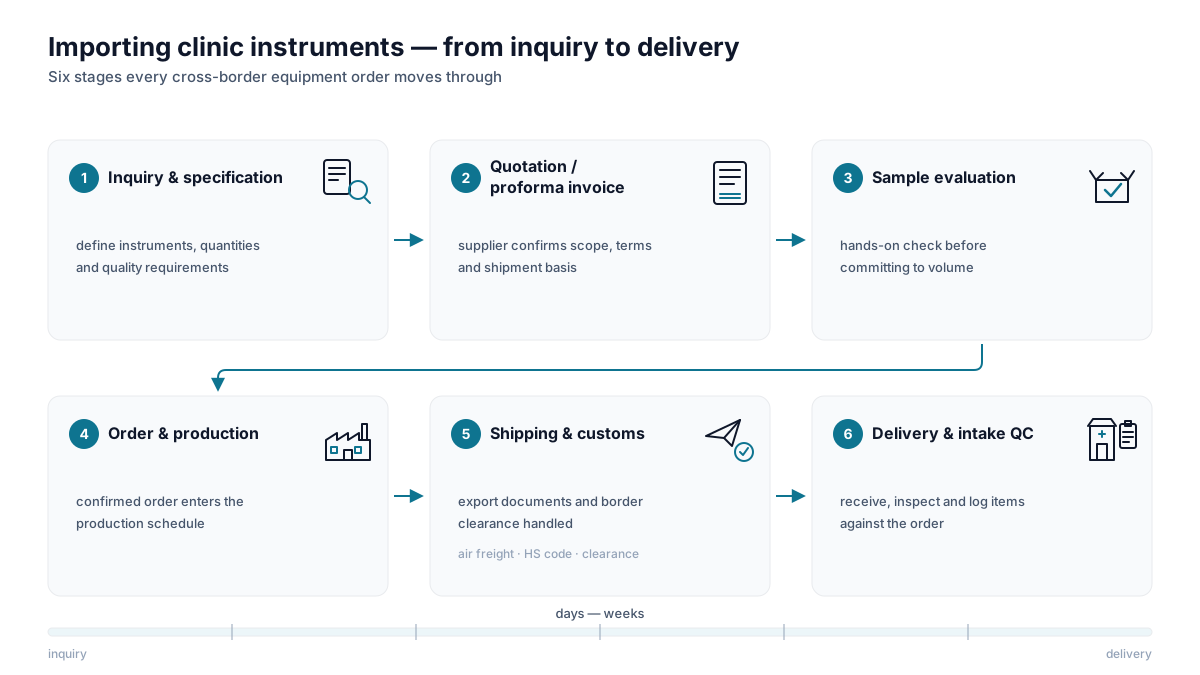
Inbound logistics are those of a classic third-country import: entry through US Customs and Border Protection with a customs broker handling filing, and FDA-regulated goods subject to review at the border — reason enough to keep product codes, classifications and paperwork immaculate on every shipment. Freight itself is easy; the US is served by every major carrier, and domestic distribution infrastructure is excellent once goods are in.
Payment culture is the fastest in this series. Credit cards are a normal B2B instrument at the small-practice end — build card fees into pricing rather than fighting the habit — while ACH transfers and net-30 terms dominate with larger buyers; cheques still appear from smaller practices, a quirk that startles European finance teams but clears reliably. Currency risk is nil for dollar-denominated sellers and the dollar's dominance simplifies pricing globally. One structural note: there is no national VAT, but state and local sales-tax rules apply to sales into many states, and remote-seller obligations can arise once volumes grow — a bookkeeping matter to raise with a US accountant early rather than late.
Sequenced sensibly, a US entry usually looks like this: confirm the regulatory footing for each device with counsel; assemble the documentation pack American buyers will request before they request it; pick one or two beachhead regions with dense clinic scenes rather than declaring national coverage; open a direct channel for the small-practice segment while courting reps or a specialty distributor for the rest; and let congress presence compound year over year. The suppliers who struggle here are rarely beaten on product — they are beaten on patience, paperwork or channel discipline. Broader groundwork on structuring entry into foreign markets sits in our sourcing and import hub.
Frequently asked questions
Can a foreign manufacturer sell directly to US clinics?
Yes, subject to meeting applicable FDA requirements for the devices in question. US clinics are unusually comfortable buying direct — online, by quote or through reps — though many group practices and franchise brands purchase only through distributors, so most suppliers end up running both channels.
Does CE marking help in the United States?
Not as a market-access credential. The US operates its own FDA framework rather than recognising the CE mark, so confirm classification and clearance obligations for your specific devices with regulatory counsel before planning entry.
Why does US vendor onboarding take so long?
Larger buyers route new suppliers through procurement, compliance and accounts-payable checks — questionnaires, certificates of insurance, W-9 forms and documentation review — before a first purchase order. It reflects the litigation and insurance environment, and it is a stage to plan for, not a signal of fading interest.
How do US clinics usually pay?
Small practices pay readily by credit card; larger buyers use ACH transfer on net-30 terms, and cheques still circulate at the small end. Payment is fast by global standards once onboarding is complete — the delay lives in paperwork, not in settlement.
Do I need a distributor for every state?
No, but assume no single partner covers the whole country well. Clinic density and composition vary by state, and distributor strength is regional; define territories by named accounts and performance commitments rather than by lines on a map.
Related articles
Sourcing & Import: Buying Medical Instruments Across Borders
The commercial mechanics of importing hair restoration instruments — customs, MOQs, samples, payment terms and how to evaluate a supplier before committing.
Distribution Agreement Terms: The Clauses That Decide Whether the Deal Works
A clause-by-clause walk through medical device distribution agreements: territory and exclusivity, minimum commitments, pricing structure, marketing obligations, IP use, termination and the post-term provisions most first-time distributors overlook.
Buying Direct from a Manufacturer vs a Distributor: An Honest Comparison
A clinic buyer's comparison of direct-from-manufacturer and distributor purchasing: where the price gap really comes from, what distributors genuinely add, and the volume point where direct sourcing starts to win.
Instrument Sterility and Packaging: A Buyer's Guide
What clinic buyers need to know about sterile and non-sterile supply formats, sterile barrier packaging, sterilisation methods, receipt inspection, shelf life and storage.