
Switzerland: Buying & Distributing Hair Transplant Instruments
What makes Switzerland different for instrument buyers and suppliers: a real customs border with the EU, Swissmedic oversight, three business languages, CHF invoicing and a small-volume, high-margin clinic market.
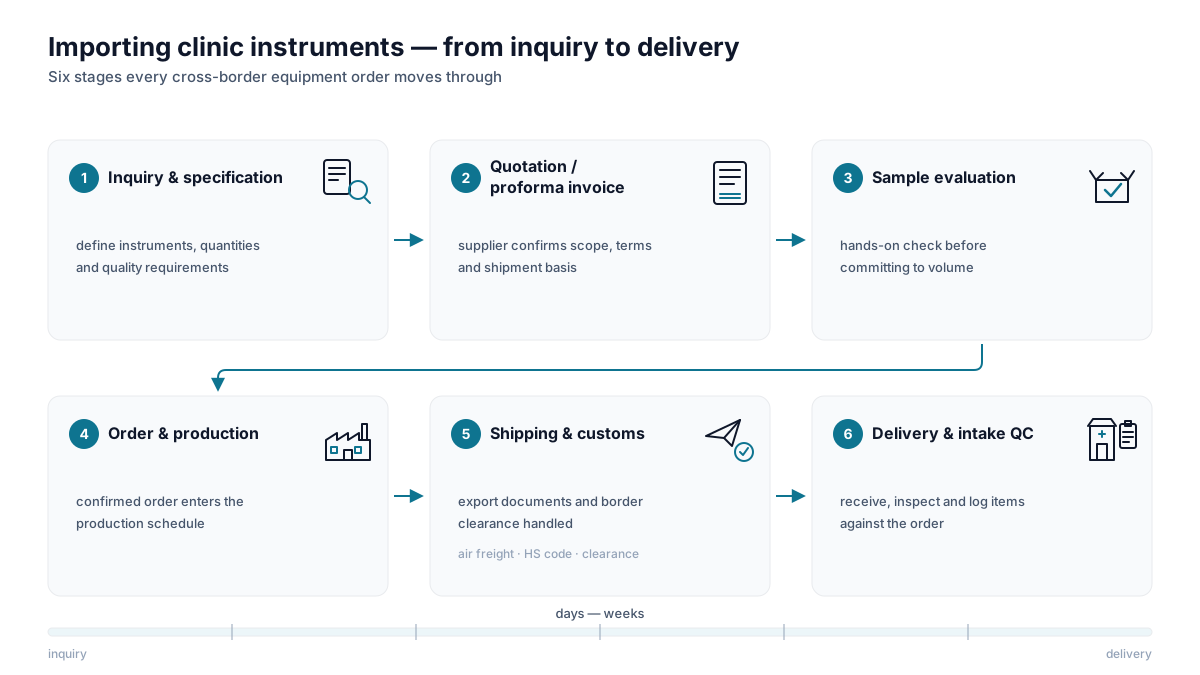
Switzerland is the European market where the border is real: it sits outside the EU, so every shipment — even from Germany next door — is an export followed by an import, with customs declarations and Swiss VAT at the frontier. The compensation is one of the world's most attractive clinical markets per unit sold: small volumes, high prices, exacting quality expectations, and buyers who pay promptly in Swiss francs.
Key takeaways
- There is no single market shortcut: EU goods entering Switzerland need export and import clearance, though Switzerland's abolition of industrial tariffs has removed duty from most industrial goods.
- Swiss import VAT is charged at the border and structures the cash flow of every shipment; DDP-style convenience terms need careful VAT wording.
- Swissmedic is the authority, and Swiss rules apply in their own right — including the Swiss authorised representative construct for foreign manufacturers.
- The market is small-volume, high-margin: price resistance is low, but tolerance for quality or service lapses is close to zero.
- Switzerland is three language markets in one — German, French and Italian — and B2B coverage plans should say which of them they actually serve.
The border, in practice
Treat every Swiss order as an international shipment, because legally it is one. A consignment from an EU warehouse to a Zurich clinic requires an EU export declaration, carriage under a transit or courier procedure, and a Swiss import declaration on arrival; the same applies in reverse for returns and repairs, which is worth remembering before promising casual exchange logistics. Two features soften the picture considerably. First, Switzerland has abolished customs duties on industrial goods, which removes tariff cost from most instrument and equipment lines regardless of origin — one of the corridor's genuine simplifications. Second, the Swiss customs system is fast, digital and predictable; clearance is measured in hours, not days, when paperwork is clean.
What the border does still extract is Swiss import VAT, assessed on the value of the goods plus transport, and payable at import before recovery through the Swiss VAT system by registered businesses. This is a cash-flow fact more than a cost fact, but it decides commercial structures: a foreign supplier selling "delivered" to Swiss clinics must resolve who acts as importer and how VAT is handled, and vague DDP promises cause exactly the disputes you would expect. Classification works on the same HS logic as everywhere — the HS code reference applies — and shipments from Turkey follow the standard third-country mechanics described in the import-from-Turkey guide, with Switzerland substituted as the destination customs territory.
| What changes at the Swiss border | Intra-EU shipment | Shipment into Switzerland |
|---|---|---|
| Customs declarations | None | EU export + Swiss import entry |
| Customs duty | None | None on industrial goods (tariffs abolished) |
| VAT treatment | Reported through EU VAT system | Swiss import VAT collected at the border |
| Typical clearance friction | Zero | Low, but paperwork-dependent |
| Returns and repairs | Informal | Formal re-export/re-import procedures |
A note on carriers, because mode choice matters more here than inside the EU. Integrated couriers handle the double clearance invisibly and are the right tool for samples, urgent top-ups and low-line-count parcels; their weakness is the automated customs entry, which handles a mixed invoice of instruments, consumables and care products crudely. Once shipments become regular, a forwarder with Swiss clearance capability — or a Swiss-side broker receiving consolidated freight — gives control over classification and VAT treatment, and typically lowers landed cost per unit. Whichever mode carries the goods, invoice discipline is the whole game at this border: line-level descriptions, values and consistent HS codes are what keep Swiss clearance in the hours-not-days category.
Swissmedic and Swiss rules
Since the lapse of the mutual-recognition arrangement between Switzerland and the EU for medical devices, Switzerland applies its own device rules rather than accepting EU market access automatically. Swissmedic is the competent authority, and foreign manufacturers placing devices on the Swiss market need a Swiss authorised representative (CH-REP) under Swiss requirements. Confirming current requirements for a specific product with Swissmedic or a Swiss regulatory adviser is a standing part of entering this market; the procedural detail is beyond this guide's scope.
Small volume, high margin, zero patience
Commercially, Switzerland behaves like a boutique. The domestic procedure market is modest in absolute size — a population smaller than many single EU regions, spread across cantons — but its clinics operate at some of the highest price points in the world, serving a wealthy domestic clientele plus an international patient flow drawn to Swiss medicine's reputation for discretion and precision. Price resistance at the instrument level is accordingly low: a few francs more per punch or blade is invisible inside a Swiss procedure fee, and buyers know it.
What replaces price sensitivity is an almost architectural expectation of quality and service. Swiss buyers expect instruments to arrive exactly as specified, exactly when promised, in packaging that survives inspection by people who inspect things for a living. They expect defects to be acknowledged immediately and replaced without negotiation. And they expect the supplier's administration — invoices, customs paperwork, correspondence — to be as precise as the product. A supplier who meets that bar can hold Swiss accounts for a decade at margins unavailable anywhere else in Europe; a supplier who misses it twice is done. Plan the economics accordingly: Switzerland is not a volume play, it is a reference and margin play, and a handful of satisfied Zurich or Geneva clinics is the entire prize.
Three languages, one country, several markets
Switzerland's linguistic geography is commercial geography. The German-speaking region — Zurich, Basel, Bern and most of the country's economic weight — operates in High German for documents with Swiss German in the room; the French-speaking Romandie around Geneva and Lausanne expects French; Ticino works in Italian. These are not preferences but parallel business cultures: a supplier "covering Switzerland" from Germany typically covers German-speaking Switzerland and leaves the Romandie — with its internationally connected Geneva clinic scene — under-served. French-language documentation and a francophone contact are the difference between claiming the whole country and actually selling in it. English, meanwhile, is widely workable in B2B, particularly in the international clinic segment, but clinical end-users still expect instructions in their own region's language.
Sequencing a Swiss entry
The efficient order of operations differs from an EU launch precisely because of the border. Start with the structural decisions, not the sales calls: who will act as importer of record, who fills the Swiss representative role, and whether stock will sit inside Switzerland. These answers change what you can promise a clinic, so they come first — a Swiss buyer's earliest questions are about delivery time and returns handling, and "we will figure out customs later" ends conversations politely and permanently.
With the structure settled, sample into the market by courier; the parcel channel's bundled clearance makes early sampling as easy as anywhere in Europe, and Swiss clinics evaluate samples seriously and reply with usable technical feedback. Then concentrate on a small number of reference accounts in one language region — usually Zurich or Geneva, depending on where your coverage is credible — before claiming the national market. Swiss professional circles are compact, cantonal, and well connected across specialties; a genuine reference in one city carries surprising weight in the others, and an overpromised launch carries equally far. Finally, revisit pricing with the border in the calculation: landed cost into Switzerland includes clearance fees and VAT cash-flow, but the market's price levels absorb properly structured costs without strain. The mistake to avoid is not overpricing — it is underinvesting in the setup and leaking the margin into per-shipment improvisation.
Distribution and payment customs
Swiss distribution favours specialised national players: the country's size makes a single competent distributor with stock inside Switzerland the natural structure, and holding stock domestically is a genuine service argument here, since it moves the customs border upstream of the clinic entirely. Direct supply from abroad works for sophisticated buyers who import routinely, but each such account carries the VAT-and-clearance conversation described above. For most foreign manufacturers, the decision tree is short: find one strong Swiss partner covering at least the German- and French-speaking regions, agree who acts as importer and CH-REP, and let them own the border.
Payment customs are a bright spot. Invoicing is in Swiss francs — quoting in euros signals a supplier who has not committed to the market, and shifts FX risk onto the buyer, which is noticed — and settlement runs through Swiss bank transfer against the QR-bill invoice format that has become the national standard. Payment discipline is excellent by any international comparison; net terms around thirty days are honoured, and prepayment requests after the first orders read as unfamiliarity with the market. The commercial guides in the sourcing and import hub apply here with one Swiss amendment: precision in the paperwork is not an administrative virtue, it is the sales pitch.
Frequently asked questions
Is there customs duty on instruments imported into Switzerland?
Generally no. Switzerland has abolished customs duties on industrial goods, which covers most instruments and clinic equipment regardless of origin. Customs declarations are still required on both the EU export and Swiss import side, and Swiss import VAT is collected at the border, so the process is duty-free but not formality-free.
Can an EU distributor simply ship to Swiss clinics like to any EU customer?
No. Every consignment needs an EU export declaration and a Swiss import entry, someone must act as importer of record, and Swiss import VAT must be handled explicitly. Couriers bundle these steps for parcel shipments, which works for samples and small orders; regular volume deserves a deliberate setup, often via a Swiss partner holding stock domestically.
Who regulates medical devices in Switzerland?
Swissmedic, the Swiss Agency for Therapeutic Products, is the competent authority. Switzerland applies its own medical device rules rather than automatically accepting EU market access, and foreign manufacturers need a Swiss authorised representative; current requirements should be confirmed for each product before market entry.
Should I quote Swiss customers in euros or Swiss francs?
Swiss francs. CHF invoicing is the professional norm, keeps FX risk off the buyer, and signals commitment to the market. Swiss payment behaviour is reliably prompt, typically by bank transfer against QR-bill invoices with net terms around thirty days.
Do I need French-language coverage, or does German cover Switzerland?
German covers the largest region, not the country. The French-speaking Romandie — including Geneva's internationally oriented clinic scene — expects French documentation and a francophone contact, and Ticino works in Italian. Suppliers serving Switzerland only through German structures routinely under-penetrate the French-speaking market.
Is the Swiss market worth the border friction for a small supplier?
Often yes, if approached as a margin market rather than a volume market. Volumes are small, but price points are the highest in Europe, accounts are stable, and payment is dependable. The economics work when the customs setup is done once, properly — usually through one Swiss distribution partner — rather than improvised per shipment.
Related articles
Sourcing & Import: Buying Medical Instruments Across Borders
The commercial mechanics of importing hair restoration instruments — customs, MOQs, samples, payment terms and how to evaluate a supplier before committing.
HS Codes for Hair Transplant Instruments and Supplies
A heading-level HS/CN classification reference for the hair-restoration product basket: instruments, consumables, equipment and hair-care products, with the pitfalls that cause misclassification.
Importing Hair Restoration Instruments from Turkey: A Practical Guide
Why Turkey became a manufacturing base for hair-restoration instruments, and the practical import mechanics — Incoterms, customs documents, duty and VAT logic — for buyers in the EU, UK and Gulf.