
Germany: Buying & Distributing Hair Transplant Instruments
What Germany's instrument market expects from suppliers and distributors: documentation-first buying culture, BfArM and state-level oversight, single-market logistics, and invoice-based payment customs.
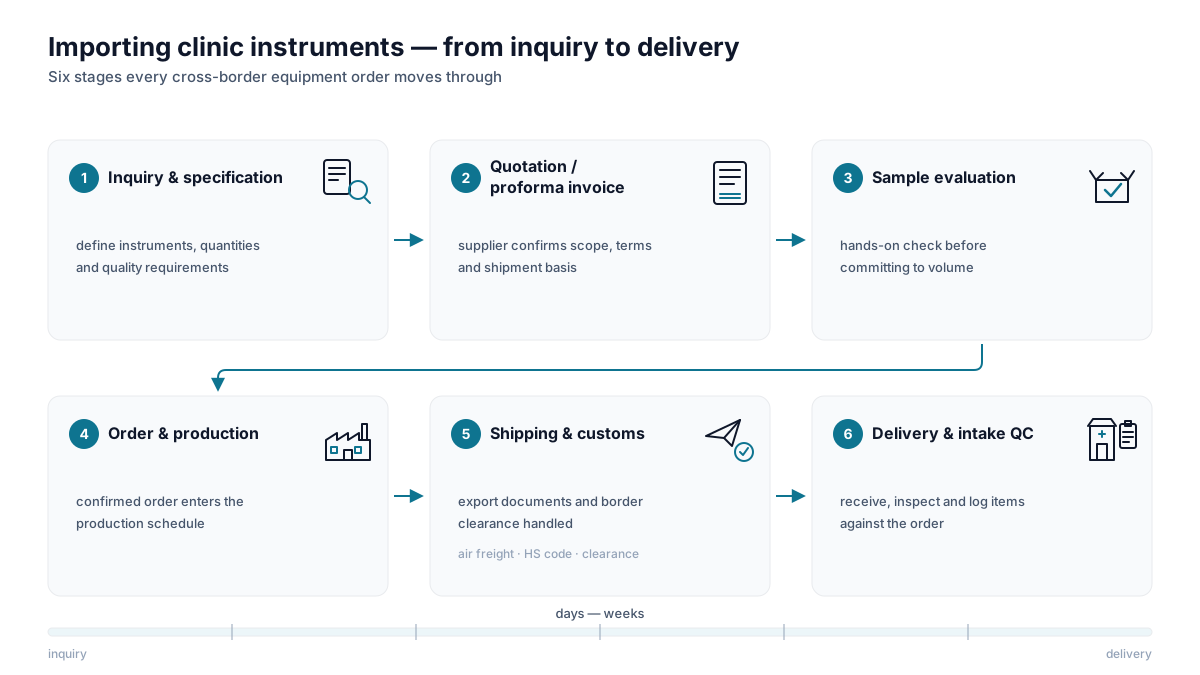
Germany is Europe's largest medical-device market and, for hair-restoration instruments, its most demanding buyer: purchase decisions are won on documentation, consistency and service before price enters the conversation. CE-marked instruments circulate freely within the EU single market, so the commercial question is not access but credibility — whether a supplier's paperwork, labelling and support meet the standard that German clinics and dealers treat as baseline.
Key takeaways
- Germany rewards preparation: complete technical documentation, German-language labelling and instructions, and responsive after-sales service count for more than aggressive pricing.
- BfArM is the federal device authority; day-to-day market surveillance of devices sits largely with the federal states.
- Inside the EU single market there is no customs border between member states — third-country goods clear once into free circulation, then move freely.
- Distribution runs through established medical dealers as much as through direct sales; German clinics prefer a domestic invoice and a German-speaking contact.
- Payment culture is invoice-based: SEPA transfer against invoice with net terms is the norm once a relationship is established.
Documentation culture decides here
Start with the trait that shapes everything else. German buyers — whether a Munich clinic ordering punches or a Rhineland dealer building a portfolio — read paperwork the way other markets read price lists. A quotation without article numbers, material specifications and packaging details reads as amateur. A delivery whose lot numbers do not match the delivery note will be queried, and a supplier who answers that query slowly will not get a second order. This is not bureaucratic theatre; it reflects how German healthcare purchasing allocates responsibility. The person who signs for incoming goods is accountable for what enters the clinic, so they buy from suppliers who make that accountability easy to carry.
For an exporter or a new distributor, the practical consequence is that the sales asset is the document pack, not the brochure. Clean commercial invoices, consistent labelling, instructions for use in German, traceable lot numbering and prompt certificates of conformity on request are what move a German account from trial to standing order. Suppliers who treat documentation as an afterthought self-select out of this market, which is precisely why the accounts, once won, tend to be loyal: the switching cost a German buyer fears most is a new supplier's unknown paperwork.
Who regulates: BfArM and the federal states
Medical devices in Germany fall under BfArM, the Federal Institute for Drugs and Medical Devices, with day-to-day market surveillance largely carried out by the competent authorities of the federal states. Instruments placed on the German market carry the CE mark under the EU Medical Device Regulation, and requirements apply to economic operators along the chain — manufacturer, importer and distributor each have defined obligations. This guide stays at that level deliberately; registration pathways and operator duties deserve their own treatment.
Import and customs: one border, then none
Germany sits inside the EU single market and customs union, which splits the import question in two. Goods already in free circulation in another member state — a shipment from a Spanish or Dutch warehouse, say — cross into Germany with no customs entry at all; intra-EU B2B trade is handled through VAT reporting rather than border formalities. Goods from outside the EU clear customs once, at whichever member-state border they enter, and then move freely. A Turkish shipment cleared in Hamburg and a Turkish shipment cleared in Rotterdam end up in the same legal position on a German shelf.
For direct third-country imports, the mechanics are standard EU practice: an EORI number, a broker-filed entry, classification per line — the HS code reference for hair transplant supplies maps the product basket — and import VAT at the German standard rate, which registered businesses recover through their normal returns. Buyers sourcing from Turkey benefit from the EU–Turkey Customs Union's duty-free treatment of most industrial goods; the import-from-Turkey guide walks the corridor end to end. Germany's dense freight infrastructure means clearance is rarely the bottleneck; supplier paperwork is.
Market character: scale with a Mittelstand backbone
Germany's procedure market is large, decentralised and quality-led. Alongside a handful of multi-site clinic chains sits a broad Mittelstand-style layer: independent dermatology and aesthetic practices, often owner-run, performing hair-restoration work with small permanent teams. That structure matters commercially. There is no single national buyer to win; there are hundreds of independent purchasing decisions, each made by a practitioner or practice manager who values continuity of supply, consistent instrument quality between lots, and a supplier who answers the phone in German.
Patient flows run in both directions. Germany generates significant outbound medical tourism to lower-cost destinations, which German clinics counter not on price but on proximity, follow-up care and accountability — an argument that depends on visibly professional standards, instruments included. Inbound, German clinics draw patients from neighbouring markets on the strength of that same reputation. Quality expectations are correspondingly unforgiving: a punch line with inconsistent edge quality between lots will be noticed, documented and dropped. The industry meets at MEDICA in Düsseldorf, which remains the natural venue for a first face-to-face with German dealers and clinic buyers.
Distribution structure: dealers still matter
Germany retains one of Europe's strongest medical-dealer traditions. Specialised Fachhändler — regional medical-supply dealers — hold long-standing clinic relationships, carry service obligations, and remain the default route into independent practices, particularly outside the major cities. Direct manufacturer-to-clinic sales are growing in the aesthetic segment, but a foreign supplier without German infrastructure will usually reach more of the market, faster, through a dealer or importing distributor than through a web shop and a courier account.
For a distributor evaluating the territory, the bar to entry is credibility rather than capital: German clinics will try a new dealer who presents complete documentation, holds local stock for next-day replenishment, and offers German-language support. Exclusive territories are negotiated seriously and honoured; the distributor route into medical devices covers the general build-out, and the economics of holding stock reward suppliers who help their German partner with consignment or staggered delivery.
| What German buyers expect before a first order | Why it matters |
|---|---|
| German-language IFU and labelling | Standard expectation for clinical users |
| Specification sheet per article number | Orders are placed against specs, not photos |
| Lot-numbered packaging matching the delivery note | Incoming-goods checks are taken seriously |
| Named German-speaking contact | Service questions are asked in German |
| Sample set before volume commitment | Trial-first culture; samples are evaluated formally |
Entry routes and sequencing
A supplier approaching Germany has three realistic routes, and they are not mutually exclusive. The slowest but strongest is the dealer route: qualify two or three regional Fachhändler, equip them with a German document pack and sample sets, and let their clinic relationships do the introduction work. The fastest is direct sale to early-adopter clinics — typically larger aesthetic practices in Berlin, Munich, Hamburg, Frankfurt and the Rhine-Ruhr region that already import instruments themselves and will trial a well-documented line on its merits. The third is a hybrid: direct sales to build reference accounts, then a distribution agreement once the line has German users a dealer can call.
Sequencing matters more than route choice. German references sell to German buyers; a supplier's first three accounts are worth disproportionate effort, including sampling generously and accepting small trial orders that would not clear minimums elsewhere. It is also worth deciding early how service will be delivered — replacement of a defective instrument within days, not weeks, is an expectation, which usually means either local stock or a distributor who holds it. Finally, take territory promises seriously in both directions: German dealers expect exclusivity discussions to be explicit and contractual rather than implied, and a supplier who quietly supplies a second dealer in the same region will lose both.
Payment customs and commercial terms
German B2B payment culture is invoice-driven and disciplined. Established accounts expect delivery against invoice with net terms — commonly around thirty days — settled by SEPA bank transfer; some buyers still take the traditional early-payment discount (Skonto) where offered. Credit-card payment is rare in clinical purchasing, and cheques are extinct. New foreign suppliers can reasonably ask for prepayment on early orders, but should expect the relationship to migrate to invoice terms as trust builds; refusing that migration reads as distrust and costs accounts.
Formality extends to paperwork and address. Correspondence uses the Sie form, quotations are expected to be firm and dated, and verbal agreements are followed by written confirmation as a matter of course. Price negotiation happens, but quietly and once — German buyers dislike bazaar dynamics and remember suppliers whose first price was theatrical. The sourcing and import hub collects the general commercial guides; in Germany, apply all of them with the paperwork turned up a notch.
Frequently asked questions
Do I need a German entity to sell instruments to German clinics?
No — any EU-established business can invoice German clinics, and third-country suppliers can sell through a German or EU importer. In practice, a German-speaking contact, German-language documentation and fast local availability matter more to buyers than where the invoice is issued. Many foreign manufacturers serve the market through an importing distributor precisely to provide that local face.
Is there customs duty on instruments shipped to Germany from another EU country?
No. Goods in free circulation move between EU member states without customs entries or duty; the transaction is reported through the VAT system instead. Customs only enters the picture when goods arrive from outside the EU, and then only once, at the point of entry into the Union.
Which authority oversees medical devices in Germany?
BfArM, the Federal Institute for Drugs and Medical Devices, is the federal competent authority, while operational market surveillance of devices is largely carried out at federal-state level. Instruments on the German market carry the CE mark under the EU Medical Device Regulation.
How price-sensitive are German instrument buyers?
Less than most European markets at the point of decision, but they are value-disciplined: they compare landed cost against documented quality and service, and they punish inconsistency harshly. A supplier who is slightly more expensive but flawless on lot consistency, documentation and delivery reliability typically beats a cheaper supplier with occasional lapses.
What payment terms are normal for German B2B instrument orders?
Invoice with net terms around thirty days, paid by SEPA transfer, is the standard for established relationships; early orders from new suppliers are often prepaid or part-prepaid. Skonto — a small discount for fast payment — is a traditional feature some buyers still expect to see offered.
Is German-language labelling genuinely required, or just preferred?
Treat it as required. Clinical users in Germany expect instructions and labelling in German, and requirements apply to devices made available to German users. Commercially it is not negotiable either — a German-language document pack is usually the first filter a dealer applies to a new supplier.
Related articles
Sourcing & Import: Buying Medical Instruments Across Borders
The commercial mechanics of importing hair restoration instruments — customs, MOQs, samples, payment terms and how to evaluate a supplier before committing.
Importing Hair Restoration Instruments from Turkey: A Practical Guide
Why Turkey became a manufacturing base for hair-restoration instruments, and the practical import mechanics — Incoterms, customs documents, duty and VAT logic — for buyers in the EU, UK and Gulf.
HS Codes for Hair Transplant Instruments and Supplies
A heading-level HS/CN classification reference for the hair-restoration product basket: instruments, consumables, equipment and hair-care products, with the pitfalls that cause misclassification.
How to Become a Hair Transplant Instrument Distributor
A practical guide to building a distribution business in hair restoration instruments: how the revenue model actually works, how to build a starting portfolio, which manufacturer relationship to choose and how the first customers are won.