
Buying & Distributing Hair Transplant Instruments in Colombia
Colombia's aesthetic-surgery boom has reached hair restoration: Bogotá and Medellín anchor a fast-professionalizing clinic scene that international suppliers reach through local registration holders, customs agencies and stock positioned on the right side of the Andes.
Colombia is the market to enter while it is still forming. Hair restoration arrived later than the plastic-surgery boom that made Medellín and Bogotá continental references in aesthetic medicine, so the clinic scene an international supplier meets today is young, fast-growing and professionalizing its purchasing in real time — accounts that look small this year can be running twin operating rooms in two. Getting in requires respecting the structure: INVIMA sanitary registration frames who may import and sell devices, customs clearance runs through an agencia de aduanas as a matter of market norm, and Colombia's mountain geography makes stock location a genuine competitive variable.
Key takeaways
- Bogotá and Medellín concentrate Colombia's aesthetic boom, its serious hair-restoration clinics and its specialized medical distribution.
- INVIMA is the national health authority; devices are subject to registro sanitario, and foreign certifications alone do not replace it.
- Import clearance is handled through an agencia de aduanas by market norm, with air freight via Bogotá as the standard inbound route.
- The market buys with a calculator but no longer on price alone — documented quality, lot traceability and supply continuity increasingly decide.
- Local business runs in Colombian pesos while imports are quoted in dollars, making the exchange rate part of every landed-cost calculation.
A young market riding an established boom
Medellín earned a continental reputation in plastic and aesthetic surgery, Bogotá supplies capital-city scale, and between them sit the majority of Colombia's serious hair-restoration clinics, with Cali and the coffee-axis cities as growing secondary markets. Because hair restoration joined the aesthetic wave late, the market's current phase is distinctive: young clinics scaling quickly, surgeons returning from training abroad with international standards, and domestic patients who now treat the procedure as one more mainstream aesthetic service rather than an eccentric luxury. Inbound medical tourism — patients from the United States, the Caribbean and neighboring countries drawn by the price-to-reputation ratio — adds an international layer and pushes presentation standards up across the whole scene, instruments included.
The practical consequence for a foreign supplier is timing. In mature markets the supplier positions are already allocated; in Colombia they are being allocated now. Colombian commercial loyalty demonstrably favors the supplier who accompanied a clinic from its early days with fair prices and fast answers, which makes early relationship-building worth more here than the current order sizes suggest.
Professionalization is the story
The single biggest change in how Colombia buys instruments is the shift from informal to structured purchasing. Clinics that three years ago bought on personal recommendation and same-day availability now request specifications, compare punch diameters and steels, ask about lot traceability, and want to evaluate product before committing volume — an instinct that maps naturally onto a structured trial approach, and one an exporter should welcome rather than rush. Price sensitivity has not disappeared: Colombia buys with a calculator, and cost per procedure governs. But the criterion has become double — price and demonstrable quality — and a supplier who can only offer the first loses precisely the clinics that will grow the most.
This transition also redefines what selling well means. A Spanish technical data sheet, a documented answer to a metallurgy question, lot traceability a clinic can show a demanding patient: routine in mature markets, still differentiating in Colombia. Suppliers and distributors who teach — explaining why a punch behaves differently by cutting geometry instead of merely quoting — build technical authority in a market that is actively in its learning phase. For local companies weighing whether to take on that role formally, our guide to becoming an instrument distributor describes what the position involves.
INVIMA, in brief
Colombia's national health authority is INVIMA, the National Institute for the Surveillance of Medicines and Foods, which oversees medical devices alongside medicines, foods and cosmetics. Medical devices marketed in Colombia are subject to the registro sanitario, a national authorization whose holder answers for the product on the market; certifications from other countries can support the process but do not replace it by themselves. Which route applies to which product class belongs to specialist regulatory advice — what matters for entry planning is that the registration exists and structures the import channel around established holders.
Clearing customs: the agencia de aduanas norm
Colombian import practice runs the declaration through an agencia de aduanas — the licensed customs agency that files, classifies and manages the process before the authority — and for instrument shipments this is the working norm, not an option to engineer around. A capable agency classifies the goods on Colombia's Andean nomenclature, which is built on the same six-digit Harmonized System base organized in our HS code reference, settles duty and VAT, and coordinates inspection when one occurs. Instruments almost always arrive as air freight through Bogotá, and landed-cost math should include duty, VAT and the agency's fees from the first quotation rather than discovering them at clearance. Two habits prevent most of the remaining pain: choose an agency with demonstrable medical-device experience, and agree each line's tariff position with the agency before the first shipment, so the supplier's paperwork and the destination's expectations never diverge at the border.
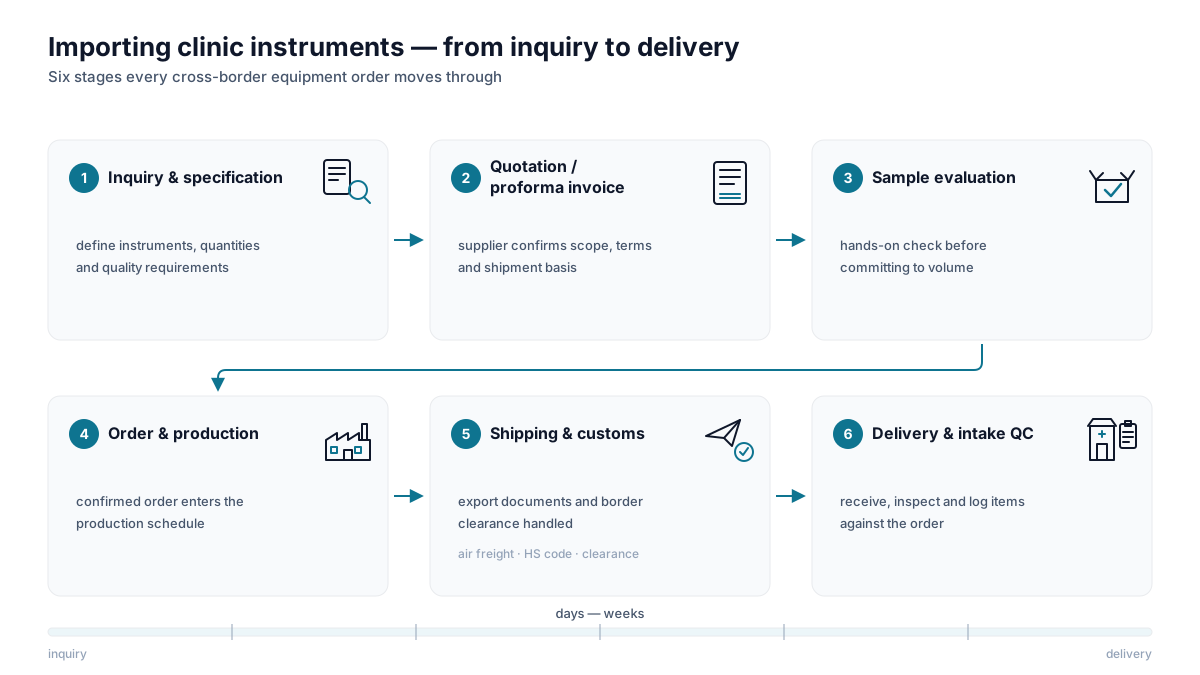
Order economics deserve equal planning. Colombian replenishment cycles favor consolidated shipments that spread fixed clearance and freight costs across several product lines; sizing those orders against real consumption is exactly the calculation covered in our MOQ guide, and the surrounding fundamentals — proforma, Incoterms, samples, supplier evaluation — are collected in the sourcing and import hub.
Mountains move the logistics
Colombia adds a chapter flat countries never read: three Andean cordilleras cut the country into regions, overland transport between the major cities is slow relative to straight-line distance, and national distribution is in practice an exercise in air logistics. Imports enter through Bogotá, but Medellín has full commercial life of its own, so serious distributors hold inventory in both cities at minimum and serve the rest of the country by domestic air shipment in a day or two. For clinics — and for the exporters supplying their distributors — the operative question when weighing a channel is where the stock physically sits: the punch sleeping in a warehouse across town is worth more, in surgical-continuity terms, than a cheaper one that must cross a cordillera or an ocean.
| Market-entry question | The Colombian answer |
|---|---|
| Who holds the product on the market? | A registro sanitario holder — typically the local distributor partner |
| Who clears the goods? | An agencia de aduanas with medical-device experience, agreed tariff lines in hand |
| Where should stock sit? | Bogotá and Medellín at minimum; domestic air covers the rest |
| Who is the growth customer? | Young professionalizing clinics — small today, loyal and larger tomorrow |
| What wins the account? | Price plus documented quality plus continuity — no longer price alone |
Pesos, payments and the commercial relationship
Local business lives in Colombian pesos while imports are quoted in dollars, so the importer — distributor or large clinic — carries the exchange exposure between the two, and currency movement feeds directly into real replenishment cost and periodic price-list revisions. Cross-border, the universal sequence applies: proforma invoice, advance payment, balance against shipping documents, with flexibility earned step by step through accumulated history. Domestically, trade credit is granted prudently and reputations for payment punctuality circulate among distributors more than anyone admits.
The commercial culture is close and conversational: visits count, peer recommendation counts more, and the supplier who responds fast — quotation, data sheet, incident resolution — compounds reputation in a scene where everyone knows everyone. For a foreign manufacturer, the realistic entry combines a local partner with regulatory and clearance capability, jointly worked coverage of the two capital cities, and patience calibrated to a market whose best accounts are still growing into themselves.
What the next few years reward
Reading Colombia's trajectory honestly, three supplier behaviors look best positioned. Backing young clinics early — accepting modest initial orders, supporting trials, answering technical questions generously — converts into anchor accounts as those clinics scale, because switching costs in surgical routine are real and Colombian loyalty compounds. Investing in Spanish-language technical depth — data sheets, training material, straight answers about steels and geometries — differentiates while the market is still in its learning phase, a window that will eventually close as it has everywhere else. And building supply continuity into the channel design — realistic stock in both capitals, consolidated replenishment on a disciplined calendar, honest lead-time communication — addresses the failure mode Colombian clinics complain about most. None of these is exotic; what makes Colombia attractive is that doing the fundamentals well still visibly stands out, in a market growing fast enough to repay the effort.
Frequently asked questions
Do hair transplant instruments need INVIMA registration to be sold in Colombia?
Medical devices marketed in Colombia are subject to registro sanitario before INVIMA, and foreign certifications do not replace it on their own. Requirements vary by risk classification, so verify each product's status with regulatory counsel or the authority before committing inventory or signing agreements.
Is a customs agency mandatory for importing into Colombia?
It is the practical norm of the market: Colombian import clearance is customarily managed through a licensed agencia de aduanas that files the declaration, classifies the goods and settles duty and VAT. Choose one with proven medical-device experience — surgical-instrument classification is exactly where that experience shows.
Why does everyone emphasize Bogotá and Medellín?
Because they concentrate the aesthetic boom, the majority of serious hair-restoration clinics and the specialized distribution infrastructure, with Cali and the coffee axis as growing secondary markets. Imports also physically enter through Bogotá, and credible distributors hold stock in both cities given the country's mountain logistics.
Is Colombia purely a price-driven market?
It buys with a calculator, but no longer on price alone. Professionalizing clinics — pushed by inbound medical tourism and internationally trained surgeons — increasingly decide on documented quality, lot traceability and supply continuity alongside cost. A supplier competitive on price and consistent on quality holds the strongest position.
How does the exchange rate affect instrument costs?
Directly: imports are quoted in dollars and local sales run in pesos, so real replenishment cost moves with the rate. Serious importers price with an exchange margin and revise lists when the peso moves sharply — which is why local price updates happen and why landed-cost math should always be run in pesos.
What is the entry route for a foreign instrument manufacturer?
Almost always a local distributor with regulatory and import capability — holding or managing registrations, an established customs-agency relationship and a commercial network across Bogotá and Medellín. Building that infrastructure independently from abroad is possible but slow compared with a well-negotiated distribution partnership.
Related articles
Sourcing & Import: Buying Medical Instruments Across Borders
The commercial mechanics of importing hair restoration instruments — customs, MOQs, samples, payment terms and how to evaluate a supplier before committing.
HS Codes for Hair Transplant Instruments and Supplies
A heading-level HS/CN classification reference for the hair-restoration product basket: instruments, consumables, equipment and hair-care products, with the pitfalls that cause misclassification.
How to Become a Hair Transplant Instrument Distributor
A practical guide to building a distribution business in hair restoration instruments: how the revenue model actually works, how to build a starting portfolio, which manufacturer relationship to choose and how the first customers are won.
Minimum Order Quantities for Medical Instruments: A Buyer's Guide
Why MOQs exist in instrument manufacturing, what typical minimums look like by product category, which negotiating levers actually move them, and why a supplier with no minimum at all deserves scrutiny.