
Buying & Distributing Hair Transplant Instruments in Oman
Oman builds slowly and buys carefully: a Muscat-centred clinic scene growing at a measured pace, an agent-based import structure, and a business culture that rewards suppliers who commit for years rather than quarters.
Oman is the Gulf market for suppliers who think in years. Its private aesthetic sector is growing — visibly, in Muscat above all — but at a deliberate pace set by a smaller economy, a careful business culture and a healthcare system that expands capacity step by step rather than in leaps. Instruments reach clinics through local agents, relationships are built slowly and kept long, and the suppliers who do well are the ones who match the country's rhythm instead of trying to accelerate it.
Key takeaways
- Oman rewards long-horizon commitment: the market grows steadily rather than explosively, and business relationships are built to last.
- The Ministry of Health regulates medical devices, with registration requirements applying before instruments are marketed.
- Muscat concentrates nearly all relevant clinic demand; the rest of the country matters for logistics more than for sales.
- A local agent is the standard route in, typically a Muscat medical-supply firm with an established ministry and clinic network.
- The Omani rial is pegged to the US dollar and is one of the highest-valued currency units in circulation; payment customs are conservative and correct.
A market that rewards patience
Every market has a tempo, and Oman's is unhurried by design. The economy is smaller than those of its northern neighbours, government planning favours gradual diversification, and commercial culture prizes courtesy, deliberation and continuity — meetings open slowly, decisions mature over multiple conversations, and pressure tactics that merely irritate in Dubai can quietly end a discussion in Muscat. For an instrument supplier the planning consequence is concrete: forecast conservatively, size opening stock modestly, and measure success over a multi-year arc. Flexible minimums help more here than almost anywhere; the approaches in our instrument MOQ guide are directly relevant when a serious Omani partner wants to start with careful quantities and grow proven demand.
The reward for patience is durability. Omani businesses change suppliers reluctantly, honour long relationships, and extend a loyalty that compounds: the brand a Muscat clinic adopted five years ago is usually the brand it still buys, because switching is itself a decision the culture treats with caution. Market entry is slow; market defence, once established, is easier than in the churn-heavy hubs.
Muscat first, then the distances
Commercially, Oman is Muscat. The capital area — from Seeb along the coast through Muttrah and Ruwi — holds the private hospitals, dermatology practices and aesthetic clinics that constitute effectively the entire addressable market for hair-restoration instruments. Salalah, a thousand kilometres south, has its own smaller private-health scene and a seasonal rhythm shaped by the khareef tourist influx, but for instrument demand it is an occasional secondary stop, not a second market. The practical meaning: one Muscat-based agent covers the country, and a supplier's travel plans are simple — fly to Muscat, and go often enough to be remembered.
The demand picture mirrors the region's pattern at gentler intensity. Omani patients have historically travelled for hair restoration — to Turkey for price, to the UAE for proximity — and a growing share of dermatology and cosmetic practices now offer transplant and adjacent services at home, competing on convenience, follow-up care and trust rather than headline price. Growth is real but measured: new clinic openings arrive steadily rather than in waves, and each new entrant typically represents a considered investment by an established physician rather than speculative capital chasing a boom.
The Ministry of Health, in brief
Medical devices in Oman are regulated by the Ministry of Health, whose registration requirements apply before instruments are placed on the Omani market. Applications proceed through locally established companies acting for foreign manufacturers, with recognised international approvals commonly forming part of the supporting file. Confirm the current requirements with the ministry and your local partner at the outset of planning.
Bringing instruments in
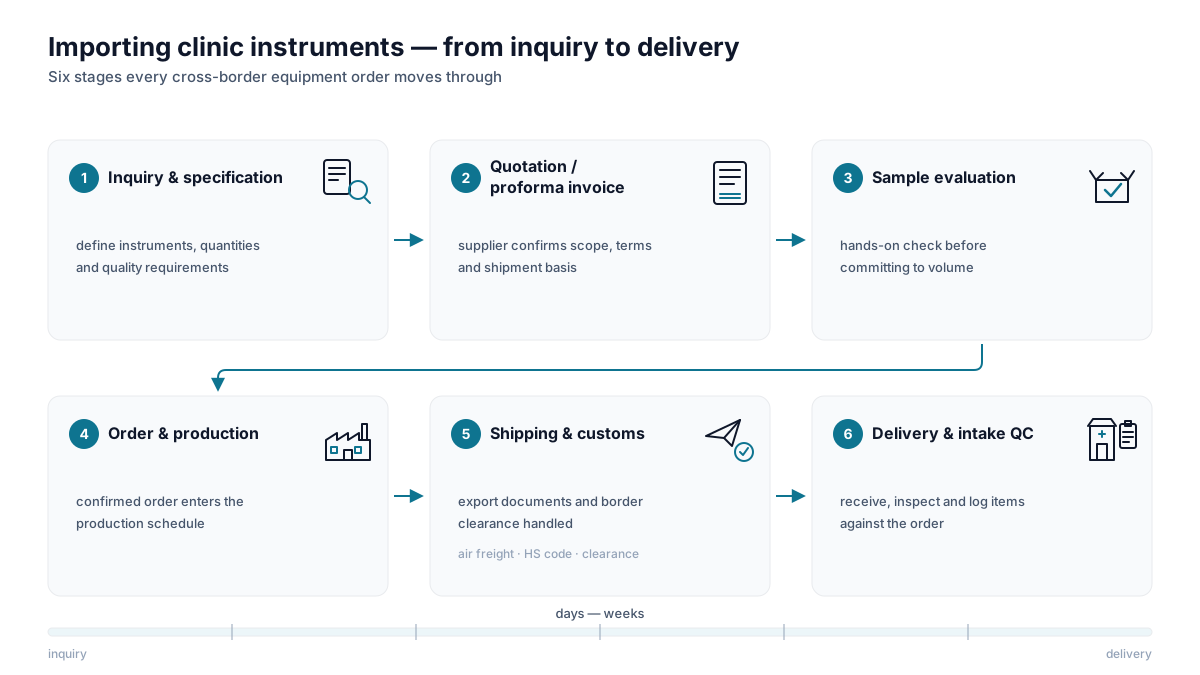
The import route follows the Gulf norm: a locally established agent acts as consignee and clears the goods, and Oman sits inside the Gulf customs bloc's common tariff perimeter. What is distinctive is the logistics map. Air cargo into Muscat serves the instrument trade's typical small, high-value shipments well; on the sea side, Sohar in the north has taken over most container traffic serving the capital region, while Salalah — one of the region's great transshipment ports — matters mainly as a routing point rather than a destination. Overland trucking from the UAE is a routine supplementary channel, used when regional distributors holding Dubai stock serve Omani orders, though the regulatory file must still be Omani: registration does not cross the border with the truck.
For the exporter, the discipline is documentary. Classification set correctly from the start — our HS code reference covers the relevant tariff lines — and invoices consistent with the registration file keep clearance uneventful. Where Turkey is the origin, as it is for a large share of hair-restoration instruments, the dispatch-side sequence in our importing from Turkey guide applies unchanged to a Muscat consignment, whether it flies direct or transits a Gulf hub.
Service expectations in a careful market
Omani buying caution has a mirror image: once a clinic commits, it expects the supplier relationship to carry real weight. Training sits at the centre of that expectation. Because the clinical community is small and new procedures spread surgeon by surgeon, a supplier's willingness to fund proper instruction — a visiting trainer, structured sessions on punch handling and implanter technique, reprocessing guidance the clinic's nurses can actually follow — often decides adoption more than price does. The same smallness cuts the other way after the sale: a single instrument failure handled badly will be known across Muscat's medical community within the month, while a failure handled generously becomes a story your agent tells prospects for years.
Documentation expectations are solid without being baroque. Clinics want clean instructions for use, sterilisation parameters and certificates that satisfy ministry inspections; hospital-affiliated buyers add formal vendor paperwork. What Oman does not reward is aggressive commercial machinery — quarterly promotion pushes, loud discount campaigns and pressure-laden sales targets read as unseriousness here. The tone that works is technical, steady and modest, matching how Omani clinicians themselves conduct business. Suppliers accustomed to louder Gulf markets sometimes misread this reserve as lack of interest; more often it is simply diligence moving at local speed, and the correct response is complete answers, not repeated follow-ups.
One more structural point favours the patient supplier: because the market is small, it is underserved. International manufacturers who blanket Dubai and Riyadh with attention frequently leave Oman to be handled "from the region", which in practice means rarely visited and slowly supported. A supplier who shows up in person, trains generously and answers quickly is not competing against the whole industry here — only against the fraction of it that bothered to come.
Payment, the rial and the pace of money
The rial reinforces the market's character: pegged to the US dollar since the 1980s and denominated in units worth more than three dollars each — subdivided into 1,000 baisa — it is a currency that encourages precision. Cross-border contracts are typically written in dollars, occasionally rials, and exchange risk is not a live concern. Payment behaviour is conservative and, in the market's favour, correct: Omani firms are widely regarded as reliable counterparties who pay what was agreed when it was agreed, but they commit slowly, examine terms carefully and expect the same steadiness in return. Advance payment or letters of credit govern early orders; open account follows once the relationship has proved itself through a few cycles.
Set the calendar accordingly. The working week runs Sunday to Thursday, Ramadan slows commercial decision-making appreciably, and the summer months thin out availability. An annual rhythm of two well-prepared Muscat visits, prompt technical support in between, and unhurried responsiveness to the agent's questions fits the market far better than campaign-style bursts of attention — and costs less than the campaign approach while achieving more. The groundwork of structuring and qualifying such long-horizon export relationships is covered across our sourcing and import hub.
What a realistic Omani entry looks like
- Qualify one Muscat agent thoroughly — an established medical-supply firm with ministry experience and dermatology-clinic relationships; expect the courtship itself to take months.
- Complete registration before commercial push — let the local file be finished and verified rather than selling ahead of it.
- Open with modest stock and full support — small quantities, training included, replenishment logistics proven on real orders.
- Grow with the clinics — add SKUs and volume as individual practices expand their hair-restoration work, and let peer recommendation inside Muscat's compact medical community do the marketing a billboard never could.
Frequently asked questions
Is Oman's market big enough to be worth a dedicated entry?
As a volume play, no; as a durable, low-churn market entered through one Muscat agent at modest cost, yes. Suppliers who size expectations to steady multi-year growth generally find the effort-to-reward ratio favourable.
Who regulates medical devices in Oman?
The Ministry of Health, whose registration requirements apply before instruments are marketed. Locally established companies handle applications for foreign manufacturers, and current requirements should be confirmed with the ministry and your agent.
Can a UAE distributor simply cover Oman as well?
Logistically it happens — overland trucking from Dubai stock is routine — but the regulatory pathway is national, so Omani registration and a locally established consignee are still required. Treat Oman as its own regulatory project even when the warehouse is shared.
Where are Omani clinic buyers concentrated?
Almost entirely in the Muscat capital area, where the private hospitals, dermatology practices and aesthetic clinics cluster. Salalah has a smaller private-health scene but functions as an occasional secondary stop rather than a genuine second market.
What are Omani partners like as payers?
Conservative to commit and reliable once committed. Early orders run on advance payment or letters of credit in dollar-denominated contracts, with open-account terms following after a few proven cycles; the rial's dollar peg keeps currency risk out of the picture.
How fast should I expect an Omani launch to ramp?
Slowly and steadily. Registration, agent courtship and first clinic adoptions each take unhurried months, and growth then compounds through Muscat's tight professional networks. Plan in years, keep minimums flexible, and treat durability — not launch speed — as the metric.
Related articles
Sourcing & Import: Buying Medical Instruments Across Borders
The commercial mechanics of importing hair restoration instruments — customs, MOQs, samples, payment terms and how to evaluate a supplier before committing.
Importing Hair Restoration Instruments from Turkey: A Practical Guide
Why Turkey became a manufacturing base for hair-restoration instruments, and the practical import mechanics — Incoterms, customs documents, duty and VAT logic — for buyers in the EU, UK and Gulf.
Minimum Order Quantities for Medical Instruments: A Buyer's Guide
Why MOQs exist in instrument manufacturing, what typical minimums look like by product category, which negotiating levers actually move them, and why a supplier with no minimum at all deserves scrutiny.