Hair Transplant Clinic Equipment: The Complete Stack
The full equipment stack of a hair transplant clinic, from operating table to autoclave — written for founders specifying their first operating room.
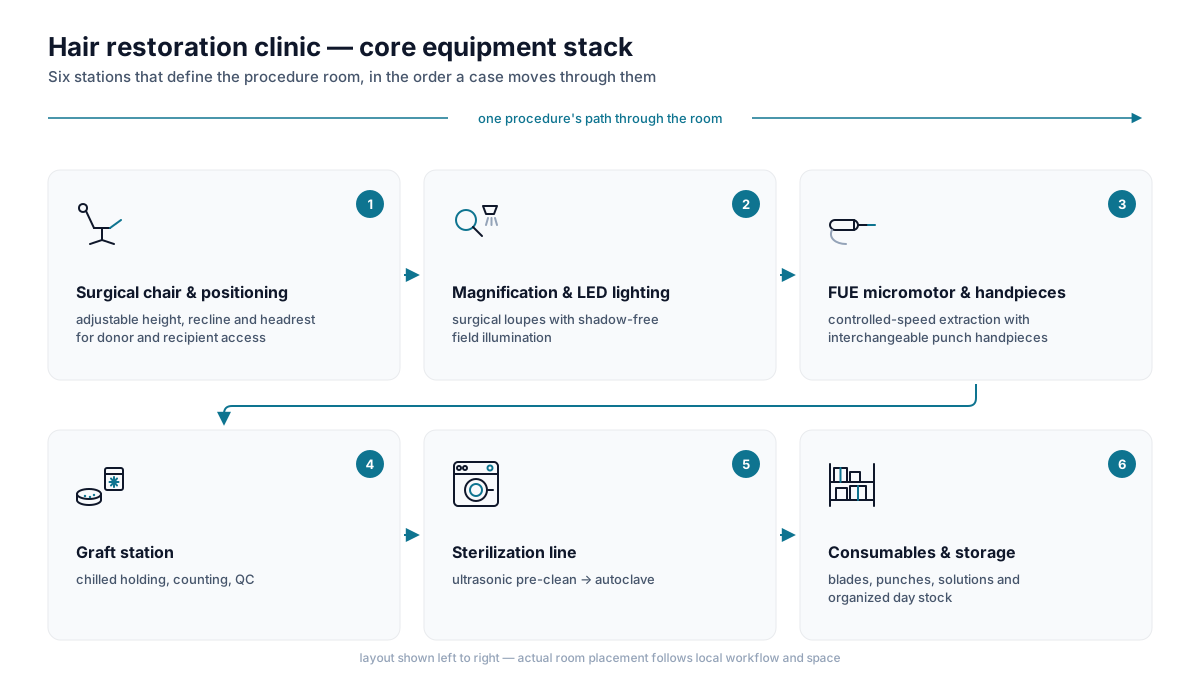
The core equipment stack of a hair restoration clinic at a glance
Equipping a hair transplant clinic is a longer list than most founders expect and a shorter one than most equipment vendors suggest. A functioning operating room is roughly six systems, and the discipline is specifying each of them for the way hair restoration is actually performed — sessions lasting six to ten hours, a team of three to six people working simultaneously, and thousands of grafts that must survive outside the body — rather than copying a general surgery fit-out.
Patient positioning and team seating. The operating table is the anchor purchase: hair restoration needs stable prone and supine positioning, fine height adjustment, and head-end access from three sides for hours at a time. The less glamorous half of this system is staff seating — technicians sit at high magnification for entire shifts, and poor saddle chairs show up within months as turnover and back complaints. Budget for the chairs like clinical equipment, because they are.
Lighting and magnification. Graft work is fine work. Clinics combine surgical luminaires for the field with task lighting at the graft-processing station, and magnification at two tiers: surgical loupes for extraction and site-making, and stereo microscopes or high-quality lamps with magnification for graft counting, trimming and quality control. Magnification is where cutting budget costs graft survival — it belongs near the top of the priority list, not the bottom.
The sterilization line. Every reusable instrument cycles through cleaning, packaging, autoclaving and sterile storage, and the line has to keep pace with daily case volume. For most clinics that means a Class B autoclave sized for the instrument load, an ultrasonic cleaner, a sealing device for sterilization pouches and a documented storage arrangement. Founders should design this workflow — dirty-to-clean, one direction — before signing a floor plan, because retrofitting it is expensive.
Instrument sets and technique-specific hardware. The core surgical sets — forceps in several profiles, needle holders, scissors, bowls and trays — plus whatever the clinic's techniques demand: micromotor and handpieces with FUE punches, implanter pens, blade handles for sapphire or steel blades. Instruments are covered in depth in their own hubs; the equipment-planning point is that sets must be multiplied by simultaneous team members and sterilization turnaround, not bought as one beautiful tray.
Graft management. Between extraction and implantation, grafts live in chilled holding solution — which means dedicated cold storage, holding trays, petri dishes, and a counting workflow at the processing station. This is cheap equipment with expensive consequences; it deserves specification, not improvisation.
Consumables. Gloves, drapes, gauze, syringes, anesthetics-adjacent supplies, holding solutions, marking tools. Consumables planning is really supplier planning: a clinic burns through these continuously, so the founding question is who supplies them reliably at wholesale terms — the subject of the sourcing and import hub and the wholesale page.
For a startup, sequence matters as much as selection. The pattern that works: specify the room around workflow first, buy the systems with long lead times early (table, sterilization, lighting), pilot instruments with samples before standardizing, and resist stocking a year of consumables before the first month of real case volume teaches you what you actually use. The guides in this hub work through each system with concrete specifications and startup-budget framing.
Opening a clinic, country by country
Equipping a clinic is only half the founding story — licensing, practitioner requirements and setup sequencing differ sharply by jurisdiction. The opening-a-clinic guides walk each market: the United Kingdom, Germany, Spain, France, Italy, the Netherlands, Poland, Greece, the UAE, Saudi Arabia, the United States and Mexico — each with its licensing landscape, facility expectations and a realistic setup sequence.
Frequently asked questions
What equipment does a hair transplant clinic actually need to open?
Six systems: an operating table with proper head access plus team seating; surgical lighting and magnification; a sterilization line (autoclave, ultrasonic cleaner, sealer, sterile storage); surgical instrument sets and technique-specific tools; graft holding and cold-storage equipment; and a consumables supply arrangement. Everything else is optimization.
Where should a startup clinic not cut budget?
Magnification, the sterilization line and staff seating. Poor magnification degrades graft quality directly, an undersized sterilization line throttles daily case capacity, and bad chairs damage the team a clinic depends on. Savings are more safely found in furniture aesthetics and in phasing purchases against real volume.
How many instrument sets does a team need?
Enough that a full team can work simultaneously while used sets are in reprocessing — in practice, sets multiplied by team members and by sterilization turnaround, plus a margin for breakage. One session's arithmetic with your own case schedule answers this better than any generic number.
Should equipment be bought locally or imported from manufacturers?
Usually both. Heavy infrastructure with service needs — tables, autoclaves — often justifies local suppliers with maintenance coverage. Instruments and consumables are commonly imported at manufacturer-direct pricing once samples have been evaluated. The split depends on your market’s service landscape and import practicalities.
What gets forgotten most often in clinic equipment planning?
The graft-processing station and the sterilization workflow. Founders specify the operating table carefully, then improvise the place where grafts spend hours and the one-way dirty-to-clean flow that inspections and daily throughput both depend on. Plan both into the floor layout before construction.
How to read the forceps wall of a surgical catalog: what straight and curved patterns, tip profiles, jaw textures and materials each do in graft work, why jeweler-style numbering is not a standard, and how to inspect and retire forceps.
A working inventory system for clinic supplies: classify SKUs by velocity and criticality, set par levels and reorder points from the session calendar, rotate stock first-expiry-first-out, buffer supplier lead times — and run it all from a disciplined spreadsheet.
The reprocessing room from the floor plan up: why one-way dirty-to-clean-to-sterile flow is the whole design, what equipment each zone needs and why, how to plan a small footprint honestly, and where water quality and documentation fit.
The economics behind the single-use versus reusable decision: what a reprocessing cycle really costs once labor minutes are counted, a break-even formula in variables, why risk cost dominates at the margin, and a decision matrix by clinic volume.
Instruments that go into the autoclave bright and come out stained are telling you exactly what went wrong — if you read the color. Rainbow films, black marks, white deposits and rust spots each have distinct causes in the heat, chemistry and water chain, and each has a different fix.
The operational logic of a hair transplant OR: how to zone the room, position the table and team, layer the lighting, secure power and climate, and build ergonomics that survive eight-hour sessions.
What OEM really means for hair transplant instruments: which specifications you can change without tooling investment, how qualification from drawing to pilot lot works, and who ends up owning what.
Per-session instrument consumption is arithmetic, not guesswork: the four drivers that set it, honest per-1,000-graft ranges for punches, blades and implanter needles, a worked 2,000-graft plan and the safety-stock rule that keeps sessions from stalling.
What clinic buyers need to know about sterile and non-sterile supply formats, sterile barrier packaging, sterilisation methods, receipt inspection, shelf life and storage.
Reprocessing as a chain of eight steps — point-of-use pre-clean through sterile storage — with the purpose behind each step, the typical failure that occurs there, and why the chain is only as strong as its most rushed link.
Stainless steel resists corrosion through a microscopically thin passive layer — and everything that damages that layer, from chloride exposure to hard tap water to instruments stored wet, shows up later as pitting, staining and rust. A taxonomy of corrosion types and the reprocessing habits that prevent each one.
A category-by-category equipment walkthrough for opening a hair transplant clinic: what belongs in the OR, the sterilization line, instrument sets and consumables — and the order to buy it in.
How chilled saline, buffered hypothermic solutions and platelet-derived additions compare for holding grafts between extraction and placement — evidence framed cautiously, with protocol and cost.
What actually belongs on an FUE surgical tray, phase by phase — anesthesia, extraction, graft storage, incision and placement — with the quantity logic behind each item, sterile setup practice and the restock triggers that keep sessions from stalling.
The cost-per-graft calculation from first principles: what belongs in the consumable basket, the formula and its variables, why session size and single-use policy move the number more than any discount, and how to benchmark without fake industry averages.
A room-by-room look at hair transplant clinic starter packages: what belongs in the OR, sterilization line and graft-prep station on day one, what can wait until month two, and an honest view of when a package beats piecemeal buying — and when it doesn’t.
A budget structure for equipping a new hair transplant clinic: the three ledgers — capital, consumables, hidden costs — how to phase purchases so cash follows patients, where cheap equipment gets expensive, and an honest word on financing.
A hair transplant session consumes over a dozen distinct disposables beyond punches and blades. This guide maps the full basket with per-session quantity logic, shows how to convert it into bulk orders, and weighs procedure kits against separate SKUs.
A buyer’s path through the autoclave decision: what B, S and N cycle classes actually mean for hollow and wrapped instrument loads, how to size the chamber to your session rhythm, and why drying time, water quality and the service network decide long-term satisfaction.
Markets and locations
Country buyer guides, clinic-opening guides and city snapshots — each written for buyers working in or with that market.
The commercial mechanics of importing hair restoration instruments — customs, MOQs, samples, payment terms and how to evaluate a supplier before committing.