
Buying & Distributing Hair Transplant Instruments in Brazil
Brazil pairs one of the world's great aesthetic-medicine markets with some of its highest walls: demanding ANVISA registration, a heavy import tax stack, and a commercial reality in which a committed local partner is close to indispensable.
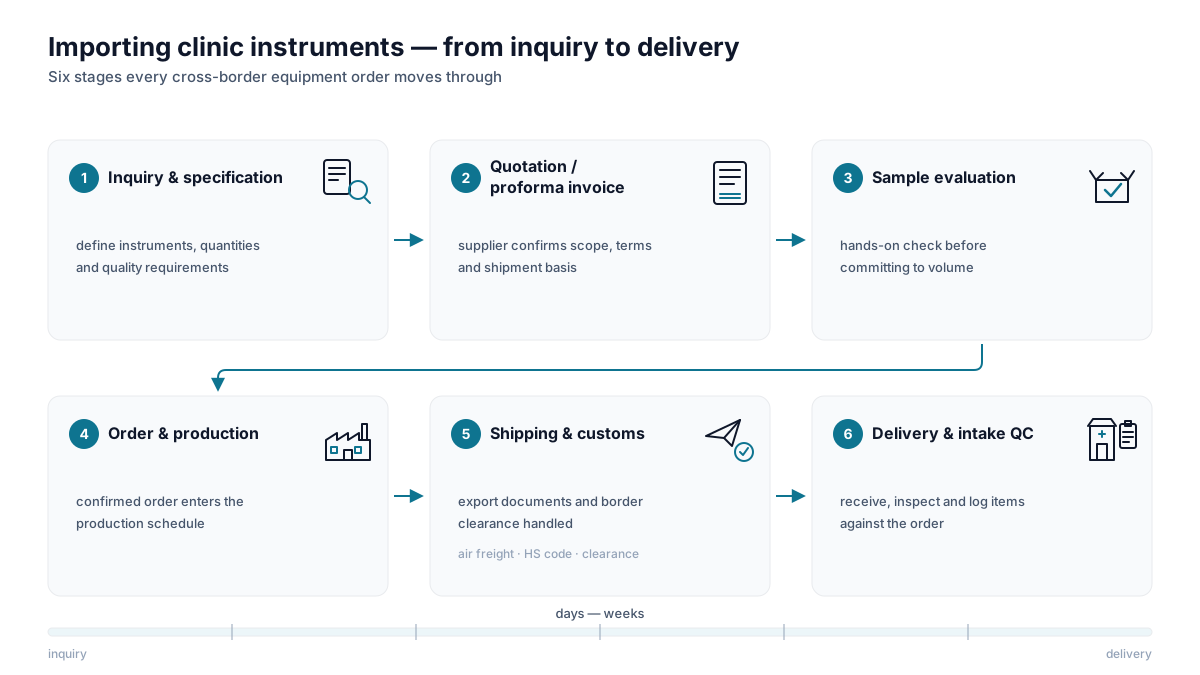
Brazil is the market foreign suppliers circle for years before entering, and the hesitation is rational. Behind the walls sits a prize: a huge, aesthetics-obsessed country with a deep domestic procedure culture and a clinic scene that buys in real volume. The walls themselves are equally real — a demanding device-registration system, an import tax burden that transforms landed costs, and a commercial environment that functions in Portuguese through local structures. Brazil punishes opportunistic entry and rewards commitment; the suppliers who succeed treat it as a multi-year project run through a strong local partner, not an export destination.
Key takeaways
- Brazil is a large, protected market: ANVISA registration requirements apply before devices are marketed, and the process is widely regarded as demanding.
- The layered import tax stack raises landed costs substantially above ex-works prices — cost models built on European assumptions will be badly wrong.
- São Paulo is the market's centre of gravity for clinics, congresses and distribution alike.
- A committed local partner is near-essential: registrations, importing, tax handling and clinic sales all run through locally established companies.
- Contracts price in currency volatility — the real floats hard — and B2B life happens in Portuguese.
A protected giant
Scale first: Brazil has one of the world's largest aesthetic-medicine cultures, and hair restoration participates fully in it. Demand is overwhelmingly domestic — this is not a medical-tourism play but a vast internal market of Brazilian patients treated by Brazilian clinics — and it spans a wide price pyramid, from elite São Paulo practices equipped to international standards down to high-volume clinics competing hard on price. That breadth matters for product strategy: there is room for premium instrument lines and for value tiers, but rarely for both through the same positioning.
Protection second. Brazil's regulatory and tax architecture was built to be substantial, and it filters who participates. The practical effect for an instrument manufacturer is that the market cannot be tested casually with a few shipments; entry has fixed costs in time, registration work and partnership building that only make sense against a serious revenue ambition. Sensible entrants budget the runway in years rather than quarters, sequence a handful of registrable lead products rather than a whole catalogue, and measure early progress in relationships and regulatory milestones rather than revenue. Plan on that basis or defer the market — half-commitment is the one strategy with no payoff here.
ANVISA, named honestly
Medical devices in Brazil are regulated by ANVISA, the Brazilian Health Regulatory Agency, and registration or notification requirements apply according to device class before products are placed on the market. The system has a deserved reputation as one of the more complex and time-consuming in the world, with substantial documentation expectations and timelines that must be planned for rather than hoped around. The pathway itself sits outside this guide's scope — engage a Brazilian regulatory specialist, or a partner who already holds relevant registrations, before building any market-entry timeline.
The tax stack, and what it does to your price
Brazil taxes imports through several layers at once — federal import duty plus a series of federal and state taxes applied through the import process — and the cumulative effect is heavy. Without quoting rates, which shift with product classification and state, the honest summary is this: the landed cost of an imported instrument in Brazil commonly ends up dramatically higher than its ex-works price, by margins that would be unthinkable in Europe or North America, and the calculation depends on classification decisions made line by line. Tariff classification is therefore not clerical work but pricing strategy; start from the lines in our HS code reference and have your Brazilian import partner model the full stack for each SKU before you commit to market pricing.
Two commercial consequences follow. First, price positioning set abroad does not survive contact with Brazil — a mid-market European product can land as a premium-priced one, so decide deliberately which Brazilian tier you are actually competing in after tax. Second, the tax stack is a moat for whoever crosses it: competitors face the same arithmetic, and locally registered, locally stocked lines enjoy real protection against casual foreign competition. This is a market where incumbency, once earned, is worth defending.
São Paulo gravity
Every thread of the Brazilian market runs through São Paulo. The city and its state hold the country's densest concentration of aesthetic clinics and hair-restoration practices, the major medical congresses where lines are launched and relationships made, and the bulk of the specialised medical-device import and distribution trade. Rio de Janeiro, Belo Horizonte, Curitiba, Porto Alegre and the wealthy cities of the south and southeast all carry real clinic scenes — and the northeast's capitals are growing — but a supplier's Brazilian story almost always starts in São Paulo, and a distributor without a genuine São Paulo operation should prompt questions. Congress presence matters disproportionately: Brazilian clinical culture is congress-centred, and visibility at the major São Paulo events does work that no amount of digital outreach replaces.
The domestic-manufacturing factor
Brazil's protection has, predictably, grown domestic capability behind it. The country has its own surgical-instrument and medical-device manufacturing base, and locally made instruments — untouched by import taxes and priced in reais — dominate the value tiers of the pyramid. An imported line will rarely win a pure price fight in Brazil; the arithmetic of the tax stack settles that before the first sales call. What imported instruments can win on is differentiation: specialised FUE geometry, coatings, motorised systems, consistency of manufacture and the credibility of an internationally used brand, sold into the clinics whose own positioning depends on offering something the value tier does not. Be clear-eyed about which of your SKUs carry that differentiation and which are, in Brazilian terms, commodities better left out of the container. A focused catalogue of defensible products beats a full catalogue landing at uncompetitive prices — and it simplifies the registration workload your partner is carrying on your behalf.
Why the local partner is near-mandatory
Foreign suppliers do not really "sell to Brazil"; they supply a Brazilian company that sells within Brazil. Device registrations are held by locally established entities, importing requires licensed local importers, the tax machinery demands Brazilian fiscal infrastructure, invoicing runs through the national electronic system, and clinics buy in Portuguese from companies that can finance their purchases in local currency. Each of those functions points to the same conclusion: a committed local partner — whether an established distributor or, for large suppliers, a Brazilian subsidiary — is close to indispensable, and partner choice is the single highest-stakes decision of the entire market entry.
Choose accordingly. Because your partner will likely hold the registrations for your lines, the relationship carries a structural dependency that European agreements rarely create: changing partners later can mean re-doing registration work, so negotiate the ownership and transfer of registrations, alongside territory and performance terms, before signing anything. Our guides to distribution agreement terms and exclusive versus non-exclusive distribution cover the clauses that matter; in Brazil, read them with the registration-dependency problem in front of you. Exclusivity requests are standard from serious Brazilian distributors and often justified by the investment they are making — the answer is conditional yes, with teeth.
Currency, language and payment customs
The real floats freely and moves hard, and the market has long since built its habits around that fact. Upstream contracts between foreign manufacturers and Brazilian importers are commonly denominated in dollars or euros, with the Brazilian side carrying the exchange exposure into its local pricing — one more service the local partner performs, and one more reason their margins are wider than European norms. Early-relationship payment typically runs on prepayment or letters of credit, moving to negotiated terms with history; international transfers from Brazil involve formal exchange procedures, so payments are orderly but not instant. Build realistic lead times into cash-flow planning, and resist reading administrative delay as reluctance — your partner's finance team is working through a process, not around a decision. Domestically, Brazilian clinics are accustomed to instalment-based purchasing across the whole economy, and distributors extend financing to clinic customers as a standard service; it is one more function bundled into the local-partner role, and one more reason the intermediated model is not really optional here.
Language is not negotiable: Brazilian B2B runs in Portuguese, English fluency thins quickly outside the largest players, and labelling and instructions in Portuguese are an expectation of the market. Spanish is not a substitute and using it as one reads as carelessness. For a supplier weighing all of this against the market's size, the groundwork on structuring foreign-market entry in our sourcing and import hub is the place to pressure-test whether Brazil's walls are worth your particular climb — for many instrument makers, they are.
Frequently asked questions
Can I test the Brazilian market with a few direct shipments to clinics?
No — Brazil does not work as a casual export destination. Device registration requirements, licensed-importer rules and the tax machinery mean market entry runs through locally established companies, with fixed costs in time and money that only pay off against a committed, multi-year plan.
Who regulates medical devices in Brazil?
ANVISA, the Brazilian Health Regulatory Agency. Registration or notification requirements apply by device class before marketing, and the system is widely regarded as one of the more demanding globally — engage a Brazilian regulatory specialist or a partner holding relevant registrations.
Why are landed costs in Brazil so high?
Imports pass through several layers of federal and state taxation whose cumulative effect is heavy, commonly lifting landed cost far above the ex-works price. Classification drives the outcome line by line, so have your Brazilian import partner model the full stack per SKU before setting market prices.
Who should hold the ANVISA registrations — my company or my distributor?
Registrations are held by locally established entities, and in practice that is often your distributor — which creates a dependency, since switching partners can mean re-doing registration work. Negotiate registration ownership and transfer provisions in the distribution agreement before signing.
How volatile is the currency risk in Brazil?
The real floats freely and can move sharply. Upstream contracts are commonly denominated in dollars or euros with the Brazilian partner absorbing exchange exposure into local pricing — part of why Brazilian distribution margins run wider than European norms.
Where should a new supplier focus first in Brazil?
São Paulo. The city concentrates the clinic scene, the major congresses and the specialised device-distribution trade; a partner without genuine São Paulo operations, and a launch plan without congress presence there, should both raise questions.
Related articles
Sourcing & Import: Buying Medical Instruments Across Borders
The commercial mechanics of importing hair restoration instruments — customs, MOQs, samples, payment terms and how to evaluate a supplier before committing.
HS Codes for Hair Transplant Instruments and Supplies
A heading-level HS/CN classification reference for the hair-restoration product basket: instruments, consumables, equipment and hair-care products, with the pitfalls that cause misclassification.
Distribution Agreement Terms: The Clauses That Decide Whether the Deal Works
A clause-by-clause walk through medical device distribution agreements: territory and exclusivity, minimum commitments, pricing structure, marketing obligations, IP use, termination and the post-term provisions most first-time distributors overlook.
Exclusive vs Non-Exclusive Distribution: Which Model Actually Serves You?
An honest comparison of exclusive and non-exclusive distribution rights: what each model really grants, when each one wins, the hybrid structures in between, and the performance clauses that make an exclusive territory earn its keep.