
Austria: Buying & Distributing Hair Transplant Instruments
How Austria's compact, premium instrument market works: portfolio-breadth distribution economics, Vienna's clinic and medical-tourism scene, BASG oversight, and Austrian service expectations.
Austria is a small, affluent, Vienna-centred market where premium expectations meet compact volumes: the clinics buy like their German neighbours, but there are far fewer of them, and that arithmetic shapes every distribution decision. Suppliers succeed here by respecting the small-market economics — broad portfolios per partner, realistic volume expectations, and a genuine Austrian service presence rather than an afterthought appended to a German operation.
Key takeaways
- Small-market economics rule: an Austrian distributor survives on portfolio breadth across specialties, not on volume in one product line.
- Vienna dominates — clinic density, purchasing decisions and inbound medical tourism from CEE and the Gulf all concentrate in the capital.
- Austria is frequently served through German distribution structures, but buyers notice, and reward, suppliers with an actual Austrian presence.
- BASG is the competent authority; CE-marked instruments circulate under EU rules with no customs border to any EU neighbour.
- Commercially the market is low-risk and loyal: modest volumes, stable relationships, invoice-based SEPA payment in euros.
The arithmetic of a small premium market
Begin with the constraint, because everything commercial in Austria follows from it. The country's procedure market is a fraction of Germany's, concentrated in a handful of cities, with Vienna carrying most of the weight. A distributor who tried to live on FUE punches alone would starve; the ones who thrive carry instruments, consumables, equipment and often adjacent aesthetic lines, spreading a small country's order flow across a wide catalogue. For a manufacturer, this changes the partner profile you should look for: the right Austrian partner is rarely a hair-restoration specialist, and more often a well-connected aesthetic or surgical dealer for whom your line completes a portfolio.
The same arithmetic sets expectations on volume and terms. Minimum order quantities calibrated for the German or UK market will simply not turn over in Austria; suppliers who insist on them either lock capital into a partner's shelf or lose the territory. Smaller, more frequent replenishment, generous sampling and patience with a slower ramp are the price of entry — paid back by the market's other side: Austrian accounts churn rarely. In a market where everyone in a specialty knows everyone, reputations compound, switching is conspicuous, and a supplier who has served a Viennese clinic well for three years is very hard to displace.
Vienna's gravity — and who the patients are
Vienna is not merely the largest market; it is effectively the market's centre of gravity, with Graz, Linz, Salzburg and Innsbruck forming a thin second tier. The capital's private aesthetic scene is dense, discreet and quality-led, and it treats far more than a domestic clientele. Vienna has long functioned as a medical destination for patients from Central and Eastern Europe, and Gulf patients are a visible presence in the city's private clinics — flows that push Viennese practices toward premium positioning rather than price competition. For an instrument supplier, that means the sales conversation is about consistency, finish and service, and almost never about being the cheapest quote on the table.
The practical consequence for coverage is pleasant: a partner based in Vienna with a car can service most of the national market within a day's radius, and the western provinces are often handled on scheduled routes or by courier. Austria does not need a dealer network; it needs one or two good partners and a reliable parcel service. Plan coverage economics on that basis: the cost of serving the territory is low once the Viennese anchor accounts are won, which is also why the fight for those anchor accounts is where a launch budget should concentrate. A supplier with three respected Viennese reference clinics has, in practical terms, launched nationally.
BASG in brief
The competent authority for medical devices in Austria is BASG, the Federal Office for Safety in Health Care, which handles market surveillance and vigilance for devices on the Austrian market. Instruments circulate under the CE mark per the EU Medical Device Regulation, and the usual EU economic-operator obligations apply along the supply chain. Deeper regulatory pathways are outside this guide's scope.
Import and customs: frictionless borders, careful books
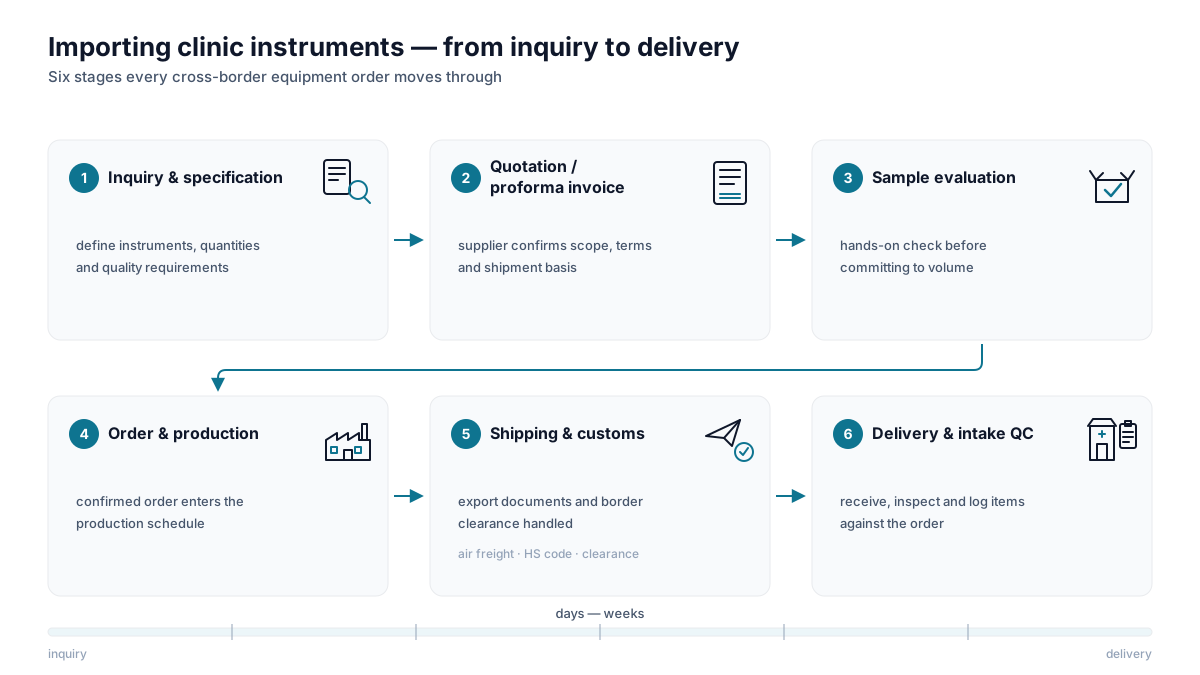
As an EU member inside the single market and the customs union, Austria presents no customs border to goods in free circulation: a shipment from Germany, Italy or Slovenia arrives like a domestic delivery, and intra-EU B2B transactions are handled through VAT reporting rather than border paperwork. Third-country goods — a direct shipment from Turkey, for instance — clear customs once at their EU point of entry, which for Austrian buyers is frequently not Austria at all but a German or Dutch hub upstream; the import-from-Turkey guide covers that corridor, and the HS code reference covers classification.
The quirk worth naming is structural rather than procedural: because so much product reaches Austria through German intermediaries, Austrian buyers often sit at the end of a two-step margin chain. Suppliers willing to invoice Austrian accounts directly — while still providing German-language documentation and local service — can be meaningfully more competitive without discounting, which is one of the quiet openings this market offers a newcomer.
Served via Germany, judged as Austria
It is common, and often sensible, for manufacturers to bolt Austria onto a German distribution agreement — same language, adjacent logistics, one contract. The trap is treating that as the whole answer. Austrian clinics notice when their "local" partner is a Frankfurt warehouse with no Austrian phone number, when service visits require a border crossing, and when marketing materials carry only German addresses. None of this blocks sales outright; all of it erodes the premium positioning that Austrian buying culture otherwise supports.
The workable patterns are captured below. Whichever is chosen, the distribution-agreement fundamentals apply — with territory language deserving special care, since Austria bundled silently into a German exclusive is a frequent source of later conflict.
| Route into Austria | Strengths | Watch-outs |
|---|---|---|
| German distributor covers Austria | One contract, shared logistics and stock | Service distance; Austria deprioritised against larger German accounts |
| Austrian sub-distributor under a German master | Local face, quick start | Double margin; clarity needed on who owns clinic relationships |
| Dedicated Austrian partner | Best service credibility and loyalty | Must carry a broad portfolio to be viable; slower to find |
Quality expectations in a market where everyone talks
Austrian quality expectations sit at the top of the European range, but they are enforced differently than in larger markets. In Germany, a failed supplier loses an account; in Austria, a failed supplier loses a reputation, because the professional community is small enough that surgeons, practice managers and dealers all know each other and compare notes. A chipped blade edge or a late replacement shipment becomes a story told at the next professional gathering, and there is no adjacent regional market inside the country to retreat to. The reverse is equally true — a supplier who resolves a problem quickly and gracefully earns word-of-mouth that no marketing budget buys.
Evaluation itself tends to be personal and surgeon-led. Austrian practices are mostly small, owner-run operations where the practitioner who uses the instrument also approves its purchase, so trials are hands-on, opinions form fast, and the feedback a supplier receives is specific and worth listening to. Sample sets should be complete and representative of production lots, not hand-picked; an Austrian surgeon who finds the volume shipment worse than the sample will treat it as a character judgment, not a logistics error.
Two practical habits fit this culture well. First, put a real person on the account — the same person over time — because continuity of contact is read as commitment to the market. Second, close the loop on every complaint in writing, even small ones; the formality is expected, and the paper trail protects both sides. In a market where relationships are the moat, complaint handling is not overhead. It is the product.
Payment, language and commercial style
Austria transacts in euros through standard SEPA rails, and its payment culture mirrors the German-speaking norm: delivery against invoice with net terms for established accounts, prepayment acceptable for early orders from new suppliers, and settlement discipline that makes credit risk a minor concern in the clinical segment. Written confirmation of orders is expected, quotations should be firm, and pricing theatrics are counterproductive.
Language deserves a finer point than "German". Austrian business culture retains a formality of address — titles are used, correspondence is polite and complete, and the Sie form is universal in B2B. German-language documentation is expected as a matter of course, and materials that acknowledge Austria specifically, rather than arriving visibly repurposed from a German campaign, land noticeably better. For a market this relationship-driven, an annual visit to key Viennese accounts is worth more than any volume of email — and the distributor route guide covers the relationship mechanics that small markets amplify.
Frequently asked questions
Is Austria worth entering separately, or should it be bundled with Germany?
Bundling the contract is fine; bundling the service is not. Many suppliers cover Austria through a German partner successfully, but the accounts respond measurably better when there is an Austrian phone number, Austrian stock or scheduled service presence, and materials addressed to the Austrian market. Decide the contract structure on logistics, and the service structure on Austrian expectations.
How large is the Austrian opportunity for a single product line?
Modest — and planning should assume that. The market's compact size means single-line volumes are small, which is why Austrian distributors carry broad portfolios and why suppliers should size minimums, marketing spend and exclusivity expectations accordingly. The compensation is stability: accounts are loyal and switching is rare.
Which authority regulates medical devices in Austria?
BASG, the Federal Office for Safety in Health Care, is the Austrian competent authority for medical devices, handling market surveillance and vigilance. Instruments carry the CE mark under the EU Medical Device Regulation, as everywhere in the single market.
Are there customs formalities when shipping from another EU country to Austria?
No — a delivery from Munich or Milan arrives like a domestic parcel, with the transaction handled through VAT reporting rather than border paperwork. The Austrian nuance sits upstream: much of what Austrian clinics buy has already cleared EU customs at a German or Dutch hub, so the import work — and an intermediary's margin — is often priced in before goods ever reach Austria. That is precisely the opening for suppliers willing to invoice Austrian accounts directly.
Does Vienna really dominate the market that much?
Yes. Clinic density, purchasing authority and the inbound patient flows from CEE and the Gulf all concentrate in the capital, with a thin second tier in Graz, Linz, Salzburg and Innsbruck. A Vienna-based partner can realistically serve the whole country, which is why Austria needs one good distributor rather than a network.
What payment terms do Austrian clinics expect?
Euro invoicing with SEPA transfer and net terms — typically around thirty days for established relationships — with prepayment normal on first orders from a new supplier. Payment discipline is strong, and formal, complete paperwork is part of being taken seriously.
Related articles
Sourcing & Import: Buying Medical Instruments Across Borders
The commercial mechanics of importing hair restoration instruments — customs, MOQs, samples, payment terms and how to evaluate a supplier before committing.
How to Become a Hair Transplant Instrument Distributor
A practical guide to building a distribution business in hair restoration instruments: how the revenue model actually works, how to build a starting portfolio, which manufacturer relationship to choose and how the first customers are won.
Distribution Agreement Terms: The Clauses That Decide Whether the Deal Works
A clause-by-clause walk through medical device distribution agreements: territory and exclusivity, minimum commitments, pricing structure, marketing obligations, IP use, termination and the post-term provisions most first-time distributors overlook.