
Buying & Distributing Hair Transplant Instruments in Portugal
Portugal is routinely folded into Iberia plans and served as an afterthought from Madrid — yet it is a distinct, price-conscious, steadily growing instrument market that rewards suppliers who treat it as its own country.
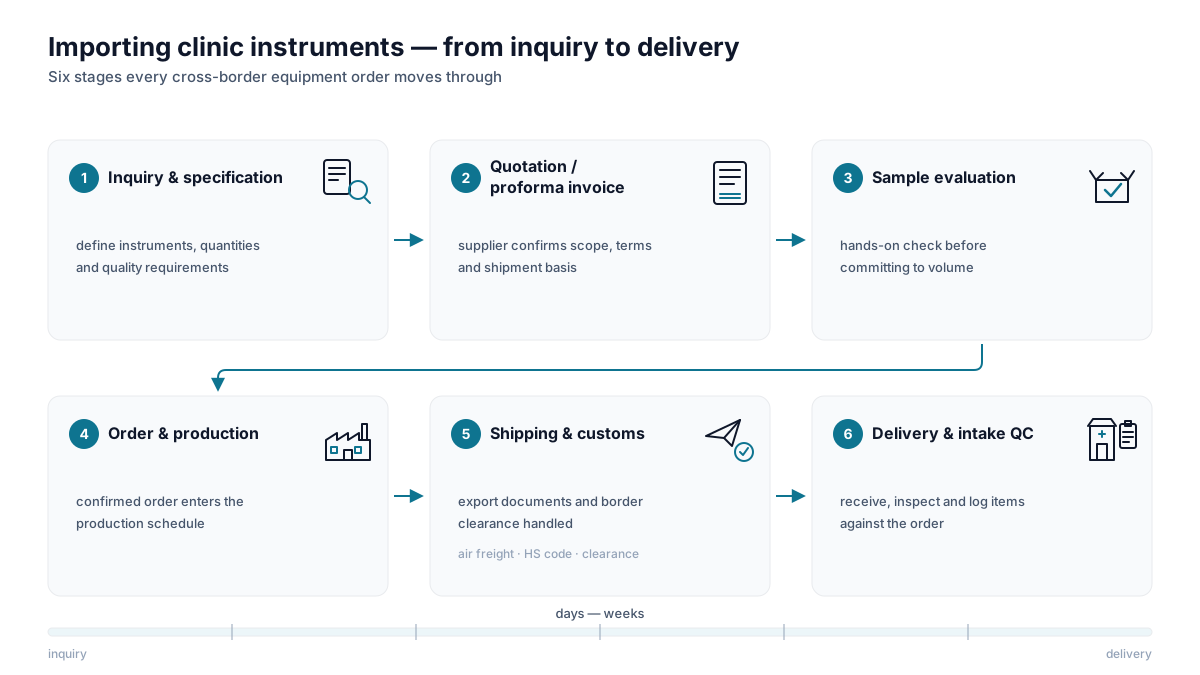
The commonest mistake foreign suppliers make with Portugal is not underestimating it — it is bundling it. In pan-European plans the country tends to appear as a line item under "Iberia", covered from Madrid or Barcelona by whoever holds the Spanish contract, and the result is a market that is structurally underserved relative to its actual demand. Portugal's procedure scene is smaller than its neighbour's but growing on its own terms, its buyers are famously careful with money and famously loyal once won, and a supplier who gives the country dedicated attention competes against surprisingly little.
Key takeaways
- Portugal is an EU single-market country: CE-marked instruments circulate freely, and INFARMED is the national medical-device authority.
- Much of the market is covered as an annex to Spanish distribution — which works logistically but often leaves Portuguese clinics under-served on language and attention.
- Demand concentrates in Lisbon and Porto, with a growing clinic scene that is price-conscious but quality-aware.
- Payment culture is careful: expect measured opening orders, negotiated terms, and strong loyalty once trust is established.
- B2B works in English, but Portuguese-language documentation and service are a genuine competitive lever precisely because they are rare.
Don't buy the Iberia bundle
Start with the structural honesty most market guides skip: a large share of the instruments used in Portuguese clinics arrive through Spanish distribution. Language proximity, a land border and the sheer weight of the Madrid and Barcelona medical-trade scene make it natural for manufacturers to appoint one Iberian partner and let Lisbon be a delivery address. Logistically this is fine — trucks cross the border without formalities, and delivery times from central Spain are short.
Commercially it is where the opportunity hides. Coverage from Spain frequently means Spanish-language quotes, a sales visit twice a year, and training delivered in Castilian to a room that would have preferred Portuguese. Portuguese buyers are polite about this and quietly resentful of it. A supplier who fields a dedicated Portuguese distributor — or at minimum a Portuguese-speaking account owner with real visit frequency — is offering something the incumbent Iberia arrangements often do not, and clinics respond to it. If you do fold Portugal into a Spanish partner's territory, write measurable Portuguese service obligations into the contract; our guide to distribution agreement terms covers how to make territory clauses enforceable rather than decorative.
INFARMED in brief
Portugal's medical-device authority is INFARMED, the National Authority of Medicines and Health Products, which handles market surveillance and the national obligations that sit alongside the EU framework. Instruments circulate under the CE mark of the EU MDR, and economic operators have notification duties in Portugal as elsewhere in the Union. Confirm current obligations with INFARMED or your regulatory adviser before first placement.
Import and customs: quiet inside the single market
For EU-origin goods there is nothing to clear: shipments from Germany, Spain or Poland move to Lisbon like domestic freight. Third-country goods — and a large share of hair-transplant instrumentation is Turkish-made — enter under the common EU tariff at whichever border they first cross. In practice many consignments destined for Portugal clear customs in Spain or at a northern European hub and travel onward freely; direct entry through Lisbon or Porto works just as well and keeps the paperwork in Portuguese hands. Classification drives duty either way, so check lines against our HS code reference, and if you are buying from Turkish manufacturers, the mechanics in the importing from Turkey guide apply unchanged — the destination port is the only variable.
One practical note: VAT-registered Portuguese buyers handle intra-EU acquisitions through the reverse-charge mechanism like their peers elsewhere in the Union, so invoicing is routine for any supplier already selling cross-border in Europe.
Lisbon, Porto and the shape of demand
Portugal's procedure market has two centres of gravity. Lisbon holds the larger and more international clinic scene — aesthetic-medicine practices, dermatology-led clinics and a small but growing set of dedicated hair-restoration providers. Porto anchors the north with a compact cluster of its own and a business culture that is, if anything, even more relationship-driven than the capital's. Outside the two metros, demand thins quickly; a distributor who covers both cities covers most of the country's purchasing.
The market's character is shaped by two honest facts. First, Portuguese patients have historically travelled for hair restoration — to Turkey above all — which kept the domestic procedure base modest. Second, that is visibly changing: domestic clinics are multiplying and competing on the argument of local follow-up care, and each new clinic is an instrument account that did not exist before. This is a growth market from a small base, which means buyers are often first-time purchasers of FUE instrumentation. They need more guidance than a seasoned Madrid or Istanbul buyer, they compare carefully, and they reward suppliers who teach rather than merely quote. Practical support — help specifying a first instrument set, sensible starter quantities, training for technicians who are new to the work — converts better here than glossy catalogues, and the supplier who educated a clinic at its founding tends to keep the account as it grows. Price matters — Portuguese clinics operate at lower procedure prices than northern Europe and buy accordingly — but the cheapest option does not automatically win; predictable quality at a fair price does.
The Lusophone bridge
Portugal carries one structural asset that the Iberia framing obscures entirely: language reach. Portuguese medical trading houses have long-standing commercial ties across the Lusophone world — Angola, Mozambique and Cape Verde above all, with softer links to Brazil — and several Lisbon-based distributors quietly re-export medical goods into Portuguese-speaking Africa as a routine part of their business. For an instrument manufacturer, this can turn a small-market partner into a door onto markets that are otherwise hard to research and harder to serve. Treat the opportunity honestly, though: PALOP demand is opportunistic and logistics-dependent rather than a guaranteed channel, each destination has its own regulatory and import realities that a Portuguese registration does not cover, and the re-export leg belongs in the distribution agreement as an explicitly discussed territory question, not a discovered surprise. Raised early, it is a genuine bonus; discovered late, it is a dispute.
Distribution structure and payment customs
The domestic distribution scene is small and personal: family-run medical trading houses, a handful of aesthetics-focused importers, and dental-surgical distributors who have added hair-restoration lines as the segment grew. Portfolios are broad because the market's size demands it — a partner carrying only punches and blades cannot live on Portugal alone — so expect your products to sit alongside adjacent categories, and evaluate whether the partner's existing call cycle actually reaches hair clinics rather than hospitals.
Payment behaviour is conservative in the best sense. Opening orders are deliberately small; Portuguese buyers test a supplier with a modest purchase and expand steadily when service proves out, a pattern worth accommodating with sensible minimums — see our MOQ guide for structuring that first tier. Terms are negotiated rather than assumed: prepayment or proforma invoicing is normal at the start, migrating to 30- and then 60-day SEPA transfer terms as trust builds. Payment discipline in the private aesthetic segment is reasonable, but build the relationship before extending meaningful credit. Once established, Portuguese accounts are notably loyal — switching suppliers is treated as a serious step, not a sport.
Two administrative notes save friction later. Portuguese businesses issue invoices through certified invoicing software under national rules, so your partner's paperwork will be precise and they will expect the same discipline in return — sloppy commercial documents read badly here. And if your distributor serves Madeira or the Azores, expect the islands to add sea or air legs, their own lead times and locally reduced VAT rates; it is a small slice of demand, but one a Lisbon partner prices in as routine.
Language belongs in the commercial calculus. Nearly every Portuguese clinic owner and buyer you meet will manage in English, and B2B email runs bilingually without friction. But quotes, IFUs and training materials in Portuguese signal commitment in a market accustomed to being served in someone else's language — a cheap differentiator that few competitors bother with.
Three ways to cover Portugal
| Route | What it looks like | The honest trade-off |
|---|---|---|
| Annex to a Spanish partner | One Iberian distributor, Lisbon served from Spain | Efficient, but service quality in Portugal depends entirely on contract discipline |
| Dedicated Portuguese distributor | A local house owning INFARMED-side duties, stock and clinic visits | Best service and loyalty; partner needs a broad portfolio to sustain itself |
| Direct supply to key accounts | EU cross-border sales to the largest Lisbon and Porto clinics | Workable inside the single market for sophisticated buyers; leaves the long tail uncovered |
Whichever route you take, judge it by visit frequency and language, not by the map. Broader groundwork on structuring market entry sits in our sourcing and import hub.
Frequently asked questions
Can I serve Portugal through my Spanish distributor?
Logistically yes — goods move freely across the border and delivery times are short. Commercially it works only if the contract obliges real Portuguese coverage: visit frequency, Portuguese-language service and local training. Many Iberia arrangements underdeliver on exactly those points, which is the opening for dedicated Portuguese distribution.
Who regulates medical devices in Portugal?
INFARMED, the National Authority of Medicines and Health Products, is the national competent authority, operating within the EU framework. Instruments circulate under the CE mark of the EU MDR, and national notification duties apply to economic operators.
Is the Portuguese market too small to justify its own distributor?
It is small but concentrated — Lisbon and Porto account for most purchasing — and growing from a low base as domestic clinics win back patients who previously travelled abroad. A distributor with a broad aesthetics or surgical portfolio can serve it profitably; a punches-only partner cannot.
What payment terms do Portuguese buyers expect?
Prepayment or proforma invoicing at the start of a relationship, moving to 30- and 60-day SEPA terms as trust builds. Opening orders are deliberately modest; buyers scale up steadily once service proves reliable, and they are notably loyal thereafter.
Do I need Portuguese-language documentation?
English will get you through most B2B conversations, but Portuguese-language quotes, instructions and training materials are a real differentiator in a market often served in Spanish or English by default. Treat the language investment as a competitive lever rather than a compliance chore.
Related articles
Sourcing & Import: Buying Medical Instruments Across Borders
The commercial mechanics of importing hair restoration instruments — customs, MOQs, samples, payment terms and how to evaluate a supplier before committing.
Importing Hair Restoration Instruments from Turkey: A Practical Guide
Why Turkey became a manufacturing base for hair-restoration instruments, and the practical import mechanics — Incoterms, customs documents, duty and VAT logic — for buyers in the EU, UK and Gulf.
The European Hair Restoration Market: A Qualitative Overview for Distributors
What the European hair restoration landscape looks like from a distributor’s chair: the forces driving demand, how the major regions differ in character and buying culture, and where supply-side opportunities actually sit.
Distribution Agreement Terms: The Clauses That Decide Whether the Deal Works
A clause-by-clause walk through medical device distribution agreements: territory and exclusivity, minimum commitments, pricing structure, marketing obligations, IP use, termination and the post-term provisions most first-time distributors overlook.