
OEM Surgical Instruments: Your Brand, the Maker's Factory
What OEM really means for hair transplant instruments: which specifications you can change without tooling investment, how qualification from drawing to pilot lot works, and who ends up owning what.
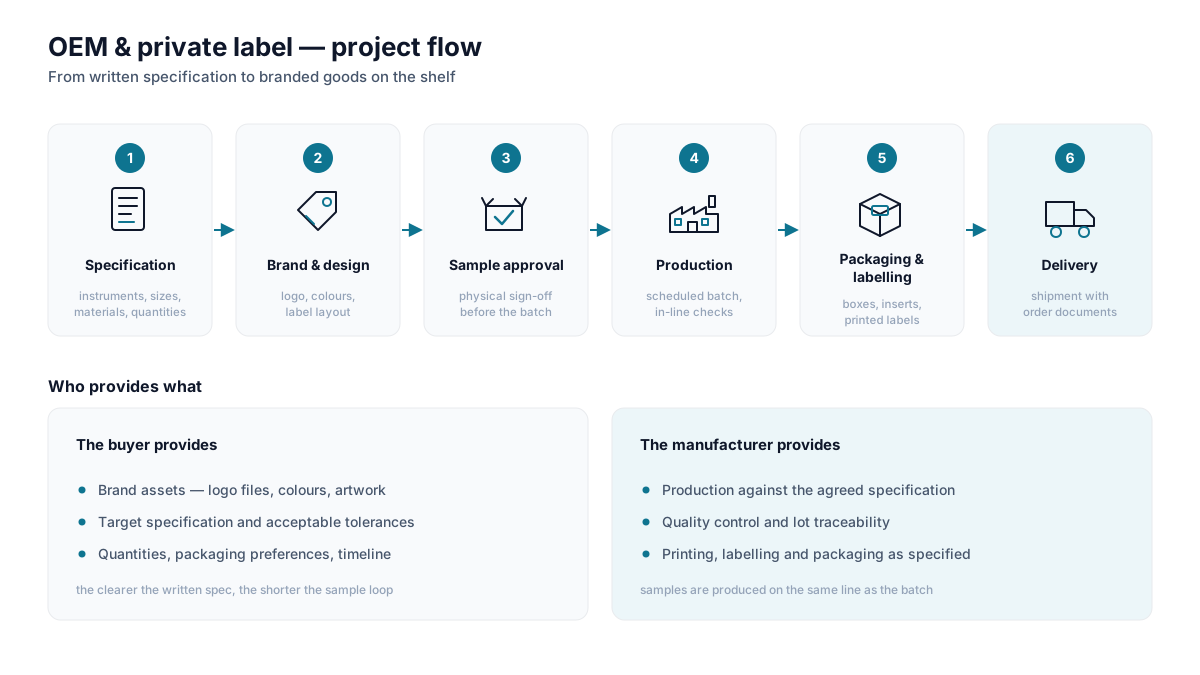
OEM surgical instruments means instruments produced in an established maker's factory but sold under your brand: your name on the packaging and, where the design allows, on the instrument itself, with specifications either taken from the maker's proven designs or defined by you. The commercial reality that shapes every such project is the line between customisation that is essentially free — laser marking, packaging, set configuration, surface finish options — and customisation that requires tooling and engineering investment, which is where core geometry changes live. Understand that line, the qualification sequence from drawing to pilot lot, and who owns what at the end, and you can brief an instrument OEM project like a professional. This guide covers all three.
Key takeaways
- OEM instruments put your brand on a manufacturer's production capability — the fastest version uses their proven designs, the deepest version manufactures to your drawings.
- The cost line is tooling: marking, packaging, finish and set configuration are low-cost customisations, while new geometries need tooling and engineering investment that must amortise over volume.
- Qualification is a sequence — specification, drawings, first articles, evaluation, pilot lot — and skipping steps to save weeks is how brands end up recalling boxes.
- IP ownership is contractual, not automatic: who owns custom drawings, tooling and exclusivity must be written down before development money is spent.
- Your brand carries the market-facing responsibility for what it sells, so choose a manufacturer you have verified, not just visited.
What OEM means in instruments, precisely
The hair restoration instrument market runs on a small number of real factories and a much larger number of brands. Punches, sapphire blades, implanter pens and forceps sold under many different names frequently originate from shared production capability — which is neither scandal nor secret, but the normal structure of surgical instrument manufacturing. OEM is the arrangement that makes you one of those brands deliberately: instead of reselling a maker's catalog under their name (the wholesale model) or joining a distribution programme, you commission production under your own identity.
Within that arrangement sit two distinct depths, and conflating them causes most early confusion. Brand-on-proven-design takes the manufacturer's existing, production-validated instrument — an 0.9 mm serrated punch, an 18G implanter — and applies your identity: marking, packaging, set composition, documentation. Development is measured in weeks because nothing about the instrument itself changes. Manufacture-to-specification starts from your drawings or requirements — a punch wall thickness the catalog does not offer, a handle ergonomic your surgeons designed — and engages real engineering: tooling, prototyping, first-article inspection. Development is measured in months and priced accordingly. Most successful instrument brands start with the first depth, learn from the market, and reserve the second for the products where their specification genuinely differs. The equivalent decision in cosmetics — private label versus OEM formulation — follows the same logic and is compared in the OEM versus private label guide.
What you can customise — and what needs tooling
The engineering economics of instrument production draw a sharp line between changes that ride on existing tooling and changes that require new tooling or process development. The table below is the honest version of the conversation a good manufacturer will have with you.
| Element | Typically available without tooling investment | Requires tooling or engineering investment |
|---|---|---|
| Brand marking | Laser marking of your logo or name on handles and bodies; printed hubs where designs allow | Marking on geometries with no flat marking surface; moulded-in logos on plastic parts |
| Packaging | Your artwork on pouches, boxes, set trays; your lot-label layout | Custom thermoformed trays or novel sterile-barrier formats requiring validation |
| Set configuration | Custom assortments — diameters, counts, mixed instruments per box | None — configuration is a packing decision, use it freely |
| Surface finish | Available finish options: satin, mirror, existing coating lines | New coatings or treatments outside the maker’s validated processes |
| Dimensions within range | Selecting from the produced range — e.g. punch diameters, blade widths, needle gauges | Dimensions outside the produced range; new wall thicknesses or edge geometries |
| Core geometry | — | New punch tip geometries, novel implanter mechanisms, bespoke handle designs — prototyping, tooling and test cycles |
The practical use of this table is sequencing your brief. List what your brand genuinely needs on day one, and check how much of it sits in the left column — usually almost all of it. A distinctive set composition, professional packaging in your artwork, clean laser marking and a well-chosen assortment from the produced range create a fully branded, differentiated product with no tooling spend at all. The right-column items are not forbidden; they are investments, and they should be justified the way investments are — by expected volume and real clinical differentiation, not by the aesthetic preference of a launch meeting.
The product families on the table
OEM conversations in this niche usually cover a familiar basket: FUE punches across the standard diameter range in disposable and reusable formats; sapphire and steel incision blades with their handles; DHI-style implanter pens and their consumable needles; micro forceps and other graft-handling instruments; and composed surgical sets that combine them into procedure-ready configurations. Instruments differ in how much brand surface they offer — a punch shows your name mostly on its packaging, while an implanter pen or forceps carries marking visibly through years of use — which is worth weighing when you decide where the brand investment goes. The broader equipment context these instruments sit in is mapped in the clinic equipment hub.
Qualification: from specification to pilot lot
Whatever the customisation depth, disciplined OEM projects walk the same sequence, and each step exists because skipping it has burned somebody.
- Specification agreement. Product definition in engineering terms: dimensions and tolerances, materials, finish, sterility format, packaging and marking. For brand-on-proven-design projects this is largely selecting from documented options; either way, it ends in a written specification both sides sign.
- Drawings and quotation. The manufacturer returns technical drawings, unit pricing at volume tiers, tooling costs where relevant, and lead times. Read the drawings — errors caught here cost nothing.
- First articles or samples. Physical instruments from production processes — not hand-finished showpieces — inspected and, where appropriate, evaluated in realistic use by your clinical advisors.
- Evaluation and iteration. Structured feedback against the specification, and a revision loop if needed. One disciplined iteration is normal; endless loops signal a specification problem, not a manufacturing one.
- Pilot lot. A first production run at modest quantity, made with production tooling, packed in production packaging with your artwork and lot labelling. This is the run that proves consistency, which samples cannot.
- Series production. Scheduled runs against your orders or a framework agreement, with the pilot lot as the reference standard for every lot that follows.
Incoming inspection on your side should continue past qualification — checking received lots against the retained pilot-lot reference is the cheapest quality system a small brand can run. What to inspect on arrival, particularly for sterile-packed product, is covered in the instrument sterility and packaging guide.
Who owns what: IP and brand questions to settle early
Instrument OEM creates several assets, and ownership of each is decided by contract, not by assumption. Your trademark is straightforwardly yours. Custom drawings and designs you paid to develop should be assigned to you or exclusively licensed — put it in writing before development starts, because negotiating ownership after the tooling exists reverses the leverage. Tooling itself is commonly owned by whoever paid for it, but possession stays at the factory; the agreement should say what happens to your tooling if the relationship ends. Exclusivity is the subtlest asset: a maker can rarely promise that nobody else will sell a similar catalog-based product, but they can contractually agree not to supply your custom geometry to others, and serious manufacturers will distinguish those two promises plainly rather than blurring them. One more allocation belongs in the same conversation: as the brand placing instruments on a market, your company carries that market's product-responsibility obligations, and the manufacturing agreement should state which documentation the maker provides to support them.
MOQ and commercial structure
Instrument MOQs follow production batch logic — machining runs, grinding setups, sterilisation loads and packaging runs each have minimum economic sizes — so minimums vary by product family and by how much of the packaging is custom-printed. Qualitatively: catalog-based OEM with custom packaging starts at the friendliest thresholds, often reachable for a single ambitious clinic group; custom-geometry products must additionally amortise their tooling, which pushes sensible first commitments higher. Structural levers work here as everywhere in manufacturing — mixed-SKU orders that share setups, framework agreements drawn down over a year, phased deliveries — and the general mechanics of minimums and how to negotiate their structure are covered in the instrument MOQ guide.
Choosing the factory behind your brand
Everything above assumes a manufacturer worth building on, which is the real decision. The evaluation discipline is the same as for any instrument supplier — verify production capability, batch consistency, documentation practices and reference customers, as laid out in how to evaluate an instrument manufacturer — with one OEM-specific addition: assess them as a development partner, not only a producer. How they handle your specification questions during quoting predicts how they will handle a tolerance problem in year two. A maker who pushes back on an unmanufacturable request at the drawing stage is showing you exactly the behaviour you are buying.
Life after launch: running an instrument brand
Qualification ends with a pilot lot; the brand's real work starts with lot two. Three operational habits separate instrument brands that last from those that fade after the launch stock sells through.
Consistency monitoring. Every received lot should be checked against the retained pilot-lot reference — dimensions on a sample basis, edge condition where relevant, packaging integrity, lot documentation. This is hours of work per delivery, and it is the difference between catching a drift at goods-in and hearing about it from a surgeon. Manufacturers behave measurably better for customers they know inspect.
Complaint routing. When a clinic reports a problem with a branded instrument, the report reaches you, not the factory — that is what carrying the brand means. Agree in advance how complaints flow to the manufacturer, what investigation they owe you, and on what timeline. A maker who treats a complaint as an input to their process rather than an insult to their honour is worth keeping; you learn which kind you have the first time it happens, which is why small problems early in the relationship are strangely valuable.
Supply security. Your brand's reliability is now coupled to one factory's capacity and priorities. Mitigations are ordinary but must be deliberate: safety stock proportional to lead times, framework agreements that reserve capacity, early warning clauses for material or process changes, and — for the products your business genuinely depends on — an honest assessment of how quickly a second source could be qualified if it ever came to that. None of this signals distrust; manufacturers with professional OEM customers expect exactly these questions and answer them fluently.
The pattern across all three habits is the same: an instrument brand is an ongoing quality relationship wearing a logo, and the buyers who treat it that way keep both the logo and the quality.
Start an instrument OEM conversation
If you can describe the instruments you want to brand, the markets you sell into and a realistic first-year volume, the response can be concrete: which items ride on proven designs, which need tooling, and what qualification against your timeline looks like.
Frequently asked questions
What is the difference between OEM and wholesale for instruments?
Wholesale means buying a maker’s catalog products under the maker’s or no brand, at trade prices. OEM means the products carry your brand — at minimum through marking and packaging on proven designs, at maximum manufactured to your own specification. Wholesale is a purchasing relationship; OEM is a manufacturing partnership with qualification steps and contracts to match.
Can I put my brand on instruments without designing anything?
Yes — that is the most common form of instrument OEM. The maker’s production-validated designs are supplied with your laser marking, your packaging artwork and your set configurations. Because nothing about the instrument changes, development is measured in weeks, and minimums are the friendliest available.
What does changing an instrument’s geometry involve?
Tooling and engineering: prototyping, new production setups, first-article inspection and test cycles, with costs that must amortise over expected volume. It is justified when your specification genuinely differs from what the produced range offers — not for cosmetic distinctiveness, which marking, finish and packaging deliver far more cheaply.
Who owns the design and tooling in an OEM project?
Whatever the contract says — which is why it must say something. The usual healthy arrangement: your trademark is yours, custom designs you funded are assigned or exclusively licensed to you, tooling belongs to whoever paid for it with agreed terms for release, and custom geometries are contractually excluded from supply to other brands.
What minimum quantities should I expect?
It varies by product family and packaging depth. Catalog-based OEM with custom packaging carries the lowest thresholds — sometimes within reach of a large clinic group. Custom geometries add tooling amortisation and push sensible first commitments higher. Mixed-SKU orders, framework agreements and phased delivery are the standard levers for making minimums manageable.
How long does qualification take?
Brand-on-proven-design projects typically qualify in weeks: specification, samples, pilot lot. Custom-geometry projects run months, dominated by tooling and iteration cycles. The step not to compress is the pilot lot — a production-tooling, production-packaging run is the only honest preview of what your customers will receive.
Related articles
Hair Transplant Clinic Equipment: The Complete Stack
The full equipment stack of a hair transplant clinic, from operating table to autoclave — written for founders specifying their first operating room.
How to Evaluate an Instrument Manufacturer
A balanced seven-criterion framework distributors and clinics can use to vet instrument manufacturers before committing a territory or a large order.
Instrument Sterility and Packaging: A Buyer's Guide
What clinic buyers need to know about sterile and non-sterile supply formats, sterile barrier packaging, sterilisation methods, receipt inspection, shelf life and storage.
OEM vs Private Label vs White Label for Hair Products
The three routes to selling hair care under your own brand — OEM, private label and white label — compared on control, speed, minimums, cost and IP ownership.