
Opening a Hair Transplant Clinic in the United States
There is no national clinic license in the United States. Everything that matters — physician licensure, who may own the clinic, facility rules, what technicians may do — is decided state by state, which makes choosing the state the first real decision.
Ask what license a hair transplant clinic needs in the United States and the honest answer is: it depends on the state, because there is no such thing as a national clinic license. Physicians are licensed by state medical boards, the rules on who may own a medical practice differ from state to state, facility requirements for office-based procedures are set by a patchwork of state rules and voluntary accreditation, and the scope of what technicians may do varies just as widely. That fragmentation is not a footnote — it is the organizing fact of the entire project. The first real decision in a US clinic plan is not the logo or the lease; it is the state.
Key takeaways
- Physician licensure runs through state medical boards — a license in one state confers nothing in another, though interstate compact pathways can speed additional licenses.
- Corporate-practice-of-medicine doctrines mean some states restrict non-physician ownership of medical practices, shaping the corporate structure before formation.
- Facility rules for office-based surgery are largely state- and accreditation-driven rather than federal; several states tie requirements to sedation level.
- Malpractice insurance is a genuine, recurring cost line that varies significantly by state and must be priced into the business plan, not discovered later.
- What technicians may lawfully do in an FUE procedure differs by state — the staffing model must be designed around delegation rules, not imported from abroad.
Fifty regulatory environments, not one
The physician side is the most uniform part of the picture, and even it is state-bound. Every doctor performing or supervising hair restoration surgery must hold a license from the medical board of the state where the clinic operates; the Federation of State Medical Boards maintains the directory of those boards and operates the licensure services many physicians use when adding states. Hair restoration itself is not a board-certified specialty gate — physicians from dermatology, plastic surgery and other backgrounds all practice it — but the license must be active, unrestricted and in the right state, and telemedicine consults across state lines bring their own rules.
Everything beyond licensure fragments further. States differ on facility registration for office-based surgery, on whether specific procedure rooms need state notification or accreditation, and on the advertising rules that govern how aggressively a cosmetic practice may market. None of this is unmanageable — thousands of aesthetic practices navigate it — but it means the compliance research must be done for the specific state, and a plan copied from a colleague in Florida may simply be wrong in New York.
The state decision is therefore a genuine strategy exercise, not an afterthought of where the founder happens to live. The large cosmetic-medicine markets each present a different bundle: some combine deep patient demand with crowded competition and heavier regulatory or insurance burdens, while others pair lighter-touch rules and lower operating costs with thinner or more price-sensitive demand. Layer the legal variables — ownership doctrine, delegation rules, insurance pricing — over the commercial ones, and the map narrows quickly to a shortlist worth visiting in person.
Ownership: the corporate-practice-of-medicine question
Before forming any entity, confront the corporate-practice-of-medicine question. A number of states maintain doctrines restricting who may own a medical practice or employ physicians for clinical work — in those states, the operating clinical entity typically must be physician-owned, and non-physician investors participate through management services arrangements rather than direct ownership of the practice. Other states are permissive and the distinction barely bites. The practical consequence is that the corporate structure of a US hair transplant clinic is a state-specific legal design task: physician founders in permissive states can keep it simple, while investor-backed projects in restrictive states need the clinical entity and the management company structured correctly from day one. This is one of the few areas of the project where experienced healthcare counsel in the target state is not optional.
Facility standards: accreditation does the heavy lifting
Federal law does not define what a hair transplant procedure room must look like. Instead, facility expectations arrive through two channels: state office-based surgery rules — which in several states are triggered by the level of sedation used rather than by the procedure itself — and voluntary accreditation through recognized bodies for office-based surgical facilities. Because hair restoration is typically performed under local anesthesia, many US clinics sit below the thresholds that force registration or accreditation; plenty pursue accreditation anyway, both as an internal quality framework and as a marketing signal in a market where patients research hard.
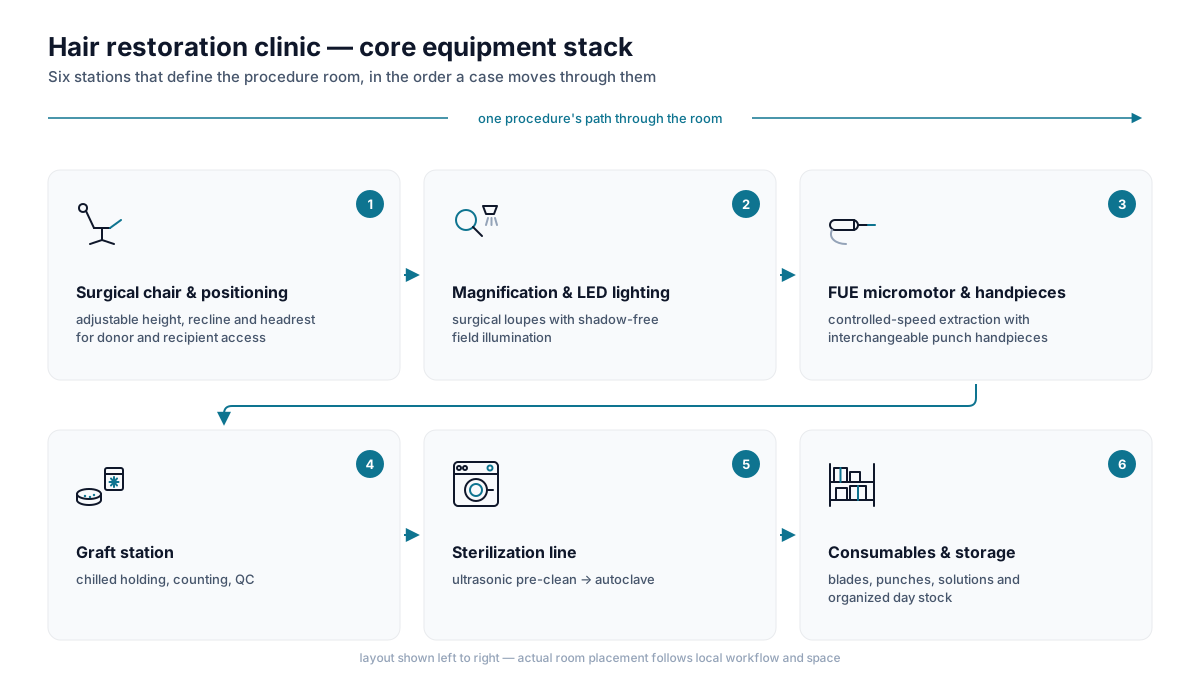
Whatever the formal trigger points, the substantive expectations are consistent with good practice anywhere: a procedure room designed for long local-anesthetic surgery, emergency preparedness proportionate to the setting, and a real instrument-reprocessing workflow with a properly commissioned autoclave and documented cycles. Our operating room setup guide covers the room itself, and the broader clinic equipment hub maps everything that has to be inside it.
Malpractice insurance: a real line in the budget
In most markets a founder treats insurance as paperwork; in the United States it is a structural cost. Medical professional liability coverage for a physician performing cosmetic surgical procedures varies significantly in price by state, specialty classification and coverage limits, and the difference between jurisdictions can be large enough to influence the state decision itself. Beyond the premium, the litigation environment shapes daily operations: documentation standards, consent processes and photographic records are managed with an eye to defensibility, and reputable carriers effectively function as a second quality regulator through the risk-management conditions they attach. Budget the premium as a recurring cost line from the first pro forma, get quotes early — insurability questions are better discovered before the lease is signed — and treat the carrier's risk-management guidance as free consulting rather than friction.
Staffing and the delegation question
The staffing model deserves special care because it is where international experience most often misleads. In the high-volume clinics of Turkey much of the procedure is performed by technicians; in the United States, what an unlicensed or allied-health team member may lawfully do — making incisions, extracting grafts, placing grafts — is governed by state delegation and scope-of-practice rules, and the answers differ meaningfully between states. Some states allow broad physician delegation under supervision; others restrict core surgical steps to licensed clinicians. Design the staffing model around the target state's rules, document the supervision structure, and be conservative where the rules are silent: delegation practice is an active enforcement topic in cosmetic medicine, and it is also a common thread in malpractice claims.
Equipping the clinic
Equipment procurement is the least bureaucratic part of a US launch. Instruments and devices sold in the United States must comply with FDA requirements, and clinics simply buy from US-based suppliers and distributors — punches, implanters, micromotors, consumables and sterilization equipment are all available domestically, usually with fast shipping and credit-card simplicity that surprises founders used to import projects elsewhere. The real work is specification and budgeting rather than access: choosing instrument systems the surgical team actually wants, sizing the autoclave to daily caseload, and resisting the temptation to over-buy before case volume justifies it. The US market also offers options thinner elsewhere — a liquid secondary market in refurbished capital equipment and leasing structures for larger purchases — which let a cash-disciplined startup put its money into instruments the surgeon touches daily rather than into over-specified capital items. The clinic equipment budget guide breaks the spend into honest categories and is written for exactly this planning stage.
A realistic sequence
- Choose the state — deliberately. Weigh patient demographics and competition alongside corporate-practice rules, delegation rules and insurance costs. This decision constrains everything else.
- Design the corporate structure. Physician-owned practice, or practice-plus-management-company, per the state's doctrine; engage healthcare counsel in-state.
- Secure licensure and credentials. Confirm the physician's license in the target state (or begin the additional-license process), and line up DEA registration and local prerequisites tied to practice.
- Bind insurance. Get malpractice quotes early; let coverage realities inform the final go/no-go.
- Premises and buildout. Lease and fit out a procedure-appropriate space; check whether local or state office-based-surgery provisions or planned accreditation impose design requirements before construction.
- Hire to the delegation model. Recruit nursing and technician staff against the state's scope-of-practice reality, with written supervision protocols.
- Equip, commission, document. Purchase domestically, commission the sterilization workflow, and stand up consent, records and photography systems.
- Open and market within the rules. Cosmetic-practice advertising is regulated speech; build the marketing engine on claims you can substantiate.
For the operational detail behind each step, our printable clinic startup checklist keeps the threads visible through the buildout months.
Frequently asked questions
Is there a federal license for hair transplant clinics in the US?
No. Physicians are licensed by state medical boards, and facility requirements come from state rules and voluntary accreditation. The regulatory environment is chosen when you choose the state.
Can a non-physician own a hair transplant clinic?
It depends on the state. Corporate-practice-of-medicine doctrines in some states require the clinical practice to be physician-owned, with non-physician investors participating through management services structures; other states are permissive. Structure the entity with in-state healthcare counsel.
Does a hair transplant clinic need facility accreditation?
Often not as a legal matter, because procedures under local anesthesia sit below many states' office-based-surgery thresholds — but requirements vary by state and by sedation level, and many clinics pursue voluntary accreditation for quality and marketing reasons.
How big a factor is malpractice insurance?
A significant recurring cost that varies by state, specialty classification and limits — large enough that it can rationally influence the choice of state. Obtain quotes during planning, not after signing a lease.
Can technicians perform parts of the procedure like in Turkey?
Only to the extent the state's delegation and scope-of-practice rules allow, and states differ meaningfully on steps like incisions, extraction and placement. Design the staffing model around the target state's rules and document physician supervision carefully.
Is buying equipment complicated in the US?
It is the easy part. Devices sold in the US must comply with FDA requirements, and clinics buy domestically from US suppliers with short lead times. The real task is specifying the right instruments and sizing the budget to realistic early case volume.
Related articles
Hair Transplant Clinic Equipment: The Complete Stack
The full equipment stack of a hair transplant clinic, from operating table to autoclave — written for founders specifying their first operating room.
The Equipment Budget for a New Hair Transplant Clinic: Categories and Phasing
A budget structure for equipping a new hair transplant clinic: the three ledgers — capital, consumables, hidden costs — how to phase purchases so cash follows patients, where cheap equipment gets expensive, and an honest word on financing.
Hair Transplant Clinic Startup Checklist: Every Equipment Category, in Order
A category-by-category equipment walkthrough for opening a hair transplant clinic: what belongs in the OR, the sterilization line, instrument sets and consumables — and the order to buy it in.
Operating Room Setup for Hair Transplantation: Space, Light and Flow
The operational logic of a hair transplant OR: how to zone the room, position the table and team, layer the lighting, secure power and climate, and build ergonomics that survive eight-hour sessions.