
Opening a Hair Transplant Clinic in the United Kingdom
In England the defining step is CQC registration: hair transplant surgery is a regulated activity, and the provider, its registered manager and its premises must all pass scrutiny before the first patient. Here is how the whole setup actually sequences.
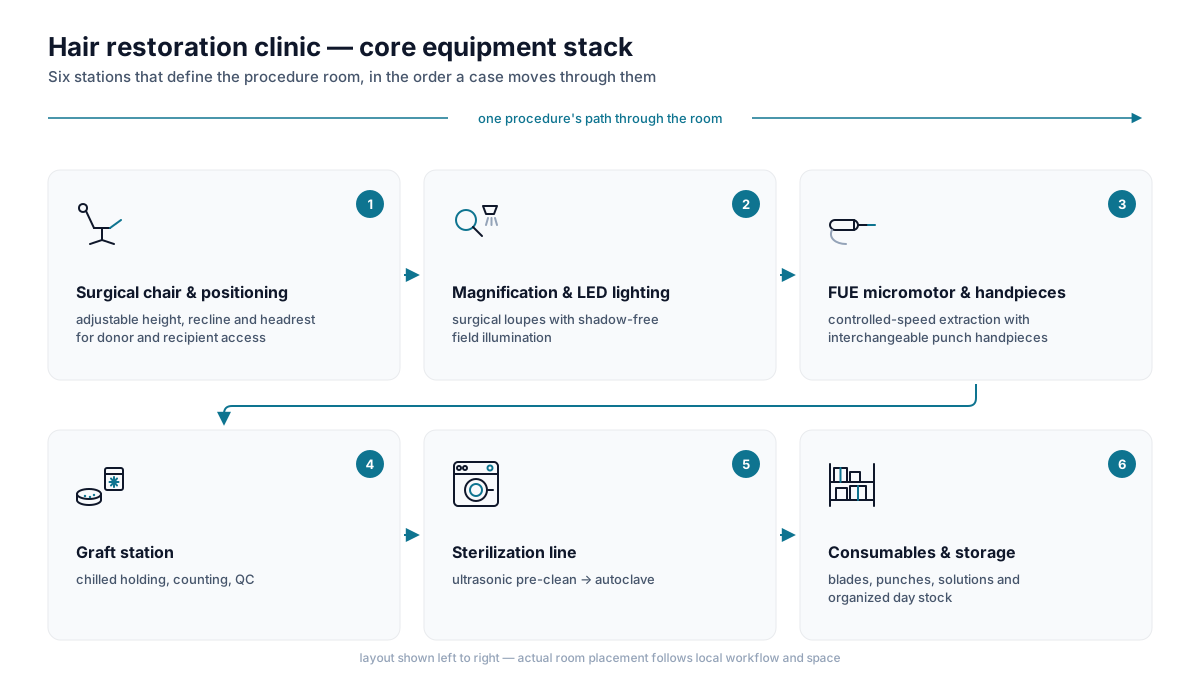
Opening a hair transplant clinic in the United Kingdom is, above all, a registration project. Hair transplantation is surgery, and in England any provider carrying on surgical procedures must be registered with the Care Quality Commission before treating a single patient — which means the CQC's expectations about your governance, your people and your premises shape the whole venture from day one, long before equipment arrives. Founders who treat registration as a form to file at the end routinely lose months; those who build the clinic around what an inspector will want to see tend to open on schedule.
Key takeaways
- In England, hair transplant surgery falls under CQC-regulated activities: the provider must be registered, with a fit registered manager, before opening.
- Scotland, Wales and Northern Ireland run their own equivalent regulators, so the registration route depends on where the clinic sits.
- Surgeons must hold GMC registration with a licence to practise; the wider team is built around that clinical accountability.
- Decontamination and infection-prevention arrangements are inspected in practice, not just on paper — plan the sterilization line into the floor plan.
- The realistic sequence runs company, premises, people and policies, CQC application, then fit-out and equipment while the application is processed.
Who licenses the clinic — and who may hold the scalpel
The licensing authority for independent healthcare in England is the Care Quality Commission, and its logic is worth internalising early. The CQC does not license "a hair clinic" as such; it registers a provider — a company or individual — to carry on defined regulated activities, of which surgical procedures is the relevant one, at defined locations. Registration requires a registered manager who is personally accountable for day-to-day quality, a statement of purpose describing what the service does, and evidence that the provider meets fundamental standards of safety, governance and staffing. If your clinic will sit in Scotland, Wales or Northern Ireland instead, the same idea applies through Healthcare Improvement Scotland, Healthcare Inspectorate Wales or the RQIA respectively.
On the practitioner side, the anchor is the General Medical Council. Hair transplant surgery in the UK is performed under the responsibility of doctors holding GMC registration with a licence to practise, and the GMC's professional standards — consent taken by someone with appropriate knowledge, honesty in marketing, cooling-off space for cosmetic decisions — apply squarely to hair restoration. Nurses on the team register with the NMC, and every clinical hire will need employment checks including DBS clearance as part of the CQC's fit-person expectations. There is no separate statutory "hair transplant surgeon" qualification; competence is assessed through the general framework of medical regulation plus your own governance, which is precisely why inspectors look hard at training records and audit.
Premises and sterilization: what inspection-readiness means
British regulation of clinic premises is outcome-driven rather than prescriptive, but the outcomes are checked in person. Expect scrutiny of how the procedure room is ventilated, cleaned and separated from patient-facing and administrative space; how sharps and clinical waste are segregated and removed under contract; and how the clinic prevents infection across the whole patient pathway, typically with a named infection-prevention lead and a written protocol the team can actually describe when asked.
Reprocessing deserves a decision before the floor plan is fixed. A UK clinic reusing surgical instruments needs a credible decontamination arrangement — a dedicated dirty-to-clean workflow with washer-disinfection and steam sterilization in line with national decontamination guidance, or a documented single-use policy that eliminates reprocessing for the items concerned. Either route is defensible; a vague mixture of the two is what fails inspections. Our guides to sterilization room setup and operating room requirements cover the physical logic in detail, and both are worth reading before you sign a lease, because plumbing, drainage and room count are cheaper to change on paper.
Buying devices for a UK clinic
Instrument and equipment purchasing for a UK clinic is shaped by the post-Brexit marking regime: devices are placed on the British market under UKCA marking, with CE-marked devices accepted under transitional arrangements whose deadlines have shifted more than once — check the current MHRA position rather than assuming. For a founder, the practical discipline is to buy from suppliers who provide clean documentation — appropriate marking, instructions for use, lot traceability — and to keep those records with your equipment inventory, since device provenance is a natural question in any well-run governance audit. The clinic equipment hub maps the full purchasing landscape from punches to sterilizers.
A realistic setup sequence for the UK
The defining feature of the British sequence is that the CQC application sits in the middle, not the end, and that its processing time — typically some months — becomes your fit-out window.
- Form the company and secure funding. Registration is granted to a legal entity; incorporate early so leases, employment and the CQC application all sit under the provider that will actually operate.
- Find premises and design for compliance. The application names a location, so the lease usually comes before the licence. Involve whoever will lead on infection prevention in the layout, and budget the works honestly — the equipment budget guide shows how capital, consumables and hidden costs split.
- Recruit the accountable people. The registered manager, the lead surgeon and the governance framework around them are the heart of the application. DBS checks, references and interviews take longer than founders expect.
- Write the operational backbone. Statement of purpose, clinical policies, consent pathway, decontamination protocol, incident and complaints procedures — written to be used, because inspectors interview staff against them.
- Submit the CQC application and use the waiting time. While the assessment runs, complete fit-out, order equipment against realistic lead times, and train the team on the actual kit.
- Open only after registration is granted. Treating patients while unregistered is an offence; the first weeks after opening are for embedding audit habits, since a first inspection can follow relatively early.
For a phase-by-phase working document you can adapt, download the clinic startup checklist — it tracks the licensing, premises, staffing and equipment threads in parallel, which is exactly how a UK opening actually runs.
Building the team: the question everyone asks
The staffing model is where UK founders spend the most planning time, because hair transplantation is delivered by teams — a surgeon plus assistants handling graft preparation and, in many models, implantation — and the division of labour must be defensible under British clinical governance. The safe framing is accountability: the GMC-registered surgeon remains responsible for the surgical care, delegation happens only within each team member's demonstrated competence, and the clinic can evidence how that competence was trained, assessed and reviewed. Recruitment is its own challenge in a market where experienced hair-restoration assistants are scarce: most new UK clinics either hire from existing providers, buy structured training from experienced practitioners, or grow their own team slowly with the surgeon supervising a deliberately low early caseload. Whichever route you take, write the training records as you go — they are the evidence an inspector, an insurer and a defence lawyer will each eventually ask for.
Marketing deserves equal forethought. Cosmetic-procedure advertising in the UK is policed by the advertising-standards system as well as by GMC expectations of doctors, and the recurring failure points are familiar: before-and-after imagery used misleadingly, time-pressure discounts on surgical decisions, and social-media promotion that trivialises a surgical procedure. A UK clinic's compliant marketing leans on verifiable substance — the named surgeon, the registered provider status, honest outcome discussion — which conveniently is also what converts the well-researched British patient.
Cost structure and market position
Two economic features distinguish the UK. First, hair restoration is almost entirely private-pay, so nothing about NHS commissioning constrains you — but nothing subsidises you either, and marketing spend competes with well-funded national chains. Second, indemnity is a real line item: surgeons need appropriate cover for cosmetic surgical work, and the provider needs its own insurances, with underwriters increasingly asking governance questions that mirror the CQC's. Location economics follow the private-pay logic: a Harley Street address buys instant credibility at extreme rent, while Manchester, Birmingham, Leeds and Glasgow support strong clinics at a fraction of the property cost, drawing on regional catchments that prefer not to travel to London. Founders comparing the UK with lower-cost jurisdictions abroad should also price the credibility dividend honestly: CQC registration is a marketable trust signal with domestic patients who have grown wary of unregulated providers, and a share of the UK's large outbound medical-tourism flow returns home for revisions and aftercare that a domestic clinic is positioned to capture.
Frequently asked questions
Do I need CQC registration to open a hair transplant clinic in England?
Yes. Hair transplantation is a surgical procedure, which is a CQC-regulated activity, so the provider must be registered for that activity at the clinic's location before treating patients. Operating without registration is an offence.
Who is allowed to perform hair transplant surgery in the UK?
Surgery is carried out under the responsibility of doctors holding GMC registration with a licence to practise, working within their competence and the GMC's cosmetic-practice standards. Team roles around the surgeon are defined through the clinic's own governance, which regulators examine.
How long does CQC registration take?
Assessment commonly takes some months from a complete application, and incomplete applications take longer. Most founders use the waiting period for fit-out, equipment purchasing and staff training so the clinic is ready when the decision arrives.
What does the CQC expect of premises and sterilization?
A safe, clean, well-governed environment: a properly managed procedure room, segregated clinical waste, infection-prevention protocols staff can explain, and either a credible instrument decontamination workflow or a documented single-use policy. Evidence in practice matters more than paperwork alone.
Is the process different in Scotland, Wales or Northern Ireland?
The principle is the same but the regulator differs: Healthcare Improvement Scotland, Healthcare Inspectorate Wales and the RQIA register independent clinics in their nations, each with its own application process and standards. Check the relevant body before committing to premises.
Related articles
Hair Transplant Clinic Equipment: The Complete Stack
The full equipment stack of a hair transplant clinic, from operating table to autoclave — written for founders specifying their first operating room.
The Equipment Budget for a New Hair Transplant Clinic: Categories and Phasing
A budget structure for equipping a new hair transplant clinic: the three ledgers — capital, consumables, hidden costs — how to phase purchases so cash follows patients, where cheap equipment gets expensive, and an honest word on financing.
Hair Transplant Clinic Startup Checklist: Every Equipment Category, in Order
A category-by-category equipment walkthrough for opening a hair transplant clinic: what belongs in the OR, the sterilization line, instrument sets and consumables — and the order to buy it in.
Operating Room Setup for Hair Transplantation: Space, Light and Flow
The operational logic of a hair transplant OR: how to zone the room, position the table and team, layer the lighting, secure power and climate, and build ergonomics that survive eight-hour sessions.