
The Equipment Budget for a New Hair Transplant Clinic: Categories and Phasing
A budget structure for equipping a new hair transplant clinic: the three ledgers — capital, consumables, hidden costs — how to phase purchases so cash follows patients, where cheap equipment gets expensive, and an honest word on financing.
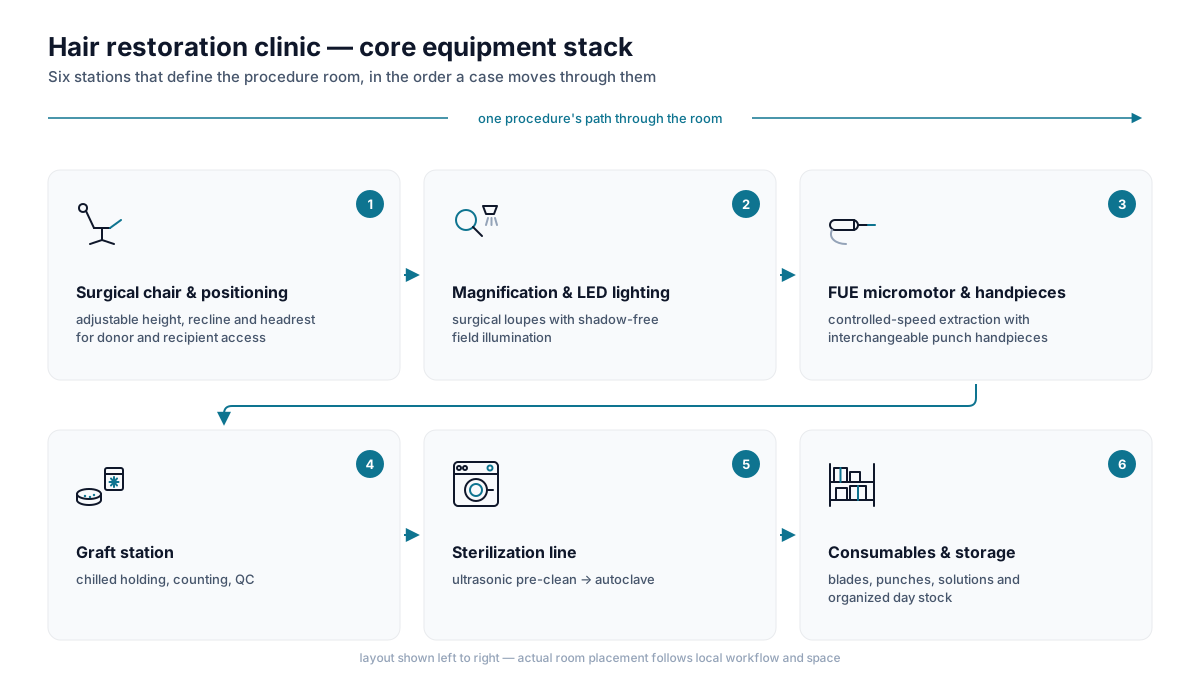
A workable equipment budget for a new hair transplant clinic is structured as three ledgers, not one: capital (the sterilization line, OR furniture, magnification, micromotors — bought once, depreciated over years), consumables (sharps, sterile stock, chemistry — a recurring cost that scales with sessions), and hidden costs (installation, training, service contracts, spares — the ledger first-time buyers omit and then fund from emergencies). Phasing matters as much as the split: buy what the first patient requires to full quality, defer what only higher volume justifies, and let booked sessions — not optimism — pull each later purchase forward.
Key takeaways
- Budget in three ledgers — capital, consumables, hidden costs — because they behave differently: one depreciates, one scales with sessions, one ambushes.
- The hidden ledger is real money: installation, training, service contracts, spare handpieces and validation typically add a material fraction on top of sticker prices.
- Phase purchases against patient volume: full quality for day-one clinical essentials, deliberate deferral for capacity and comfort items.
- Cheap is expensive where downtime or safety concentrates — autoclave, patient chairs, micromotor; mid-range is rational for furniture, trolleys and general instruments.
- Financing is a cash-flow tool, not a discount: leases and payment plans raise total cost in exchange for preserved working capital — price that trade explicitly.
Three ledgers, not one number
Most equipment budgets fail by being a single list with a single total. The problem is that the three kinds of spending behave differently over time, and mixing them hides the clinic's true cost structure at exactly the moment financial planning matters most.
Capital is the one-time list: sterilization line (autoclave, ultrasonic cleaner, sealer), OR table or patient chair, surgical seating, lighting, magnification, micromotor systems, graft-storage cooling, emergency equipment, furniture and storage. It is bought before revenue exists, and its costs are mostly visible upfront — which is why it gets all the attention.
Consumables are the recurring ledger: punches, blades, implanter needles, anesthesia supplies, holding media, drapes, gloves, reprocessing chemistry and packaging. They look small next to capital at opening and then dominate it over the clinic's life. The per-session arithmetic in consumable cost per graft is the bridge between this ledger and the revenue forecast: sessions per month × basket per session is the burn rate, and the opening budget needs several months of it as stock and cash — not just the first order.
Hidden costs are everything that follows capital home: delivery and installation, electrical and plumbing work the sterilization room needs, staff training time, autoclave validation and commissioning, service contracts, spare parts (a second micromotor handpiece is the classic), water treatment for reprocessing, and small-tools miscellany. Individually modest, collectively material — experienced buyers plan a meaningful surcharge on top of quoted equipment prices for this ledger, and the clinics that skip it fund it anyway, later, at distressed prices.
The budget table
Budget weights below are stated as logic, not percentages — the honest ratios depend on market, scale and how much of the fit-out the building already provides.
| Category | Budget weight logic | Phasing |
|---|---|---|
| Sterilization line (autoclave, ultrasonic, sealer, water treatment) | Heavy — quality here protects every session and every instrument; downtime stops the clinic | Phase 0 — installed, validated and practiced before the first patient |
| OR core (patient chair/table, surgeon and tech seating, lighting) | Heavy — ergonomics for 6–8 hour sessions; the chair carries patient and team through every case | Phase 0 — full quality at opening; this is not where to economize |
| Extraction and placement systems (micromotor + spare handpiece, implanter stock) | Moderate — performance-critical but compact; spare handpiece is non-negotiable | Phase 0 core + spares; additional units in Phase 1–2 as parallel workflows appear |
| Magnification and visualization | Moderate — per-operator cost; quality affects graft survival via dissection and placement precision | Phase 0 for the founding team; scales per hire thereafter |
| Graft storage and cooling | Light — dishes, cooling method, temperature monitoring | Phase 0 — cheap insurance on the most valuable material in the room |
| Instrument sets and trays | Moderate — forceps, holders, handles at per-operator multiples plus reprocessing float | Phase 0 working sets; deepen in Phase 1 once real consumption is logged |
| Opening consumable stock | Several months of projected session burn, not one order | Phase 0 initial stock; steady-state ordering rhythm from Phase 1 |
| Hidden ledger (installation, training, validation, service contracts, spares) | A planned surcharge on capital lines — never zero | Phase 0 unavoidably; contracts renew annually — budget them as operating cost |
| Capacity and comfort additions (second OR fit-out, additional sterilizer capacity, upgraded furniture) | Deferred — justified by booked volume only | Phase 2 — pulled forward by utilization, never by optimism |
Phasing: let patients pull purchases
The phasing principle is simple: cash leaves in the order patients require, at the quality level patients require.
Phase 0 — before the first patient. Everything clinically essential, at full quality: the sterilization line installed and validated, the OR core, one complete extraction-to-placement equipment chain with spares on failure-critical items, graft storage, emergency equipment, and an opening consumable stock deep enough that early supplier lead-time surprises cannot touch the calendar. The complete room-by-room sequence, including the licensing and staffing threads that run alongside equipment, lives in the clinic startup checklist.
Phase 1 — the first months of cases. Deepen what reality corrects: instrument counts adjusted to logged consumption, the consumable ordering rhythm settled into par levels, a second magnification station if a hire lands, small workflow purchases the team discovers it needs. Phase 1 spending should be small and reactive — its budget is a reserve, not a shopping list.
Phase 2 — proven volume. Capacity purchases: parallel micromotor systems, expanded sterilizer capacity or a second sterilizer for redundancy, second-room fit-out, upgraded team ergonomics. Each item here has a utilization argument attached — booked sessions that wait on equipment — or it stays deferred. Bundled procurement can compress Phases 0–1 usefully; the trade-offs of buying the stack as a package versus line-by-line are covered in clinic equipment packages.
Where cheap is expensive — and where mid-range is fine
The budget's hardest calls are quality-tier decisions, and the reliable heuristic is: spend where failure concentrates — on safety, downtime or daily ergonomic load — and economize where it does not.
Cheap gets expensive at the autoclave, the patient chair, and the micromotor. A marginal autoclave is the clinic's worst purchase: it sits upstream of every instrument and every session, its failure halts the entire surgical calendar, and weak documentation features create compliance labor forever. The patient chair carries every patient and shapes the team's posture for six-to-eight-hour sessions — a chair that cannot hold positions precisely, or that breaks under daily articulation, costs surgical quality and staff health in a currency no invoice shows. Micromotors earn quality spending for a different reason: mid-case failure, which is why the spare handpiece belongs in Phase 0 regardless of brand tier. The same logic extends to anything single-point-of-failure: one sealer, one cooling method, one of any instrument the session cannot run without.
Mid-range is rational for storage furniture, trolleys, task seating for non-surgical staff, general instrument lines where inspection and replacement are routine, and most room fit-out. These items fail gracefully — a wobbly trolley annoys; it does not cancel a session or compromise a graft. Buying them at premium tier buys finish, not function.
The consumable ledger has its own version of this heuristic: graft-contact sharps are the wrong place to chase the cheapest unit, since a shorter honest edge life or looser tolerances shift cost into clinical outcomes — the arithmetic behind that trap is worked through in the single-use versus reusable cost model. Commodity field consumables, by contrast, compete on price with a clear conscience.
Financing honesty
Equipment financing — leasing, installment purchase, supplier payment plans — is a legitimate tool with one honest description: it trades total cost for cash-flow shape. A lease keeps opening capital in the bank, where it can fund the consumable runway and survive a slow ramp; it also costs more than the cash price by the financier's margin, may bind the clinic to service terms, and turns a one-time ledger into a recurring obligation that sits next to rent and salaries whether sessions are booked or not.
Three questions keep the decision clean. First, is the financed item revenue-critical at opening, or is financing being used to afford a Phase 2 purchase in Phase 0? Financing an autoclave the first patient needs is defensible; financing capacity ahead of demand is optimism with interest. Second, what is the all-in cost against the cash price — stated as one number, including fees and mandatory service bundles? Third, what happens at the end — ownership, return, balloon payment — and does the equipment's realistic service life match the term? A budget that answers those three questions per financed line is using financing; one that does not is being used by it.
Governance after opening
A budget that stops mattering on opening day was a shopping list. Three review rhythms keep it a management tool. Monthly, reconcile consumable burn against the runway plan: sessions delivered × basket per session versus actual purchasing, with variance chased into its causes the way the cost-per-graft decomposition prescribes. Quarterly, review the hidden ledger's recurring lines — service contracts approaching renewal, validation and maintenance due dates, spare-parts stock — because these are the costs that arrive silently and compound when deferred. Per Phase 2 proposal, apply the utilization gate in writing: which booked sessions waited on equipment, how often, and what the wait cost. A proposal that cannot cite waiting sessions is a Phase 2 item still waiting for its phase.
The discipline pays off most visibly at the first expansion decision. A clinic that has tracked burn, renewals and utilization for a year approaches its second operating room with evidence — real consumption rates, real service costs, real demand pressure — where a clinic without the records approaches it with the same optimism that pads every startup plan, this time with more zeros attached.
The equipment stack itself — what belongs in each room and what buyers evaluate per category — is mapped across the clinic equipment hub; the budget's job is to put honest numbers and honest sequencing behind that map, three ledgers at a time.
Frequently asked questions
How should a new clinic structure its equipment budget?
As three ledgers: capital (sterilization line, OR core, micromotors, magnification — one-time, depreciated), consumables (sharps and sterile stock — recurring, scaling with sessions, budgeted as several months of runway), and hidden costs (installation, training, validation, service contracts, spares — a planned surcharge on capital, not an afterthought).
What equipment must be bought before the first patient?
Phase 0 covers everything clinically essential at full quality: a validated sterilization line, patient chair and OR core, one complete extraction-to-placement chain with a spare micromotor handpiece, magnification, graft storage and cooling, emergency equipment, and an opening consumable stock deep enough to absorb supplier lead-time surprises.
Where is it a mistake to buy cheap?
Where failure concentrates: the autoclave (upstream of every session, downtime stops the clinic), the patient chair (carries every case and the team’s ergonomics for years), the micromotor (mid-case failure), and any single point of failure. Mid-range is rational for trolleys, storage furniture, general fit-out and items that fail gracefully.
What are the hidden costs of equipping a clinic?
Delivery and installation, electrical and plumbing work for the sterilization room, autoclave commissioning and validation, staff training time, service contracts, water treatment, spare parts and small-tools miscellany. Collectively they add a material fraction to sticker prices — budget them as a named ledger or fund them later from emergencies.
Is leasing clinic equipment a good idea?
It is a cash-flow tool, not a discount: leasing preserves opening capital for the consumable runway and a slow ramp, at a higher all-in cost and a recurring obligation that persists whether sessions are booked or not. It is most defensible for revenue-critical Phase 0 items and least defensible for funding capacity ahead of demand.
Related articles
Hair Transplant Clinic Startup Checklist: Every Equipment Category, in Order
A category-by-category equipment walkthrough for opening a hair transplant clinic: what belongs in the OR, the sterilization line, instrument sets and consumables — and the order to buy it in.
Clinic Equipment Packages: What a Starter Setup Includes
A room-by-room look at hair transplant clinic starter packages: what belongs in the OR, sterilization line and graft-prep station on day one, what can wait until month two, and an honest view of when a package beats piecemeal buying — and when it doesn’t.
Consumable Cost per Graft: How to Calculate and Control It
The cost-per-graft calculation from first principles: what belongs in the consumable basket, the formula and its variables, why session size and single-use policy move the number more than any discount, and how to benchmark without fake industry averages.
Hair Transplant Clinic Equipment: The Complete Stack
The full equipment stack of a hair transplant clinic, from operating table to autoclave — written for founders specifying their first operating room.