
Distribution Agreement Terms: The Clauses That Decide Whether the Deal Works
A clause-by-clause walk through medical device distribution agreements: territory and exclusivity, minimum commitments, pricing structure, marketing obligations, IP use, termination and the post-term provisions most first-time distributors overlook.
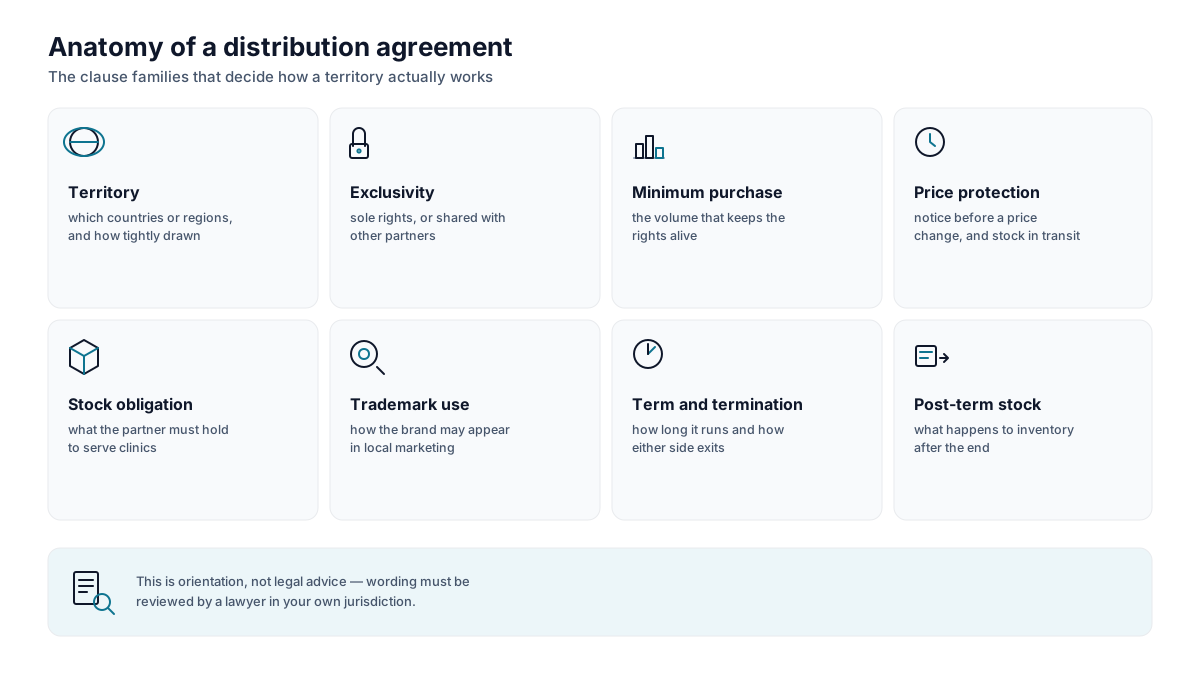
A distribution agreement stands or falls on eight clause families: territory and exclusivity, minimum purchase commitments, pricing and discount structure, marketing obligations, trademark and IP use, term and termination, post-term provisions, and dispute resolution. The headline clauses — territory, margin — get all the negotiating attention, but the deals that go wrong usually go wrong in the quiet ones: a minimum commitment with no ramp-up curve, a termination clause with no stock buyback, a trademark license that dies the day the agreement does. This guide walks through each family, what it governs and what a distributor should negotiate for. It is a practical orientation, not legal advice — have any agreement reviewed by a lawyer qualified in the governing jurisdiction before signing.
Key takeaways
- Territory, minimums and pricing form one system — never negotiate them separately, because a generous territory with unrealistic minimums is worth less than a small territory with achievable ones.
- Minimum purchase commitments need a ramp-up curve in year one and a defined, proportionate consequence for a miss — loss of exclusivity, not loss of the whole line.
- The post-term clauses matter most when things end: stock buyback, open-order handling and customer data decide whether termination is a setback or a write-off.
- Trademark clauses should let you market the products properly during the term and oblige both sides to a clean separation afterwards.
- Everything that was promised verbally — support, lead times, protected accounts — is worth exactly what the written agreement says about it.
Read the agreement as a system, not a checklist
Before the clause-by-clause detail, one framing that changes how you negotiate: a distribution agreement is a single economic system. The manufacturer grants market access rights (territory, exclusivity, brand use) and expects performance in return (minimums, marketing effort, market feedback). Every right has a price somewhere else in the document. Exclusivity is paid for with commitments; better discounts are paid for with volume; a long term is paid for with harder termination conditions. The practical consequence is that you should always negotiate trades, not positions — offering a higher minimum in exchange for a longer ramp-up, or accepting a narrower territory in exchange for genuinely protected accounts. A counterpart who refuses every trade is telling you something useful about the relationship ahead, before any money has changed hands.
The second framing: the agreement is written for the bad year, not the good one. While sales grow and everyone is happy, nobody opens the contract. It comes out of the drawer when targets are missed, when the manufacturer is courted by a bigger distributor, or when one side wants out. Read every clause by asking what it does in that moment.
The eight clause families
| Clause | What it governs | What to negotiate for |
|---|---|---|
| Territory and exclusivity | Where you may sell, whether alone, and what happens to direct inquiries from your area | Precise geographic and segment definition; direct-sale rules in writing; leads from your territory routed to you |
| Minimum purchase commitments | The volume you must buy to keep your rights | A ramp-up curve in year one; targets derived from a joint plan; miss consequence limited to exclusivity, not termination |
| Pricing and discounts | Transfer prices, volume tiers, price-change mechanics | Volume tiers agreed in advance; notice periods for price changes; protection for quotes already given to customers |
| Marketing obligations | Fairs, sales staffing, promotion, reporting duties | Obligations you would largely do anyway; manufacturer contribution to fairs and materials; reporting that is light enough to actually deliver |
| Trademark and IP use | How you may use the manufacturer’s name, marks and materials | An explicit license for the term; freedom to use marks in normal marketing; clear post-term wind-down rules |
| Term and termination | How long the deal runs and how either side exits | An initial term long enough to recover your build-up investment; cure periods before termination for cause; renewal mechanics agreed up front |
| Post-term provisions | Stock, open orders, customers and data after the end | Buyback of sealed, saleable stock or a sell-off period; delivery of confirmed open orders; clarity on who owns the customer relationships you built |
| Dispute resolution and governing law | Which law applies and where disagreements are decided | A forum you can realistically use; escalation steps (negotiation, then mediation) before formal proceedings |
Territory and exclusivity: define the edges
Territory clauses fail at the edges, so the negotiation is mostly about definitions. Geography needs to be named precisely — countries, not vague regions — and the harder questions answered in text: what happens when a customer from your territory contacts the manufacturer directly, whether the manufacturer’s own online or fair sales reach into your area, and how cross-border customers with sites in several territories are handled. If the deal is exclusive, ask for inquiries from the territory to be routed to you; if it is not, ask at least for named-account protection on the customers you develop. The deeper strategic choice between exclusive and non-exclusive structures — and the hybrid forms in between — is a topic of its own, covered in the comparison listed under related reading; what belongs here is the drafting rule that whichever model you choose must be written down at the level of concrete cases, not principles.
Minimum purchase commitments: the clause that kills deals
Minimums are legitimate — a manufacturer granting exclusivity needs protection against a distributor who locks up a market and then underperforms. The failure mode is minimums copied from the manufacturer’s ambitions rather than derived from a sales plan. Negotiate three things. First, a ramp-up curve: year one carries a fraction of the steady-state target, because building a customer base in a trust-driven specialty takes time, as anyone who has read a realistic account of becoming an instrument distributor knows. Second, the consequence of a miss should be proportionate and staged: conversion of exclusivity to non-exclusive status, or a renegotiation trigger — not automatic termination of the whole line. Third, the counting rules: which orders count toward the minimum (shipped or invoiced, samples included or not), measured over which period, with what carry-over for a strong year. A minimum without defined counting rules is a future argument, scheduled in advance.
Pricing, discounts and the money mechanics
The pricing clause governs more than the transfer price. Volume tiers should be fixed in advance so that growth automatically improves your buying price instead of requiring a fresh negotiation from a weak position each year. Price-change mechanics need a notice period long enough for you to reprice your own quotes — and ideally protection for offers already submitted to customers at the old price. Payment terms belong in the same conversation, because the spread between what you pay the manufacturer and when your clinics pay you is the working-capital heart of the whole business; the practical instruments — proforma, open account, the usual securities — are covered in the guide on supplier payment terms. Where minimum order quantities apply per order rather than per year, get them into the agreement too, with the flexing rules the MOQ guide describes, so that a warehouse-friendly order pattern does not silently violate the contract.
Marketing obligations and trademark use
Manufacturers reasonably expect their distributor to actually work the market: attend the relevant fairs, maintain trained sales capability, present the products professionally, report market feedback. The negotiating aim is not to minimise these obligations but to keep them concrete and mutual — a defined number of fair presences with manufacturer cost participation beats a vague duty to promote the products adequately, and a quarterly one-page report beats an open-ended information obligation. Reporting clauses deserve particular attention: agree a format you can produce in an hour, because an obligation you silently stop fulfilling is a termination ground sitting in the drawer.
The trademark clause is the marketing clause’s twin. You need an explicit, written license to use the manufacturer’s name, marks and product imagery for the term of the agreement — in your catalog, on your site, at fairs. Equally important is the wind-down: how long after termination you may sell remaining branded stock, when web content must come down, and a mutual obligation not to create confusion afterwards. Distributors who invest in their own brand identity alongside the manufacturer’s — a route compared in the white-label discussion under related reading — should make sure the agreement does not restrict their own marks.
Term, termination and what happens afterwards
The term should reflect your investment horizon: if the build-up phase realistically consumes the first year, a one-year initial term means you invest for the manufacturer’s benefit. Negotiate an initial term that lets you harvest what you build, with defined renewal mechanics. On termination, distinguish the two exits. Termination for cause needs cure periods — a missed payment or a late report should trigger a written warning and a window to fix it, not an immediate end. Ordinary termination needs notice long enough to wind down in an orderly way on both sides.
The post-term clauses are where first-time distributors lose real money. Three questions decide the damage. Stock: does the manufacturer buy back sealed, saleable inventory at your purchase price, or do you get a defined sell-off period? Either is workable; silence is not — silence means you own dead stock the day the agreement dies. Open orders: confirmed orders and quotes outstanding at termination should be delivered and honoured. Customers: the relationships you built are your main asset, so read carefully any clause that hands customer data to the manufacturer or restricts you from serving those accounts with other products afterwards. A non-compete that outlives the agreement should be narrow, time-limited and compensated — or absent.
Dispute resolution: boring until it is everything
Governing law and forum clauses read like boilerplate and behave like economics. A dispute venue on another continent, in another language, under unfamiliar law, prices most real-world claims out of existence regardless of their merit — which is precisely why some counterparties propose it. Push for a forum you could realistically use, and for an escalation ladder: structured negotiation between principals first, mediation second, formal proceedings last. Cross-border agreements often land on arbitration as neutral ground; the details matter less than the honesty test — a manufacturer who wants a fair mechanism is planning a partnership, and one who wants an unreachable forum is planning an advantage.
Before you sign
Run the whole document through the bad-year test one final time: targets missed by a third, a lot rejected by your biggest customer, the manufacturer acquired by a competitor, your own wish to exit in year three. If the agreement gives workable answers to all four, it is a good agreement almost regardless of the margin points. If the counterparty resisted writing down what was promised verbally, believe the document, not the meeting. And weigh the agreement together with the partner behind it — contract quality and manufacturer quality are separate assessments, and the structured conversation described in the distributor program is a reasonable place to test both at once.
Frequently asked questions
What is the most important clause in a distribution agreement?
As a system: the interaction of minimum commitments with termination and post-term provisions. Minimums decide whether you can keep the agreement in a normal year; termination and post-term clauses decide what a failure costs. Territory and margin get the attention, but the downside clauses carry the real risk.
Are minimum purchase commitments standard, and should I accept them?
They are standard wherever exclusivity is granted, and they are legitimate. Accept minimums that are derived from a sales plan you believe, with a ramp-up in year one, defined counting rules and a proportionate consequence for a miss — typically loss of exclusivity rather than termination. Refuse minimums that are round numbers from the manufacturer’s wish list.
What should happen to my stock if the agreement ends?
The agreement should say so explicitly: either the manufacturer buys back sealed, saleable stock at your purchase price, or you receive a defined post-term sell-off period with continued trademark use for that purpose. If the document is silent, assume the answer is that the stock is your problem — and negotiate before signing, not after termination.
Do I need a lawyer for a distribution agreement?
Yes — qualified in the governing law of the contract, which may not be the law of your home country. Use guides like this one to prepare the commercial positions so the legal review is fast and focused; use the lawyer for what only a lawyer can do, which is telling you how the clauses actually behave in that jurisdiction.
Can I distribute competing product lines under a typical agreement?
Many agreements restrict directly competing lines during the term, especially exclusive ones — and the definition of competing is worth negotiating narrowly and precisely. Watch post-term non-competes closely: a restriction that outlives the agreement should be narrow, short and compensated, because otherwise a terminated agreement locks you out of your own market.
What does a fair exclusivity-miss consequence look like?
Staged and proportionate: a first miss triggers a review and a joint recovery plan, a sustained miss converts the territory to non-exclusive or narrows it, and only persistent underperformance ends the line. That structure keeps the manufacturer protected while giving the distributor a survivable path through a weak year — which is in both parties’ interest.
Related articles
How to Become a Hair Transplant Instrument Distributor
A practical guide to building a distribution business in hair restoration instruments: how the revenue model actually works, how to build a starting portfolio, which manufacturer relationship to choose and how the first customers are won.
Exclusive vs Non-Exclusive Distribution: Which Model Actually Serves You?
An honest comparison of exclusive and non-exclusive distribution rights: what each model really grants, when each one wins, the hybrid structures in between, and the performance clauses that make an exclusive territory earn its keep.
White Label vs Distribution: Two Business Models Compared Honestly
An honest comparison of the white-label and distribution business models: how margin, brand ownership, inventory risk, time-to-market and exit value differ, when switching makes sense, and how experienced operators stage the two together.
Payment Terms with Medical Instrument Suppliers: Proforma, T/T and LC
How payment actually works when buying instruments internationally: the proforma invoice flow, common T/T split structures, when a letter of credit earns its cost, and the red flags that should stop a transfer.