
Minimum Order Quantities for Medical Instruments: A Buyer's Guide
Why MOQs exist in instrument manufacturing, what typical minimums look like by product category, which negotiating levers actually move them, and why a supplier with no minimum at all deserves scrutiny.
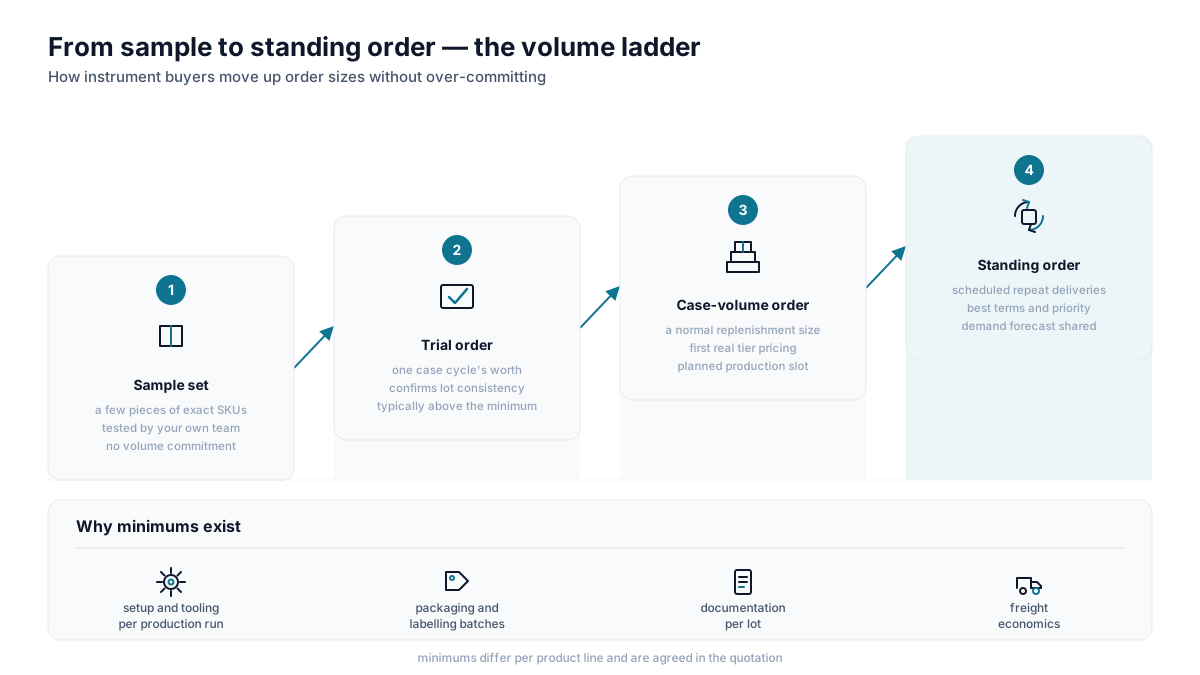
Minimum order quantities exist because instrument production runs in batches, not single pieces: machine setup, grinding runs, sterilisation loads and packaging runs all have fixed costs that only make sense spread across a minimum volume. For hair-restoration instruments, typical minimums range from a few boxes for stocked disposables up to full production runs for custom or branded work — and most of them are negotiable in structure even when they are not negotiable in size. This guide explains where MOQs come from, what realistic minimums look like per product category, which levers genuinely move them, and why a supplier who asks for no minimum at all is sometimes the bigger risk.
Key takeaways
- MOQs are batch economics made visible: setup, sterilisation loads and packaging runs have fixed costs that a minimum volume must absorb.
- Stocked disposables carry the lowest minimums; custom, coated or own-brand products carry the highest, because they cannot be resold to anyone else.
- The strongest negotiating levers change the structure of an MOQ — mixed-SKU orders, staged delivery, framework agreements — rather than its size.
- A supplier with no minimum at all on manufactured goods is often a trading company reselling stock of unknown provenance, not a factory.
- Always sequence samples before MOQ negotiation: committing to a minimum of an untested SKU converts a discount into a liability.
Why manufacturers set minimums at all
An MOQ is not a sales tactic. It is the point at which a production batch stops losing money, and understanding its components tells you which parts of it can flex.
Machine setup. CNC turning, tube grinding and edge-finishing lines are configured per SKU. Changing over from a 0.8 mm punch to a 0.9 mm punch means new tooling positions, new inspection settings and scrapped warm-up pieces. That changeover cost is identical whether the run produces two hundred units or twenty thousand, so short runs carry it as a heavy per-unit surcharge.
Sterilisation batches. Sterile disposables are processed in validated loads — an ethylene oxide chamber or gamma pallet is booked and paid as a unit. A manufacturer cannot economically sterilise a handful of pouches, which is why sterile-format MOQs are usually a multiple of a sterilisation load, and why non-sterile bulk formats often carry lower minimums for the identical instrument.
Packaging and labelling runs. Printed pouches, lot-labelled boxes and instructions-for-use inserts are themselves ordered from converters with their own minimums. When you ask for your own branding, your packaging becomes a dedicated purchase the manufacturer cannot use for anyone else — the single biggest reason OEM and private-label minimums sit far above catalog minimums.
Material purchasing. Surgical-grade tubing and blade stock are bought in mill quantities. A stocked catalog product spreads that material across many customers; a custom specification forces the factory to buy a minimum quantity of material for one buyer.
Demand risk. For anything customised — a special length, an unusual diameter, a private label — the factory carries the risk that you never reorder. The MOQ transfers enough volume to make that risk acceptable. Seen this way, a high MOQ on custom work is not greed; it is the honest price of exclusivity.
Typical MOQ shapes by product type
Exact minimums vary by factory, specification and season, so the useful map is qualitative: what shape the minimum takes and what drives it for each category.
| Product type | Typical MOQ shape | What drives the minimum | Flexibility |
|---|---|---|---|
| Stocked disposable punches and blades | A few boxes to a carton per SKU | Pick-pack economics only — production already ran | High: often waived for trial orders alongside other lines |
| Sterile disposables in custom or low-turnover sizes | One sterilisation load or production run | Sterilisation batch size, changeover cost | Medium: size mixes within one run are often accepted |
| Reusable instruments (punches, forceps, handles) | Small unit counts, sometimes single instruments | Mostly stock availability; machining runs for unusual items | High for catalog items, low for custom geometry |
| DHI implanter pens and spare needles | Pens in small counts; needles in box multiples | Needles are the consumable — packaging run drives the minimum | Medium: pen and needle minimums are usually negotiated together |
| PRP tubes and kits | Carton multiples per tube type | Filling and additive batches, shelf-life management | Medium: mixed additive types within a carton are sometimes possible |
| OEM / private-label instruments and hair care | Full production runs per SKU | Dedicated packaging, labelling, formulation or tooling | Low on quantity, high on structure — staged delivery is common |
Two readings of this table matter for planning. First, the same physical instrument can carry very different minimums depending on format: a punch supplied non-sterile in bulk trays may be available at a fraction of the sterile-pouched minimum, because it skips the sterilisation-load constraint. Second, minimums compound with customisation. Every element you personalise — size, coating, packaging, brand — moves you down the table into lower-flexibility territory.
Lead times: the MOQ's quiet twin
A minimum order quantity almost always comes with a lead-time profile, and the two should be negotiated together. Stocked items ship in days. Items produced to order wait for a slot in the factory's schedule — typically weeks, and longer when your order includes sterilisation, custom packaging or peak-season congestion. The practical consequence: a low MOQ on a made-to-order item can be worse for your cash cycle than a higher MOQ on a stocked item, because you carry the deposit through the entire production wait. When comparing suppliers, ask for the MOQ, the lead time at that MOQ, and the lead time for repeat orders — factories often quote faster repeats once your specifications and packaging are on file.
What a complete MOQ quote looks like
Suppliers usually volunteer a single number — "MOQ 500 pieces" — and buyers usually accept it as the whole answer. A quote you can actually plan against contains eight elements, and asking for them in one structured request marks you as a professional counterparty: the minimum per SKU and whether minimums can be combined across SKUs; the unit price at the minimum quantity; where the next price break sits, because ordering just below a break is the most common silent overpayment; the lead time at minimum quantity for a first order; the lead time for repeat orders once specifications are on file; the packaging unit, since goods ship in box and carton multiples and a nominal minimum of 500 may in practice mean 480 or 520 depending on the carton; the sterile format the minimum applies to, because sterile and non-sterile minimums frequently differ for the same instrument; and how long the quoted terms remain valid.
Two of these deserve emphasis. Packaging multiples matter more than they look: planning inventory, reorder points and shelf allocation around cartons rather than nominal units prevents both part-carton surcharges and awkward stock fragments. And the repeat lead time is often the better negotiation target than the minimum itself — a supplier who will not cut the MOQ will frequently commit to faster repeats or held safety stock, which reduces the inventory you must carry and therefore the practical burden the MOQ imposes. The minimum is one line of a quote; the shape of the ongoing supply relationship is the other seven.
Negotiating levers that actually work
Buyers waste energy asking factories to abandon their batch economics. The levers below work because they improve those economics instead.
Mixed-SKU orders. Most manufacturers will let a minimum span several sizes of the same product family — say, one production run of punches split across 0.8, 0.85 and 0.9 mm — because the setup cost they are protecting is per family and format, not per diameter. Mixing product families (punches plus blades plus tubes) to reach a combined value minimum is also common with suppliers who want the whole basket. This is often the single easiest concession to win.
Staged delivery. If the factory's problem is run size and your problem is cash and shelf space, a blanket order with scheduled part-shipments solves both. You commit to the full run; they hold stock and ship quarterly. Expect to pay for the goods per shipment or per an agreed schedule — the structure is covered in more detail in our guide to supplier payment terms.
Framework agreements. An annual quantity commitment drawn down as needed usually beats repeated MOQ-sized spot orders on both price and priority. It converts you into forecastable demand, which is the commodity factories actually price.
First-order concessions. Many manufacturers will run a below-minimum pilot order — often at a modest surcharge — for a buyer who presents a credible volume story: a specification sheet, a target annual quantity, evidence of an existing customer base. Present yourself the way a factory qualification process would, as described in how to evaluate an instrument manufacturer, and the pilot conversation becomes much easier.
Distributor stock as a bridge. When a factory minimum is genuinely out of reach, buying the same or an equivalent line from a stocking distributor at smaller quantities is a legitimate bridge while your volume grows — the trade-offs are mapped in manufacturer versus distributor buying.
What rarely works: demanding a lower minimum with no structural offer, or bluffing volume you cannot evidence. Factories hear both weekly, and the usual response is a polite quote at small-quantity pricing that makes the MOQ look attractive again.
When an MOQ — or its absence — is a red flag
MOQs carry information about the seller, and both extremes deserve attention.
No minimum at all on manufactured sterile goods is the classic signature of a trading company rather than a factory. Someone selling three sterile pouches of anything did not sterilise them in a validated load for you; they are breaking up stock whose storage history and authenticity you cannot verify. That is acceptable for commodity consumables from a reputable stocking distributor, and dangerous for precision instruments from an unknown seller. Ask directly who manufactured the goods and whether lot documentation will accompany the shipment.
Implausibly high minimums on catalog items — a full container of a stocked disposable, for instance — usually signal that you are talking to an exporter optimising freight rather than a partner interested in your business, or that the "catalog item" is actually produced to order by a third party.
Minimums that change between quotation and proforma are a process red flag regardless of direction. A factory that cannot hold its own commercial terms for the length of a negotiation will not hold specifications either.
A minimum quoted without a lead time is an incomplete quote. Insist on both numbers together, in writing, on the proforma invoice.
Planning your first order around the minimum
For a first order, the defensible sequence is: samples first, minimum second. Test the exact SKUs against a structured protocol — the sample orders guide sets out a workable one — and only then negotiate quantity on the shortlisted lines. Size the first order at or slightly above the true minimum even if you could afford more: the first delivery is itself a test, of lot consistency, packaging quality, documentation and logistics, and you want the option to change course cheaply. Check the delivered goods against the samples piece by piece before committing to a framework. A supplier who passes that first cycle cleanly is worth consolidating volume with; concentrated volume is what unlocks every other concession in this guide, including access to broader wholesale pricing tiers.
Frequently asked questions
What is a typical MOQ for FUE punches or sapphire blades?
For stocked disposable lines, minimums are usually modest — box or carton multiples per size — because production has already run and the supplier is only protecting pick-pack economics. Custom sizes, coatings or own-brand packaging move the minimum up to a full production or sterilisation run. Exact figures vary by factory and format, so request the current tier structure per SKU in writing.
Can I combine different sizes or products to reach a minimum?
Very often, yes. Minimums usually protect a per-family setup cost, so spreading one run across several diameters of the same punch line is routinely accepted. Many suppliers also honour a combined-value minimum across product families for buyers taking a broader basket. It is the first concession to ask for.
Why is the MOQ so much higher for private-label products?
Because nothing in the order can be resold to anyone else. Dedicated packaging, printed labels, custom formulations and tooling are purchased specifically for you, and the factory carries the risk that you never reorder. The minimum transfers enough volume to cover those dedicated costs — which is why private-label minimums respond better to staged-delivery structures than to haggling.
Is a supplier with no MOQ a good find?
Sometimes — reputable stocking distributors legitimately sell small quantities of catalog goods. But a seller offering tiny quantities of sterile manufactured instruments with no factory relationship you can verify is often a trading company breaking up stock of unknown provenance. Ask who manufactured the goods, and whether lot numbers and documentation will match the physical shipment.
Do MOQs come down over time with the same supplier?
The formal minimum rarely moves, but its practical weight does. Established customers get below-minimum top-up orders, faster repeat lead times, mixed-SKU flexibility and held stock under framework agreements. The reliable route to flexibility is order history and forecast sharing, not negotiation pressure on the first purchase order.
Should I negotiate the MOQ before or after testing samples?
After. Negotiating quantity on an untested SKU wastes leverage and risks committing you to a minimum of a product you will reject. Test first, shortlist two or three suppliers you would genuinely buy from, then negotiate structure between them — real alternatives are the only leverage factories consistently respect.
Talk through your order plan with a specialist
If you are sizing a first order, weighing a factory minimum against a distributor's smaller quantities, or trying to structure a staged-delivery agreement, our sourcing team can walk through the numbers with you against current production realities — no volume commitment required for the conversation.
Related articles
Instrument Samples Before a Bulk Order: How Professionals Evaluate
A clinic buyer's guide to sample orders: how to request the exact SKUs you intend to buy, what paid and free samples really signal, a structured evaluation protocol, and how to convert results into a safe first order.
Payment Terms with Medical Instrument Suppliers: Proforma, T/T and LC
How payment actually works when buying instruments internationally: the proforma invoice flow, common T/T split structures, when a letter of credit earns its cost, and the red flags that should stop a transfer.
How to Evaluate an Instrument Manufacturer
A balanced seven-criterion framework distributors and clinics can use to vet instrument manufacturers before committing a territory or a large order.
Sourcing & Import: Buying Medical Instruments Across Borders
The commercial mechanics of importing hair restoration instruments — customs, MOQs, samples, payment terms and how to evaluate a supplier before committing.