
The European Hair Restoration Market: A Qualitative Overview for Distributors
What the European hair restoration landscape looks like from a distributor’s chair: the forces driving demand, how the major regions differ in character and buying culture, and where supply-side opportunities actually sit.
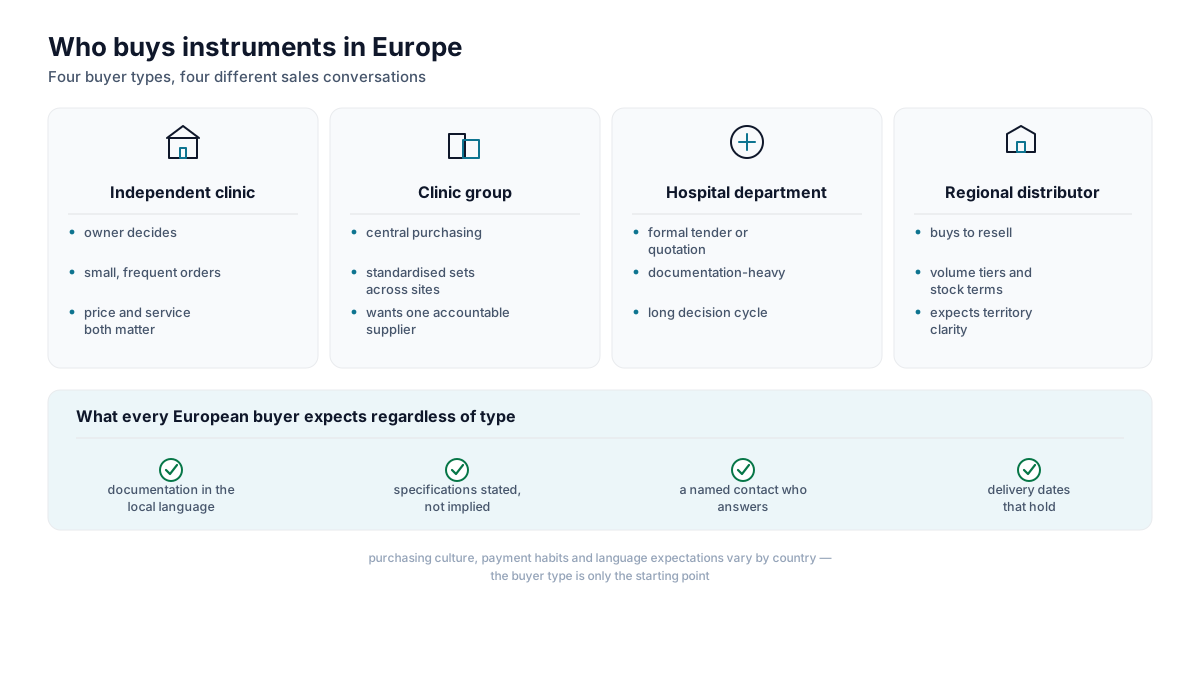
The European hair restoration market is best understood as several distinct markets sharing one demand story: hair transplantation has moved from a discreet niche into the mainstream of medical aesthetics, procedure capacity has followed, and the supply chains feeding that capacity have professionalised behind it. For a distributor, the map matters more than the total: Turkey anchors the procedure volume and much of the instrument manufacturing, the DACH countries buy on documentation and reliability, Southern Europe is in a clinic-building phase, and Central and Eastern Europe is emerging as both a treatment destination and a growing home market. This overview is deliberately qualitative — it describes structures, characters and directions rather than quoting figures, because credible current numbers belong to paid market research and everything else is decoration.
Key takeaways
- Demand rests on durable drivers — destigmatisation, medical tourism, an aging population and social-media visibility — not on a passing trend.
- Europe is several markets, not one: procedure hubs, quality-driven home markets and emerging regions each need a different distribution approach.
- Turkey is both the continent’s procedure hub and a major instrument manufacturing base, which shapes every supply chain in the industry.
- The distribution opportunity sits with the clinics being founded and professionalised outside the established hubs — they need suppliers who bring knowledge, not just boxes.
- Buying cultures differ sharply by region; a pitch that wins in Frankfurt can fail in Madrid for reasons that have nothing to do with the product.
The demand story: why this market keeps growing
Four forces carry demand, and none of them looks temporary. The first is destigmatisation. A hair transplant was once something men hid; it is now something footballers, actors and colleagues discuss openly. Social media accelerated the shift — before-and-after content made results visible and normalised the decision — and each cohort of satisfied patients recruits the next through simple word of mouth. The second is demographics: hair loss correlates with age, and Europe is aging, while at the same time younger patients present earlier because the option is now visible and socially acceptable. The third is the broadening of the patient base: what began as an overwhelmingly male market has widened, with female hair loss treatment, hairline work, and adjacent procedures such as eyebrow and beard transplantation adding distinct demand streams. The fourth is the maturing of adjacent therapies — PRP programs, medical-grade aftercare, maintenance treatments — which turn a one-off procedure into an ongoing treatment relationship and, for suppliers, turn a one-off instrument sale into recurring consumable demand.
Medical tourism deserves its own note, because it redistributes demand in ways that matter to suppliers. Patients travelling from Northern and Western Europe toward Istanbul, and increasingly toward CEE destinations, concentrate procedure volume — and therefore consumable consumption — in the hub countries. But the flow generates supply-side demand at both ends: the travelling patient returns home needing aftercare products, follow-up appointments and sometimes touch-up work, which pulls home-market clinics and their suppliers into the value chain of procedures performed elsewhere. Home-market clinics have responded by competing on what travel cannot offer — continuity, accountability, language, aftercare relationships — and that competitive posture shapes what they buy and how carefully they buy it.
For a supplier, the crucial characteristic of this demand is that it is procedure-driven. Every transplant consumes punches, blades, needles and disposables; every active clinic is a recurring customer by construction. Markets built on repeat consumption reward exactly the reliability-centred distribution model described in our guide to becoming an instrument distributor.
Turkey: the procedure hub and the manufacturing base
Any map of European hair restoration starts in Istanbul. Turkey became the world’s most visible hair transplant destination through a combination that is hard to replicate: clinical specialisation at scale, cost advantages, established medical-tourism infrastructure from flights to patient coordinators, and an early embrace of the marketing channels through which patients actually choose. High procedure volume did what high volume always does — it deepened specialisation, trained large surgical teams, and pulled a supplier ecosystem up behind it.
That ecosystem is the second half of Turkey’s role: the country is not only where procedures happen but where a substantial share of the industry’s instruments are manufactured. A dense cluster of instrument makers grew alongside the clinics, with short feedback loops between surgeons and factories that accelerated product iteration. For buyers and distributors everywhere in Europe, this makes Turkey a sourcing question as much as a market question — the practicalities are covered in the import from Turkey guide, and the origin-versus-evaluation logic matters here more than anywhere: the cluster contains excellent manufacturers and mediocre ones, and the evaluation discipline, not the country label, separates them.
As a sales territory, Turkey is demanding: buyers are sophisticated, volumes concentrate in large clinics with strong negotiating positions, and proximity to manufacturers compresses distributor margins. Most European distributors relate to Turkey as a supply base first and a market second.
The DACH region: documentation, reliability, patience
Germany, Austria and Switzerland form the archetypal quality-driven home market. Clinics tend to be surgeon-led practices and specialised private clinics rather than high-volume centres; procedure prices are higher, patient expectations are exacting, and a meaningful share of local demand still travels abroad for price — which leaves home clinics competing on trust, follow-up and perceived quality, and buying accordingly. Purchasing culture follows the stereotype more often than not: written specifications, documented lots, conservative supplier switching and a strong memory for both reliability and failure. Sales cycles are long; standardisation, once won, is durable.
For a distributor, DACH rewards precisely the disciplines that price-led markets let you skip: complete documentation, punctual logistics, fluent technical conversation and quiet, fast complaint handling. It is a difficult market to enter and an excellent market to hold — the inverse of the emerging regions, and a reasonable second market for a distributor who has proven the model elsewhere.
Southern Europe: the clinic-building phase
Spain, Italy, Portugal and Greece share a trajectory: strong aesthetic-medicine cultures, growing local transplant capacity, and an expanding middle segment of clinics adding hair restoration to broader aesthetic offerings. Spain has developed genuine centres of gravity in hair surgery with international patient draw of their own; Italy’s aesthetic sector is broad and quality-conscious; Greece combines a domestic market with tourism-linked demand. The character of the opportunity differs from DACH: more new clinics, more first-time buyers of instruments and equipment, more demand for advice, training support and complete starter solutions rather than incremental consumable supply alone.
Buying culture is more relationship-led than in the north. Personal trust, presence and responsiveness weigh heavily; the formal documentation apparatus matters but opens fewer doors by itself. Price sensitivity is real, particularly in the middle segment — but so is loyalty once a supplier has become part of the clinic’s story. Distributors with local presence and language do disproportionately well here, which is exactly why regional sub-distribution and country partnerships are common structures.
Central and Eastern Europe: the emerging map
The CEE region — Poland, Czechia, Hungary and their neighbours — plays two roles at once. As a treatment destination it offers Western European patients quality at accessible prices with short travel: Budapest, Prague and Warsaw all host clinics oriented at cross-border patients. As home markets, the region’s growing middle class is beginning to consume aesthetic medicine domestically at scale. Clinic professionalisation is advancing quickly, often leapfrogging: new clinics buy modern instruments and current techniques from day one rather than inheriting legacy habits.
Supply chains in the region are younger and less locked-in than in Western Europe, which cuts both ways: openings for new distributors are more frequent, price competition is sharper, and supplier loyalty is still forming. For a distributor with cost discipline and genuine product knowledge, CEE offers what mature markets cannot — accounts that are still winnable — with the growth risk that some of today’s clinics will not exist in five years.
Where the distribution opportunities sit
| Region | Market character | Where the opportunity sits for a distributor |
|---|---|---|
| Turkey | Procedure hub with dense clinic and manufacturer landscape; sophisticated, price-aware buyers | Primarily a sourcing base; selling requires scale or specialisation and tolerates thin margins |
| DACH | Quality-led home market; documentation-driven, conservative purchasing, durable relationships | Premium consumable supply with full documentation and service; slow entry, strong retention |
| Southern Europe | Clinic-building phase inside strong aesthetic cultures; relationship-led buying | Starter equipment plus consumable standardisation for new and expanding clinics; local presence pays |
| CEE | Emerging home markets plus treatment-destination hubs; young supply chains | Early standardisation accounts and equipment for new clinics; sharper price competition, formative loyalty |
Across regions, the structural opportunity is the same shape: procedure capacity is being built and professionalised faster than specialised supply relationships are, and the gap is widest away from the established hubs. A new clinic in Valencia, Kraków or Thessaloniki needs punches, blades, implanters, a sterilisation line and someone who can explain the trade-offs — and generalist medical wholesalers rarely speak the specialty. Adjacent to instruments, the aftercare and clinic-branded product space adds a second stream: clinics increasingly want serums, shampoos and kits under their own name, which pulls distributors toward the private-label capabilities described on the OEM and private label page.
Reading the buying cultures
The practical differences compress into a few contrasts worth internalising before the first sales trip. In the north and the DACH region, the specification opens the door and the relationship follows; in the south, the relationship opens the door and the specification follows. Emerging markets forgive supply-chain improvisation less than you would expect — a young clinic burned by a stock-out remembers it — while mature markets forgive it never. Congresses and fairs matter everywhere but play different roles: contact-making in relationship-led markets, credibility-signalling in documentation-led ones. And in every region without exception, the fastest-travelling asset is reputation among surgeons, who talk to each other across borders far more than suppliers assume.
None of this replaces market research for a concrete business plan — procedure volumes, clinic counts and price levels shift, and current figures should come from primary sources and paid studies, not from articles. But the structures move slowly, and it is the structures that should shape a distribution strategy: pick the region whose buying culture matches your strengths, build depth before breadth, and treat the emerging map as a sequence of markets to earn rather than a single Europe to cover.
Frequently asked questions
Is the European hair restoration market still growing?
The structural drivers point that way: destigmatisation keeps widening the patient base, demographics add candidates each year, adjacent therapies deepen the revenue per patient, and clinic capacity keeps being built outside the established hubs. For current growth figures, consult primary market research — but the qualitative direction across regions is expansion, at different speeds.
Which European country is best for a new instrument distributor?
The one whose buying culture matches your strengths. Documentation-driven markets like DACH reward process discipline and patience; relationship-led Southern European markets reward presence and language; CEE rewards agility and price competitiveness with accounts that are still winnable. Entering the market you understand beats entering the market that looks largest on paper.
Why does Turkey matter so much in this industry?
Because it concentrates both sides of the market: the highest-visibility procedure hub in Europe and a dense instrument-manufacturing cluster that grew alongside the clinics. Most European supply chains touch Turkey somewhere, which makes it a sourcing question for every distributor — including those who never sell a single item there.
Do clinics in different European countries buy differently?
Markedly. DACH clinics buy on written specification, documentation and supplier track record; Southern European clinics weigh personal trust and responsiveness more heavily; emerging-market clinics combine price sensitivity with fast-forming loyalty to suppliers who bring genuine knowledge. The product may be identical — the sales motion that wins it is not.
Where are the underserved segments in European hair restoration supply?
The clearest gap is specialised supply to new and professionalising clinics outside the established hubs — buyers who need workflow-complete portfolios and advice, not just catalogs. Clinic-branded aftercare and private-label products form a second, adjacent stream that instrument distributors are well positioned to add once the core relationship exists.
Why does this overview avoid market-size figures?
Because honest current figures require primary research that is updated continuously, and numbers quoted in articles tend to be stale, unsourced or both. Structures — demand drivers, regional characters, buying cultures — change slowly and are checkable against experience; a distribution strategy is better built on those than on a headline number of uncertain origin.
Related articles
How to Become a Hair Transplant Instrument Distributor
A practical guide to building a distribution business in hair restoration instruments: how the revenue model actually works, how to build a starting portfolio, which manufacturer relationship to choose and how the first customers are won.
Hair Restoration Industry Events: The Congresses and Trade Fairs That Matter
A working map of the recurring events that matter in hair restoration — the scientific congresses, the aesthetic industry meetings and the supply-chain fairs — and a practical method for getting real sourcing value out of them.
Importing Hair Restoration Instruments from Turkey: A Practical Guide
Why Turkey became a manufacturing base for hair-restoration instruments, and the practical import mechanics — Incoterms, customs documents, duty and VAT logic — for buyers in the EU, UK and Gulf.