
How to Start a Medical Supply Business: A Realistic Guide
A realistic guide to starting a medical supply business: why the niche decides everything, why supplier relationships come before customers, what working capital the model really consumes, and the failure modes that end most attempts.
A medical supply business is started in a different order than most founders assume: first a niche narrow enough to own, then supplier relationships solid enough to promise delivery on, then capital sized to the gap between paying suppliers and being paid by customers — and only then customers. The businesses that fail usually inverted that order, winning interest they could not supply or supplying a catalog too broad to stock. The model itself is old and sound: buy from documented manufacturers, hold inventory, deliver reliably, handle problems fast, and earn the margin that reliability commands. What follows is the realistic version of each step.
Key takeaways
- The niche decides everything downstream: a narrow specialty you can know deeply beats a broad catalog you can only list.
- Suppliers come before customers — a signed first order you cannot deliver reliably does more damage than no order at all.
- Working capital is the silent constraint: stock plus the gap between supplier payment and customer payment consumes more cash than founders plan for.
- First customers are won through supported product evaluations in one segment, not through broadcast marketing across many.
- Most failures repeat five known patterns — too broad, undercapitalised, supply-unreliable, price-only, or process-blind — and all five are avoidable.
The niche decision: narrow enough to own
Medical supply rewards specialists. A hospital’s general purchasing department buys commodity consumables from giant wholesalers on price and logistics — a game a founder cannot win. Specialised clinical fields work differently: purchasers are clinicians or clinic owners, products are technically differentiated, advice is genuinely valued, and volumes are too small for the giants to serve attentively. That mismatch is the founder’s opening. The selection criteria for a niche are practical: recurring consumption rather than one-off equipment, technical depth you can genuinely acquire, a customer segment you can identify and reach, and suppliers accessible to a new company rather than locked into national contracts.
Hair restoration illustrates the pattern well — specialised clinics, consumable-heavy procedures, instruments whose differences genuinely matter, and an accessible manufacturer base — and this platform documents that vertical in depth, including a dedicated guide to becoming an instrument distributor in the field. But the structural logic transfers to any clinical specialty with the same shape. What does not transfer is breadth: the founder who lists surgical, diagnostic and rehabilitation products simultaneously has chosen not to be an expert in anything, and expert is the only defensible position available at small scale.
Within the niche, think in workflows rather than products. A clinic does not buy a punch; it buys the ability to run tomorrow’s procedures. A portfolio that covers a complete workflow — with depth in the fast-moving consumables and confirmed availability — is what turns a first order into a standing relationship.
Suppliers before customers
The counterintuitive sequencing rule: secure the supply side before courting the demand side. Every promise you make to a customer is underwritten by a manufacturer you do not control, so the manufacturer relationship is the load-bearing wall of the whole structure. Building it means real evaluation, not catalog browsing: request documentation, order samples, assess them the way your customers will, test communication responsiveness, and place a small trial order to observe lead times and packaging discipline before any customer depends on them. The full method is laid out in how to evaluate an instrument manufacturer; it was written for buyers, and a new distributor is exactly that — a professional buyer whose reputation now depends on someone else’s factory.
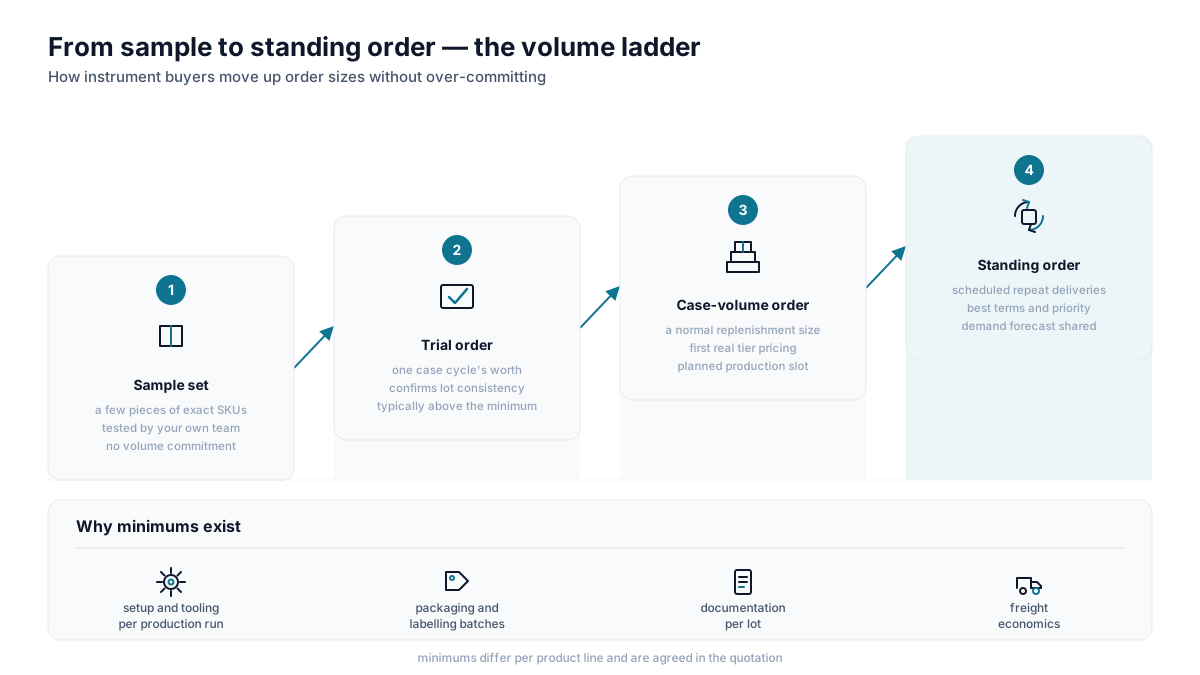
Two or three suppliers are enough to start: a core manufacturer for the main line, one or two complementary sources for gaps. Each relationship costs evaluation time, minimum order quantities and relationship maintenance, so more sources means shallower relationships and worse terms everywhere. Understand each supplier’s minimums and how they flex — the related reading on minimum order quantities covers the structures — because minimums determine both your starting inventory and your reorder rhythm, which is to say your cash.
The working capital reality
Most first-time founders budget for the visible costs — company formation, a website, some travel — and are then surprised by where the money actually goes: inventory and the payment gap. The mechanics deserve to be stated plainly. You pay your manufacturer at or before shipment, often with production lead time in front and freight time behind. The goods then sit in your stock until sold. Your clinic customers, once they are established accounts, expect invoice terms — they pay weeks after delivery. Between your outgoing payment and their incoming one lies a gap measured in months, and every unit of growth widens it: more customers means more stock and more receivables, funded by you. Growth consumes cash in this model; that is not a failure sign, but it must be planned. The negotiating levers on the supplier side — deposit structures, open account after a track record, the standard securities — are treated in the guide to supplier payment terms.
The stock side responds to discipline. Depth in few items beats breadth in many: stock the proven fast movers properly, list the long tail as order-on-request with honest lead times, and let customer demand rather than catalog ambition pull new items into inventory. Watch weeks-of-cover per item monthly, and treat slow stock as the cash it is — discounted and moved, not admired.
For completeness, the obligations: a company that places medical devices on the market as a distributor takes on defined duties — among them verifying correct labeling and documented sourcing, and maintaining orderly processes for storage, traceability and complaint handling. They are organisationally manageable and belong in the setup phase with qualified advice for the target market, not retrofitted after the first incident; a full treatment is beyond this guide’s scope.
First customers: the evaluation-led path
Medical customers do not switch suppliers because of advertising; they switch when a credible specialist makes trying something easy and the trial goes well. The repeatable first-customer motion is therefore evaluation-led. Identify a shortlist of target accounts in one segment — new clinics are disproportionately winnable because they have no incumbent to displace. Approach each with a specific product hook, not a general introduction. Offer a structured evaluation: samples of defined products, a feedback conversation booked in advance, technical answers within a day. The disciplines of a professional evaluation, described from the buyer’s side in the sample orders guide, are your sales script read in the mirror — run the process you would want to be sold through.
Then convert deliberately: a small first order, flawlessly delivered, followed by attentive service, becomes standardisation over months. Track one number above all in year one — the share of first customers who reorder within six months. It is the single most honest indicator of whether product, availability and service are actually working, and it predicts the business’s trajectory better than the size of any individual win. Everything else in early sales is patience: cycles in medical purchasing are long because trust is the actual product, and shortcuts that manufacture urgency read as exactly what they are.
Pricing without a race to the bottom
Pricing deserves its own discipline, because the default gravity of a new supplier pulls downward. With no track record to sell, undercutting the incumbent feels like the only available argument — and it works just often enough to teach the wrong lesson. The problem is arithmetic as much as positioning: your margin funds the stock depth, the fast answers and the painless complaint handling that make customers stay, so a price that undercuts the market by more than your operating advantage is a promise to deliver worse service later. Price a little below the incumbent where you must, at parity where you can, and put the surplus energy into the things buyers actually switch for: availability they can rely on, advice that saves them mistakes, and problems resolved before they escalate. A useful internal rule is to know, before the first negotiation, the floor below which an account is not worth winning — and to let the accounts below it go without regret. In a reorder-driven business, one loyal account at healthy margin outearns three bargain-hunters who leave for the next discount, and the bargain-hunters consume triple the service while they stay.
The five failure modes
| Failure mode | Why it happens | What prevents it |
|---|---|---|
| Too broad, too early | Catalog ambition outruns stocking capital and expertise; every category is shallow | One niche, one workflow, depth in the fast movers; expansion only along customer pull |
| Undercapitalised growth | The payment gap widens with every new account until a good month causes a cash crisis | Size capital to stock plus months of receivables; treat growth as a cash consumer in the plan |
| Unreliable supply | Supplier chosen from a catalog, not an evaluation; first stock-out burns early accounts | Trial orders and sample evaluation before customer promises; a qualified second source for the core line |
| Price-only positioning | Without expertise to sell, discounting feels like the only lever; margin erodes, service follows | Sell workflow knowledge and reliability; concede price last, and never below the service it funds |
| Process-blind operation | Orders, lots and complaints handled ad hoc until an error hits a good customer | Simple written processes for ordering, traceability and complaints from day one, run consistently |
Read as a set, the five share a root: each substitutes optimism for structure in one dimension — portfolio, cash, supply, positioning or process. The businesses that survive year two are rarely the ones with the most impressive launch; they are the ones that were boringly solid in all five dimensions at once, at a scale small enough to manage.
What year one should actually look like
A realistic year one is unglamorous and specific. A portfolio measured in dozens of SKUs, not hundreds, with the core line always in stock. A handful of accounts that reorder — worth more than a long list that sampled once. Supplier relationships deepening: better terms earned through payment discipline, a second source qualified for the core line, first conversations about volume pricing. Processes that run without heroics. And a founder who has personally conducted every sales conversation, because those conversations — what customers asked, what they compared, why they hesitated — are the market research that shapes year two. Wholesale platforms and manufacturer partner programs can compress parts of the path; how a structured sourcing relationship works from the buying side is described on the wholesale page. The rest is compounding: in a reputation-driven market, every reliably delivered order is marketing with a longer half-life than any campaign.
Frequently asked questions
How much money do I need to start a medical supply business?
It depends on niche and stocking strategy, but the structure of the need is universal: initial inventory of the core line, sample stock, company setup and sales costs, plus enough working capital to bridge the months between paying suppliers and being paid by customers — for several accounts at once. The payment-gap component is the one founders most often undersize.
Do I need medical qualifications to sell medical supplies?
Generally no formal clinical qualification is required to trade, but the operational duties of a device distributor must be met, and commercial success requires real product and workflow knowledge — customers are clinicians who notice its absence in the first conversation. Regulatory specifics vary by market and belong in qualified local advice during setup.
Should I start with one product niche or several?
One. Every additional category divides your stocking capital, your learning time and your credibility. A narrow niche lets you know the products deeply, stock them properly and speak the customer’s language — the only advantages available against larger generalists. Expand later, along what your existing customers ask you to supply.
How do I find my first customers?
Through supported evaluations in one clearly defined segment: a shortlist of target accounts, a specific product hook, samples with a structured feedback process, then a small first order delivered flawlessly. New and expanding clinics are the most winnable first accounts because no incumbent supplier has to be displaced.
Can I start without holding inventory?
Holding no stock undermines the two things customers are actually buying — availability and accountability — and sits badly with a distributor’s traceability duties. If capital is the constraint, shrink the niche and stock a short core list deeply rather than dropshipping a long one; the trade-offs are examined honestly in our article on dropshipping medical devices.
How long until a medical supply business is profitable?
Plan in years, not months. Medical purchasing cycles are long, first accounts convert through evaluations, and the reorder base that carries fixed costs builds gradually. The encouraging half of the same fact: revenue built on standardised reorder customers is unusually durable once it exists.
Related articles
How to Become a Hair Transplant Instrument Distributor
A practical guide to building a distribution business in hair restoration instruments: how the revenue model actually works, how to build a starting portfolio, which manufacturer relationship to choose and how the first customers are won.
Dropshipping Medical Devices: An Honest Assessment of a Bad Fit
The honest answer on dropshipping medical devices: why the model conflicts with what device distribution actually requires, where the practical risks bite — lot control, complaints, customs — and the legitimate low-capital alternatives.
Payment Terms with Medical Instrument Suppliers: Proforma, T/T and LC
How payment actually works when buying instruments internationally: the proforma invoice flow, common T/T split structures, when a letter of credit earns its cost, and the red flags that should stop a transfer.
Minimum Order Quantities for Medical Instruments: A Buyer's Guide
Why MOQs exist in instrument manufacturing, what typical minimums look like by product category, which negotiating levers actually move them, and why a supplier with no minimum at all deserves scrutiny.