
Payment Terms with Medical Instrument Suppliers: Proforma, T/T and LC
How payment actually works when buying instruments internationally: the proforma invoice flow, common T/T split structures, when a letter of credit earns its cost, and the red flags that should stop a transfer.
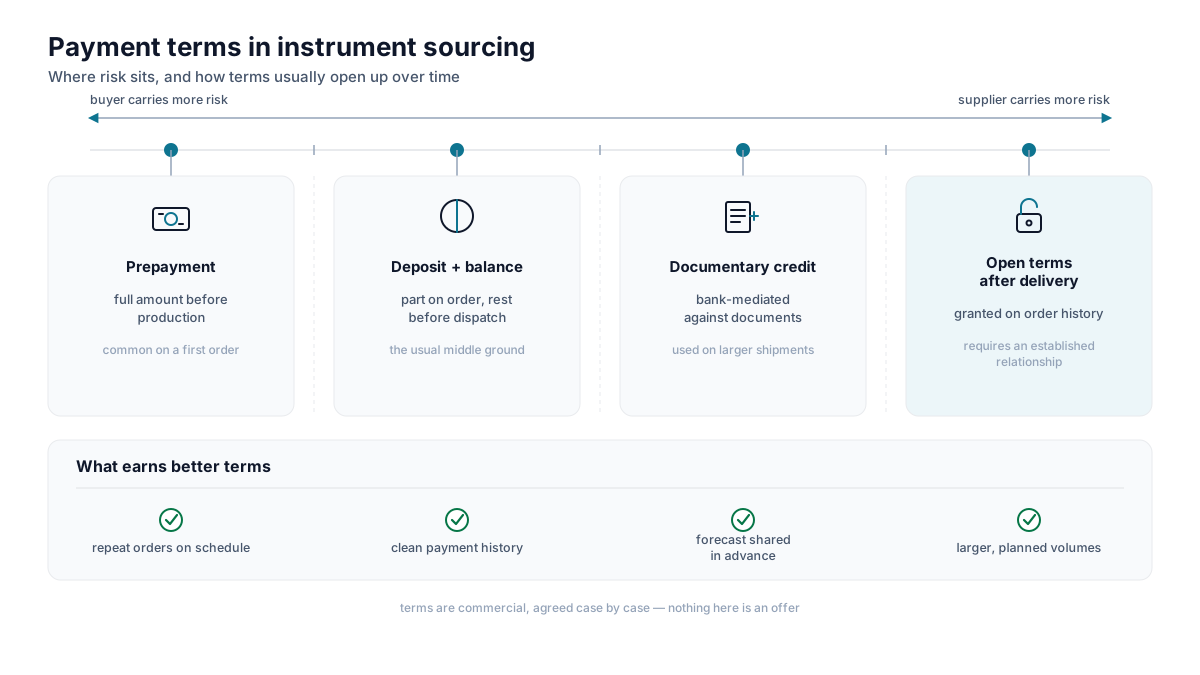
International instrument purchases almost always run on a proforma invoice settled by bank transfer, most commonly as a split — a deposit on order, the balance before shipment or against shipping documents, with 30/70 the pattern you will see most often. Letters of credit make sense for large first transactions with unproven counterparties; open account terms come later, once trust and order history exist. The method you agree matters less than the discipline around it: verified bank details, terms stated on the proforma, and a payment structure that keeps both sides carrying some of the risk until the goods arrive and pass inspection.
Key takeaways
- The proforma invoice is the contract in practice: SKUs, quantities, prices, Incoterm, lead time, bank details and payment split all belong on it before any money moves.
- Split T/T payments — commonly around 30% deposit, 70% before shipment — are the market norm because they share risk rather than assigning it all to one side.
- Letters of credit buy real protection at real cost; they earn their fees on large first orders with unproven suppliers, not on routine repeat purchases.
- Verify bank details through a second channel before the first transfer and treat any mid-transaction change of account as fraud until proven otherwise.
- Crypto-only suppliers, personal bank accounts and pressure to skip the proforma stage are walk-away signals, not negotiation quirks.
The proforma invoice flow
A proforma invoice is not bureaucracy — it is the document that turns a quotation into a checkable transaction. The standard sequence runs: you confirm SKUs and quantities, the supplier issues a proforma, you review it line by line, pay per its terms, and the proforma's details then reappear on the commercial invoice and packing list that travel with the shipment. Any difference between those documents is a problem you want to discover on paper, not at customs.
Review the proforma against a fixed checklist. Exact SKUs and specifications, matching what you sampled — the discipline described in the sample orders guide pays off here. Unit prices and the currency of settlement. The Incoterm with a named place, because "FOB" without a port is half a term. Lead time stated from receipt of deposit, which is when factories actually start counting. The payment split and the trigger for each tranche. Validity period of the pricing. And the beneficiary's full bank details: account name matching the company you performed due diligence on, not a director's personal account or an unrelated entity "for easier processing."
One structural point buyers miss: the proforma is your negotiation checkpoint. Once the deposit is paid, your leverage drops sharply. Quantity flexibility, staged deliveries and MOQ structure — the levers described in the instrument MOQ guide — must be settled before the proforma is signed, not after.
T/T splits: how bank-transfer terms are structured
Telegraphic transfer — an ordinary international bank payment — settles most instrument transactions, and the negotiation is really about the split. Common shapes, from most supplier-friendly to most buyer-friendly:
100% in advance. Normal for sample orders and small first purchases below the cost of arguing. Acceptable at low values with a supplier you have vetted; unwise as the structure for a significant first production order.
30/70 — deposit on order, balance before shipment. The workhorse structure. The deposit funds materials and signals commitment; the balance is paid when the supplier confirms goods are ready, typically against photos, a packing list and, in more careful setups, an inspection report. Variants of the same logic — 40/60, 50/50 — trade a few points of risk between the parties without changing the principle.
Balance against copy of shipping documents. A stronger variant for the buyer: the final tranche is paid when the supplier presents the bill of lading or air waybill copy showing goods actually shipped. It removes the window where you have paid in full for goods still sitting in the factory.
Open account. Goods ship, invoice follows, you pay within an agreed period. This is a credit line the supplier extends you, and it is earned with order history, not requested on the first purchase. When a stranger offers generous open-account terms unprompted, the goods or the invoice are usually the problem.
The right split also depends on what the order contains. Custom or private-label production justifies a larger deposit — the factory is buying dedicated materials and packaging it cannot resell — while stocked catalog goods justify a smaller one.
Letters of credit: when the cost is worth it
A letter of credit puts banks between the parties: the buyer's bank commits to pay when the supplier presents documents that exactly match the credit's terms. Done properly, the supplier is certain of payment and the buyer is certain money moves only against evidence of shipment. That assurance has a price — issuance and confirmation fees, document handling, and a real administrative burden on both sides, since a misspelled port name can hold up payment.
The honest guidance: LCs earn their cost on large first transactions with unproven counterparties, in situations where a failed transaction would be seriously damaging, and where the order size absorbs the fees without distorting unit economics. They are rarely worth it for routine consumable reorders, small orders where fees become a visible percentage, or established relationships where split T/T already works. Some buyers use one LC to bootstrap trust on the first large order, then migrate to split T/T from the second order on — a sensible pattern. If you do open an LC, keep the document requirements simple and aligned with what the supplier's forwarder actually produces; an LC nobody can comply with protects no one.
Documentary collections: the middle path few buyers know
Between plain bank transfers and full letters of credit sits a quieter instrument: the documentary collection. The supplier ships, then routes the shipping documents through the banks; you receive the documents — and with them the ability to clear and collect the goods — either against payment (documents against payment, D/P) or against your signed acceptance of a payment date (documents against acceptance, D/A). The banks act as couriers and gatekeepers for the paperwork, but unlike an LC they guarantee nothing: if you refuse the documents, the supplier still owns goods sitting in a foreign port.
That risk profile explains where collections fit. They cost far less than an LC and give the supplier more assurance than shipping against a promised transfer, so they appear in mid-trust relationships — second and third transactions, or corridors where both banks handle collections routinely. For a buyer, D/P is effectively "balance against original documents" with bank-grade handling of the paperwork. If a supplier proposes a collection, it is neither exotic nor alarming; it is a sign of a finance department that thinks in structures. Just confirm which documents will travel through the banks and check them against your customs checklist before agreeing.
Currency, fees and the mechanics of paying
Small mechanical choices move real money at order scale. Agree the settlement currency on the proforma and keep it constant through the relationship — suppliers quoting in one currency and invoicing in another are exposing you to reprice risk with every order. Decide explicitly who pays the transfer charges: international payments carry sender, correspondent and receiver fees, and the standard instructions (shared charges versus sender-pays-all) can mean the supplier receives less than the invoice amount and asks you to top up. Sender-pays-all on the deposit avoids the most common first-order friction. Always put the proforma number in the payment reference so tranches reconcile cleanly on both sides, and request a payment receipt and the supplier's confirmation of funds received before counting a tranche as settled — a transfer sent is not a transfer arrived, and production clocks start on arrival.
Payment methods compared
| Method | Buyer protection | Cost and friction | Typical use |
|---|---|---|---|
| T/T 100% in advance | Lowest — full performance risk on the buyer | Cheap and fast; single transfer fee | Samples, small first orders, low-value top-ups with vetted suppliers |
| Split T/T (e.g. 30/70) | Moderate — both sides carry risk; balance can be tied to readiness or documents | Cheap; two transfer fees and light coordination | The market norm for production orders at all relationship stages |
| T/T balance against shipping documents | Good — final payment only after evidence of shipment | Cheap; requires document discipline from both sides | Buyer-favoured variant of split T/T for larger or custom orders |
| Letter of credit | Strong — banks pay only against conforming documents | Highest: bank fees both sides, strict document compliance, slower setup | Large first transactions with unproven counterparties |
| Open account (net terms) | Strongest for buyer — pay after shipment or delivery | Cheap in fees; supplier carries credit risk, so pricing may reflect it | Established relationships with order history; earned, not requested |
| Card / online payment platforms | Variable — some dispute mechanisms, limits and surcharges apply | Percentage fees make it expensive at order scale | Sample fees and small purchases where speed beats cost |
Red flags that should stop a transfer
Payment fraud in trade runs on urgency and plausibility, and the defences are procedural rather than clever.
Changed bank details mid-transaction. The most damaging scam in international trade is the compromised email thread: a genuine negotiation, then a message — apparently from your contact — announcing new bank details for the balance payment. Treat any change of beneficiary, account or bank as fraud until verified by phone on a number you sourced independently, not from the email that announced the change. Serious suppliers know this and expect the call.
Personal accounts and mismatched names. The beneficiary on the proforma must be the legal entity you evaluated. Payments routed to directors' personal accounts, unrelated companies or third-country accounts "to avoid delays" remove every layer of recourse you have.
Crypto-only or untraceable channels. A manufacturer with real banking relationships does not need payment in cryptocurrency or via remittance apps. As the sole offered channel, this is a walk-away signal.
Pressure to skip the paperwork. Discounts for paying today, invoices that never arrive in company letterhead, reluctance to state terms on a proforma — each converts your transaction from a documented trade into a favour between strangers.
Terms wildly out of market. Demands for 100% prepayment on a large custom order from an unknown factory push all risk onto you; unsolicited generous credit from a stranger usually precedes goods that never ship or are not what they claim. Both extremes deserve the same scepticism. Payment behaviour is part of supplier quality, and it correlates: the factories that pass the due-diligence checks in how to evaluate an instrument manufacturer are, with few exceptions, the ones whose payment paperwork is boring and correct.
Payment terms as a negotiating currency
Payment terms are not only a risk instrument — they are money. A supplier financing materials for your production run values early cash; if your position allows a larger deposit or faster settlement, price it and trade it explicitly rather than conceding it for free. Conversely, as order history accumulates, negotiate the structure forward: balance against documents instead of before shipment, then partial open account for repeat SKUs. Payment terms interact with everything else in the landed cost — Incoterms, freight timing, customs cash-flow — so negotiate them as part of the whole package described in our import from Turkey guide and the broader sourcing and import hub, not as an afterthought at proforma stage.
Frequently asked questions
What does a 30/70 payment term actually mean?
You pay roughly 30% of the order value as a deposit when the order is confirmed, and the remaining 70% later — most commonly when the supplier confirms goods are ready to ship, or in a buyer-friendlier variant, against a copy of the shipping documents. The deposit funds production and commitment; the balance keeps the supplier accountable for delivery. Nearby splits like 40/60 or 50/50 follow the same logic.
Is paying 100% in advance ever acceptable?
For sample orders and small purchases from a supplier you have vetted, yes — the amounts are below the cost of structuring anything better. For significant production orders it concentrates all performance risk on you, and a reasonable supplier will accept a split. A large custom order demanding full prepayment from an unknown factory is a red flag, not a norm.
When is a letter of credit worth the fees?
When the order is large, the counterparty is unproven, and a failed transaction would genuinely hurt — typically a first major purchase from a new international supplier. The banks' involvement protects both sides, but fees and document strictness make LCs poor value for routine reorders or small transactions. Many buyers use an LC once to establish the relationship, then move to split T/T.
How do I protect against bank-detail fraud?
Verify the beneficiary details before the first transfer through a second channel — a phone call to a number obtained independently of the email thread — and re-verify any change, ever, the same way. Pay only the legal entity named on the proforma and your due-diligence documents. Email threads get compromised precisely at the balance-payment moment; a two-minute call is the entire defence.
Can I get credit terms from an instrument supplier?
Eventually, usually. Open-account terms are a credit decision the supplier makes about you, and they follow demonstrated payment behaviour over several orders, sometimes supported by trade references or credit insurance on their side. Asking for net terms on a first order rarely works and occasionally marks you as a risk. Build the history first, then negotiate the structure forward order by order.
Should the payment terms appear in the contract or the proforma?
Both, and they must match. In practice many instrument transactions run on the proforma alone, which is why it must state the split, the trigger for each tranche, the Incoterm, lead time and bank details explicitly. If there is also a supply agreement, check that its payment clause and the proforma agree — discrepancies between documents are where disputes are born.
Structure your first transaction with a specialist
If you are setting up a first international order and want a second pair of eyes on the proforma, the payment split or whether an LC is worth it at your order size, our sourcing specialists will talk it through with you — including how terms typically flex as the relationship matures.
Related articles
Minimum Order Quantities for Medical Instruments: A Buyer's Guide
Why MOQs exist in instrument manufacturing, what typical minimums look like by product category, which negotiating levers actually move them, and why a supplier with no minimum at all deserves scrutiny.
Instrument Samples Before a Bulk Order: How Professionals Evaluate
A clinic buyer's guide to sample orders: how to request the exact SKUs you intend to buy, what paid and free samples really signal, a structured evaluation protocol, and how to convert results into a safe first order.
Importing Hair Restoration Instruments from Turkey: A Practical Guide
Why Turkey became a manufacturing base for hair-restoration instruments, and the practical import mechanics — Incoterms, customs documents, duty and VAT logic — for buyers in the EU, UK and Gulf.
Sourcing & Import: Buying Medical Instruments Across Borders
The commercial mechanics of importing hair restoration instruments — customs, MOQs, samples, payment terms and how to evaluate a supplier before committing.