
How to Become a Hair Transplant Instrument Distributor
A practical guide to building a distribution business in hair restoration instruments: how the revenue model actually works, how to build a starting portfolio, which manufacturer relationship to choose and how the first customers are won.
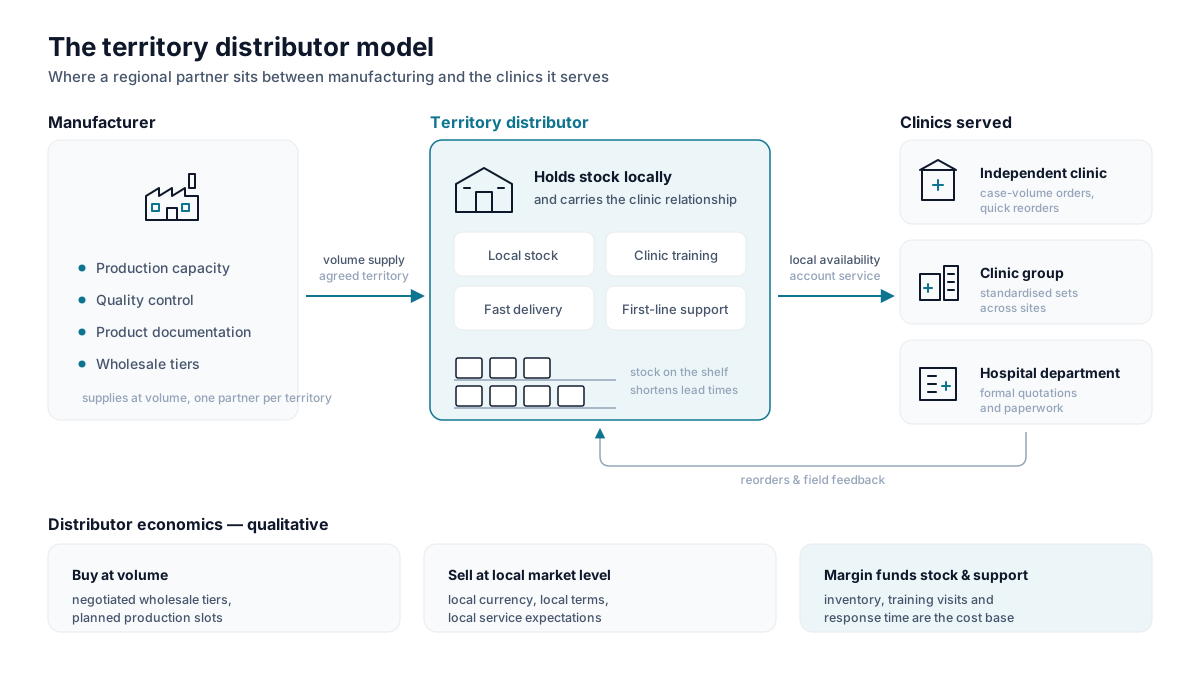
Becoming a hair transplant instrument distributor requires three things, in this order: a reliable manufacturer relationship backed by documented product quality, a focused starting portfolio built around the clinical workflow, and access to a customer segment whose purchasing logic you genuinely understand. It is a relationship business with moderate capital requirements and long trust cycles — the first standing order from a clinic takes months to win, and the margin is made on reorders and portfolio expansion, not on the first sale.
This guide walks through the build step by step: the business model, the portfolio, manufacturer relationships, target segments, the sales motion and the economics underneath it all. It is written for founders coming from sales or medical technology backgrounds, and equally for established medical product distributors evaluating hair surgery as a new line.
Key takeaways
- The business runs on reorders: consumables like punches, blades and implanter needles create predictable repeat purchasing — the first sale is only the entry ticket.
- Build the starting portfolio around the clinical workflow, not around a manufacturer catalog: extraction, incision, implantation, plus the consumables that ride along with every order.
- Exclusivity is not a goal in itself — an exclusive territory only pays if the attached purchase commitments are realistic, and non-exclusive terms are often the smarter entry.
- Clinics buy reliability: availability, clean documentation and fast complaint resolution beat the last percentage point of discount in almost every account.
- Distribution here is specialist selling — a distributor who understands operating-room workflow and runs sample phases properly wins accounts that a price list alone never will.
The business model: where the money actually is
Hair restoration instrument distribution is a niche with an attractive structure: a growing population of specialised clinics and practices, a high share of consumable products with regular repurchase, and a need for knowledgeable support that generalist medical wholesalers rarely provide. The revenue mechanics run on two levels. The base layer is consumables — FUE punches, sapphire and steel blades, implanter needles, surgical disposables — which an active clinic reorders continuously as long as it operates. Above that sit equipment sales with longer cycles: micromotors, handpieces, magnification systems and complete instrument sets for new clinic openings.
For your own planning, the consequence is direct: the value of a customer is measured by annual consumption across the life of the relationship, not by the first invoice. A mid-sized clinic that has standardised its consumable line on one distributor does not switch over trivialities. Switching costs — new sample phases, new documentation, a team relearning its instruments — work in favour of the incumbent supplier. That is exactly why the early phase is slow and the established phase is attractive: at the start you are selling against a competitor’s switching costs, and later you benefit from your own.
| Revenue layer | Typical products | Purchase pattern | Role in the P&L |
|---|---|---|---|
| Core consumables | FUE punches, sapphire and steel blades, implanter needles | Continuous reorders tied to procedure volume | The backbone — predictable margin, defends the account |
| Supporting disposables | Drapes, marking tools, storage consumables, dressings | Ride along with core orders | Modest margin, raises order value and stickiness |
| Instruments and sets | Forceps, handpieces, starter sets for new clinics | Occasional, spiky, often tender-like | Opens accounts and funds the relationship-building phase |
| Equipment | Micromotors, magnification, sterilisation-line items | Multi-year replacement cycles | Irregular but large tickets; strong service component |
Capital requirements are moderate but real: sample stock, a base inventory of the fast movers, financing the gap between paying manufacturers and being paid by clinics, plus the usual start-up costs. A founder who starts with a focused niche and keeps the warehouse disciplined needs far less capital than classical medical wholesale demands — the products are small, storable and logistically simple.
Building the portfolio: follow the workflow, not the catalog
The most common beginner mistake is the bazaar portfolio: a hundred items pulled from three manufacturer catalogs, none of them stocked in depth. Clinics buy the other way round — they look for a supplier who covers their core workflow completely and reliably. The starting portfolio therefore follows the three phases of the procedure. For extraction: FUE punches in the commonly used diameters, with compatible handpieces or at least confirmed compatibility statements. For incision: sapphire and steel blades in graduated widths. For implantation: implanter pens and needles in the relevant gauges. Around that core, a narrow ring of disposables that travel with every order anyway.
Depth beats breadth. Three diameters of a proven punch line permanently in stock serve a clinic better than twelve variants available on backorder — and they serve your cash position better too. Expansion then follows customer feedback: what clinics repeatedly request gets evaluated and added; what nobody asks about stays out of the warehouse. The purchasing criteria your future customers will apply are the same ones you should learn first, and the category resources on this platform — the FUE punch hub among them — are as useful to a new distributor as to a clinic buyer.
A strategic option for later is the own brand: beyond a certain volume, a distributor can have parts of the portfolio manufactured under its own name, improving both margin and customer lock-in. The mechanics — specification, branding, packaging, minimum quantities — are described on the OEM and private label page. It is not a launch topic, but it is worth keeping in mind when choosing manufacturers, because not every factory offers OEM production.
Manufacturer relationships: the most important single decision
The manufacturer relationship carries the whole business, and it deserves a correspondingly rigorous selection process. Evaluate candidates the way a demanding clinic would evaluate you: documented specifications, consistent sample quality across orders, honest lead times, responsive technical answers and clean complaint handling. A structured method for this — production depth, quality control, sample policy, documentation — is laid out in the guide on how to evaluate an instrument manufacturer, and running your own sample evaluation exactly as your customers later will is the single best preparation for selling.
The relationship itself comes in two basic forms. An exclusive arrangement grants you a defined territory alone — attractive on paper, but almost always tied to minimum purchase or revenue commitments, and a young distributor who misses those targets can lose not just exclusivity but the entire line. Non-exclusive terms give up territorial protection in exchange for low entry barriers: little or no minimum commitment, a faster start, and the freedom to test several lines in parallel. For most founders the non-exclusive route is the smarter opening move, with exclusivity negotiated later from a position of demonstrated performance; the trade-offs and the hybrid structures in between deserve their own analysis, and the comparison of exclusive and non-exclusive models in the related reading covers them in depth.
Whatever the model, certain things belong in every manufacturer agreement: documented product specifications, sample and first-order terms, binding lead times, defined complaint channels, and clarity on who serves direct inquiries that originate from your territory. Minimum order structures vary widely between factories and product families; our separate guide to instrument minimum order quantities explains how minimums are typically built and where they flex.
Target segments and how they buy
The customer base divides into four groups with distinct purchasing logic. Specialised hair transplant clinics are the core segment: high, plannable consumption, expert counterparts and demanding quality expectations — here sample quality, availability and the ability to hold a technical conversation decide the account. Dermatology and plastic surgery practices offering transplantation as an additional service buy smaller volumes but value complete solutions and advice; for them the distributor is also an equipment consultant, sometimes up to a full clinic fit-out when they enter the procedure. Clinic groups and chains negotiate centrally, expect framework agreements and punish stock-outs hard; they carry thinner margins but serious volume. Training academies and professional societies, finally, are small in revenue but valuable for visibility: whoever supplies the instruments on which the next generation learns becomes the reference brand when that generation later buys for its own clinics — a slow but remarkably reliable channel.
Across all four groups, one pattern holds in professional markets everywhere: purchasing decisions are conservative and documentation-conscious. A supplier who delivers specifications in writing, labels lots cleanly and resolves complaints quickly and quietly builds a reputation that travels faster than any advertising in a market this small — in both directions.
The build, in phases
In practice the build follows four overlapping phases. Phase one is the foundation: understand the market, define your target customer groups, identify two or three manufacturer candidates and put them through a real evaluation — including sample phases you run yourself, by clinic criteria. Phase two is structure: negotiate the manufacturer agreement, fix the starting portfolio and price architecture, set up warehousing and logistics, and organise your obligations as a distributor properly from day one. Phase three is market entry: approach the first ten to twenty qualified target accounts systematically, accompany their sample phases actively and win the first standardisations. Phase four is scale: portfolio expansion along customer feedback, possibly territory growth or an exclusivity negotiation from demonstrated strength — and the evaluation of an own brand for the highest-volume consumables.
The most common phase error is pulling sales forward: approaching clinics before portfolio and availability are in place burns exactly the first contacts that would later be most valuable. The second most common is skipping your own sample phase — a distributor who has never evaluated his own products by clinic criteria discovers the gap in the first serious technical conversation, at the worst possible moment.
The sales motion: how accounts are actually won
This is specialist sales with long cycles. The typical path to a clinic account runs through a first approach with a concrete hook — a product line that solves a documented problem — then a technical conversation with the surgical team rather than only the administration, then a sample phase the distributor actively supports, and finally a small first order that grows into standardisation if the experience is good. The sample phase is the actual sale: a distributor who treats it as a parcel shipment loses it, while one who follows up on protocol questions, collects structured feedback and answers technical questions fast is doing the selling that matters. The disciplines of a well-run evaluation are described from the buyer’s side in the sample orders guide — read it as the playbook your customers will use on you.
Around the direct motion, three channels support the build: professional congresses and trade fairs as contact surfaces, a serious digital presence with real specifications instead of marketing prose, and referrals from existing accounts. Realistically, the path from first contact list to a sustainable customer base takes one to two years; whoever plans faster is planning away the trust cycles of the market. And from the first day, inside-sales quality — reachability, binding delivery answers, error-free order processing — decides reorders at least as strongly as field work decides first orders.
The economics and the obligations
Margin structure varies by category: consumables carry proportionally more than equipment, own brands more than third-party brands, and price pressure rises with the comparability of the item. The control variables that matter are reorder rate, inventory turnover and payment terms. Three numbers are enough to steer the young business. First, the reorder quota: what share of first customers orders again within six months — if it sags, the problem sits in product, availability or support, not in new business. Second, contribution per account per year, which shows which customer groups actually carry their cost of service. Third, weeks of stock cover per item, which balances capital tie-up against availability. Watched monthly, these three surface problems long before the annual accounts do — and they give you real numbers to negotiate with manufacturers instead of hopes. On the liquidity side, the gap between paying your manufacturer and being paid by your clinics is the critical quantity, and it belongs in the plan from the first draft.
For completeness: a business that places medical devices on the market takes on defined obligations as a distributor — among them verifying that products are correctly labeled and sourced from documented manufacturers, and maintaining orderly processes for storage, traceability and the handling of complaints. These duties are organisationally very manageable, but they should be set up cleanly with qualified advice before launch rather than retrofitted afterwards; a full treatment is beyond the scope of this guide.
The fastest way to make your own plan concrete is a structured conversation about portfolio, terms and territory with a manufacturer or program partner — with a clear picture of your target customers and starting portfolio as the basis. The distributor program bundles what that looks like in practice: conditions, sample packages and support during the market build.
Frequently asked questions
How much starting capital does an instrument distributor realistically need?
Considerably less than classical medical wholesale, but more than zero: sample stock, a base inventory of fast movers, financing the gap between manufacturer payment and clinic payment terms, and the usual founding and sales costs. The exact figure depends on portfolio depth and stocking strategy — a focused start with a narrow, deep portfolio keeps the requirement small.
Do I need a medical background to distribute hair transplant instruments?
Not a degree, but genuine procedural knowledge: a distributor who cannot follow operating-room workflow, instrument parameters and the vocabulary of the surgical team is selling against specialists who can. The knowledge is learnable — through congresses, manufacturer training, clinic visits and systematic study of the product categories.
Should I start exclusive or non-exclusive?
For most founders, non-exclusive: low entry barriers, no target-miss risk, several lines testable in parallel. Exclusivity pays when demonstrable sales strength meets a realistically negotiated territory with a fair ramp-up curve — and it always belongs in writing, including what happens if targets are missed.
How long does it take to build a sustainable customer base?
Realistically one to two years. Cycles are long because clinics standardise through sample phases and small first orders, and switching costs protect incumbent suppliers. The same inertia later works for you: a standardisation account won once stays for years if the service holds.
How many manufacturers should a new distributor work with?
Few, and well vetted — typically one core manufacturer for the main line plus one or two complementary sources for portfolio gaps. Every manufacturer relationship costs evaluation effort, minimum orders and management time; too many parallel sources dilute purchasing terms and quality control. Expand along customer demand, not along catalog availability.
What role should an own brand play at the start?
None at launch — it ties up capital and presupposes volume that still has to be built. As a second step, once reorder business is stable, an own brand can improve margin and customer retention markedly. The smart move is to keep the option in mind early and check, during manufacturer selection, who offers OEM production.
Related articles
Distributor Program for Hair Restoration Instruments
Manufacturer-direct hair restoration instrument lines for medical distributors — territory models, documentation support and a clear application process.
Exclusive vs Non-Exclusive Distribution: Which Model Actually Serves You?
An honest comparison of exclusive and non-exclusive distribution rights: what each model really grants, when each one wins, the hybrid structures in between, and the performance clauses that make an exclusive territory earn its keep.
How to Start a Medical Supply Business: A Realistic Guide
A realistic guide to starting a medical supply business: why the niche decides everything, why supplier relationships come before customers, what working capital the model really consumes, and the failure modes that end most attempts.
White Label vs Distribution: Two Business Models Compared Honestly
An honest comparison of the white-label and distribution business models: how margin, brand ownership, inventory risk, time-to-market and exit value differ, when switching makes sense, and how experienced operators stage the two together.