
White Label vs Distribution: Two Business Models Compared Honestly
An honest comparison of the white-label and distribution business models: how margin, brand ownership, inventory risk, time-to-market and exit value differ, when switching makes sense, and how experienced operators stage the two together.
Distribution and white label answer the same question — how to sell products you do not manufacture — with opposite trades. A distributor sells the manufacturer’s brand: fast to start, lighter on capital, but forever building equity in someone else’s name. A white-label operator puts their own brand on manufactured products: slower and more capital-hungry, but every satisfied customer compounds into an asset the operator owns and could one day sell. Neither is simply better; they reward different stages of a business. The pattern experienced operators converge on is staged: prove demand and learn the market as a distributor, then convert the proven, high-volume products to an own brand while keeping distribution for the rest.
Key takeaways
- The core trade is speed against ownership: distribution starts fast on someone else’s brand equity; white label builds your own, slowly and at your cost.
- Margin structure differs less at the invoice line than in who captures the brand premium — under white label, it is you.
- White label concentrates risk: minimum production runs, packaging investment and claim responsibility all land on the brand owner.
- Exit value diverges sharply — a house brand with loyal reorder customers is sellable in a way a revocable distribution right rarely is.
- Staging beats choosing: distribute to learn the market, white-label the two or three SKUs your reorder data has already validated, keep distributing the long tail.
The two models, stated precisely
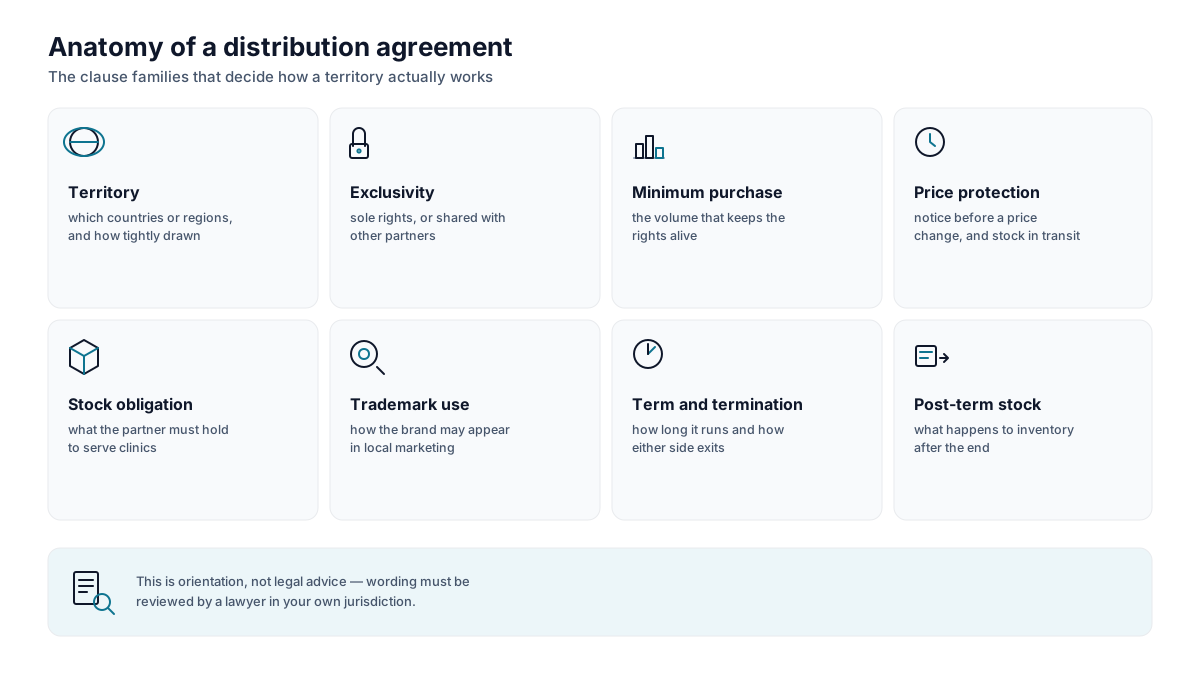
A distributor buys finished, branded goods from a manufacturer and resells them — the customer knows whose product it is, and the distributor’s value lies in access, stock, service and advice. The relationship is governed by a distribution agreement: territory, pricing, commitments and the exit clauses examined clause by clause in the related guide to distribution agreement terms.
A white-label operator instead buys products manufactured to an existing or lightly adapted specification and sells them under its own brand: its name on the label, its packaging, its claims, its customer relationship entirely. The manufacturer becomes invisible. In the adjacent OEM variant, the buyer goes further and commissions products to its own specification; the distinction between reselling, white label and full OEM is unpacked in the comparison of OEM versus private label, and both instrument and hair-care versions of the model run through the platform’s OEM and private label services. For this article, the essential difference is simpler: under distribution the brand belongs to the factory; under white label it belongs to you.
The comparison, dimension by dimension
| Dimension | Distribution | White label |
|---|---|---|
| Margin structure | Resale margin on the manufacturer’s price; compressed wherever the same brand is sold by others | Manufacturing cost plus your full brand premium; no same-brand price comparison exists |
| Brand ownership | None — every sale builds the manufacturer’s equity, and the line can be repriced or withdrawn | Full — customer loyalty, recognition and goodwill accrue to your asset |
| Inventory risk | Moderate: stocked goods are usually returnable to the market, sometimes to the supplier | Concentrated: minimum production runs of goods only you can sell, plus packaging stock |
| Time-to-market | Weeks — established products, existing documentation, immediate credibility | Months — specification, branding, packaging, labeling and production lead time before the first sale |
| Capital requirement | Stock plus receivables financing | Production minimums, brand and packaging development, plus the same stock and receivables |
| Marketing burden | Shared — the manufacturer’s brand and materials carry part of the load | Entirely yours — the brand is only what you invest in it |
| Responsibility profile | Distributor duties for products carrying the maker’s name | Brand-owner responsibility: your label, your claims, your complaint desk |
| Exit value | Limited — agreements are typically terminable and rarely transferable | Real — a brand with reorder customers and documented sales is a sellable asset |
Margin and brand: the same coin, two sides
The margin argument for white label is usually stated too crudely as higher margins. The precise version: under distribution, the price ceiling is set by the brand’s market price, which every reseller of that brand shares — and wherever a second seller exists, competition converges on price, the dynamic examined in the related comparison of exclusive and non-exclusive distribution. Under white label there is no same-brand comparison, because nobody else sells your brand. The customer weighs your product against different products, not identical ones, and the premium your service, positioning and trust command belongs entirely to you. The cost of that freedom is symmetric: nobody else builds your brand either. The manufacturer’s reputation, materials and recognition — assets a distributor borrows on day one — are replaced by whatever you construct, at your expense, over years.
Which side of the coin weighs more depends on the category. Products bought on trust and routine — aftercare lines a clinic hands to patients, standard consumables reordered monthly — carry an own brand well, because the buyer’s loyalty attaches to the supplier relationship anyway. Products bought on documented technical reputation carry it harder: a surgeon’s confidence in a punch line’s edge consistency took the manufacturer years to earn, and a new label starts that clock from zero unless the operator’s own standing substitutes for it.
A concrete illustration makes the mechanics tangible. Consider a distributor supplying clinics with a manufacturer-branded aftercare shampoo alongside a range of instruments. The shampoo sells steadily — clinics reorder it monthly, patients accept whatever the clinic hands them, and no customer has ever asked a technical question about it. Two other regional distributors carry the same brand, so quotes are compared line by line and the margin has thinned every year. This is the textbook white-label candidate: loyalty already sits with the clinic relationship rather than the label, reorder volume is proven, and the same-brand price comparison is doing real damage. Now consider the same distributor’s premium punch line, where surgeons specify the manufacturer by name on the strength of years of edge-consistency experience. Converting that product to a house label would discard the very asset that sells it. Same portfolio, same customers — opposite answers, which is why the decision is made SKU by SKU rather than for the business as a whole.
Risk, capital and time-to-market
Distribution scales down gracefully: a stocked line that underperforms is discounted and discontinued, and the loss is bounded by inventory on hand. White label concentrates risk at three points. Production minimums are the first — factories price white-label runs against batch economics, so entry means committing to volumes of goods only you can sell; if the launch stalls, the stock has no alternative buyer. Brand investment is the second: naming, design, packaging tooling and content are sunk before the first invoice. Responsibility is the third and least discussed: your label makes you the brand owner your customers and their patients look to, with your claims on the packaging and your desk answering complaints — organisationally manageable, but a real step up from reselling that belongs in the plan with qualified advice for the target market.
Time-to-market divides the models just as cleanly. A distribution line can be selling within weeks of the agreement. A white-label line moves at the speed of specification, label and packaging development, production scheduling and freight — months in honest planning. For a founder still validating whether a market exists at all, that difference is decisive, which is one of several reasons the sequencing question below usually answers itself.
What changes operationally when the label is yours
The model switch is also an operational switch, and underestimating it is a classic staging error. As a distributor, you receive finished, labeled, documented goods; your quality role is checking that what arrived matches what was ordered. As a brand owner, you become the quality gate: the manufacturer produces to the agreed specification, but what reaches the customer under your name is your responsibility, which makes supplier evaluation, retained reference samples and disciplined incoming inspection more important, not less. Claim discipline arrives with the label too — every statement on your packaging and marketing is now yours to substantiate, and the sober, evidence-cautious wording that professional buyers respect is also simply the safe habit.
Planning rhythm changes as well. Distribution replenishes in small, frequent orders against the manufacturer’s stock; a house brand replenishes in production runs, scheduled ahead, with label and packaging stock managed alongside the product itself. Forecasting errors that a distributor absorbs as a slightly late reorder become, for a brand owner, either a stock-out of a product nobody else can supply or a cash-heavy overrun sitting in the warehouse. None of this argues against the model — thousands of suppliers run it well — but it belongs in the plan as real operational capability to build, not as a labeling detail.
Exit value: the quiet decider
If the models still look balanced, the exit lens usually breaks the tie. A distribution business’s revenue rests on agreements that are typically terminable on notice and rarely transferable without the manufacturer’s consent — an acquirer discounts revenue that a third party can switch off accordingly. Well-built distributors still sell, but what is being bought is mostly customer relationships and operations, at valuations that reflect the dependency. A house brand changes the arithmetic: reorder customers loyal to a label you own, documented sales history, transferable supply agreements — that is an asset an acquirer can buy whole, and even small niche brands with steady reorder bases attract genuine buyers. An operator who never intends to sell still benefits from the same logic, because the things that create exit value — owned customer loyalty, supplier independence, pricing power — are the things that make the business durable while it runs.
When to switch — and how to stage the hybrid
The honest sequencing rule: white label is a second move, made from evidence, not a first move made from ambition. Launching an own brand before knowing which products the market reorders means placing production-minimum bets on guesses. Distribution first converts those guesses into data — which SKUs reorder, at what volumes, through which customers — while building the very reputation and customer base a young brand will later need. The build itself is covered in the guide to becoming an instrument distributor.
The switch signals are readable in the numbers a distributor should be tracking anyway. Reorder volume on specific SKUs approaching white-label production minimums is the arithmetic trigger. Customers buying on your advice and service rather than the label — asking what you recommend instead of asking for a brand — is the relationship trigger. Margin compression from same-brand competition is the pain trigger. And a category where your volume products are functionally comparable across manufacturers — true of much aftercare and many standard consumables — is the category trigger. When several align on the same products, the staging is straightforward: convert those two or three proven SKUs to your brand, keep distributing everything else, and let each side of the hybrid do what it does best — the brand carrying margin and identity on the head of the portfolio, distribution carrying breadth, novelty and low-risk testing on the tail. Many mature suppliers never leave this hybrid, because it dominates both pure forms: new products enter as distributed lines, prove themselves in the reorder data, and graduate to the house brand only after the market has voted.
Two failure patterns deserve flags. The first is white-labelling the wrong products — technically differentiated instruments where the manufacturer’s name carries surgeon trust — instead of the routine consumables where loyalty already sits with the supplier relationship. The second is running the hybrid without agreement hygiene: the same portfolio can contain distributed brands and your own label peacefully, but the distribution agreements need checking for non-compete and competing-line clauses before the house brand launches beside them, not after.
Frequently asked questions
Is white label more profitable than distribution?
Per unit, usually — the brand premium accrues to you and no same-brand price competition exists. As a business, only after the brand investment, production minimums and marketing burden are carried, which takes volume and time. Distribution is frequently the more profitable model at small scale, white label at established scale; the crossover shows up in your reorder data.
Can I run white label and distribution at the same time?
Yes — the hybrid is the standard end-state for experienced operators: an own brand on the proven, high-volume SKUs, distributed manufacturer brands across the rest. It works cleanly provided the distribution agreements are checked for competing-line clauses, and provided the house brand is reserved for products your reorder data has actually validated.
How much volume do I need before white label makes sense?
The arithmetic gate is the factory’s minimum production run for a labeled batch: your reorder volume on the candidate SKU should absorb a full run within a period you are comfortable holding as stock. Minimums vary widely by product and factory — tube-filled cosmetics, packed instruments and kits all behave differently — so the real answer comes from quotes against your actual numbers.
Does white label mean lower product quality than branded distribution?
No — white-label goods often come off the same lines as branded equivalents. Quality is determined by the manufacturer you choose and the specification you agree, not by whose name goes on the label. The difference is accountability: under your brand, you are the quality gate, which makes manufacturer evaluation and incoming inspection more important, not less.
What happens to my distribution business if I launch my own brand?
Handled openly, usually nothing dramatic — manufacturers understand portfolio logic, and many supply white-label runs themselves. The risks are contractual and relational: check existing agreements for non-compete clauses before launching, avoid positioning the house brand as a copy of a partner’s flagship, and expect harder conversations where your brand competes head-on with a line you distribute.
Which model is better for eventually selling the business?
White label, clearly. An acquirer pays for assets that transfer: an owned brand, its customer loyalty and its sales history transfer; a terminable distribution right largely does not. A hybrid sells on the strength of its brand side. If exit is a serious consideration, that alone justifies migrating proven volume to an own label earlier rather than later.
Related articles
OEM vs Private Label vs White Label for Hair Products
The three routes to selling hair care under your own brand — OEM, private label and white label — compared on control, speed, minimums, cost and IP ownership.
How to Become a Hair Transplant Instrument Distributor
A practical guide to building a distribution business in hair restoration instruments: how the revenue model actually works, how to build a starting portfolio, which manufacturer relationship to choose and how the first customers are won.
Distribution Agreement Terms: The Clauses That Decide Whether the Deal Works
A clause-by-clause walk through medical device distribution agreements: territory and exclusivity, minimum commitments, pricing structure, marketing obligations, IP use, termination and the post-term provisions most first-time distributors overlook.
Exclusive vs Non-Exclusive Distribution: Which Model Actually Serves You?
An honest comparison of exclusive and non-exclusive distribution rights: what each model really grants, when each one wins, the hybrid structures in between, and the performance clauses that make an exclusive territory earn its keep.