
Exclusive vs Non-Exclusive Distribution: Which Model Actually Serves You?
An honest comparison of exclusive and non-exclusive distribution rights: what each model really grants, when each one wins, the hybrid structures in between, and the performance clauses that make an exclusive territory earn its keep.
Neither model is inherently better: exclusive distribution wins when a distributor with proven sales strength commits to building a defined territory and gets protection worth that investment, while non-exclusive terms win for market entry, portfolio testing and any situation where the honest sales forecast is still a guess. The real decision is rarely binary anyway — the structures that work best in practice are usually hybrids, with exclusivity granted narrowly by segment, channel or product line, tied to performance clauses that let it be earned, kept or lost on evidence rather than on promises.
Key takeaways
- Exclusivity is protection for investment: it makes sense exactly where a distributor spends real money building a market and needs assurance that the harvest is theirs.
- Non-exclusive terms are the honest choice when the forecast is a guess — low commitment, fast start, several lines testable in parallel.
- Every exclusive grant has a price in commitments; a territory you cannot realistically develop is a liability dressed as an asset.
- Hybrids beat both pure forms in most real deals: exclusivity by segment, channel or product line, with the rest left open.
- Performance clauses make exclusivity self-justifying — staged targets with a ramp-up, review points, and lapse-to-non-exclusive instead of termination.
What each model actually grants
An exclusive distribution right means the manufacturer appoints you alone for a defined scope — usually a geography, sometimes a segment or channel — and agrees not to appoint others or, in the stronger form, not to sell directly into that scope either. That last distinction matters more than most first-time negotiators realise: sole distribution that leaves the manufacturer free to serve big accounts directly is a very different asset from true exclusivity, and the difference belongs in writing. In exchange, the distributor almost always accepts obligations: minimum purchases or revenue targets, marketing commitments, sometimes a restriction on carrying competing lines.
A non-exclusive right is simpler: you may sell, and so may others. The manufacturer keeps its options open; the distributor keeps theirs. Entry barriers are low — minimums are small or absent, terms are shorter, and nobody is betting the relationship on a forecast. The cost is strategic: you may invest in developing a customer only to watch a parallel distributor, or the manufacturer itself, harvest the account with a sharper price. Non-exclusive distribution of an identical product tends to converge on price competition, because when several sellers offer the same item, price is the only lever left.
That convergence is the economic heart of the choice. Exclusivity exists to make market development investable: educating customers, running sample phases, holding stock, attending fairs — all of it creates value that spills over to whoever sells the product. Exclusivity internalises that spillover. Where little development investment is needed, exclusivity protects little and costs the manufacturer flexibility; where the investment is heavy, no serious distributor will make it without protection.
The comparison, honestly
| Factor | Exclusive | Non-exclusive |
|---|---|---|
| Territorial protection | Defined scope is yours alone; strongest form also excludes the manufacturer’s direct sales | None — parallel distributors and direct sales can compete for the same accounts |
| Entry conditions | Minimum purchases or revenue targets almost always required | Low or none; short terms, fast start |
| Risk profile | Target-miss risk: underperformance can cost exclusivity or the whole line | Low contract risk, but investment-spillover risk: others may harvest accounts you developed |
| Margin tendency | Structurally better — territory investment is rewarded and price competition on the identical product is absent | Market-level; converges toward price competition where sellers overlap |
| Manufacturer relationship | Close: joint planning, marketing support, deeper information sharing | Loose: transactional, several lines can run in parallel |
| Investment logic | Justifies real market-building spend: stock depth, fairs, sample programs, training | Justifies opportunistic selling; heavy market-building is hard to defend |
| Flexibility | Low — commitments bind capital and attention to one line | High — portfolio can be tested, rebalanced and pruned freely |
| Best fit | Proven sales capability in a well-understood market | Market entry, portfolio testing, secondary lines |
When exclusivity genuinely wins
Exclusivity earns its commitments in a specific situation: you know the market, you have demonstrable access to the customer segment, and the line requires real development investment that would be irrational without protection. A distributor introducing a manufacturer’s instrument line to clinics through supported sample phases, stocking depth in the core sizes and attending national congresses is creating the market for that brand — and should own what that creates. Exclusivity also concentrates the manufacturer’s attention: an exclusive partner gets the joint planning, the marketing support, the early product information, because the manufacturer’s success in that territory now runs entirely through one relationship.
There is a second, less discussed advantage: exclusivity disciplines the manufacturer. With parallel distributors, a manufacturer can play sellers against each other on terms; with an exclusive partner, the relationship is symmetrically dependent, which tends to produce more honest planning on both sides. The dependency cuts both ways, of course — which is why the exit and performance clauses discussed below carry so much weight.
The failure mode is equally specific: exclusivity accepted on hope. A founder takes a whole-country exclusive with minimums derived from the manufacturer’s ambitions, spends year one discovering the real sales cycle, misses the target, and loses the line — having spent the year building a market someone else now inherits. An exclusive territory you cannot develop at the committed pace is not an asset; it is a liability with your name on it.
When non-exclusive wins
Non-exclusive terms are the honest structure for uncertainty. At market entry — the situation described in the guide to becoming an instrument distributor — your forecast is a hypothesis, your customer access is unproven and your evaluation of the manufacturer is provisional. Non-exclusive terms let you test all three cheaply: carry the line, run real sample phases with real clinics, learn the reorder behaviour, and only then decide what deserves commitment. The same logic applies to secondary lines that round out a portfolio without carrying its economics, and to opportunistic additions where demand may prove thin.
Non-exclusive status also suits distributors whose strength is a customer relationship rather than a brand: a supplier whose clinics buy on trust and service can sell whichever line fits the case best, and giving up that neutrality for one manufacturer’s exclusivity may cost more than the protection is worth. The discipline required is investment restraint — build the market for a brand you do not hold protection on, and you are working partly for your competitors.
Hybrid models: how experienced parties actually structure it
Most sophisticated agreements land between the poles, and the hybrid toolbox is worth knowing before any negotiation.
Exclusivity by segment or channel. The distributor takes exclusive rights for defined customer groups — say, private clinics — while the manufacturer keeps hospitals, tenders or online channels. This matches protection to where the distributor actually invests, and it is often the compromise that unlocks a stalled negotiation.
Exclusivity by product line. Exclusive rights on the flagship line where the distributor concentrates its market-building; non-exclusive rights on the rest of the catalog. The distributor’s investment case is protected without locking the whole relationship.
Named-account protection. Short of any territorial grant, the parties list the accounts the distributor develops and protect those. Administratively light, and for a young distributor often the most realistic first step — it protects exactly the value being created, no more.
Staged exclusivity. The agreement starts non-exclusive with a written option: hit defined milestones and exclusivity follows automatically. This inverts the usual risk — instead of granting protection on promises and clawing it back on failure, protection is earned on evidence. Manufacturers respect it because it costs them nothing if the distributor underdelivers; distributors should insist the trigger is automatic rather than a renewed negotiation.
Lapse-to-non-exclusive. The mirror image for exclusive starts: a missed target converts the grant to non-exclusive rather than terminating the line. The distributor keeps the business it built; the manufacturer regains freedom. As a default consequence it is far healthier than termination, and it belongs in almost every exclusive agreement.
Performance clauses that make exclusivity earn itself
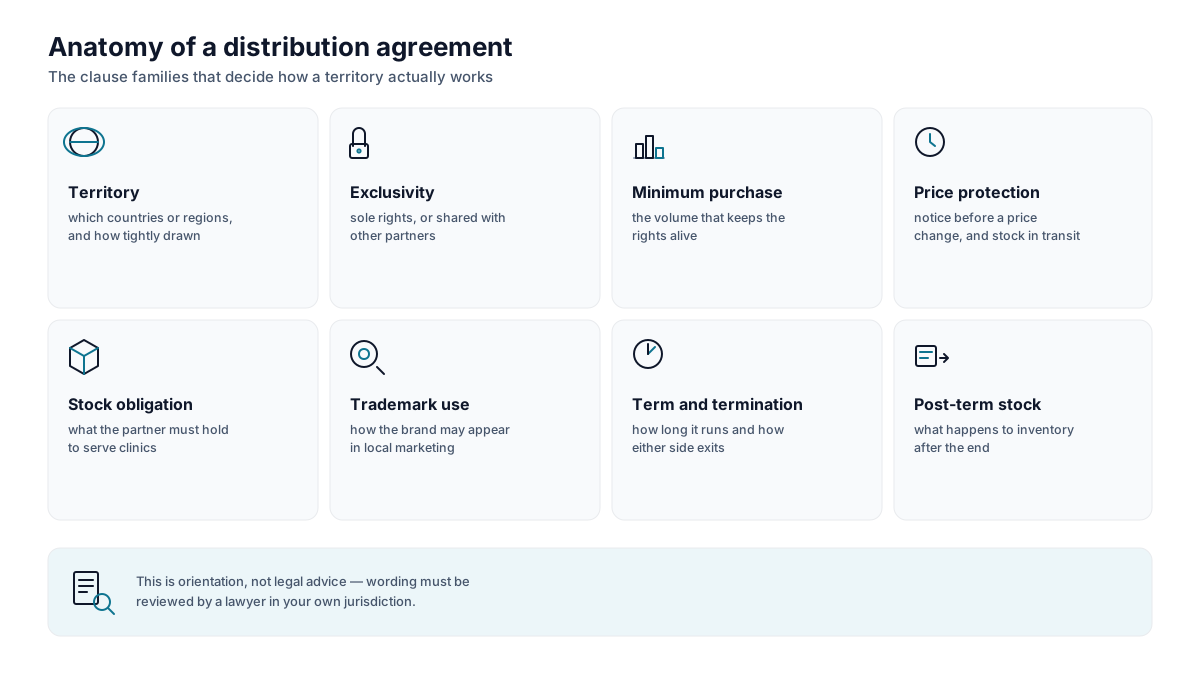
Whatever the structure, exclusivity should be self-justifying — kept because it demonstrably works, not because it was once granted. Four drafting elements do that work. First, targets derived from a joint bottom-up plan, with a ramp-up curve in year one that respects the real sales cycles of the market. Second, defined counting rules: what counts toward the target, over what period, with carry-over for strong years, so the number is a measurement rather than a future argument. Third, scheduled reviews — an annual session where targets, support and territory are adjusted against evidence, which keeps the agreement aligned with reality instead of drifting away from it. Fourth, proportionate consequences in stages: recovery plan first, narrowed or lapsed exclusivity second, termination only for persistent failure. These mechanics live inside the broader contract architecture — territory definitions, buyback clauses, dispute resolution — that the clause-by-clause guide to distribution agreement terms in the related reading covers in full.
One clause pair deserves special mention because it is so often missed: direct-inquiry routing and manufacturer online sales. Exclusivity that does not say what happens when a customer from your territory contacts the factory — or orders from the manufacturer’s own webshop — is exclusivity with a hole in it. Close the hole in writing.
The manufacturer’s side of the table
Negotiations go better when each party understands what the other is actually weighing, so it is worth stating the manufacturer’s calculus plainly. Granting exclusivity means betting a market on one partner: if the distributor underperforms, the manufacturer loses not just sales but time — years, once the agreement’s term and the rebuilding afterwards are counted. Manufacturers therefore read an exclusivity request as a request for trust, and they price it in evidence: an existing customer base, a written market plan with named target accounts, demonstrated competence in the category, and commitments the candidate visibly believes rather than merely accepts. A distributor who asks for a continent on the strength of enthusiasm is not being ambitious; from the other chair, they are being unserious.
The same lens explains manufacturer behaviour that distributors often misread. Reluctance to exclude direct sales from large accounts is usually risk management, not bad faith — those accounts are the manufacturer’s insurance against a partner who stalls. An insistence on staged exclusivity or a trial period signals a manufacturer who has been burned before, which is common, and worth asking about directly. And a manufacturer who grants broad exclusivity easily, without probing your plan at all, is telling you the line has no other suitors — information worth having before you commit your next two years to it.
Deciding for your situation
Reduce the decision to three questions. Can you write a bottom-up sales plan for this line that you would bet your own money on? If not, start non-exclusive or staged — you are not ready to price exclusivity, and that is fine. Does the line require real market-building investment to sell at all? If not, exclusivity protects little; if yes, do not make the investment unprotected. And is the manufacturer offering commitments that match yours — support, supply reliability, routing of inquiries? Exclusivity is bilateral or it is a trap, and the partner’s substance deserves the same scrutiny as the terms: the criteria in how to evaluate an instrument manufacturer apply doubly when you are about to bind your business to one factory. Manufacturers evaluating partners weigh the same questions from the other side, which is why the honest conversations tend to be the productive ones; the distributor program describes how those conversations are structured, including how territory models are matched to a partner’s actual stage.
Frequently asked questions
Is exclusive distribution better than non-exclusive?
Neither is better in general. Exclusivity wins when proven sales capability meets a line that needs real market-building investment — the protection makes the investment rational. Non-exclusive wins under uncertainty: market entry, unproven demand, portfolio testing. Most well-constructed deals end up hybrid.
What do manufacturers demand in exchange for exclusivity?
Almost always performance: minimum purchases or revenue targets, marketing commitments such as fair attendance and trained sales capacity, market reporting, and sometimes a restriction on competing lines. The commitments are legitimate; the negotiation is about making them realistic — ramped in year one, measurably defined, and with proportionate consequences for a miss.
Can exclusivity be limited to certain customers or products?
Yes, and it usually should be. Exclusivity by segment, channel or product line — or simple named-account protection — matches the grant to where the distributor actually invests. Narrow, well-defined exclusivity is easier to obtain, easier to defend and easier to live with than a broad grant carrying broad commitments.
What happens if an exclusive distributor misses its targets?
Whatever the agreement says — which is why the consequence clause matters more than the target itself. The healthy default is staged: a review and recovery plan first, conversion to non-exclusive or a narrowed territory second, termination only for persistent failure. Automatic termination on a single miss turns one weak year into the loss of everything built.
Can I start non-exclusive and become exclusive later?
Yes — staged exclusivity is one of the most constructive structures available. The agreement starts non-exclusive and grants exclusivity automatically when defined milestones are hit. Insist on the automatic trigger in writing; an informal promise to discuss exclusivity later is a renegotiation from whatever bargaining position you happen to have then.
Does exclusivity include protection from the manufacturer selling directly?
Only if the agreement says so. Sole distribution classically means no other distributors are appointed but the manufacturer may still sell directly; full exclusivity excludes the manufacturer too. The difference — including webshop sales and direct inquiries from your territory — should be resolved explicitly in the text, because it decides who harvests the largest accounts.
Related articles
Distribution Agreement Terms: The Clauses That Decide Whether the Deal Works
A clause-by-clause walk through medical device distribution agreements: territory and exclusivity, minimum commitments, pricing structure, marketing obligations, IP use, termination and the post-term provisions most first-time distributors overlook.
How to Become a Hair Transplant Instrument Distributor
A practical guide to building a distribution business in hair restoration instruments: how the revenue model actually works, how to build a starting portfolio, which manufacturer relationship to choose and how the first customers are won.
Distributor Program for Hair Restoration Instruments
Manufacturer-direct hair restoration instrument lines for medical distributors — territory models, documentation support and a clear application process.