
OEM vs Private Label vs White Label for Hair Products
The three routes to selling hair care under your own brand — OEM, private label and white label — compared on control, speed, minimums, cost and IP ownership.
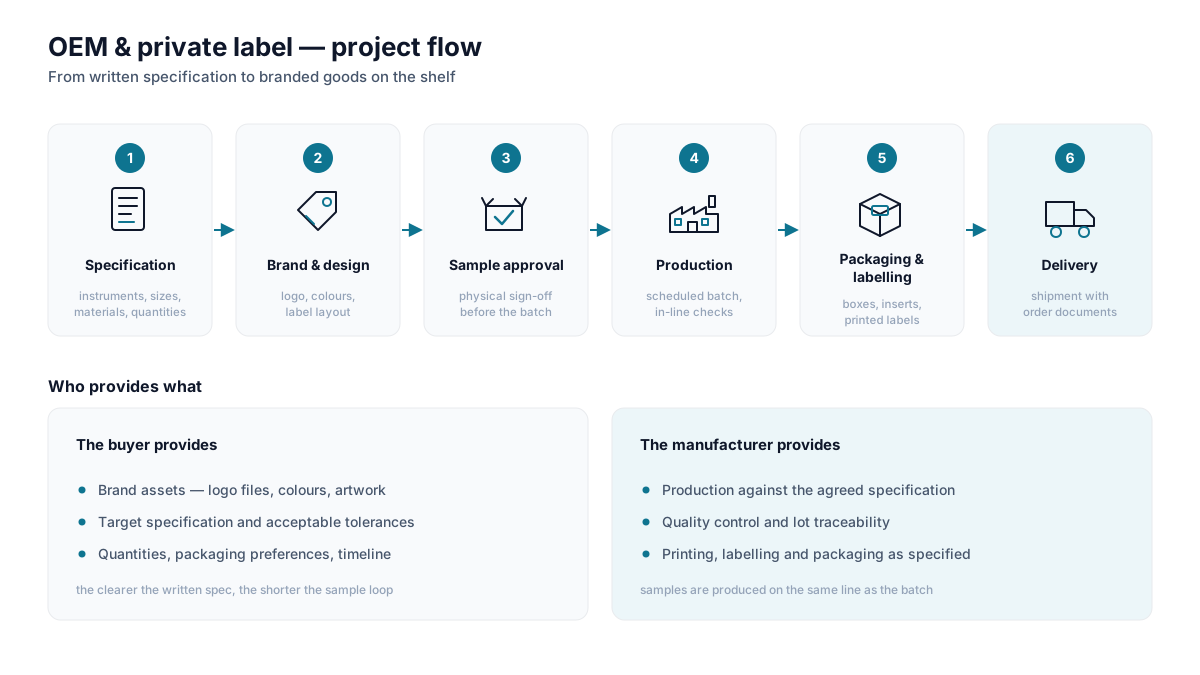
The difference between OEM, private label and white label hair products is who owns the formulation and how much of it you can change. In an OEM arrangement the manufacturer produces to your specification — your formula, or one developed for you — giving maximum control at the cost of development time and higher minimums. Private label puts your brand on a manufacturer's existing formulation, usually with moderate customisation of fragrance, packaging and claims, trading control for speed. White label is the fastest and most constrained: a finished, standardised product where you change little beyond the label. For most clinics and emerging brands, private label is the pragmatic starting point; OEM is where you go once you have proof of demand and a formulation worth owning.
Key takeaways
- The models sit on one axis: white label (fastest, least control) → private label (moderate speed, moderate control) → OEM (slowest, full control).
- OEM means your specification and, contractually done right, your intellectual property; private and white label mean renting a manufacturer's formulation under your brand.
- Minimums scale with customisation: white label can start small, private label needs mid-sized runs, OEM requires volumes that justify dedicated formulation and production.
- Development time follows the same curve — weeks for white label, a few months for private label, several months to a year for a genuine OEM development.
- Choose by stage: validate demand with white or private label, then move winning products to OEM when volume and differentiation justify it.
Three models, one axis
All three models answer the same question — how does a clinic, distributor or brand sell hair care without building a factory? — but they divide the work differently.
OEM (original equipment manufacturing) means the manufacturer produces to your specification. In hair care that spans a range: at the deep end, a formulation developed from your brief (actives, texture, fragrance profile, claims positioning) through lab samples and stability work; at the shallower end, substantial modification of a manufacturer's base. Either way, the defining feature is that the product exists because you specified it, and — if the contract is written properly — the resulting formulation is yours or exclusively licensed to you.
Private label means the manufacturer maintains a portfolio of proven, market-ready formulations — post-transplant shampoos, serums with established actives, vitamin blends, aftercare kits — and produces them under your brand. Customisation is real but bounded: packaging format, label design, fragrance variants, sometimes minor formulation tweaks. You benefit from a formulation that has already survived stability testing and market use; the trade is that a competitor can put their label on something very similar.
White label is private label with the customisation dialled to near zero: a finished, standardised product, often already packaged, where your involvement is the label artwork and the order. It is the model behind many "our clinic's shampoo" products — fast, low-risk and generic by construction.
The boundaries blur in practice — manufacturers use the terms loosely, and a heavily customised private-label deal shades into shallow OEM — so define relationships by their substance: who owns the formula, what can you change, and who else can sell it.
Because the labels are unreliable, the useful habit is to ignore what a supplier calls the arrangement and interrogate the three substantive questions directly. Ownership of the formulation decides whether you are building an asset or renting one. The scope of change decides how differentiated your product can be. Exclusivity decides whether your marketing spend builds a moat or a shop window competitors can copy. A deal a manufacturer markets as "OEM" but which reserves the formulation to them and offers no exclusivity is, in substance, private label with extra steps — and priced as if it were more. Conversely, a generous private-label agreement with meaningful fragrance and packaging latitude and a soft exclusivity in your territory can deliver most of what a small brand actually needs. Read the substance, not the brochure.
Control versus speed: the real trade
The models are honestly understood as points on a control–speed frontier, and pretending to occupy two points at once is how projects go wrong.
OEM control is comprehensive: ingredient selection and concentrations, texture, fragrance, claims strategy, packaging engineering, and exclusivity. That control costs calendar time — briefing, formulation rounds, sampling, stability and compatibility testing, packaging sourcing, then a first production run — and it costs attention, because a specification only protects you if you can evaluate what comes back against it. A buyer who lacks the capacity to judge lab samples critically inherits OEM's timeline without capturing its control premium.
Private label inverts the bargain. The formulation decisions were made before you arrived, which means both that you cannot change most of them and that you do not wait for them. A private-label launch is mostly a branding and compliance exercise on top of a finished chemistry, which is why it fits clinics whose product ambition is an adjacent revenue line rather than a differentiated brand. The hair care and aftercare hub covers what clinic buyers should look at inside these formulations.
White label removes even the branding depth: you are choosing from a catalog, and speed is the entire point. That is not a criticism — for testing whether patients will buy an aftercare kit at your front desk at all, a white-label pilot answers the question in weeks for minimal committed capital.
The trade also has a hidden dimension beyond speed and control: risk. OEM concentrates risk at the front of the project, where a formulation might fail stability testing or a packaging choice might prove incompatible months before a single unit sells — capital and time committed against an unproven product. Private label spreads risk thinner, because the chemistry is already proven and the exposure is mostly branding and inventory. White label carries the least product risk of all, since you are ordering something that already exists and already sells, and your only real exposure is whether your particular customers buy it. A sober way to choose is to ask how much product risk your business can absorb right now: an established brand with cash and demand can carry OEM's front-loaded risk in exchange for differentiation, while a clinic dipping a toe into retail is usually better served by pushing that risk onto a manufacturer who has already borne it.
MOQ and development time: what changes qualitatively
Exact minimums vary by manufacturer, product type and packaging, so treat any specific figure with suspicion until quoted — but the structure of minimums is consistent across the industry.
White label minimums are the smallest, because the manufacturer is drawing from stock or scheduled production of a standard item; entry quantities are set by cartons and labelling economics rather than by production runs. Private label minimums are set by the batch: a filling line has to run your labelled units as a dedicated batch, so minimums jump to the scale of a production run per SKU — and multiply per variant, which is why disciplined private-label launches start with two or three SKUs rather than a ten-product range. OEM minimums are the largest, because dedicated formulation work, raw-material purchasing and dedicated batches must all amortise into your volume; manufacturers also reasonably expect a commitment that justifies tying up development chemists on your brief.
Development time follows the same staircase. A white-label order is limited mainly by artwork and logistics — weeks. Private label adds label compliance and possibly fragrance or packaging choices — a couple of months is typical. Genuine OEM development runs several months to a year depending on formulation ambition, and stability testing is the step buyers most often underestimate: accelerated protocols still take months, and skipping them to hit a launch date is how products separate on the shelf.
Branding and IP ownership
Ownership is where the models differ most sharply, and where contracts earn their fees.
Under white label and standard private label, the manufacturer owns the formulation, full stop. Your brand, artwork and trade dress are yours; the chemistry never was. The practical consequences are exclusivity-shaped: the same or a near-identical product can appear under other labels, and if you leave the manufacturer, you cannot take the formula with you — your reorder leverage weakens as your brand grows on top of chemistry you do not control.
Under OEM, ownership is whatever the contract says — which is why it must say something. The spectrum runs from full assignment of the developed formulation to the buyer, through exclusive supply arrangements where the manufacturer retains ownership but may not sell the formulation to others, down to non-exclusive development that is OEM in name only. Related questions deserve the same explicitness: who owns tooling and packaging moulds, who owns the stability data, and what happens to all of it if the relationship ends. Vetting a partner's honesty on exactly these questions is a version of the same due diligence described in how to evaluate an instrument manufacturer — the criteria transfer almost unchanged from steel to formulations.
| Dimension | OEM | Private label | White label |
|---|---|---|---|
| Formulation | Developed or substantially modified to your specification | Manufacturer's proven formulation, minor tweaks possible | Manufacturer's standard product, unchanged |
| Control | Full: ingredients, texture, claims, packaging, exclusivity | Moderate: brand, packaging format, fragrance variants | Minimal: label artwork and order quantity |
| Speed to market | Slowest — several months to a year including stability work | Moderate — typically a couple of months | Fastest — weeks, limited by artwork and logistics |
| Typical minimums | Largest: must amortise development and dedicated batches | Mid-sized: one labelled production batch per SKU | Smallest: carton-level quantities from standard production |
| IP ownership | Negotiable — can be assigned to buyer or exclusively licensed; contract-critical | Manufacturer owns the formula; buyer owns brand assets only | Manufacturer owns everything except your label |
| Differentiation | High — product can be genuinely unique | Medium — brand-level, not formula-level | Low — same product exists under other labels |
| Best suited to | Established brands with proven demand and formulation ambitions | Clinics and growing brands wanting credible own-brand products quickly | Pilots, single-location clinics, testing demand cheaply |
When each model wins
White label wins when the question is still whether a product line makes sense at all. A clinic testing front-desk retail, a distributor probing a new market segment, a brand that needs a stopgap SKU — all are better served by a fast generic than by a slow masterpiece nobody may buy.
Private label wins in the broad middle, which is most of the market. A clinic with steady patient volume can attach its name to formulations that already work, at minimums a single location can absorb, with enough packaging and fragrance latitude to feel proprietary at the point of sale. It is also the natural second step after a successful white-label pilot: same demand, better margins, more brand.
OEM wins when three conditions hold together: proven demand at volumes that clear OEM minimums comfortably, a genuine differentiation thesis that an off-the-shelf formulation cannot express, and the organisational capacity to run a development project — evaluate samples, wait out stability testing, negotiate IP. Two of three is a reason to wait, not to start; OEM rewards brands that arrive with evidence rather than enthusiasm.
The models also chain. A common and sensible trajectory is white label to validate, private label to build the brand and margin, then OEM for the two or three hero SKUs where owned formulation actually moves the business — while the long tail of the range stays private label indefinitely. Nothing about the models forces a single choice across a product line, and mixed portfolios are how most successful clinic brands are actually built. Our OEM and private label page describes how both routes work in practice, from brief through samples to production.
Frequently asked questions
What is the difference between OEM and private label in hair care?
OEM means the manufacturer produces to your specification — a formulation developed or substantially modified for you, with ownership or exclusivity negotiable by contract. Private label means your brand goes on the manufacturer's existing, proven formulation with limited customisation. OEM maximises control and differentiation; private label maximises speed and lowers minimums.
Is white label just another name for private label?
They are on the same spectrum but not identical in practice. White label typically means a finished, standardised product where you change only the label; private label usually allows moderate customisation — packaging format, fragrance, sometimes minor formulation tweaks. Manufacturers use both terms loosely, so always define the substance: what can you change, and who else can sell it?
How long does an OEM hair product development take?
Several months to a year for a genuine development, depending on formulation ambition. Briefing and lab sampling take weeks to months, and stability and packaging-compatibility testing add months more — the step buyers most often underestimate. Private label typically launches in a couple of months; white label in weeks.
Who owns the formula in a private label arrangement?
The manufacturer. You own your brand name, artwork and trade dress, but the chemistry stays with the producer — meaning similar products can appear under other labels and you cannot take the formula to another factory. If formula ownership matters to your strategy, that is the signal to negotiate an OEM development with explicit IP assignment or exclusivity.
Are OEM minimums always higher than private label?
Structurally yes, though exact figures vary by manufacturer and product. OEM volumes must amortise development work, dedicated raw-material purchasing and dedicated batches; private label needs one labelled production batch per SKU; white label can start at carton-level quantities. Get minimums quoted per SKU and per variant — ranges multiply faster than buyers expect.
Which model should a hair transplant clinic start with?
Usually private label, or white label if the goal is a cheap demand test. A clinic's advantage is a trusted point of sale, not formulation R&D, and private label converts that trust into margin quickly at absorbable minimums. Move individual winning SKUs to OEM once demand is proven and a real differentiation case exists.
Related articles
OEM Manufacturing & Private Label Hair Care
Manufacture hair restoration instruments and hair care products under your own brand — from specification and formulation through packaging to delivery.
Hair Care & Aftercare Products: A Clinic Buyer’s Guide
What clinics hand patients after a transplant — serums, shampoos, vitamins and kits — and how to buy or brand them without overclaiming.
How to Evaluate an Instrument Manufacturer
A balanced seven-criterion framework distributors and clinics can use to vet instrument manufacturers before committing a territory or a large order.