
PRP Tube Anticoagulants: ACD-A vs Sodium Citrate (and Why Not EDTA)
A specification-level look at the anticoagulants in PRP collection tubes — ACD-A versus sodium citrate, why EDTA is avoided, and the handling details that separate a clean prep from a poor one.
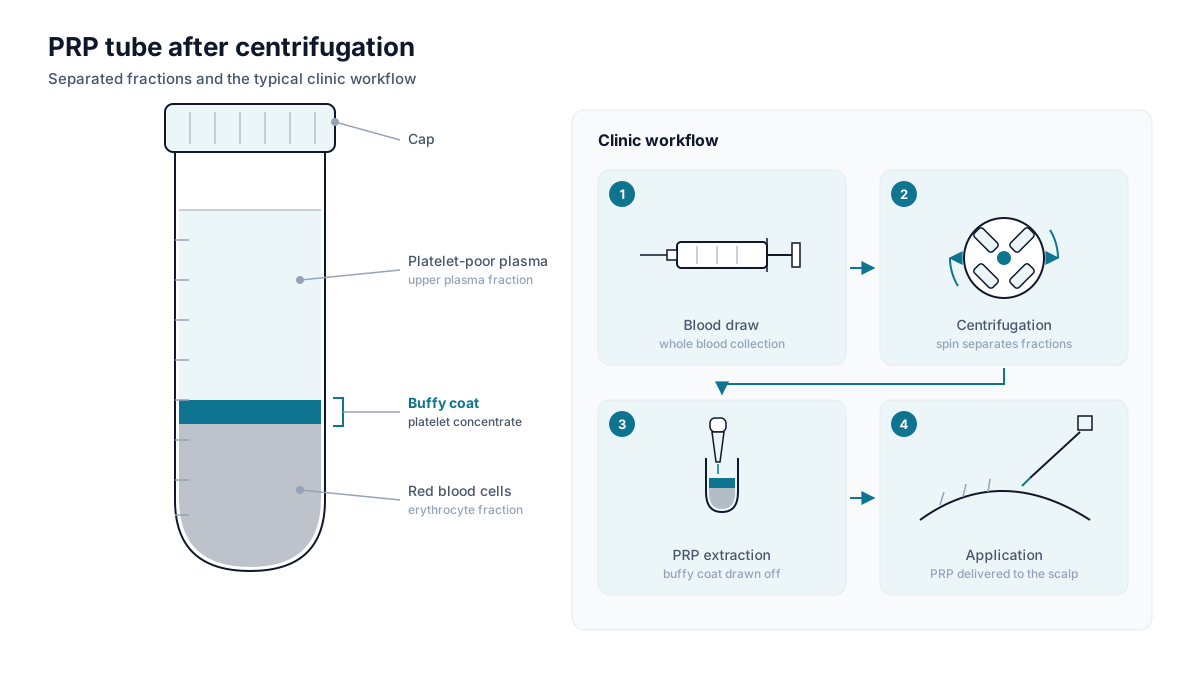
The anticoagulant in a PRP tube exists to stop the drawn blood from clotting before it is spun and prepared, and the two used in hair-clinic practice are ACD-A (acid citrate dextrose, solution A) and sodium citrate — both of which work by binding the calcium that the clotting cascade needs. ACD-A adds dextrose and a lower pH that help sustain platelets during processing, while sodium citrate is a simpler citrate buffer; the practical choice comes down to the anticoagulant-to-blood volume ratio your kit is built around and how the tube integrates with any gel separator. EDTA, though a common lab anticoagulant, is generally avoided for PRP because it can damage platelet morphology, which is exactly what you are trying to preserve.
Key takeaways
- Both ACD-A and sodium citrate anticoagulate by chelating calcium — they are reversible, platelet-friendly citrates, which is why one of them is in almost every PRP tube.
- ACD-A carries dextrose and a lower pH intended to help sustain platelet viability during handling; sodium citrate is a leaner citrate buffer.
- Volume ratio matters: citrate tubes typically run near a 1:9 anticoagulant-to-blood ratio, ACD-A commonly around 1:9 to 1:10 depending on the kit — always follow the kit’s stated fill.
- EDTA is avoided for PRP because it can distort platelet morphology and impair function, defeating the purpose of the prep.
- Underfilling or overfilling a tube changes the effective ratio and degrades the prep — respect the fill line every time.
Why an anticoagulant is there at all
Blood begins to clot the moment it leaves the vessel. For platelet-rich plasma, clotting before separation is a failure: trapped platelets end up in the fibrin clot instead of the plasma fraction you want to concentrate. The anticoagulant's job is to hold the blood fluid through the draw, the spin and the handling that follows, without harming the platelets it is protecting. That last clause is the whole reason PRP does not simply use the cheapest available anticoagulant — the additive has to be gentle on platelet structure and function, because those platelets are the product.
Citrate-based anticoagulants meet that requirement because they act reversibly. They bind ionised calcium, and since calcium is a required cofactor at several steps of the coagulation cascade, removing it from availability stops clotting. Crucially, the effect reverses when calcium is reintroduced — which is what happens at the point of use, allowing the platelets to activate where the clinician wants them to. This reversibility, and the relative kindness of citrate to platelet morphology, is why the field settled on citrates.
ACD-A versus sodium citrate
Both are citrates; the difference is what else is in the solution and at what concentration.
Sodium citrate is essentially a trisodium citrate buffer. It anticoagulates cleanly by calcium chelation and is well understood from decades of transfusion and coagulation-testing use. In PRP tubes it is valued for simplicity and a predictable citrate concentration.
ACD-A — acid citrate dextrose, formula A — adds two things to the citrate: citric acid, which lowers the pH, and dextrose (glucose). The lower pH shifts the citrate equilibrium in a way intended to improve calcium binding, and the dextrose provides a metabolic substrate that is generally held to help sustain platelet viability during the interval between draw and use. In practice, kits built around ACD-A are often marketed on this platelet-preservation rationale. Whether that translates into a clinically meaningful difference in a given hair-PRP protocol is not something to overstate; both anticoagulants produce usable PRP, and the kit's spin protocol and handling discipline influence the result at least as much as the choice between these two citrates.
One further practical distinction is worth knowing: sodium citrate itself comes in more than one concentration in general clinical use — the coagulation-laboratory world standardised on particular strengths — and different PRP tubes may be loaded to different citrate concentrations and volumes. This is another reason two "citrate" tubes are not automatically equivalent, and why the number that actually governs your prep is the specific anticoagulant type, concentration and fill volume printed on the tube you are buying, not the general category name. When a supplier describes a tube simply as "citrate," treat that as the start of the question, not the answer, and ask for the exact anticoagulant and concentration so you can compare like with like across brands and reorder the same thing consistently.
Why not EDTA
EDTA is one of the most common anticoagulants in the laboratory — the standard for full blood counts — precisely because it chelates calcium very strongly and preserves cell counts well for analysis. That strength is the problem for PRP. EDTA is associated with changes to platelet morphology, including swelling and shape change, and with effects on platelet function. For a haematology analyser counting cells, that does not matter; for a preparation whose entire value rests on delivering structurally and functionally intact platelets, it does. This is why EDTA tubes, despite being cheap and ubiquitous, are not the tube you reach for when preparing PRP.
At-a-glance comparison
| Anticoagulant | Mechanism | Typical ratio | Practical notes |
|---|---|---|---|
| ACD-A (acid citrate dextrose) | Calcium chelation, reversible; lower pH plus dextrose | ~1:9 to 1:10 anticoagulant-to-blood, per kit | Dextrose and low pH intended to support platelet viability during handling; common in dedicated PRP kits |
| Sodium citrate | Calcium chelation, reversible; simple citrate buffer | ~1:9 anticoagulant-to-blood | Lean, predictable citrate; well characterised from coagulation-lab use |
| EDTA | Strong, near-irreversible calcium chelation | — | Avoided for PRP: distorts platelet morphology and impairs function; a lab-count anticoagulant, not a PRP one |
Volume ratios and the fill line
Every anticoagulant is calibrated to a blood volume. A tube pre-loaded with a fixed amount of citrate assumes it will be filled to its mark; draw too little and the anticoagulant is proportionally too concentrated, which over-dilutes and over-citrates the sample; draw too much and there is not enough anticoagulant to keep the blood fluid, risking micro-clots that ruin the prep. The fill line on the tube is not a suggestion — it is the assumption the whole ratio rests on. Train the team to fill to the line and to discard or repeat a badly underfilled draw rather than spin it and hope.
The stated ratio also interacts with the reinjected volume. Because citrate PRP is anticoagulated, some protocols reintroduce calcium (as calcium chloride or calcium gluconate) at the point of use to restore the platelets' ability to activate. Whether and how you do that is a protocol decision tied to the specific kit and technique — follow the kit's instructions for use rather than improvising, and keep the reconstitution step consistent across operators.
Gel separators and tube construction
Many PRP tubes include a thixotropic separator gel with a density set between red cells and plasma. During centrifugation the gel migrates to form a physical barrier, trapping the red-cell fraction below and leaving platelet-rich plasma cleanly retrievable above. The gel is a convenience and a consistency aid — it makes the plasma easier to draw off without disturbing the buffy coat — but it also constrains the protocol: the spin speed and time must match what the gel and tube were designed for, and mixing a tube brand with a centrifuge programme meant for a different tube is a common source of disappointing preps. Tube construction (glass versus plastic, the exact gel formulation, the presence of a buffy-coat-concentrating geometry) varies between products, and these differences are the reason PRP kit selection is a system decision, not a commodity purchase. The centrifuge side of that system — matching spin protocol to tube — is covered in the centrifuge selection guide.
Handling from draw to spin
The anticoagulant only does its job if the blood meets it promptly and mixes with it thoroughly. Two handling habits protect the prep from the moment of draw. The first is gentle, immediate mixing: as the tube fills, the blood should contact and combine with the citrate without delay, and most tubes are inverted several times gently after the draw to distribute the anticoagulant evenly. Vigorous shaking is the wrong instinct — it can activate and damage platelets, the opposite of what a careful prep wants — so the motion is a slow, deliberate inversion, not agitation. A tube that fills slowly with poor mixing risks micro-clots forming before the anticoagulant is evenly present, and those micro-clots trap platelets out of the usable fraction.
The second habit is minimising the delay between draw and spin. Anticoagulated blood is stable for a working interval, but it is not indefinitely inert; the sooner it is processed within the kit's stated handling window, the more predictable the separation. A tube drawn and then left standing while the room gets busy is a tube whose result drifts. Keeping the draw, mix and spin as a continuous sequence — rather than a draw now and a spin whenever someone gets to it — is a small discipline that shows up in prep consistency.
Temperature during this interval matters too. Extremes in either direction stress platelets, so tubes are generally kept at a controlled ambient temperature between draw and spin rather than left on a cold windowsill or a warm piece of equipment. None of these steps is difficult, but each is the kind of quiet variable that separates a clinic whose PRP looks the same every time from one whose results wander for reasons no one can quite name.
Labelling, expiry and handling
PRP tubes are sterile consumables with expiry dates, and the anticoagulant degrades over time — an expired tube is not just old stock, it is a tube whose ratio and sterility you can no longer trust. Rotate stock so the oldest in-date tubes are used first, keep them within their stated storage conditions, and record lot numbers so a problem batch can be traced. At the point of care, label each patient's tubes unambiguously and keep the draw, spin and reinjection steps documented per your clinic protocol. None of this is glamorous, and all of it is the difference between a reproducible PRP service and one that varies case to case. When comparing suppliers, ask for the anticoagulant type and concentration, the intended fill volume and ratio, the recommended spin protocol, and the shelf life you are actually buying — the PRP systems hub frames what else belongs in that comparison, and sample-first evaluation through the wholesale channel lets you verify a kit against your own centrifuge before committing volume.
Frequently asked questions
What is the difference between ACD-A and sodium citrate in PRP tubes?
Both are citrates that anticoagulate by binding calcium reversibly. Sodium citrate is a simple citrate buffer; ACD-A adds citric acid (lowering pH) and dextrose, a combination intended to support platelet viability during handling. Both yield usable PRP, and the kit’s spin protocol and technique influence the result at least as much as the choice between them.
Why isn’t EDTA used for PRP?
EDTA chelates calcium very strongly and is excellent for preserving cell counts in lab testing, but it is associated with changes to platelet morphology and function. Since PRP depends on delivering structurally intact, functional platelets, EDTA works against the purpose of the preparation, so citrate anticoagulants are used instead.
What anticoagulant-to-blood ratio do PRP tubes use?
Citrate tubes commonly run near a 1:9 anticoagulant-to-blood ratio and ACD-A kits around 1:9 to 1:10, but the correct figure is whatever the specific kit specifies. The tube’s fill line encodes that ratio — underfilling over-concentrates the anticoagulant and overfilling under-doses it, so filling to the mark every time is essential.
Does the separator gel affect which tube I choose?
Yes. The gel’s density and the tube’s geometry are matched to a specific spin protocol, so the tube and centrifuge programme must be chosen together. Mixing a tube with a centrifuge setting designed for a different tube is a frequent cause of poor separation, which is why PRP kit and centrifuge selection are a single system decision.
Do citrate-anticoagulated PRP preparations need calcium added back?
Some protocols reintroduce calcium (as calcium chloride or gluconate) at the point of use to restore the platelets’ ability to activate, since the citrate had chelated it. Whether and how to do this depends on the specific kit and technique — follow the product’s instructions for use and keep the step consistent across operators rather than improvising.
Related articles
PRP Systems for Hair Clinics: Tubes, Kits and Centrifuges
How hair clinics buy PRP equipment and consumables — tube chemistry, centrifuge matching, kit completeness and an honest view of the evidence.
PRP Systems Buyer's Guide for Hair Clinics
How to buy PRP tubes, kits and centrifuges for a hair clinic: additives, kit completeness, rpm/rcf matching, cost per treatment, storage and honest claims.
Wholesale PRP Kits and Tubes: Ordering Against Shelf Life
PRP tubes are the one consumable in this catalogue where the calendar, not the warehouse, limits order size. This guide compares tube types, volumes and additives, clears up the cold-chain myth, and shows how to build expiry-driven order cycles.
Mesotherapy Needle Guide: Gauges and Lengths for the Scalp
A data-first reference for scalp mesotherapy needles: gauge-to-diameter chart, length options and their uses, luer-lock and multi-injector notes, with the manufacturer-variation caveat.