
Choosing a PRP Centrifuge for a Hair Clinic: RCF, Rotors and Fit
A specification-first guide to selecting a PRP centrifuge — why RCF matters more than RPM, swing-out versus fixed-angle rotors, capacity matching and spin-protocol compatibility with your tubes.
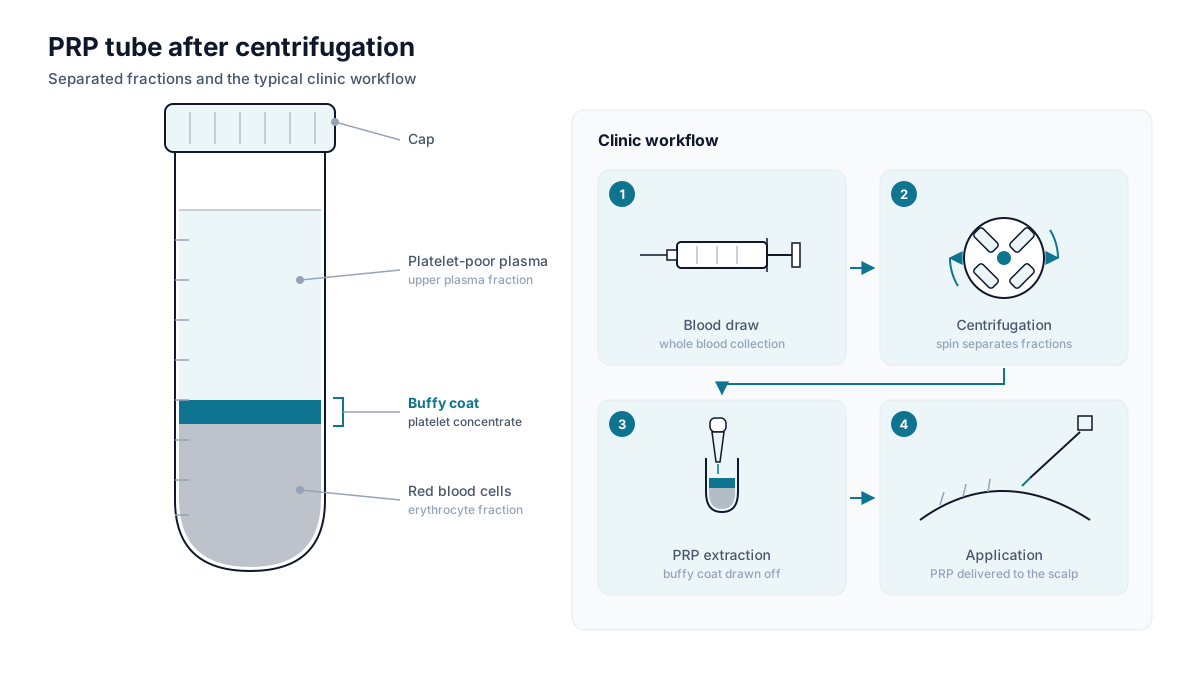
Choose a PRP centrifuge on the specifications that actually govern separation and daily workflow, not on the headline RPM number: the relative centrifugal force (RCF, measured in g) the rotor produces at its radius, the rotor type (swing-out versus fixed-angle), the capacity and tube fit for your session pattern, and — the constraint clinics most often overlook — whether the machine can run the exact spin protocol your PRP tubes were validated for. RPM alone is meaningless without the rotor radius, because two machines at the same RPM deliver different g-forces if their rotors are different sizes. Pick the centrifuge and the tube system together, confirm the service and spare-parts situation before you buy, and treat noise and footprint as real factors in a room where staff and patients sit for hours.
Key takeaways
- RCF (g-force), not RPM, determines separation — and RCF depends on both RPM and rotor radius, so an RPM figure with no radius tells you little.
- Swing-out rotors let tubes horizontalise for a flatter, cleaner separation plane; fixed-angle rotors are more compact and robust but layer against the tube wall.
- Match capacity to your real session pattern — number of tubes per case and cases per day — not to a spec-sheet maximum.
- The spin protocol is tied to the tube: the centrifuge must be able to run the RCF-and-time programme your PRP tube brand specifies, or separation suffers.
- Service, spare parts and calibration availability are buying criteria, because a centrifuge down for weeks stops your PRP service entirely.
RCF versus RPM: the number that matters
The most common mistake in centrifuge shopping is comparing machines on revolutions per minute. RPM describes how fast the rotor turns, but what separates blood components is the force experienced by the sample, and that force — the relative centrifugal force, expressed as a multiple of gravity (× g) — depends on both the rotational speed and how far the sample sits from the axis of rotation. A large rotor spinning at a given RPM generates far more g at its tube position than a small rotor at the same RPM, because the sample is travelling a larger circle.
Conceptually, RCF rises with the radius and with the square of the rotational speed. That squared relationship is why small speed changes move the g-force more than you would expect, and the radius dependence is why RPM without a stated radius is close to useless for comparison. The practical consequence: when a PRP tube's instructions specify a spin, they should give it — or be convertible — in g and time, not just RPM, and your centrifuge should let you set or reliably reach that g at the radius of its rotor. A machine that only displays RPM forces you to convert using its rotor radius before you can trust that you are matching the tube's validated protocol.
Swing-out versus fixed-angle rotors
The rotor is where geometry meets biology. Two families dominate.
Swing-out (swinging-bucket) rotors hold tubes that pivot outward to horizontal as the rotor accelerates. During the spin the tube lies along the force vector, so components stratify in flat, clean horizontal bands and the separation plane sits perpendicular to the tube axis. For PRP, many clinicians favour this because the buffy coat and plasma layers are easier to read and to draw off without disturbing the interface. The trade-offs are a larger, often taller machine and mechanically more complex buckets.
Fixed-angle rotors hold tubes at a set angle throughout the spin. They are more compact, mechanically simpler and often tolerate higher speeds, but components pellet against the lower side wall and the separation plane is angled, which can make a clean plasma draw slightly less straightforward and, for some protocols, affect yield consistency. Neither rotor is universally correct; the right answer is the one your tube system was designed around. Some PRP kits are validated specifically on swing-out geometry, and using a fixed-angle rotor with them changes the result.
Matching capacity to your sessions
Capacity is a workflow decision disguised as a spec. The relevant question is not the rotor's maximum tube count but how many tubes a typical case requires and how many cases you run in a day. A clinic doing occasional PRP alongside transplants has different needs from one running a busy standalone PRP list. Undersizing forces multiple sequential spins per case, adding minutes that accumulate across a day and leave grafts or patients waiting; oversizing wastes bench space and money. Size for your realistic peak, with a little headroom, and remember that tube size compatibility (the rotor must physically accept the diameter and length of the tubes your kit uses) is as important as tube count.
There is a second capacity dimension that spec sheets rarely foreground: cycle time. A machine's throughput is not just how many tubes it holds but how long a full run takes, including acceleration and a controlled deceleration if your protocol needs one. Two centrifuges with the same tube capacity can differ noticeably in how quickly they turn a case around, and in a busy list those differences compound. When you demo a machine, time a realistic run end to end with your own tubes and protocol rather than trusting the headline capacity figure, and think about how that run time fits the rhythm of a case where grafts or patients are waiting on the result.
Selection criteria and how to verify them
| Criterion | Why it matters | How to verify at demo or on the datasheet |
|---|---|---|
| RCF range at rotor radius | Determines separation; must reach the tube kit's specified g | Ask for max/settable RCF and rotor radius; confirm it covers your protocol, not just RPM |
| Rotor type | Swing-out vs fixed-angle changes the separation plane and plasma draw | Confirm which rotor the machine ships with and which your tube kit was validated on |
| Tube compatibility | Rotor must physically fit your tube diameter and length | Bring your actual tubes to the demo and seat them |
| Programmability | Reproducible g-and-time protocols across operators | Check for saved programmes and settable acceleration/braking |
| Capacity | Sequential spins waste time; oversizing wastes money | Size to real tubes-per-case × cases-per-day, plus headroom |
| Noise and footprint | It lives in a treatment room with people | Listen to it running at speed; measure the bench space |
| Safety features | Imbalance and lid-lock protect staff and samples | Confirm imbalance detection and lid interlock |
| Service and spares | Downtime stops the PRP service entirely | Ask about local service, calibration intervals and spare-part lead times |
Spin-protocol compatibility is the real constraint
The centrifuge does not work in isolation — it is half of a system whose other half is the tube. PRP tube manufacturers validate their separation on a specific spin: a defined RCF for a defined time, sometimes single-spin, sometimes a two-stage protocol, on a specified rotor geometry. A centrifuge that cannot reach that RCF, cannot hold that time reliably, or uses a rotor type the tube was not designed for will not reproduce the intended separation, however good the machine is in isolation. This is why buying the centrifuge and the PRP tube system as a matched pair is the sound approach, and why a bargain centrifuge that cannot run your tubes' protocol is not a bargain. If you are still choosing the kit itself, the PRP systems buyer's guide covers what to compare across the whole kit, and the PRP systems hub gathers the related material.
Balancing, maintenance and daily operation
A centrifuge is only as reliable as the way it is loaded and looked after, and two operational habits do most of the work. The first is balancing. Tubes must be loaded symmetrically, in opposing pairs of equal weight, so the rotor spins around its true centre. An unbalanced load vibrates, stresses the bearings, degrades separation and, at worst, trips the machine's imbalance cut-out mid-run — which costs you the prep and the time. When a case produces an odd number of tubes, a balance tube of matching weight fills the empty position. This sounds obvious and is still the single most common operator error, because in a busy list the temptation to spin a lopsided load "just this once" is real. Build balancing into the routine so it is automatic rather than a decision made under time pressure.
The second habit is maintenance discipline. Rotors and buckets should be kept clean and dry, inspected for cracks or corrosion, and any spillage from a broken tube cleaned up promptly, because dried blood and debris in a bucket unbalance future runs and corrode the rotor over time. Follow the manufacturer's guidance on lubrication and on when buckets or seals are replaced, and keep the machine on a stable, level surface — a centrifuge that walks across the bench under load is telling you something about balance, levelling or wear. A simple maintenance log, noting cleaning, any imbalance events and calibration checks, turns vague "it seems noisier lately" impressions into a record you can act on before a failure interrupts a clinic day.
Acceleration and braking settings deserve a mention because some PRP protocols specify them. A gentle deceleration — letting the rotor coast rather than braking hard — helps preserve the separation layers that the spin has just established, so a machine that lets you set or soften the brake is worth more than one that always stops abruptly. Where the tube kit's protocol calls for controlled acceleration or a soft stop, the centrifuge has to be able to honour it, which is another reason the machine and the tube system are chosen as a pair rather than in isolation.
Service, safety and the room it sits in
A centrifuge is a piece of rotating machinery that runs daily in a clinical space, and two practical realities deserve weight in the decision. First, service: ask before purchase who calibrates the machine, how often calibration is recommended, what the spare-parts lead time looks like, and whether local support exists — because a centrifuge waiting weeks for a part is a PRP service that has stopped. Second, the environment: it will sit in a treatment room, so noise at operating speed and bench footprint are not trivia but daily-comfort factors for staff and patients. Load tubes balanced and correctly filled every time, use the imbalance detection and lid interlock as designed, and keep a maintenance log. Confirm every specification against the manufacturer's datasheet rather than a sales sheet, and where you can, verify the machine against your own tubes before committing — sample-first evaluation through the wholesale process is the sensible way to do that.
Frequently asked questions
Is RCF or RPM more important when choosing a PRP centrifuge?
RCF — the relative centrifugal force in g — is what separates blood components, and it depends on both RPM and the rotor radius. Two machines at the same RPM deliver different g-forces if their rotors differ in size, so RPM without a radius is not comparable. Match the RCF your PRP tube kit specifies, at your rotor's radius.
Should I choose a swing-out or fixed-angle rotor for PRP?
It depends on what your tube kit was validated on. Swing-out rotors let tubes lie horizontal for a flat, clean separation plane that many clinicians find easier to draw from; fixed-angle rotors are more compact and robust but pellet components against the tube wall at an angle. Match the rotor to the kit rather than choosing in the abstract.
How big a centrifuge do I need?
Size to your real workload: tubes per case multiplied by cases per day, with modest headroom. Undersizing forces multiple sequential spins that waste time across a day; oversizing wastes money and bench space. Also confirm the rotor physically accepts the diameter and length of the tubes your kit uses.
Can I use any centrifuge with any PRP tube?
No. PRP tubes are validated on a specific spin protocol — a defined RCF, time and rotor geometry. A centrifuge that cannot reach that g-force, hold that time, or use the intended rotor type will not reproduce the separation. Choose the centrifuge and tube system together as a matched pair.
What service questions should I ask before buying?
Ask who calibrates the machine and how often, the spare-parts lead time, whether local service support exists, and what the warranty covers. A centrifuge is rotating machinery in daily clinical use; downtime waiting for a part stops your PRP service entirely, so serviceability is a genuine buying criterion, not an afterthought.
Related articles
PRP Systems for Hair Clinics: Tubes, Kits and Centrifuges
How hair clinics buy PRP equipment and consumables — tube chemistry, centrifuge matching, kit completeness and an honest view of the evidence.
PRP Tube Anticoagulants: ACD-A vs Sodium Citrate (and Why Not EDTA)
A specification-level look at the anticoagulants in PRP collection tubes — ACD-A versus sodium citrate, why EDTA is avoided, and the handling details that separate a clean prep from a poor one.
PRP Systems Buyer's Guide for Hair Clinics
How to buy PRP tubes, kits and centrifuges for a hair clinic: additives, kit completeness, rpm/rcf matching, cost per treatment, storage and honest claims.