
PRP Systems Buyer's Guide for Hair Clinics
How to buy PRP tubes, kits and centrifuges for a hair clinic: additives, kit completeness, rpm/rcf matching, cost per treatment, storage and honest claims.
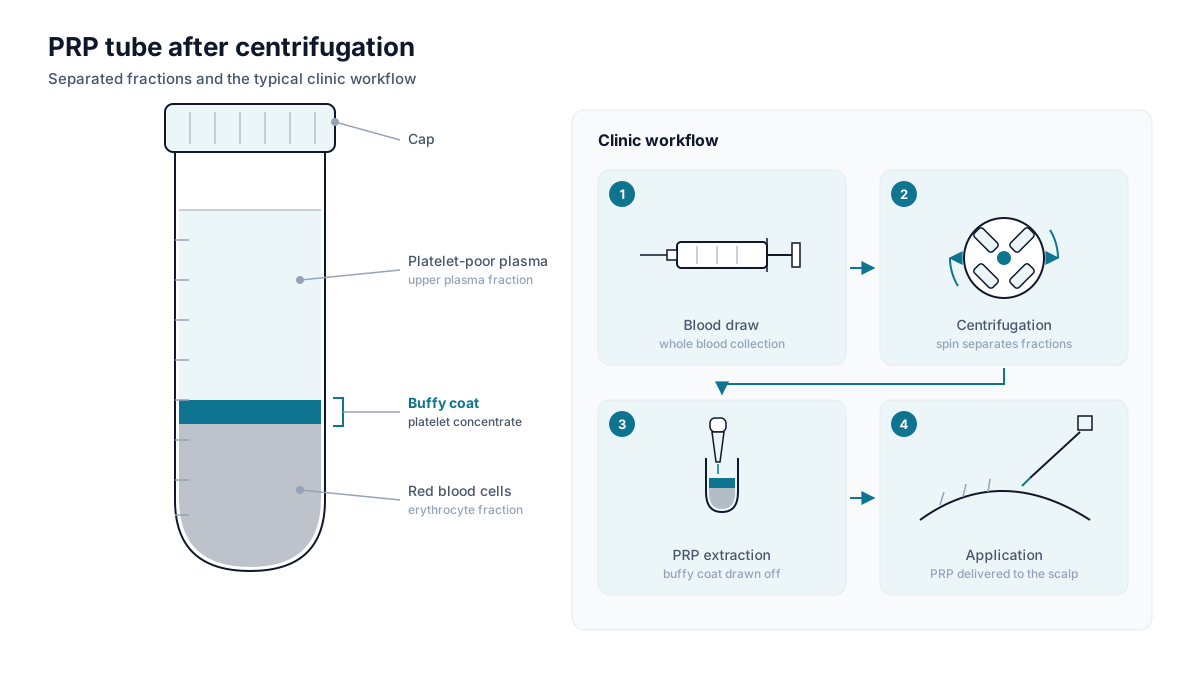
Buying PRP for a hair clinic means matching three things to each other and to your caseload: the tubes (which additive and separation format you standardise on), the kit (everything needed to draw, process and deliver the preparation), and the centrifuge (which must reach the speed your tubes' protocol specifies). Get those three aligned and PRP is a low-complexity, reasonable-margin adjunct to transplant and medical hair work; get them misaligned — tubes whose protocol your centrifuge cannot hit, or kits missing a component mid-session — and it becomes a recurring irritation. This guide covers what to compare across tubes, kits and centrifuges, how to reason about cost per treatment, and how to talk about PRP's clinical value honestly.
Key takeaways
- PRP buying is a matching problem: tubes, kit and centrifuge must share one consistent protocol, expressed in rcf (g-force), not just rpm.
- Tube choice — anticoagulant and separation format (gel/thixotropic vs plain) — defines your workflow; standardise on one to keep preparations consistent.
- Cost per treatment is dominated by the single-use tube and kit, not the one-time centrifuge; price the consumable, not the hardware.
- rpm is meaningless without the rotor radius — always convert to rcf to know whether a centrifuge actually meets a tube's protocol.
- Be evidence-cautious: present PRP to patients with honest, non-overstated framing, and buy on workflow and consistency rather than marketing claims.
What a PRP system actually is
Platelet-rich plasma for hair is a simple pipeline with a few decision points. Blood is drawn into specialised tubes, spun in a centrifuge to separate plasma and concentrate platelets, and the platelet-rich fraction is drawn off and injected into the scalp. The "system" a clinic buys is the set of consumables and hardware that makes that pipeline repeatable: tubes, a draw-and-transfer kit, and a centrifuge. Everything that follows is about choosing components that fit each other and your practice — the PRP systems hub gives the broader overview, while this guide is the purchasing detail.
The one principle underneath all of it: consistency beats cleverness. A preparation your team can produce identically every time — same tube, same spin, same yield — is worth more clinically and commercially than an exotic protocol run inconsistently. Most buying mistakes trace back to mixing components that assume different protocols.
This matters because PRP is rarely performed by a single person on a fixed schedule. In a working clinic, several staff may draw and process over the course of a week, cases cluster and thin out, and consumable lots turn over. Every one of those variables is an opportunity for the preparation to drift unless the system is designed to hold steady regardless of who is running it. That is the real argument for buying as a matched system rather than assembling the cheapest component in each category: a coherent tube-kit-centrifuge combination locked to one protocol produces the same result on a busy Friday with a locum as it does on a quiet Tuesday with your lead nurse. A patchwork of independently chosen parts, each optimal in isolation, tends to produce a preparation whose character depends on who happened to make it — which is exactly the outcome a clinical service should avoid.
Tubes: additives and separation format
The tube is where standardisation starts, because it dictates both the anticoagulant chemistry and the physical separation.
Anticoagulant. PRP tubes contain an anticoagulant to keep the sample workable during processing. The common choices behave differently in handling and in the character of the final preparation, and clinics generally pick one and stay with it rather than switching per case. The point for a buyer is less which is theoretically ideal and more that your tubes, across every order, use the same chemistry — so preparations do not drift as lots change. Anticoagulant behaviour is covered in more depth in the hub's supporting material.
Separation format. Tubes fall broadly into two families. Plain tubes with anticoagulant give a straightforward buffy-coat separation that the operator draws off manually — more operator-dependent, but transparent and flexible. Separator-gel or thixotropic tubes contain a barrier that migrates during the spin to sit between the red cells and plasma, making the plasma fraction easier and more repeatably recovered. Gel formats trade a little control for a lot of consistency and are popular where several staff run PRP; plain formats appeal to operators who want to tune the harvest. Neither is universally correct — it is a workflow choice.
Sterility and packaging. Tubes are single-use sterile consumables and carry all the packaging and lot-tracking considerations of any sterile product: intact barrier packaging, lot numbers, expiry dates and receipt checks, as set out in the sterility and packaging guide. Because tubes are the recurring cost centre, lot-to-lot consistency and reliable supply matter as much as the per-tube price.
Kit completeness: the mid-session test
A "kit" ranges from tubes alone to a full procedure pack. The failure you are buying against is discovering mid-session that something is missing, so completeness is judged against your actual workflow, not a feature list.
Think through one treatment end to end and confirm every touchpoint is covered: the blood-draw components (needle or butterfly, holder), the tubes themselves, transfer components for moving the platelet fraction to a syringe without contamination, and the delivery components (injection needles of the gauge your injectors prefer, or accommodation for a mesotherapy device). Some kits include skin prep and dressings; some assume the clinic supplies those from general stock. Either is fine as long as you know which, and have standing stock for whatever the kit omits.
| Factor | What to check | Why it matters |
|---|---|---|
| Anticoagulant | Which chemistry; consistent across every lot you buy | Switching mid-programme changes handling and preparation character |
| Separation format | Plain vs separator-gel / thixotropic | Gel gives repeatable recovery across staff; plain gives operator control |
| Protocol spec | Stated spin as rcf (g-force) and time, not rpm alone | The only way to confirm your centrifuge can actually run these tubes |
| Kit completeness | Draw, transfer and delivery components vs what you stock separately | Prevents mid-session gaps; defines true per-treatment consumable cost |
| Sterility & packaging | Barrier packaging, lot numbers, expiry dates | Single-use sterile goods; traceability and integrity are non-negotiable |
| Supply consistency | Lot-to-lot uniformity and availability at your volume | PRP quality depends on repeatability; stockouts strand a booked service |
Centrifuge matching: rpm, rcf and why the difference matters
The centrifuge is the one durable purchase, and the most common technical error in PRP buying happens here: reading rpm as if it were the force applied to the blood. It is not.
rpm (revolutions per minute) describes how fast the rotor turns. rcf (relative centrifugal force, expressed in units of g) describes the actual force the sample experiences — and that depends on both rpm and the rotor radius. A given rpm produces very different g-forces in a small benchtop rotor versus a wide one. Because separation depends on force, not turns, a tube's protocol should be read and matched in rcf. Two clinics running "the same rpm" can produce different preparations if their rotors differ; two running the same rcf are comparable.
The buyer's rule follows directly: take the rcf and spin time your chosen tube's protocol specifies, and confirm the centrifuge reaches that rcf with the rotor and tube size you will actually use. A centrifuge quoted only in rpm, with no rotor radius or rcf figure, is under-specified — ask for the rcf at the working radius before buying. Beyond that core match, the practical checklist is short: does it physically accept your tube size and count, is it a fixed-angle or swing-out rotor appropriate to your separation format, does it hold a set protocol reliably, and does it run at a noise and vibration level acceptable in a treatment room? A centrifuge is a long-lived asset, so buying one that comfortably covers your tube protocol and volume — rather than the cheapest that nominally spins — is sound economics. The clinic equipment hub places the centrifuge within the wider equipment stack.
Cost per treatment: price the consumable, not the hardware
PRP economics confuse buyers who fixate on the centrifuge's sticker price. The centrifuge is a one-time cost amortised over hundreds or thousands of treatments; within a year of steady use its contribution per treatment is small. The real per-treatment cost is the single-use tube and kit, consumed every time.
So the disciplined way to model PRP cost mirrors the logic in the FUE punch price guide: estimate annual treatments, cost the tubes and kit per treatment at the volume you will actually buy, and treat the centrifuge as a modest fixed cost spread across that volume. A cheaper tube that forces you into a separate kit, or a cheaper centrifuge that cannot run your preferred tubes and pushes you to a lesser consumable, can raise true per-treatment cost while appearing to save money. Buy the consumable you want, then choose hardware that supports it — not the reverse.
Because tubes and kits are ordered repeatedly, PRP is also a natural candidate for consolidated wholesale sourcing: committing volume on a standardised consumable line usually improves both price and supply reliability, and supply reliability is worth real money when a stockout means turning away booked patients.
Storage and shelf life feed into the same calculation. PRP tubes and kit components are dated sterile goods, so order sizing has to respect consumption rather than chase the lowest unit price on a large quantity. A tube that expires unused is more expensive than the pricier tube you actually put into a patient, and a separator gel past its date is not a saving of any kind. The practical approach is to forecast realistic monthly treatment volume, order to a comfortable buffer above it, rotate stock first-expiry-first-out, and check dated components during routine stock counts. Keep the consumables in the ordinary conditions any sterile stock requires — dry, moderate temperature, away from direct sunlight, off the floor and protected from crushing — and treat the printed expiry as a ceiling that assumes undamaged packaging, not a guarantee independent of handling. A clinic that runs its PRP inventory with the same discipline it applies to surgical consumables rarely writes off stock and never gets caught short mid-clinic.
Evidence-cautious framing
PRP for hair sits in an area where clinical evidence is still developing and results vary between patients and protocols. A responsible clinic buys and presents PRP accordingly.
Two implications. Commercially, buy on the things you can verify — consistent tubes, complete kits, a properly matched centrifuge, reliable supply — rather than on marketing claims about a particular tube producing superior outcomes; such claims are difficult to substantiate and should not drive a purchase. Clinically, present PRP to patients with honest, non-overstated language: as an adjunct with a developing evidence base, not a guaranteed result, and never with invented success rates or before-and-after promises. Consistent preparation and honest expectation-setting protect both patients and the clinic's reputation, which outlasts any single season's marketing. Detailed clinical technique and patient selection are matters for qualified medical judgement and sit outside a purchasing guide.
Frequently asked questions
What should a hair clinic look for when buying PRP tubes?
A consistent anticoagulant chemistry across every lot, a separation format that fits your workflow (separator-gel for repeatable recovery across staff, plain for operator control), a spin protocol stated in rcf and time, and reliable sterile packaging with lot numbers and expiry dates. Standardise on one tube so preparations stay consistent as lots change.
What is the difference between rpm and rcf, and why does it matter?
rpm is how fast the rotor turns; rcf is the actual g-force the blood experiences, which depends on both rpm and rotor radius. Separation depends on force, so protocols should be matched in rcf. The same rpm in a different-sized rotor produces a different preparation — always confirm a centrifuge reaches your tube's specified rcf at the working radius.
How do I match a centrifuge to my PRP tubes?
Take the rcf and spin time from your chosen tube's protocol and confirm the centrifuge reaches that rcf with the rotor and tube size you will use. Check it physically accepts your tube size and count, uses an appropriate rotor type, holds a set protocol reliably, and runs at an acceptable noise level. A centrifuge quoted only in rpm is under-specified.
What drives the cost per PRP treatment?
The single-use tube and kit consumed every treatment — not the centrifuge, which is a one-time cost spread thinly over hundreds of treatments. Model cost by pricing the consumable at your real annual volume, and beware apparent savings on hardware or tubes that force you into a more expensive kit or a lesser consumable.
Should I buy a complete PRP kit or assemble components?
Judge completeness against your actual workflow. A kit that covers draw, transfer and delivery prevents mid-session gaps and makes per-treatment cost transparent; a tubes-only purchase can work if you reliably stock the rest. Either is fine as long as you know exactly what the kit omits and hold standing stock for it.
How should a clinic talk to patients about PRP results?
Honestly and without overstatement. PRP for hair has a developing evidence base and variable results, so present it as an adjunct rather than a guaranteed outcome, avoid invented success rates or promised before-and-afters, and let consistent preparation and realistic expectations carry the service. Clinical selection and technique are matters for qualified medical judgement.
Related articles
PRP Systems for Hair Clinics: Tubes, Kits and Centrifuges
How hair clinics buy PRP equipment and consumables — tube chemistry, centrifuge matching, kit completeness and an honest view of the evidence.
Exosome Products for Hair Clinics: An Evidence-Cautious Buyer Overview
What exosome products claim to be, why the evidence is still early and heterogeneous, the questions to put to any vendor, and the marketing red flags that should make a buyer pause.
PRP Tube Anticoagulants: ACD-A vs Sodium Citrate (and Why Not EDTA)
A specification-level look at the anticoagulants in PRP collection tubes — ACD-A versus sodium citrate, why EDTA is avoided, and the handling details that separate a clean prep from a poor one.
Choosing a PRP Centrifuge for a Hair Clinic: RCF, Rotors and Fit
A specification-first guide to selecting a PRP centrifuge — why RCF matters more than RPM, swing-out versus fixed-angle rotors, capacity matching and spin-protocol compatibility with your tubes.