
Wholesale PRP Kits and Tubes: Ordering Against Shelf Life
PRP tubes are the one consumable in this catalogue where the calendar, not the warehouse, limits order size. This guide compares tube types, volumes and additives, clears up the cold-chain myth, and shows how to build expiry-driven order cycles.
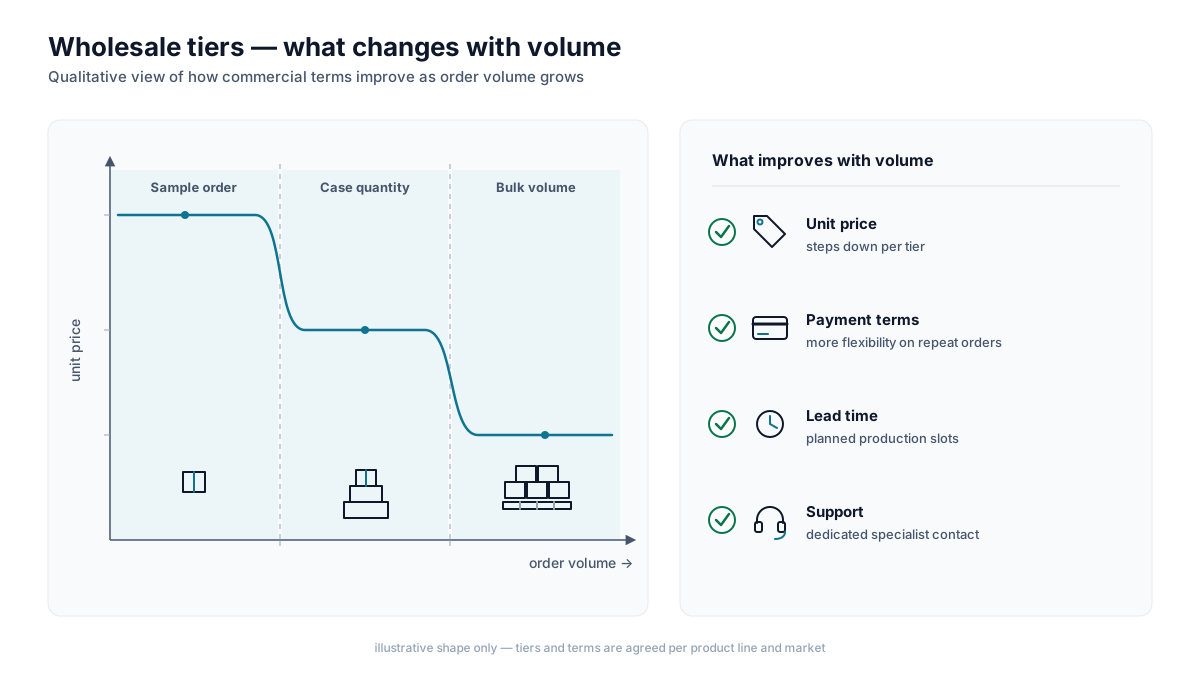
Wholesale PRP buying is expiry-date management wearing a medical-supplies coat. The tubes at the heart of every kit carry dated anticoagulant solutions and separator gels with a fixed shelf life, so the correct order size is set by what your customers will consume before dating becomes a problem — not by the price break at the next carton quantity. Beyond that discipline, the buying decisions are about matching tube types, volumes and additives to what the clinics you supply actually run, and about knowing which storage claims matter (protect from freezing and heat, keep gel tubes upright in storage) and which are myths (there is no cold chain for standard PRP tubes). This guide works through all of it.
Key takeaways
- Shelf life is the category’s defining constraint: order in cycles your customers will consume with comfortable dating margin, and rotate first-expiry-first-out without exception.
- Standard PRP tubes are room-temperature stable — there is no cold chain. The real storage enemies are freezing, sustained heat and crushed packaging.
- Stock decisions are three-dimensional: anticoagulant type (ACD-A vs sodium citrate), tube volume (commonly ~8–15 mL), and gel separator versus no gel.
- Received dating is negotiable: agree a minimum remaining shelf life on delivery with your supplier before the first bulk order.
- Kit completeness drives clinic loyalty — a kit missing its blunt cannula or transfer accessories creates support calls that outweigh its margin.
What the wholesale PRP basket contains
PRP — platelet-rich plasma prepared from the patient's own blood and reinjected into the scalp — reaches your clinic customers as a small ecosystem of goods, and a wholesale program usually touches all of it. The clinical background and system-selection criteria are covered in the PRP systems hub and the PRP systems buyer's guide; the commercial basket looks like this:
- PRP tubes — evacuated blood-collection tubes containing an anticoagulant, with or without a separator gel. This is the consumable core: every treatment uses tubes, and everything else in the category exists around them.
- Complete PRP kits — tubes packed with the per-treatment accessories: collection needle or butterfly set, syringes, transfer devices, and usually a blunt injection cannula or mesotherapy-style needles. Kits sell on convenience and completeness.
- Accessories as separate SKUs — cannulas, syringes, transfer sets bought loose by clinics that prefer to assemble their own protocol.
- Centrifuges — the capital item. A wholesale buyer stocks these thinly or brokers them to order; they follow equipment logic (units per year, service questions), not consumable logic, and belong in an equipment plan rather than a tube forecast.
The recurring business is tubes and kits. Centrifuge placements matter mainly because a clinic whose centrifuge buckets fit your tubes is a locked-in tube customer — rotor and bucket compatibility with tube size is a real constraint worth checking whenever you take on a new tube line.
Tube types, volumes and additives: the spec table
Clinics choose tubes along three axes: which anticoagulant, what draw volume, and whether a separator gel is present. Your stock has to mirror the choices your customer base has made.
| Configuration | Typical draw volumes | What it is | Why clinics choose it |
|---|---|---|---|
| ACD-A anticoagulant, no gel | ≈8–10 mL | Citrate-dextrose solution; plasma separated by centrifugation alone | Long-established anticoagulant for platelet preparations; preferred by protocol-driven clinics that want full control over separation |
| Sodium citrate, no gel | ≈8–10 mL | Citrate anticoagulant in blood-draw concentrations | Familiar from laboratory practice; simple, widely available format |
| Gel separator tubes (with citrate or ACD-A) | ≈8–15 mL | Thixotropic gel forms a barrier between red cells and plasma during spinning | Faster, more repeatable separation with less operator skill; the common choice for busy aesthetic practices |
| Larger-volume formats | ≈12–15 mL | Higher draw volume per tube, gel or non-gel | Fewer tubes per treatment for higher-yield protocols; must match centrifuge bucket capacity |
| Complete treatment kits | Kit-dependent | Tubes plus needles, syringes, transfer devices and injection cannulas in one sterile-packed set | One order line per treatment; simpler stock-keeping and training for the clinic |
Two stocking observations follow. First, do not carry both anticoagulant families at depth unless your customer base genuinely splits — most individual clinics standardise on one protocol and stay there, so your mix should be discovered from customer orders, not assumed from the catalogue. Second, volume format is coupled to hardware: a 15 mL tube is only sellable to clinics whose centrifuge accepts it. Record centrifuge models per customer account; it turns compatibility from a support surprise into a filter you apply at quotation time.
The cold-chain myth, and what storage actually requires
A persistent belief among new buyers is that PRP tubes ship and store refrigerated. For standard tubes they do not, and it is worth being plain about this because imagined cold-chain costs distort sourcing decisions — inflating quotes, narrowing supplier options, and pushing buyers toward local stock they do not need. Anticoagulant solutions and separator gels in commercial PRP tubes are formulated to be stable at room temperature for their entire stated shelf life. They ship as ordinary goods by ordinary freight, including the import routes described in the import from Turkey guide.
What the product does require is protection from extremes and from mechanical abuse:
- No freezing. Freezing can damage additive solutions and gel behaviour. In practice this means winter air-freight and unheated-warehouse exposure are the scenarios to manage, not summer ones.
- No sustained heat. Prolonged high temperatures degrade additives and can soften gel; storage guidance is ordinary controlled room temperature, away from radiators and direct sun. A parked container in high summer is the realistic risk case.
- Vacuum integrity. Evacuated tubes rely on their vacuum for accurate draw volume, and the vacuum decays toward the end of shelf life — one more reason dating discipline matters. Crushed or dropped cartons can also cost vacuum and glass alike.
- Upright, boring storage. Gel tubes are best stored upright per manufacturer guidance; beyond that, dry shelves and moderate temperature complete the requirements.
State the storage terms in your own onward paperwork too. Your clinic customers inherit the same rules, and a distributor who documents them looks like a professional and avoids inheriting blame for a clinic's radiator-adjacent stock room.
Shelf life should size every order
Here is the arithmetic that governs the category. Tubes typically leave the factory with shelf life measured in a small number of years. Freight, customs and your own receiving consume some weeks; your stock rotation consumes months; and the clinic wants comfortable dating on what it receives, because it plans its own consumption in months. Every party in the chain needs a slice of the dating, and your order size decides whether the slices fit.
The practical planning loop looks like this:
Three habits make the loop work. Negotiate received dating explicitly — a common commercial term is a minimum fraction of total shelf life remaining on delivery, and a supplier shipping you short-dated stock without agreement is telling you something about their own rotation. Check dating at goods-in the way you check quantities, lot by lot. And resist the last price break: the carton quantity that looks cheapest per unit is expensive the day you scrap expired stock or, worse, quietly ship short-dated tubes to a clinic that notices. In this category reputation is dated too.
Order cadence follows naturally: smaller, regular orders — quarterly is a common rhythm — beat annual mega-orders for everyone except the freight forwarder. The general request-catalog-samples-order sequence on this platform is described on the wholesale page, and it applies here with dating terms added to the quotation stage.
Kits versus tubes: completeness as a commercial weapon
Clinics that buy complete kits are buying certainty: every treatment opens one sterile-packed set containing everything the protocol needs, stock-keeping is one line instead of six, and a new nurse can be trained on the kit rather than on a parts list. Clinics that buy loose tubes and accessories are buying flexibility and usually a lower per-treatment cost, at the price of managing more SKUs.
A wholesale buyer should carry both paths but respect what makes kits sell — completeness. Audit kit contents against what a treatment actually requires: collection set, correctly sized syringes, transfer device, injection cannula or needles in the sizes scalp work uses. A kit that forces the clinic to buy one missing component separately has surrendered its entire reason to exist, and the support calls land on you. When you evaluate a kit line, open samples and run the contents against a treatment step by step; the gaps are always visible on a table and never in a brochure.
Per-treatment math is straightforward and worth quoting proactively: treatments per month × tubes per treatment (protocol-dependent, commonly a small number) for tube clinics, or treatments per month × one kit for kit clinics, plus the accessory attach rate for the loose-tube path. Clinics respond well to a supplier who can express their monthly consumption as a standing order with dating guaranteed.
Goods-in checks specific to this category
Incoming inspection for PRP shipments is quick but has its own checklist, distinct from steel consumables. Verify lot numbers and expiry dates carton by carton against the delivery documents and against the dating term you negotiated — this is the single most consequential check in the category, and it takes minutes. Look for freight damage with tube-specific eyes: crushed corners on a tube carton mean probable glass breakage and vacuum loss inside, so open and inspect any carton with impact marks rather than shelving it. Sample a few tubes per lot and check fill appearance and gel condition visually; separated, discoloured or bubbled gel in an unspun tube is a reason to quarantine the lot and call the supplier. For kits, open one sample per lot and confirm contents against the packing specification — kit assembly errors happen at the factory, and finding the missing cannula in your warehouse beats finding it in a treatment room.
File the inspection record by lot, as with every other line. If a clinic later reports draw problems or separation failures, the lot-level trail is what turns a vague complaint into either a supplier claim or a technique conversation — and it protects you in both directions.
MOQs and the ordering process for PRP lines
Tube and kit MOQs follow filling and sterilization batches: solutions are compounded, tubes filled and evacuated, and kits assembled in production runs, so minimums are typically stated per configuration in the hundreds of units, with kits sometimes lower in units but higher in value. Mixed configurations within one manufacturer's line often count toward a combined minimum — useful when stocking two volumes and both gel variants of the same family. Lead times behave like made-to-order pharmaceuticals-adjacent production: first orders enter a filling schedule, replenishment may ship from stock, and the two numbers deserve separate answers at quotation.
The sample stage matters as much here as anywhere. Evaluate tubes with a clinic partner on their actual centrifuge and protocol: draw behaviour, separation quality, gel barrier integrity after spinning, and the completeness check on kits. Only then commit to a stocking order sized by the shelf-life loop above.
Request the wholesale PRP catalog
If you are planning a PRP tube or kit program — a first stocking order, a configuration review, or a dating-terms renegotiation — request the catalog below. You will receive the tube and kit configuration matrix, shelf-life and storage terms per SKU, carton quantities and current lead times, with evaluation samples as the next step.
Frequently asked questions
Do PRP tubes require refrigerated shipping or storage?
No. Standard PRP tubes with anticoagulant solutions and separator gels are formulated for room-temperature stability across their stated shelf life and ship as ordinary freight. Protect them from freezing, sustained heat and physical crushing, and store gel tubes upright — but there is no cold chain.
What shelf life should I expect on wholesale PRP tubes?
Factory shelf life is typically a small number of years, and what matters commercially is remaining dating on delivery. Agree a minimum remaining shelf life with your supplier as a contract term, verify dating lot by lot at goods-in, and size orders so stock sells through with margin to spare.
Which PRP tube types should a distributor stock?
Follow your customer base rather than the catalogue: the axes are anticoagulant (ACD-A or sodium citrate), draw volume (commonly around 8–15 mL), and gel separator versus none. Most clinics standardise on one configuration, so discover the mix from real orders and keep depth where your accounts actually are.
Are complete PRP kits or loose tubes the better wholesale line?
Carry both. Kits win with clinics that value one-line ordering and training simplicity, and they hold customers well — provided contents are genuinely complete for a treatment. Loose tubes and accessories suit protocol-driven clinics optimising cost. Audit kit contents against a real treatment before taking on any kit line.
What MOQs apply to PRP tubes and kits?
Minimums typically sit in the hundreds of units per configuration, reflecting filling, evacuation and kit-assembly batches, with mixed configurations from one line often counting toward a combined minimum. Weigh every price break against dating: the cheapest carton quantity is a loss if part of it expires unsold.
Do PRP tubes need to match the clinic’s centrifuge?
Yes — tube length and diameter must fit the centrifuge rotor or bucket, and larger-volume formats are the usual mismatch. Record centrifuge models per customer account and check compatibility at quotation time rather than after delivery.
Related articles
PRP Systems for Hair Clinics: Tubes, Kits and Centrifuges
How hair clinics buy PRP equipment and consumables — tube chemistry, centrifuge matching, kit completeness and an honest view of the evidence.
PRP Systems Buyer's Guide for Hair Clinics
How to buy PRP tubes, kits and centrifuges for a hair clinic: additives, kit completeness, rpm/rcf matching, cost per treatment, storage and honest claims.
Hair Transplant Consumables in Bulk: The Full Basket
A hair transplant session consumes over a dozen distinct disposables beyond punches and blades. This guide maps the full basket with per-session quantity logic, shows how to convert it into bulk orders, and weighs procedure kits against separate SKUs.
Wholesale FUE Punches: How to Buy Punches in Bulk
A working guide to bulk FUE punch procurement: the diameter range worth stocking, how session volume converts into carton quantities, what to inspect in every incoming lot, and how punch MOQs and lead times actually behave.