
Selling Aftercare Products at the Clinic: The Honest Retail Model
Why aftercare retail works at the clinic, and how to run it without becoming a pushy shop: assortment design in three tiers, pricing psychology that survives a patient’s later price check, inventory discipline, and staff scripting built on recommendation rather than pressure.
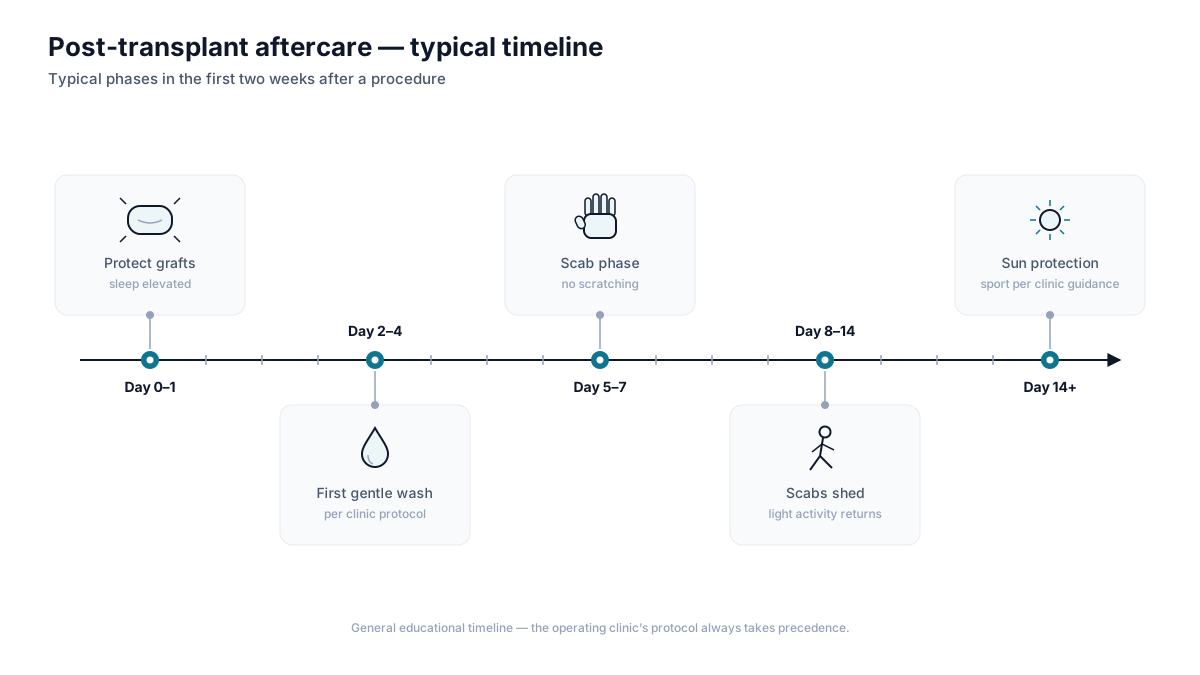
Clinic-retailed aftercare works because of a structural advantage no other retailer has: the recommendation comes from the clinical team the patient just trusted with their scalp, at the exact moment the patient is most motivated to do everything right. Run honestly — a small, protocol-linked assortment, prices a patient will not resent after a later online comparison, and staff who recommend rather than push — it becomes a durable secondary revenue line that patients experience as service. Run greedily, it reads as upselling in a white coat and quietly damages the thing the clinic actually sells, which is trust.
Key takeaways
- The clinic’s edge is credibility at the moment of maximum motivation — an advantage that survives only as long as recommendations stay clinical rather than commercial.
- Design the assortment in three tiers: protocol essentials in the kit, continuation products patients reorder, and a small optional tier — not a shelf of everything.
- Price for the later price check: patients will compare online after they get home, and the retail line must survive that comparison with its dignity intact.
- Inventory discipline beats range: few SKUs, watched expiry dates, one named owner — a clinic is not built to manage a drugstore’s stock list.
- Script the ethics explicitly: staff recommend what the protocol supports, disclose that the clinic sells it, and take no for an answer without a second attempt.
Why the trust moment works — and what it obligates
A patient leaving a transplant session occupies a rare commercial position: they have just made a major investment in an outcome, they are highly motivated to protect it, and they regard the clinical team as the authority on how. When that team says “this is the shampoo we recommend for the next two weeks, we have it here”, conversion is high — not because of salesmanship but because the recommendation removes a research task from an anxious person's list. The same product recommended by a shelf label in a pharmacy competes with thirty neighbours; recommended by the surgeon's team, it competes with nothing.
The obligation is the mirror of the advantage. The recommendation converts because it is perceived as clinical, and the moment patients sense it is primarily commercial — products unrelated to their protocol, visible pressure, prices that later look opportunistic — the credibility that powered the whole model erodes. Every design decision that follows, from assortment to scripting, is downstream of one rule: the retail line must remain an extension of the protocol, never the reverse.
Assortment design: three tiers, few SKUs
The commonest mistake is range. A clinic is not a drugstore, and every SKU beyond the protocol's needs adds inventory cost, expiry risk and — worse — dilutes the clinical framing of the whole shelf. The workable structure is three deliberate tiers.
| Assortment tier | Role in the model | Typical contents | Selling motion |
|---|---|---|---|
| Protocol essentials | Included with the procedure via the aftercare kit; establishes products and routine | Moistening spray, first-phase shampoo, instruction card | Not sold — handed over and explained as part of care |
| Continuation line | The revenue core: products the kit introduced, repurchased for the months after | Serum, gentle shampoo, hair-support vitamins | Reorder at reception, at follow-ups, or online; refill cadence matches product sizes |
| Optional tier | Small, genuinely useful extras for patients who ask for more | Travel sizes, a scalp-comfort product, a second serum format | Available and visible, mentioned only on request or clear relevance |
The kit is the engine of the model, which is why assortment design starts there: the products in the bag are the products patients later recognise and repurchase, so the continuation line should be composed of exactly the items the kit introduces — no orphaned retail products the patient has never used. How the kit itself is composed is covered in the aftercare kit contents guide; the case for putting the clinic's own name on those products, which materially changes the economics of the continuation tier, is made in the clinic-branded aftercare kits guide.
Tier three earns its place only by restraint. Its purpose is to answer real patient requests — something for travel, something for an itchy phase — without turning the reception desk into a boutique. If a tier-three product has not been asked for in months, retire it.
Pricing psychology, done honestly
Nothing in this model requires clever pricing, and much depends on avoiding it. The controlling insight is that the purchase happens twice: once at the clinic, in the trust moment, and again weeks later when the patient reorders — after they have, inevitably, searched the product category online. A price that felt fine at handover and looks inflated from the sofa converts the first sale and kills every subsequent one, along with a measure of goodwill. The line must be priced for the second look, not the first.
Honest pricing in this category is qualitative discipline rather than formula. Anchor against what comparable-quality products cost patients through ordinary retail channels, and position at or reasonably near that level — the clinic's advantage is trust and convenience, and it does not need a premium on top to make the line worthwhile. Keep prices round and stable; a clinic shelf is the wrong place for promotional churn, which reads as retailing rather than care. Bundle honestly if at all: a continuation set priced modestly below its components is a service; a bundle designed to move slow stock is visible as exactly that. And resist the temptation to bury product costs in inflated “aftercare fees” — patients dissect invoices, and opacity discovered later costs more than margin gained.
What margins should be, no one outside your numbers can say — they vary with sourcing route, branding, volumes and market. The structural point is simpler: sourced sensibly at trade terms, through the routes described on the wholesale page, or produced under the clinic's own label, aftercare products support ordinary retail economics without the clinic needing to stretch prices. If the line only works at prices that embarrass the later price check, the problem is the sourcing, not the patient.
Inventory basics for a non-retailer
Clinics fail at retail operations more often than at retail strategy, and almost always for the same mundane reasons: nobody owns the stock, expiry dates go unwatched, and reordering happens when a shelf is found empty. The fixes are correspondingly mundane. Give the line one named owner — typically a senior reception or patient-coordinator role — with stock counting, reordering and expiry checks in their actual job description. Keep SKUs few, which the three-tier assortment already enforces. Order little and often rather than deep: cosmetic products carry shelf lives, patient volume is forecastable from the surgical calendar, and a clinic's storage is expensive space. Track expiry on a simple first-in-first-out shelf discipline, and treat short-dated stock as a prompt to review order sizes, not as a discounting opportunity.
The vitamin component deserves a specific note: supplements carry their own date sensitivities and their own reorder rhythm — typically monthly per patient — which makes them simultaneously the most cadence-friendly product in the line and the easiest to overstock; the category's sourcing mechanics are covered in the private-label hair vitamins guide.
Staff scripting: recommend, don't push
The selling motion deserves the same design attention as the assortment, because it is where the model's ethics become visible. The principles script cleanly. Recommendations come from clinical relevance: staff offer the products the protocol names, at the protocol's moments — handover, follow-up visits, the point where the kit's serum runs out — and nothing else. Disclosure is explicit: “we stock this at reception” said plainly, so the patient never later feels the commercial relationship was disguised. One offer, no second attempt: a declined recommendation is answered with where the product category can be found generally, not with persistence. And no outcome leverage, ever — language implying a result depends on buying the clinic's products is both untrue for cosmetic products and corrosive to exactly the trust the model runs on.
Scripting is also protection for staff. Reception teams asked to “sell more” without language improvise, and improvised selling under a clinic's roof drifts toward pressure. Teams given exact, honest sentences — written with the clinical staff, reviewed like any patient communication — sell more over time precisely because they never appear to be selling.
Where clinic retail goes wrong
The failure modes are consistent enough to list. Range creep is the slowest and commonest: a supplier visit adds two SKUs, a staff enthusiasm adds another, and eighteen months later the reception shelf has become a shop nobody designed, with dead stock and a diluted clinical story. The quarterly review exists to prune exactly this. Price drift is the second: costs rise, prices follow in small unexamined steps, and the line quietly crosses the threshold where the later price check turns patients cynical — which shows up not as complaints but as vanishing reorders. Third is the orphan recommendation: staff verbally recommending products the shelf no longer stocks, or stocking products the current protocol no longer mentions, both symptoms of the retail line and the clinical protocol being maintained by different people who no longer talk. And last is delegation without ownership, where the line belongs to everyone at reception and therefore to no one, discovered the week the serum has been out of stock for a month and nobody noticed the expiry dates on the vitamins.
None of these is dramatic, which is the point: clinic retail rarely fails through scandal, it fails through unmanaged drift. A one-page quarterly review — SKUs, prices, stock, reorders, patient comments — run by the line's named owner, catches all four while they are still small.
Measuring whether it works
The line's health shows in a handful of signals worth reviewing quarterly: what share of patients take up the continuation products, how many reorder once the kit's supply runs out, which SKUs move and which sit, and what patients say — in reviews and follow-ups — about the aftercare experience. Reorder rate is the number that matters most, because it measures the honest version of the model: a patient who repurchases weeks later, at home, without anyone in a white coat nearby, is voting on product and price with nothing but their own judgment. A high take-up rate with poor reorders usually means the trust moment is converting but the price check or the product is failing afterwards. Clinics wanting the reorder loop to run without reception involvement typically add a simple online reorder route; those developing the line under their own brand will find the production side described on the OEM and private-label page.
Frequently asked questions
Is it appropriate for clinics to sell products to patients at all?
Yes, when the line is an extension of the clinical protocol: products the aftercare instructions actually call for, priced fairly, recommended once and without pressure, with the commercial relationship stated plainly. Patients broadly experience that as service. What damages trust is the reverse — protocol-irrelevant products, opaque pricing or persistent selling.
Which products should a clinic retail line include?
Start from the aftercare kit and sell its continuation: the serum, the gentle shampoo and the vitamin product patients already know from the bag, plus a very small optional tier for genuine requests. A short protocol-linked list outsells a broad shelf, costs less to stock, and keeps the clinical framing intact.
How should clinic-retailed products be priced?
For the patient’s later price check. Patients compare online after they get home, so position at or reasonably near what comparable-quality products cost through normal retail, keep prices round and stable, and avoid promotional tactics. Sourced at proper trade terms, the line supports ordinary retail economics without stretched prices.
What margin do clinics make on aftercare products?
It varies too much with sourcing route, branding, volume and market for any general number to be honest. The structural point: buying at trade terms or producing under the clinic’s own label leaves room for ordinary retail economics at patient-fair prices — and if it does not, the sourcing needs fixing before the pricing does.
How do we keep staff from feeling like salespeople?
Give them scripts written with the clinical team: recommend only what the protocol names, at protocol moments, disclose that the clinic stocks it, and accept a no without a second attempt. Exact honest language protects staff from improvising under revenue pressure — and converts better over time than pushing ever does.
What is the single best indicator the retail line is healthy?
Reorder rate. A patient who repurchases weeks later at home — away from the trust moment, after any price comparison they cared to make — is judging the product and price on merit. Strong first take-up with weak reorders points to a price or product problem the handover moment was masking.
Related articles
What Clinics Actually Put in Post-Transplant Aftercare Kits
A component-by-component look at the post-transplant aftercare kit: what each recovery phase demands, how clinics size and portion the products, why the instruction card outranks everything else in the bag, and where branded kits differ from generic ones.
Choosing the Shampoo Your Clinic Hands Out After a Transplant
A buyer’s framework for the most scrutinised bottle in the aftercare bag: what mildness actually means at the surfactant level, why fragrance-free is the defensible default, which pH range to ask for, and how packaging decides whether patients follow the protocol.
Clinic-Branded Aftercare Kits: Contents, Branding and Economics
A clinic buyer's guide to putting the practice's name on the post-transplant bag: kit composition, branding depth, what a kit really costs per patient, and whether to buy pre-packed or assemble in-house.
Hair Care & Aftercare Products: A Clinic Buyer’s Guide
What clinics hand patients after a transplant — serums, shampoos, vitamins and kits — and how to buy or brand them without overclaiming.