
What Clinics Actually Put in Post-Transplant Aftercare Kits
A component-by-component look at the post-transplant aftercare kit: what each recovery phase demands, how clinics size and portion the products, why the instruction card outranks everything else in the bag, and where branded kits differ from generic ones.
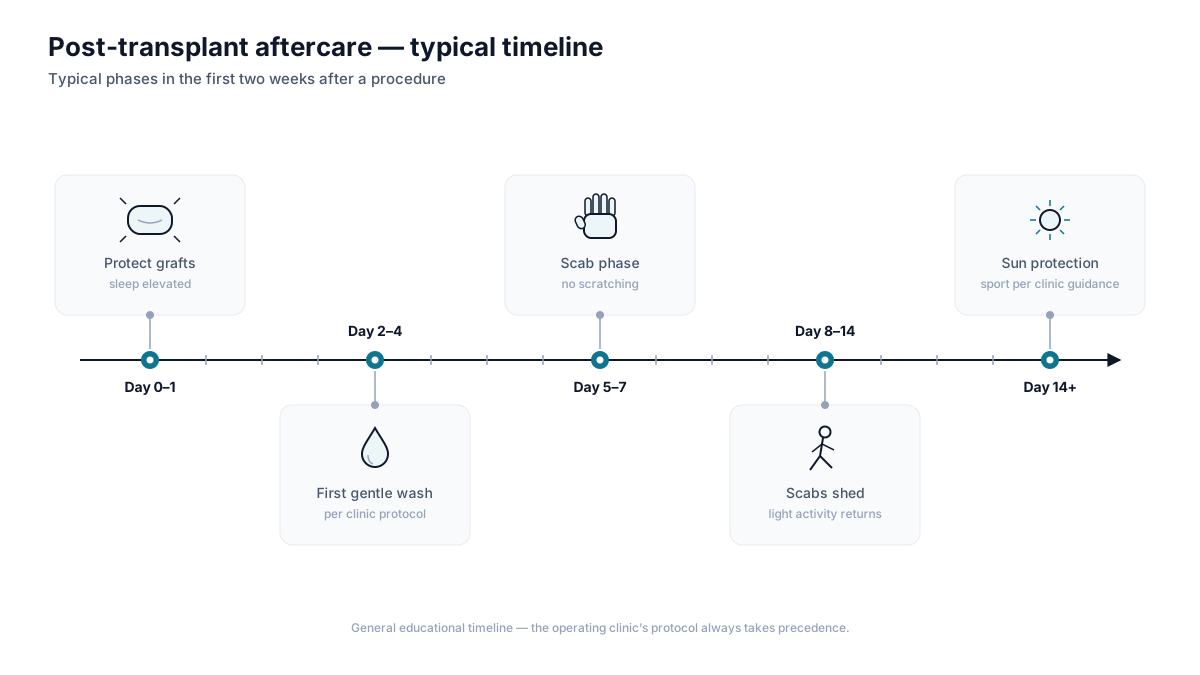
A well-built post-transplant aftercare kit contains five to seven components, each mapped to one phase of recovery: a saline or moistening spray for the first days, a mild shampoo for the staged return to washing, a leave-on serum or foam for the weeks after healing, usually a hair-support vitamin product for the months beyond, a printed day-by-day instruction card, and an outer bag or box that keeps the sequence together. The organising principle is the patient's calendar, not the product catalog — every item should answer the question a patient will actually ask in a specific week of recovery, and anything that does not answer such a question is padding.
Key takeaways
- Kit composition follows the recovery calendar: one component per phase, one clear instruction per component — not a showcase of everything the supplier fills.
- Sizing is a design decision: each container should last its phase plus a small margin, because oversized bottles blur the handover points between phases.
- The instruction card is the highest-value item in the bag — it encodes the clinic’s own protocol and is the component patients actually consult.
- Kits contain cosmetics and supplements, not medicines; anything a physician prescribes travels separately from the branded bag.
- Branded and generic kits usually hold the same functional contents — the differences are consistency, instruction quality and whose name the patient sees daily.
The recovery calendar decides the contents
Post-transplant recovery runs in phases, and each phase changes what the patient needs in hand. The first days are about protecting grafts the patient must not touch, which is why the first component is almost always a fine-mist spray that moistens the recipient area without contact. The first weeks are about washing carefully — softening crusts, cleaning the donor area, easing back toward a normal shower routine — which is the shampoo's job. Once the scalp has visibly healed, attention shifts to months of daily care where a leave-on serum and, in many kits, a vitamin product give the patient a constructive routine during the long wait for visible growth. The instruction card spans the whole journey and tells the patient which product belongs to which day.
Clinics that assemble kits by phase rather than by product enthusiasm end up with smaller, clearer bags. A patient in week one does not need three leave-on products; a patient in month three does not need saline. Mapping components to the calendar also exposes gaps — a kit with two serums but no printed washing instructions has solved the wrong problem.
| Recovery phase | What the patient needs | Typical component | Sizing logic |
|---|---|---|---|
| Days 0–3 | Moisture on the recipient area without touching it | Saline or moistening fine-mist spray | 50–150 ml; frequent small applications for a short phase |
| Days 3–14 | Gentle, staged washing of recipient and donor areas | Mild, typically fragrance-free shampoo | 100–250 ml; daily washes for roughly two weeks |
| Weeks 2–8 | A daily scalp-care routine once healing allows | Leave-on serum or foam | 30–100 ml dropper, pump or foam; sized to weeks of daily doses |
| Months 2–6 | A constructive daily habit through the slow-growth window | Hair-support vitamin or supplement product | 30–60 count; one month per container, refilled by reorder |
| Entire journey | Knowing what to do on which day | Printed instruction card or booklet | Matched to the clinic’s protocol and patient languages |
| Entire journey | Keeping the sequence together, carrying the brand | Outer box, zip bag or pouch | Fits all components plus paperwork; survives a suitcase |
The table describes the common pattern, not a mandate. Some clinics add a soft travel pillow or a headband for the first nights; some include a second spray for large sessions; clinics with many international patients weight the kit toward flight-friendly sizes. The constant is the mapping: every component earns its place by serving a phase.
Portioning and sizing: the quiet design decision
Container sizes look like a packaging detail and are actually a protocol tool. Each product should last its phase with a modest margin — enough that the patient never runs out mid-phase, not so much that the product lingers into the next phase and muddies the handover. A litre of first-phase shampoo invites the patient to keep using it for six months and never transition; a 100 ml bottle runs out roughly when the protocol says to move on, and the empty bottle itself prompts the next step.
Three practical considerations shape the sizes. First, application frequency: a spray used many times daily for a few days needs less volume than intuition suggests, while a twice-daily serum used for two months needs more than the elegant 30 ml dropper often provides. Second, travel: clinics treating flying patients favour containers that clear cabin-baggage liquid limits, because a confiscated aftercare spray at airport security undoes the whole handover. Third, reorder design: the components that continue beyond the kit — serum and vitamins above all — are deliberately sized so the kit's supply ends while motivation is still high, which is where the continuation purchase happens; the retail side of that design is covered in the hair care and aftercare hub.
Portioning also interacts with cost in a way buyers should use rather than fight. Smaller fills cost less per unit, which lets a kit include a broader phase coverage at the same total cost as fewer, larger bottles. A kit is not a value pack; it is a guided tour, and the sizing should say so.
The instruction card outranks everything else
Ask post-operative coordinators what generates week-one phone calls and the answer is rarely product quality — it is confusion about sequence. When do I start washing? How hard can I rub? Which product today? The instruction card answers those questions at two in the morning when the clinic's phone does not, which makes it the single highest-leverage component in the bag despite being the cheapest.
A good card is a clinical document, not a leaflet. It states the protocol day by day, in imperative sentences, in every language the patient base actually speaks, and it matches exactly what the surgical team says at discharge — a card that contradicts the surgeon's verbal instructions is worse than no card. It names the kit components explicitly ("use the blue-capped spray") rather than generically, so the patient never has to interpret. And it carries the clinic's emergency contact and the small set of warning signs that justify a call, which both reassures patients and channels contact toward the cases that matter.
Because the card encodes the clinic's own protocol, it is also the component that most needs version control. Protocols evolve; printed cards in pre-packed kits do not. Clinics that print cards in short runs, version them visibly and review them whenever the protocol changes avoid the slow drift in which staff verbally correct the printed instructions patient after patient.
What stays out of the kit
Restraint is a feature. The recurring temptation is to add products because they are available — a conditioner, a styling product, a second serum — until the bag communicates abundance instead of guidance. Each addition dilutes the instruction card, raises cost, and increases the odds a patient uses the wrong product in the wrong week. Five or six purposeful components consistently outperform nine impressive ones.
One boundary deserves stating plainly: an aftercare kit is a bag of cosmetics and food supplements, and medicinal products are a separate, regulated category that belongs in a prescription and a pharmacy rather than in a branded clinic kit. Where a surgeon prescribes medication as part of post-operative care, it travels through that clinical channel with its own instructions. Keeping the kit cosmetic keeps its claims honest and its logistics simple — and it means the kit can be produced, branded and shipped like the consumer-adjacent product it is. What the cosmetic components can honestly claim, ingredient by ingredient, is a discipline of its own, treated in the ingredient-focused guides of this hub.
Branded versus generic kits
Functionally, a generic kit and a clinic-branded kit can hold identical contents; the differences sit around the products rather than in them. A generic kit — stocked third-party products in a plain bag — is fast to implement, has no minimum quantities beyond the products themselves, and borrows whatever credibility the component brands carry. Its weaknesses are visual inconsistency (the bag looks assembled because it is), instruction cards that describe the manufacturer's generic guidance rather than the clinic's protocol, and a months-long brand presence in the patient's bathroom that advertises someone else.
A branded kit reverses each point: consistent presentation, an instruction card written to the clinic's own protocol, and the clinic's name on the products a patient handles twice a day through recovery — at the cost of minimum order quantities, artwork lead times and a supplier relationship to manage. The economics, branding depth options and assembly models are treated fully in the clinic-branded aftercare kits guide; the honest summary is that branding changes the kit's commercial role, not its clinical one. Clinics typically start generic, learn which components their patients value, then brand once volumes make minimums comfortable — often beginning with the component patients reorder most, which is usually the serum, as described in the private-label hair serum guide.
Room for variation without losing the standard
A fixed kit and a flexible protocol can coexist. The workable pattern is a standard core — spray, shampoo, card, outer — that every patient receives identically, plus a small set of defined variants the team can add by rule rather than by improvisation: an extra spray for sessions above a stated graft count, a sensitive-scalp shampoo alternative, a language-specific card pulled from a printed set. Defining the variants in advance preserves the two things a kit exists to protect — consistency and clear instructions — while still letting the clinical team respond to the patient in front of them. What breaks kits is not variation but undocumented variation, where reception improvises contents patient by patient and nobody can say afterwards what a given patient actually took home.
Judging a kit you are about to buy
Whether the kit comes pre-packed from a supplier or is assembled at the clinic, the evaluation questions are the same. Does every component map to a phase of your actual protocol — not a generic protocol? Are the sizes matched to phase length, travel rules and the reorder design? Is the instruction card yours, in your languages, versioned and verified by your surgical team? Are the cosmetic components ones you have sampled and would defend individually? And does the supplier answer questions about ingredient claims with restraint rather than enthusiasm? A kit that passes those checks will do its three jobs — compliance, patient experience, brand presence — regardless of whose logo is on the bag.
Frequently asked questions
What does a standard post-transplant aftercare kit contain?
Most kits hold five to seven items: a saline or moistening spray for the first days, a mild shampoo for the staged return to washing, a leave-on serum or foam for the weeks after healing, often a hair-support vitamin product, a printed day-by-day instruction card, and an outer bag or box. Each component maps to one phase of recovery.
How large should the bottles in an aftercare kit be?
Sized to the phase, not to generosity: sprays commonly 50–150 ml for a short, frequent-use phase; first-phase shampoos 100–250 ml for roughly two weeks of daily washing; serums 30–100 ml covering weeks of daily doses. Oversized containers blur the transitions between protocol phases and delay the move back to normal care.
Why is the instruction card considered the most important component?
Because it is the component patients actually consult, and it encodes the clinic’s own protocol. A clear, day-by-day card in the patient’s language reduces week-one phone calls and washing mistakes more than any product choice — and it is the cheapest item in the bag to get exactly right.
Should medication be included in the aftercare kit?
No. Kits are built from cosmetics and food supplements; medicinal products are a separately regulated category that belongs in a prescription channel with its own instructions. Keeping the kit cosmetic keeps its claims honest and its production and shipping straightforward.
Is a branded kit clinically better than a generic one?
Not inherently — the same functional contents can sit in either. Branding changes the commercial role: consistent presentation, an instruction card written to the clinic’s protocol, and the clinic’s name in the patient’s daily routine for months. Most clinics start generic and brand once patient volume makes minimum order quantities comfortable.
How many products are too many in one kit?
When components stop mapping to protocol phases, the kit is overfilled. Five or six purposeful items consistently work better than nine: each addition dilutes the instructions, raises cost and increases the chance a patient uses the wrong product in the wrong week.
Related articles
Hair Care & Aftercare Products: A Clinic Buyer’s Guide
What clinics hand patients after a transplant — serums, shampoos, vitamins and kits — and how to buy or brand them without overclaiming.
Clinic-Branded Aftercare Kits: Contents, Branding and Economics
A clinic buyer's guide to putting the practice's name on the post-transplant bag: kit composition, branding depth, what a kit really costs per patient, and whether to buy pre-packed or assemble in-house.
Choosing the Shampoo Your Clinic Hands Out After a Transplant
A buyer’s framework for the most scrutinised bottle in the aftercare bag: what mildness actually means at the surfactant level, why fragrance-free is the defensible default, which pH range to ask for, and how packaging decides whether patients follow the protocol.
Hair Serum Ingredients: An Evidence-Cautious Guide for Clinic Buyers
A buyer’s tour of the cosmetic hair serum: what caffeine, panthenol, peptides and botanical extracts actually claim to do, honest evidence-posture language for each class, how to read an INCI list past the marketing, and the claim discipline a clinic-branded product must keep.