
Clinic-Branded Aftercare Kits: Contents, Branding and Economics
A clinic buyer's guide to putting the practice's name on the post-transplant bag: kit composition, branding depth, what a kit really costs per patient, and whether to buy pre-packed or assemble in-house.
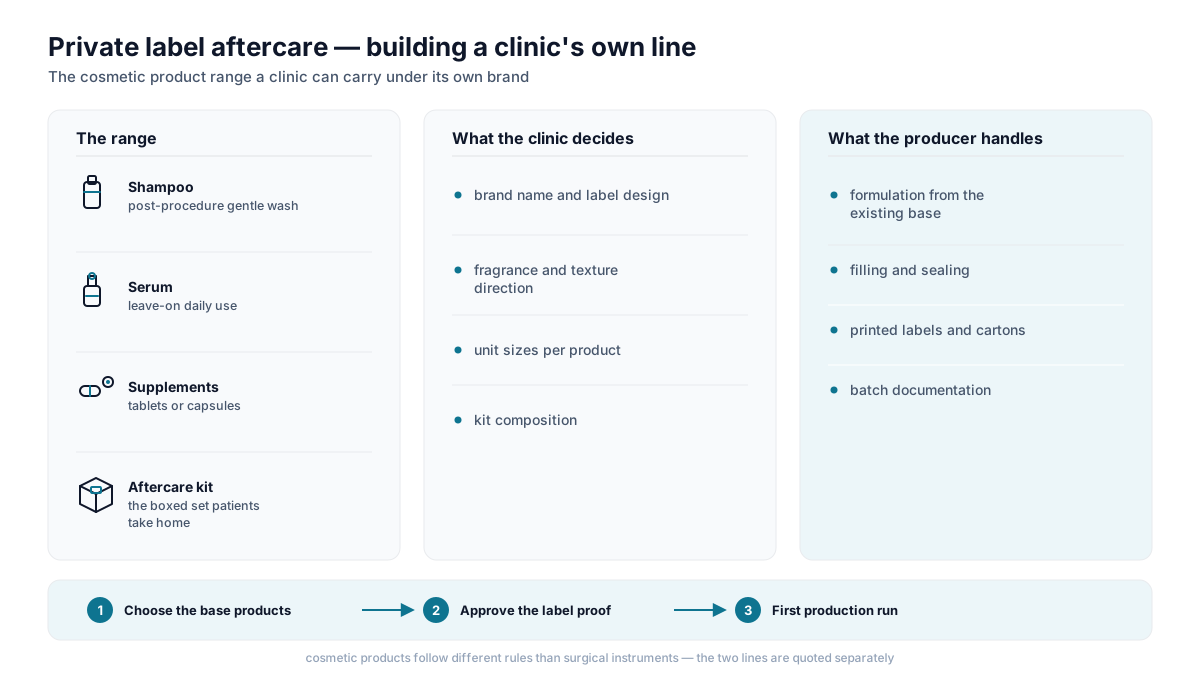
A clinic-branded aftercare kit is the bag every transplant patient takes home, produced under the clinic's own name: typically a moistening spray or saline, a gentle first-phase shampoo, a longer-term serum, printed day-by-day instructions and often a vitamin product, packed in a branded box or bag. Buying it as a kit rather than as loose products does three jobs at once — it standardises the clinical instructions, it turns a cost centre into a brand asset that sits in the patient's bathroom for months, and it simplifies purchasing into one SKU with one supplier. The decisions that shape a kit project are composition, branding depth, assembly model and order structure, and each has a sensible default this guide sets out.
Key takeaways
- A kit is a compliance tool first: clearly staged components with day-by-day instructions reduce patient calls and washing mistakes more than any single product choice.
- Branding depth is a spectrum — from your label on stock products in a stock bag to fully custom packaging — and first kits should start shallow and deepen with volume.
- Per-kit cost is small against the session fee; the honest framing is patient experience and brand retention, with margin as a bonus on later reorders of the components.
- Kit MOQ is governed by the highest-minimum component, usually the filled cosmetics — structuring the kit around shared standard components keeps the entry threshold low.
- Pre-packed kits buy convenience and consistency; clinic-assembled kits buy flexibility and lower unit cost at the price of staff time and packing discipline.
What actually goes in the box
There is no single canonical kit, but the composition logic is consistent: cover the recovery phases in order, and let each component carry one clear instruction. A typical structure maps to the patient's calendar.
| Component | Role in the patient journey | Typical format |
|---|---|---|
| Saline or moistening spray | First days: keeping the recipient area moist without touching it | 50–150 ml fine-mist spray |
| Gentle first-phase shampoo | The staged return to washing in week one and two | 100–250 ml bottle, often fragrance-free |
| Post-transplant serum or foam | Weeks to months: daily scalp care once healing allows | 30–100 ml dropper, pump or foam |
| Hair-support vitamins | The months after: a daily-cadence product that keeps the brand present | 30–60 count bottle or blister card |
| Printed instructions | The whole journey: day-by-day guidance in the patient’s language | Card or booklet matched to the clinic’s protocol |
| Outer packaging | Carries the brand and keeps the sequence together | Rigid box, zip bag or toiletry-style pouch |
Two composition mistakes recur. The first is overfilling: a kit with nine products reads generous but dilutes the instructions and inflates cost on components patients never finish. Five or six purposeful items beat nine impressive ones. The second is letting the instruction card be an afterthought — it is the component patients actually consult, it encodes the clinic's own protocol, and it is the cheapest thing in the box to get right. Clinics that treat the card as a clinical document, reviewed by the surgical team and written in every language the patient base speaks, get measurably fewer confused phone calls in week one. The individual product categories are covered in depth in their own guides — serums, shampoos and vitamins — and the category logic in the hair care and aftercare hub.
Branding depth: from label to full custom
Branding a kit is not one decision but a depth setting, and cost scales with depth.
| Branding level | What it involves | When it makes sense |
|---|---|---|
| Label-only | Your logo and text on stock bottles, stock bag or box | First kits, modest volumes, fastest and cheapest entry |
| Label plus custom outer | Stock product components inside a custom-printed box or pouch | The common sweet spot: the outer carries the brand impression, components stay standard |
| Custom components | Custom-printed or custom-moulded bottles, bespoke instruction booklet, printed tissue and fillers | Established volumes; premium positioning; photography-led marketing |
| Full custom | Custom formulations plus custom packaging throughout | High-volume clinic groups and chains treating the kit as a retail-grade product line |
The reliable advice is to start one level shallower than instinct suggests. The outer packaging carries most of the perceived branding — patients remember the box and the bag, not the bottle mould — so a custom outer around standard components delivers most of the brand effect at a fraction of the minimums. Deep customisation earns its cost once volumes are proven and the kit design has survived contact with real patients, at which point upgrading is a reorder decision rather than a gamble. The move from stock formulations toward custom ones follows the same logic as elsewhere in private label, and the OEM and private-label page describes how that transition is typically structured.
What a kit costs, honestly framed
Manufacturers will not publish kit prices because composition varies, but the cost logic is stable and worth internalising. The filled cosmetic components dominate unit cost; printed matter and outer packaging are secondary; assembly labour adds a modest per-kit amount; one-time costs — artwork, print plates, box dies — amortise across the run. A five-component kit at clinic volumes lands, qualitatively, in the range of a modest consumable line item: small against the price of a transplant session, comparable to other per-patient consumables the clinic already buys without ceremony.
One comparison puts the number in context: clinics routinely spend more per patient on single-use surgical consumables than a well-built five-component kit costs, yet the kit is the only per-patient spend the patient actually sees, keeps and associates with the clinic. Few line items in the budget buy that much visible quality per unit of cost.
That scale is why the margin question is usually framed wrong. Treated as a product to resell, a kit's absolute margin per patient is real but minor. Treated as marketing, the economics look different: the kit is handed over at the emotional peak of the patient relationship, it keeps the clinic's name in daily view through the recovery months, and it seeds reorders of the branded serum and vitamins that follow — repeat purchases that arrive with no acquisition cost. Clinics that price the kit into the procedure and optimise it for experience tend to do better than clinics that try to make the bag itself a profit centre. Where the kit components are also sold individually at reception or online, the kit functions as the free trial for the range, and the range's reorder economics carry the business case.
Pre-packed or clinic-assembled
The assembly question decides more of the day-to-day experience than buyers expect.
Pre-packed kits arrive as finished, sealed units: the manufacturer or packer assembles components, instructions and outer packaging into a single SKU. The gains are consistency — every patient receives an identical, complete, well-presented kit — plus zero staff time and clean stock control with one item to count. The costs are assembly charges per kit, less flexibility when the clinic wants to swap a component, and a full-kit reorder even when only one component runs low.
Clinic-assembled kits ship as bulk components plus empty branded outers, packed by clinic staff. Unit cost is lower, component stock can rotate independently, and the clinic can vary contents per patient — a different shampoo for a sensitive scalp, an extra spray for a large session. The price is discipline: someone must own the packing task, missing components must not reach patients, and a rushed reception desk produces exactly the inconsistent kits the branded programme was meant to end.
The pattern that works widely: start clinic-assembled at low volume, where flexibility matters and the packing load is a few kits a week, and switch to pre-packed once monthly volume makes packing a real labour line and consistency a real risk. Some suppliers offer a middle path — components pre-grouped into trays with the outer folded flat — that keeps most of the labour saving without full assembly charges.
Order structure, MOQs and the first project
A kit's minimum order is governed by its highest-minimum component. Printed instruction cards and boxes are cheap to run in modest quantities; the filled cosmetics carry the batch minimums described in the component guides, and the vitamin component brings its own batch logic. Three structuring rules keep first orders sane. Build the kit from the manufacturer's standard components so filling batches are shared rather than dedicated. Let the outer packaging and instruction card carry the customisation, since print minimums are the friendliest in the stack. And size the first run against the surgical calendar — a clinic performing a known number of transplants per month can forecast kit consumption more precisely than almost any other buyer in this industry, which is exactly the demand profile that earns favourable quotes and phased-delivery structures.
The sample stage deserves the surgical team's attention, not just the manager's: the people who wrote the post-operative protocol should confirm the kit's instructions match it exactly, because a branded kit that contradicts the clinic's own verbal instructions is worse than no kit at all. From confirmed artwork, first deliveries typically land within the same few-month window as other private-label projects, and reorders — with artwork, components and assembly settled — run substantially faster.
Where kit programmes go wrong
Most failed kit programmes fail the same few ways, and all of them are avoidable at the design stage. The first is protocol drift: the clinic updates its post-operative instructions but the printed card in a thousand pre-packed kits still says the old thing, so staff start contradicting the box. The fix is structural — keep the card's print runs short relative to the cosmetic components, and version it visibly so the team can check at a glance which instructions a patient holds. The second is orphan components: one product in the kit runs out or gets discontinued by the supplier, and the whole kit SKU stalls. Guard against it by preferring components the manufacturer runs as standard lines with steady availability, and by asking directly what happens to your kit if a single component changes. The third is claim creep on the outer packaging: the box is marketing real estate, and over successive artwork revisions the language tends to strengthen until the kit is promising outcomes no cosmetic product should. Keep the box's job modest — brand, contents, sequence — and let the instruction card do the talking.
A quieter failure is measurement neglect. A kit programme generates evidence about itself — support-call volume in week one, patients returning to buy the serum again, review mentions of the aftercare experience — and clinics that look at those signals learn within two cycles whether the kit is earning its cost and which components patients actually value. The second order should look different from the first because of what the first one taught you; a kit reordered identically for three years is usually a kit nobody is watching.
Scope your kit
If you can state your monthly patient volume, your current post-operative protocol and the components you want in the bag, a concrete proposal can come back with composition options, branding levels and realistic minimums against your calendar.
Frequently asked questions
What does a clinic-branded aftercare kit typically contain?
A moistening or saline spray for the first days, a gentle shampoo for the staged return to washing, a longer-term serum, printed day-by-day instructions, often a vitamin product, and a branded box or bag. Five or six purposeful components beat a crowded box — each item should map to one phase of recovery and one clear instruction.
What minimum quantities apply to branded kits?
The kit inherits the minimum of its highest-minimum component, usually the filled cosmetics. Built from a manufacturer’s standard components with customisation concentrated in the printed outer and instruction card, first orders can align with a mid-sized clinic’s quarterly or half-year patient volume. Fully custom components raise minimums substantially.
Pre-packed kits or assembling in the clinic — which is better?
At low volume, clinic assembly is cheaper and more flexible; at higher volume, pre-packed kits win on consistency, staff time and stock control. A common path is to start assembling in-house and switch to pre-packed once packing becomes a real labour cost or consistency starts slipping.
Is an aftercare kit a profit centre or a cost?
Per kit, the honest answer is: a modest cost that is small against the session fee. The commercial value sits elsewhere — better instruction compliance, fewer support calls, a brand presence in the patient’s home for months, and follow-on reorders of the branded serum and vitamins. Clinics that optimise the kit for patient experience rather than bag-level margin get the better overall economics.
Can the kit reflect our clinic’s specific post-operative protocol?
It should — that is the point of the instruction card, which is printed matter and therefore the easiest component to customise fully. Have the surgical team review the drafted card against the clinic’s actual protocol at the sample stage, in every language your patients need.
How branded can the kit be at the start?
The efficient first level is standard product components with your label, inside a custom-printed outer box or pouch — the outer carries most of the perceived branding at the friendliest print minimums. Custom bottles and bespoke formulations are volume-earned upgrades, not sensible starting points.
Related articles
Hair Care & Aftercare Products: A Clinic Buyer’s Guide
What clinics hand patients after a transplant — serums, shampoos, vitamins and kits — and how to buy or brand them without overclaiming.
Private Label Hair Serum: From Base Formulation to Your Brand
A buyer's guide to launching a hair serum under your own brand: choosing a base formulation, picking packaging, handling claims responsibly, and what actually drives minimum order quantities.
Private Label Hair Shampoo: Bases, Bottles and Filling MOQs
A practical buyer's guide to putting your brand on a shampoo: choosing a surfactant base, getting fragrance and pH right for post-transplant users, picking bottles and caps, and understanding filling minimums.
Private Label Hair Vitamins: Formats, Actives and MOQs
How to put your brand on a hair-support supplement: choosing between tablets, capsules and gummies, reading active-ingredient lists with appropriate scepticism, and what drives minimums and lead times.