
Hair Serum Ingredients: An Evidence-Cautious Guide for Clinic Buyers
A buyer’s tour of the cosmetic hair serum: what caffeine, panthenol, peptides and botanical extracts actually claim to do, honest evidence-posture language for each class, how to read an INCI list past the marketing, and the claim discipline a clinic-branded product must keep.
Cosmetic hair serums are built from a familiar cast — caffeine, biotin and panthenol, peptide complexes, botanical extracts, niacinamide — and the honest summary of the category is that mechanism stories are plentiful while strong clinical proof is scarce: most ingredient classes carry evidence best described as limited, mixed or plausible rather than established. That is not a reason to avoid the category; it is the reason to buy it with discipline. A clinic putting its name on a serum needs three competencies this guide supplies: reading an INCI list past the marketing, attaching an honest evidence posture to each ingredient class, and keeping product claims inside what a cosmetic may say. One boundary sits above all of this: minoxidil does not appear in this guide because it is a drug active — products are regulated as cosmetics or as medicines depending on composition and claimed action, and drug actives belong to the medicines category with its own rules, channels and oversight.
Key takeaways
- Almost no cosmetic serum ingredient has strong, replicated clinical evidence on hair outcomes — honest postures are ‘plausible’, ‘limited’ or ‘mixed’, and buyers should use those words.
- The INCI list is the only part of the label written under rules rather than by marketing: descending concentration order makes it readable once you know the landmarks.
- Actives listed after the preservatives are present at token levels — position in the list is the fastest concentration check a buyer has.
- A cosmetic may claim appearance, condition and care; growth and loss-prevention claims describe drug action and do not belong on a clinic-branded serum.
- Buy the supplier’s restraint: the vendor who volunteers evidence limits is the vendor whose other statements you can trust.
Why evidence caution is the buying skill
The commercial structure of the serum category explains its claim inflation. Ingredients are inexpensive at the doses used, differentiation is hard, and the customer — whether consumer or clinic — wants to believe. The result is a market where mechanism language (“energises the follicle”, “activates the growth phase”) does the work that data has not done. None of this makes serums worthless: leave-on scalp products are cosmetically real, patients value a constructive routine in the months after a procedure, and some ingredient classes have genuinely interesting, if early, research behind them. It makes them a category where the buyer's evidence vocabulary is the main quality tool.
For a clinic the stakes are specific. A consumer brand that overclaims risks a regulator's letter; a clinic that overclaims on a product carrying its own name spends clinical credibility — the asset the whole practice runs on — and hands every dissatisfied patient a fair grievance. The buying posture that follows: attach an explicit evidence label to every ingredient story a supplier tells, and let the product's patient-facing language be written from those labels, not from the brochure. Where the serum sits in the patient journey, and how it is handed over, is covered in the aftercare kit contents guide.
A working vocabulary for evidence tiers
Buyers do not need to run journal clubs; they need a small, consistent vocabulary for how supported a claim is, applied the same way to every supplier conversation. A workable ladder has four rungs. At the top sits established evidence — multiple independent, well-run human trials pointing the same direction — which in this category is essentially occupied only by drug actives, and therefore by nothing a cosmetic serum contains. Below it, promising: at least some independent human data on real outcomes, limitations acknowledged, direction consistent; a few cosmetic ingredients approach this rung without securely holding it. Then plausible or limited: a credible biological mechanism, laboratory or small human studies, often supplier-funded — where most of the serum category actually lives. At the bottom, traditional or marketing-led: history of use and appealing stories without meaningful outcome data, which is the honest address of many botanical garnishes.
Three habits make the ladder useful. Ask suppliers to place each headline ingredient on it themselves, and notice whether their placements survive the follow-up questions. Distinguish outcome evidence from mechanism evidence — a follicle doing something in a dish is a hypothesis about a scalp, not a result. And write the tier into the product file so patient-facing language can be traced to it later; the tier can move as research accumulates, but a claim should never sit above its ingredient's rung.
The ingredient classes, with honest postures
The table below is the guide's core: the recurring ingredient classes, the mechanism each one claims, and the evidence posture a careful buyer should attach. The posture words are deliberately qualitative — this category does not support percentages.
| Ingredient class | Typical mechanism claim | Honest evidence posture |
|---|---|---|
| Caffeine | Stimulates follicle metabolism and counters hormonal miniaturisation signals at the follicle | Plausible mechanism with some supportive laboratory and small human studies; clinical evidence on real hair outcomes remains limited |
| Biotin (vitamin B7) | Supports keratin production for stronger hair | Established only for correcting true deficiency; evidence for topical benefit in non-deficient users is weak |
| Panthenol (pro-vitamin B5) | Moisturises scalp and hair shaft, improves feel and flexibility | Reasonable support as a humectant and conditioner — a cosmetic-benefit ingredient honestly framed as such |
| Peptide complexes | Signal follicle activity, support dermal structure around the follicle | Mechanistically interesting; public clinical evidence is limited and largely supplier-generated; postures vary by specific peptide |
| Botanical extracts (rosemary, saw palmetto, ginseng and others) | Plant compounds counter miniaturisation signals or improve scalp condition | Mixed: a few extracts have small comparative studies, most rely on tradition and laboratory work; quality varies with extract standardisation |
| Niacinamide | Supports scalp barrier and microcirculation | Well-studied in skincare generally; hair-specific outcome evidence is limited |
| Proprietary trademarked complexes | Branded blends promising follicle ‘anchoring’, ‘density’ or ‘revitalisation’ | Judge by the disclosed INCI components and ask for the studies; marketing names add no evidence by themselves |
| Carriers and support ingredients (humectants, film formers, silicones) | Deliver actives, condition hair, improve product feel | Not outcome claims — but they determine how the product feels and whether patients keep using it |
Two readings of the table matter more than any row. First, the strongest honest claims in the category are cosmetic ones — condition, appearance, scalp feel — where evidence is decent precisely because the claims are modest. Second, “limited” is not “disproven”: several classes may mature into better-supported positions, and a buyer's posture can update. What must not happen is the posture being set by the packaging.
Reading an INCI list like a buyer
The INCI list — the standardised Latin-and-English ingredient nomenclature on every cosmetic — is the one label element governed by naming and ordering rules rather than by marketing, which makes it the buyer's primary instrument. The central rule: ingredients are listed in descending order of concentration down to the one-percent threshold, below which they may appear in any order. Reading it is a skill of landmarks.
Start at the top: the first three to five entries — usually water, humectants, alcohols or silicones — are the actual product, the vehicle that determines feel and behaviour. Then find the preservative system (recognisable names like phenoxyethanol tend to sit near the one-percent boundary); it is the most useful landmark on the list, because anything appearing after it is present at fractions of a percent. Now locate the marketed actives. An ingredient that headlines the front label but trails the preservatives is a token dose — legal, common, and exactly the gap between marketing and formulation this exercise exposes. Finally, note what the list cannot tell you: exact percentages, extract strength or standardisation, and the quality of the raw materials — those come only from the supplier's documentation, which is why the INCI reading generates questions rather than verdicts.
The last step deserves emphasis: studies on the actual formula. Much of the category's evidence, such as it is, concerns single ingredients at defined concentrations in specific vehicles. A finished serum containing the studied ingredient at an undisclosed lower dose in a different vehicle has borrowed the citation, not the result — asking whether trials were run on the finished formulation is the single most clarifying question in a supplier meeting.
Claim discipline for a clinic-branded serum
The regulatory line every buyer must internalise runs between what a product does to appearance and condition and what it does to the body's function. Cosmetics clean, condition, protect and improve the look and feel of hair and scalp, and their permitted language lives in that territory: reduces the appearance of thinning, supports the scalp during the post-procedure months, improves softness and manageability. Claims of growing hair, stopping loss or altering the hair cycle describe pharmacological action — the territory of medicines — and a cosmetic serum making them is misbranded regardless of who sells it. The precise wording lines vary by market, which is a reason to keep claims comfortably inside the cosmetic zone rather than to lawyer up to its edge.
For clinic-branded products the discipline extends past the bottle. The label, the kit's instruction card, the clinic's website and — hardest to control — what staff say at handover form one claim surface, and the strictest standard should govern all of it. Practical rules that hold up: write the product's three permitted sentences once, centrally, and reuse them verbatim everywhere; train the team to describe the serum as care and routine, never as treatment; and let honest modesty be the brand voice — patients who were promised comfort and routine are satisfiable, patients promised regrowth by a bottle are not. Suppliers experienced in private-label work will help draft compliant claim language for the target market; the process of specifying and producing the product itself is covered in the private-label hair serum guide and the broader capability picture on the OEM and private-label page.
Judging a formulation beyond its actives
Ingredient stories aside, serums succeed or fail with patients on mundane properties the buyer can test directly. Texture and residue decide daily compliance — a serum that leaves visible film on thinning hair gets abandoned by week three. Fragrance follows the same logic as elsewhere in aftercare: restrained or absent for products used in the sensitive months after a procedure. Packaging is a dosing instrument: droppers and metered pumps deliver consistent amounts to a scalp, open jars do not. And the supplier relationship outweighs any single formulation — a manufacturer who documents concentrations, discloses extract sourcing, states evidence limits unprompted and answers the finished-formula question directly is worth more than a spectacular ingredient list from a vendor who does none of it. The wider category context, including how serums sit alongside shampoos, vitamins and kits, is mapped in the hair care and aftercare hub.
Frequently asked questions
Which hair serum ingredients actually have good evidence?
Held to clinical standards, none of the common cosmetic classes has strong, replicated evidence on hair outcomes. The defensible postures are qualitative: plausible-but-limited for caffeine, deficiency-only for biotin, decent cosmetic-benefit support for panthenol and niacinamide, limited and largely supplier-generated for peptides, mixed for botanicals. Buying well means using those words, not avoiding the category.
Why is minoxidil not covered in this guide?
Because it is a drug active, not a cosmetic ingredient: products are regulated as cosmetics or as medicines depending on composition and claimed action, and minoxidil-containing products sit in the medicines category with its own approval, labelling and distribution rules. A cosmetic serum guide — and a clinic-branded cosmetic serum — stays on the cosmetic side of that line.
How do I tell whether an active is meaningfully dosed?
Use the INCI list’s ordering rule: ingredients appear in descending concentration down to one percent. Find the preservative system as the approximate one-percent landmark; an active listed after it is present at a token dose. For anything more precise, ask the supplier for the concentration and whether any cited study used the finished formula at that dose.
What claims can a clinic legally make on its own serum?
Cosmetic claims: appearance, condition, feel and care — reducing the appearance of thinning, supporting the scalp, improving manageability. Claims of growing hair or preventing loss describe drug action and do not belong on a cosmetic, whatever the market. Keep wording comfortably inside the cosmetic zone and apply the same standard to labels, cards, web copy and staff language.
Are trademarked ingredient complexes better than generic actives?
Not by virtue of the trademark. A branded complex is judged the same way as anything else: what INCI components it contains, at what dose, with what studies — ideally on the finished formulation. Some proprietary blends come with genuine supplier research worth reading critically; others are naming exercises. The evidence, not the name, carries the weight.
Do post-transplant patients need a serum at all?
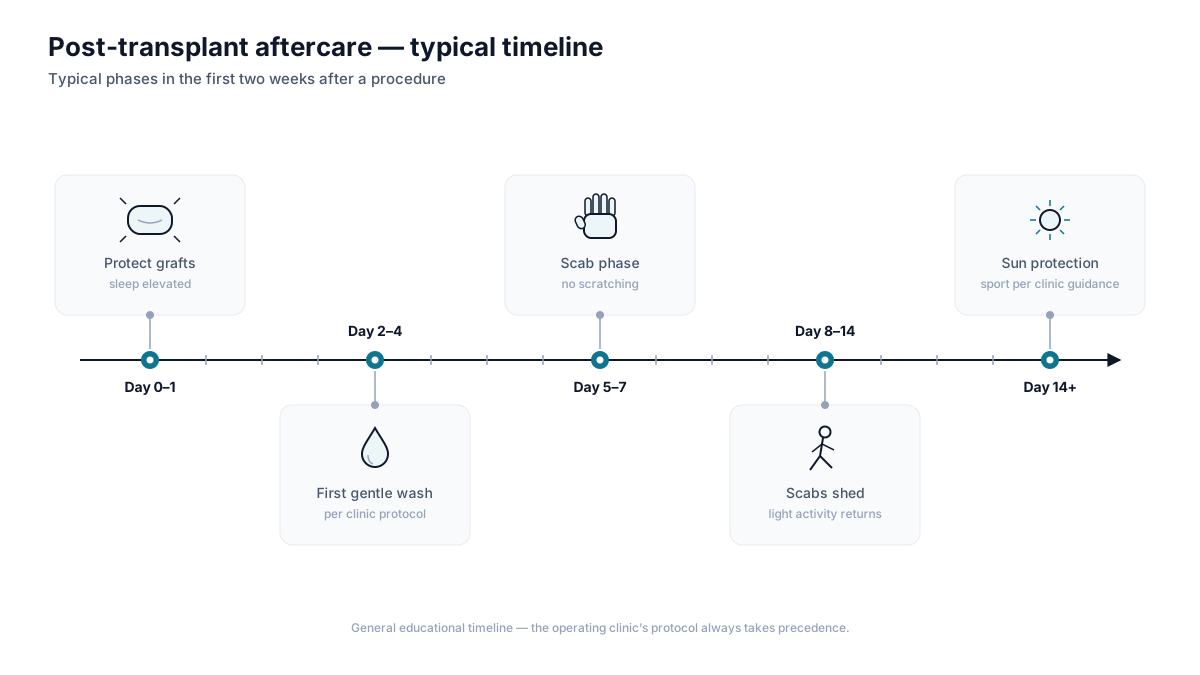
Need is the wrong frame for a cosmetic: the serum’s honest roles are scalp care, comfort and a constructive daily routine during the months when patients want to act and results are slow. Framed that way — and formulated mildly, dosed sensibly, claimed modestly — it earns its place in the aftercare kit without borrowing promises it cannot keep.
Related articles
Private Label Hair Serum: From Base Formulation to Your Brand
A buyer's guide to launching a hair serum under your own brand: choosing a base formulation, picking packaging, handling claims responsibly, and what actually drives minimum order quantities.
What Clinics Actually Put in Post-Transplant Aftercare Kits
A component-by-component look at the post-transplant aftercare kit: what each recovery phase demands, how clinics size and portion the products, why the instruction card outranks everything else in the bag, and where branded kits differ from generic ones.
Dermaroller vs Dermapen in Clinic Protocols: An Instrument Comparison
An instrument-level comparison for clinic buyers weighing rollers against motorized microneedling pens: how each configures its needles, what you can and cannot control, where the consumable money goes, and why the hygiene models differ more than the marketing suggests.
Hair Care & Aftercare Products: A Clinic Buyer’s Guide
What clinics hand patients after a transplant — serums, shampoos, vitamins and kits — and how to buy or brand them without overclaiming.