
What’s Inside a PRP Kit?
The anatomy of a PRP kit: anticoagulant-loaded tubes at the core, blood collection hardware, transfer devices for moving plasma sterilely, and sometimes an activator — plus what a complete kit actually saves you.
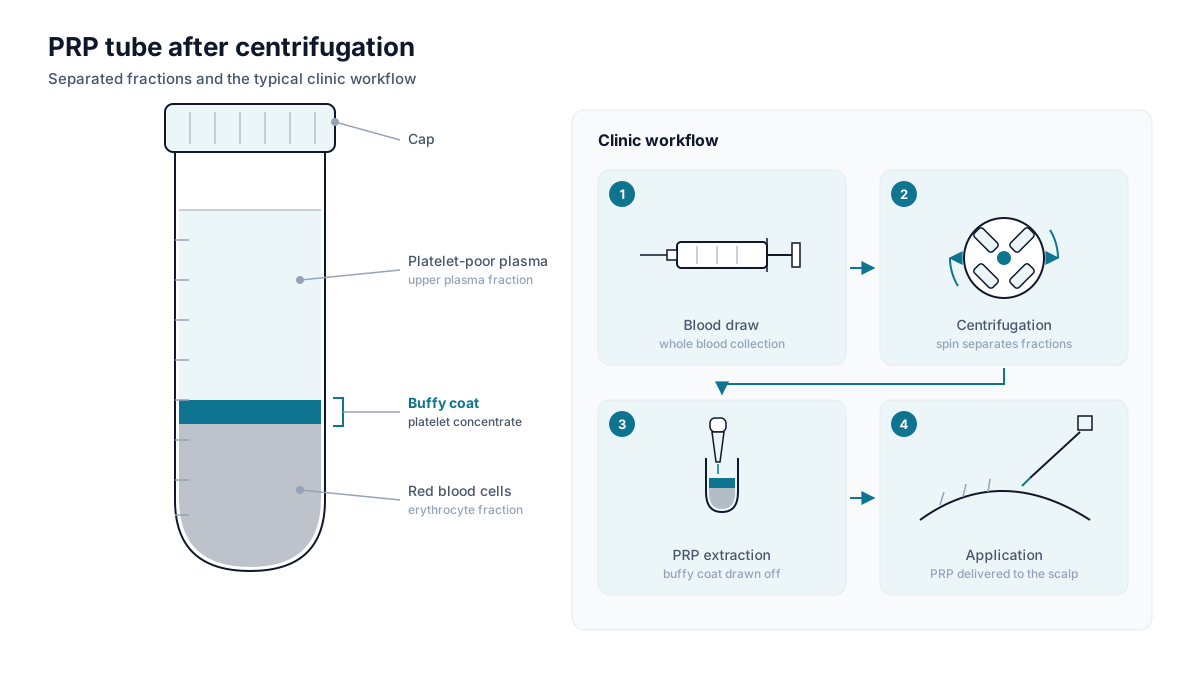
A PRP kit packages the single-use consumables for one platelet-rich-plasma preparation: at minimum, blood collection tubes pre-loaded with anticoagulant, a collection needle or butterfly set for the draw, and transfer devices — syringes, cannulas or transfer needles — for moving the separated plasma without breaking sterility. Some kits add an activator agent, separator gel inside the tubes, or the final injection needles. The word "kit" promises completeness, but kits differ meaningfully in what they actually include, so the practical buying question is always: what does this kit contain, and what will my team still need to pull from general stock?
The components, one by one
| Component | What it does | What varies between kits |
|---|---|---|
| Anticoagulant tubes | Receive the blood draw and prevent clotting before and during centrifugation | Anticoagulant type, fill volume, separator gel or none, glass vs plastic |
| Collection needle / butterfly | Draws blood from the patient into the tubes | Gauge, tubing length, wing design; butterflies dominate for patient comfort |
| Transfer devices | Move plasma from spun tube toward injection, sterilely | Blunt cannulas, transfer needles or luer transfer sets; counts differ |
| Syringes | Hold and deliver the plasma fraction | Sizes and counts; some kits under-supply these |
| Activator (sometimes) | Triggers platelet activation before application, where the protocol uses one | Included, optional or absent; type varies |
| Injection needles (sometimes) | Final delivery to the scalp | Often excluded — check |
The tubes are the heart of the kit and the component that most differentiates one system from another. Anticoagulant chemistry affects handling and comfort, fill volume determines how much whole blood one preparation processes, and separator gel changes the workflow after the spin. These differences are unpacked in the PRP tube anticoagulants guide — for buyers comparing systems, that is the component to study first.
What completeness actually means
A genuinely complete kit lets a trained operator run the full sequence — draw, spin, separate, deliver — opening nothing but the kit and standard skin-prep supplies. The value is not convenience alone: single-use, per-procedure packaging means every case starts from sterile components with one lot number on the record, simplifying both hygiene discipline and traceability.
Incomplete kits are not necessarily bad purchases — a clinic with deep general stock may prefer paying only for tubes and butterflies — but the gaps must be discovered before the first case, not during it. The classic omissions are final injection needles, enough syringes for the operator’s actual technique, and the activator where a protocol expects one. Read the contents list literally, and assume nothing is included that is not named.
Buying notes
Two things separate kit suppliers in practice. First, internal consistency: the components should work together — tubes matched to the stated draw hardware, transfer devices that fit the tubes, volumes that add up across the sequence. A kit assembled from mismatched parts betrays itself in use. Second, tube–centrifuge compatibility sits outside the kit: tubes are designed to be spun at defined settings in compatible rotors, so confirm your centrifuge handles the kit’s tubes before committing to volume. Kit contents also connect to the regulatory picture — components that contact blood destined for re-injection carry expectations covered in the PRP systems hub.
For clinics buying at volume, per-kit pricing, box quantities and shelf-life management are covered in the wholesale PRP kits guide.