
Is PRP Equipment a Regulated Medical Device?
PRP tubes and centrifuges generally fall under medical device rules, with classification differing by market and intended use — and that has practical consequences for what documentation buyers should expect from suppliers.
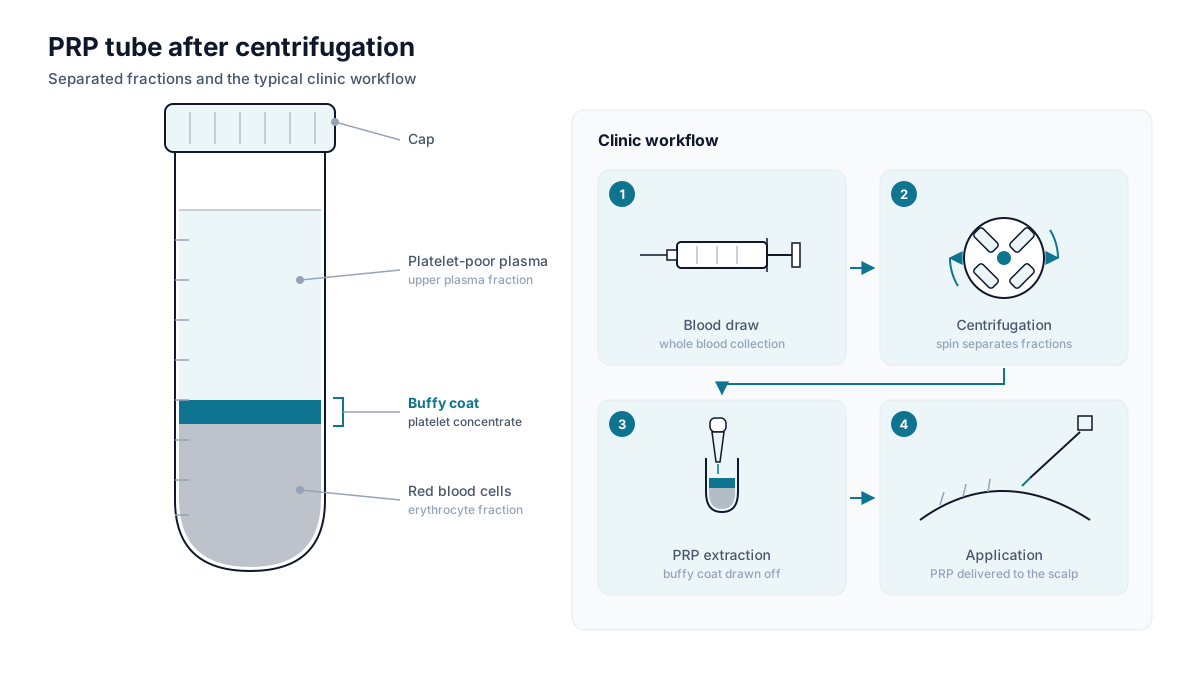
In most markets, yes. PRP tubes, kits and centrifuges are typically regulated as medical devices — the tubes and consumables because they contact blood that returns to the patient, the centrifuges as equipment used in preparing that blood — with exact classification varying by jurisdiction and by the product’s stated intended use. That variation is the practical point for buyers: the same physical tube can sit in different categories in different markets depending on how the manufacturer has positioned it, so the question to ask a supplier is not "is this regulated" but "what is this product’s status and documentation for my market."
Why intended use does so much work
Regulators classify by what a product is for, not just what it is. A blood collection tube intended purely for laboratory diagnostics is a different regulatory object from a visually similar tube intended for preparing platelet-rich plasma that will be re-injected — even when the glass, anticoagulant and stopper look alike. The same logic applies to centrifuges: a general laboratory centrifuge and one placed on the market specifically for PRP preparation carry different expectations. This is why buyers occasionally encounter strikingly cheap "PRP" tubes that are, on inspection, lab consumables never positioned for clinical re-injection use — the price difference reflects a difference in what the product is warranted to be.
What this means for buyers in practice
You do not need to become a regulatory specialist to buy PRP equipment well; you need suppliers who can demonstrate their side of the bargain. In practice that means expecting a serious supplier to state the product’s intended use plainly and provide the supporting documentation appropriate to your market on request — and treating hesitation on that point as a stronger warning than any price is an attraction.
Beyond paperwork, the buying implications are concrete:
- Match the product to the use. Buy tubes and kits that are actually positioned for PRP preparation, not lookalike laboratory consumables at lookalike-lab prices. If re-injection is the purpose, the product should be sold for that purpose.
- Check the pairing, not just the parts. Tubes are validated to be spun in defined conditions; a centrifuge that cannot hold the tube manufacturer’s specified parameters undermines whatever assurances the tube carries. Rotor compatibility and speed control are selection criteria, not details — the PRP centrifuge selection guide covers both.
- Keep records. Lot numbers, supplier invoices and product documentation are cheap to retain and hard to reconstruct. A clinic that can trace which lot of tubes was used when is in a fundamentally stronger position than one that cannot.
- Be wary of borderless listings. Marketplace offers with no stated intended use, no manufacturer identity or no documentation trail are cheap because something is missing. With products that touch blood, that something matters.
The honest summary
Treat PRP consumables with the same seriousness as any injectable-adjacent supply: regulated in most places, classification dependent on market and intended use, and the burden of demonstrating status sits with the supplier — while the burden of choosing suppliers who can carry it sits with you. Buyers building out a PRP service will find the full equipment picture, from tube chemistry to kit completeness, in the PRP systems buyer’s guide.