
Buying Direct from a Manufacturer vs a Distributor: An Honest Comparison
A clinic buyer's comparison of direct-from-manufacturer and distributor purchasing: where the price gap really comes from, what distributors genuinely add, and the volume point where direct sourcing starts to win.
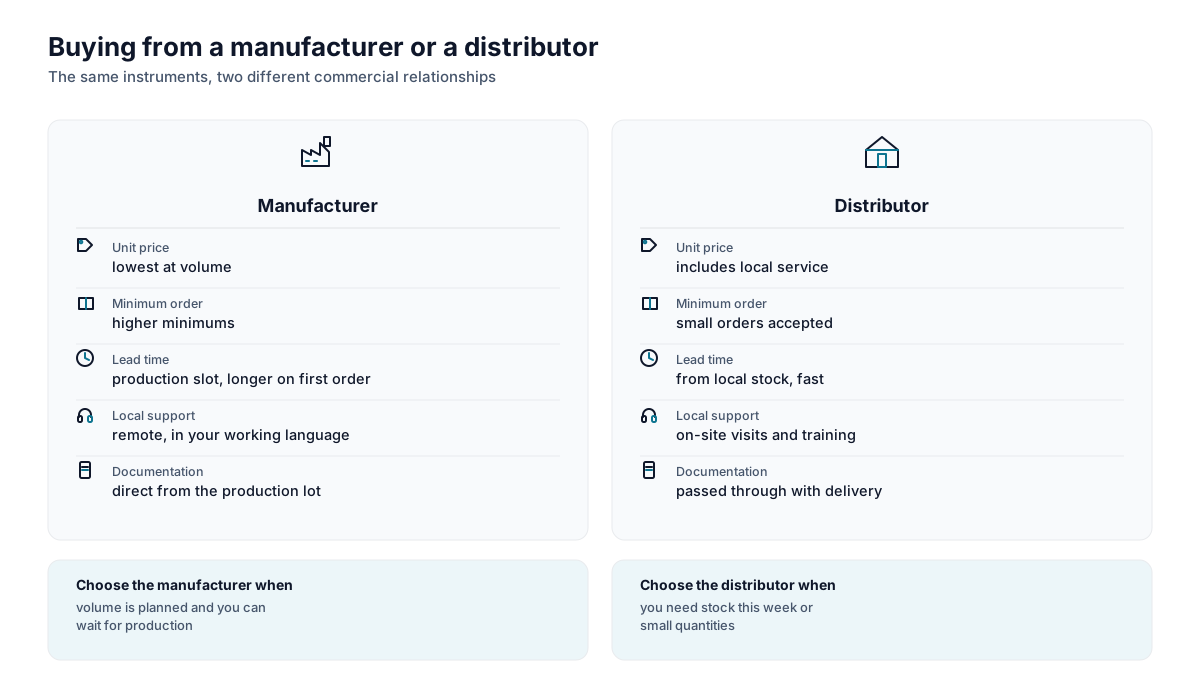
Neither route is simply better: direct-from-manufacturer buying wins on unit price and specification control once your volume clears factory minimums, while distributors win on small quantities, speed, local service and the ability to mix brands in one order. For most clinics the honest answer is a hybrid — direct sourcing for the two or three high-volume SKUs that dominate consumable spend, a distributor for everything else — and the crossover point is defined less by price than by whether your order volume, import capability and quality-assurance capacity can absorb the work a distributor would otherwise do for you.
Key takeaways
- The distributor margin pays for real work: stockholding, small quantities, fast local delivery, returns handling and consolidated ordering across brands.
- Direct buying wins on price and specification control, but only at volumes that clear factory MOQs — and it makes you the importer, with everything that implies.
- Compare landed cost per unit at your actual annual volume, not quoted unit price; freight, customs work and payment terms close much of the apparent gap at small scale.
- Most clinics do best with a hybrid: direct for the few SKUs that dominate spend, a distributor for the long tail and urgent top-ups.
- Whichever route you choose, sample and specify the exact SKU — a distributor substituting an equivalent is the same risk as a factory changing a line.
What each party actually does for its margin
The comparison only makes sense once the distributor's margin is understood as payment for work rather than pure markup. A stocking distributor buys at volume, holds inventory in your region, breaks cartons into clinic-sized quantities, delivers in days, fronts the customs and payment complexity of importing, handles returns and replacements locally, and lets you put five brands on one purchase order. When you buy direct, that work does not disappear — it moves onto your desk. You carry the factory MOQ as inventory, wait out production lead times, arrange or pay for freight, act as importer of record, and resolve any quality dispute across a border and often a language.
The manufacturer, for its part, offers what no intermediary can: the lowest structural unit price, access to the full size and specification range rather than a stocked subset, custom options, first-hand technical answers, and lot traceability one step from the source. The question is never which list is better in the abstract — it is which list matches your volumes and capabilities this year.
The comparison, honestly
| Factor | Direct from manufacturer | Through a distributor |
|---|---|---|
| Unit price | Lowest structural price at volume; breakpoints improve with commitment | Higher per unit — the margin funds stock, service and small quantities |
| Minimum order | Factory MOQs: box-to-carton for stocked lines, production runs for custom work | Small quantities, often single boxes; minimums rarely bite |
| Lead time | Production plus international freight — weeks, longer for custom or sterile runs | Days from regional stock, when the item is actually stocked |
| Range | Full catalog including every size and custom options — but one brand | Curated subset of sizes, but across multiple brands in one order |
| Support and technical answers | Deepest product knowledge, direct engineering answers, slower across time zones | Local-language, same-timezone service; depth varies with the distributor's specialisation |
| Returns and disputes | Cross-border claims: slower, freight-entangled, but authoritative on quality questions | Local returns and swap-outs; the distributor then argues with the factory for you |
| Import and customs work | Yours: Incoterms, customs documentation, import VAT, broker relationships | None — goods arrive domestically with a domestic invoice |
| Traceability | Lot documentation one step from source; strongest position for audits | Good with disciplined distributors; verify lot records survive repacking |
The table hides one dynamic worth pulling out: the price gap is widest on paper and narrowest in practice at small volumes. A clinic ordering a few boxes direct pays near-list unit prices, plus international freight that amortises badly over a small parcel, plus customs handling, plus the cost of its own time. Comparing the distributor's domestic price against a factory quote without those additions is the most common arithmetic error in this decision — the same landed-cost discipline covered in the import from Turkey guide applies to any direct purchase.
When a distributor is genuinely better
Small and irregular volumes. If your annual usage of an SKU does not clear the factory's minimum in one or two orders, the distributor's margin is cheaper than the carrying cost, expiry risk and cash lock-up of MOQ-sized inventory. How minimums are structured — and when they flex — is covered in the instrument MOQ guide.
Mixed-brand baskets. A clinic runs on dozens of SKUs from many makers: punches from one factory, blades from another, sutures, drapes, gloves from others still. One distributor order replaces five international transactions. The consolidation value is real and recurring.
Urgency and buffer failure. When a delivery is delayed or usage spikes, regional stock shipped today is worth a substantial premium over a production slot three weeks out. Even committed direct buyers keep a distributor relationship alive for exactly this case.
No import infrastructure. If your organisation has no experience with Incoterms, customs brokerage or international payment security, a distributor absorbs genuine risk — not just inconvenience — while you build that capability, or permanently if you never need to.
Local accountability. A distributor subject to your jurisdiction, language and consumer of your future orders has strong incentives to fix problems fast. That accountability has commercial value a factory ten flight-hours away cannot fully match, however good its intentions.
New product categories. When a clinic adds a service line — introducing PRP, say, or switching implantation technique — a distributor lets you trial the category at small scale across several brands before any volume exists to negotiate with. Committing to a factory relationship before you know your own consumption pattern locks in guesses; the distributor phase is where those guesses become data.
When direct wins
Volume on core SKUs. Once one or two product families dominate your consumable spend and your annual usage clears factory minimums comfortably, the distributor margin on those SKUs becomes your largest addressable saving. This is where direct relationships pay: the arithmetic in the FUE punch price guide shows how volume commitment moves unit pricing through visible breakpoints.
Specification control. If you need an exact geometry, an unusual size, custom packaging or your own branding, you need the factory — distributors sell what they stock. Direct is not merely cheaper here; it is the only route.
Traceability and audit depth. Buyers who need lot documentation, specification sheets and change notifications from the source — larger clinic groups, wholesalers reselling onward — are structurally better served one step from production.
Building toward resale. If your trajectory is from buying clinic to regional reseller, direct relationships are the asset you are accumulating. That path, and what manufacturers look for in partners, is described in our distributor program.
How the decision shifts by product category
The direct-versus-distributor answer is not one decision but several, because the categories in a clinic's basket have different economics.
High-volume sterile disposables — punches, blades. The strongest candidates for direct supply. Consumption is predictable, per-unit savings compound across thousands of units a year, and specifications are stable enough for annual agreements with staged delivery. This is where most clinics should start a direct relationship.
Implanter systems. A split category: pens are durable purchases bought occasionally, needles are the recurring consumable. Clinics often buy the system through whichever channel supports it locally, then move needle volume direct once gauge usage stabilises — while keeping pen servicing and replacements wherever the accountability is fastest.
PRP tubes and kits. Shelf life changes the arithmetic. Dated products reward smaller, more frequent orders, which favours distributor supply until your volume justifies factory-fresh dating at carton quantities. Ordering a year of tubes to hit a price break, then discarding the expired tail, is a saving that never was.
Capital equipment — chairs, sterilisers, lighting. Here local service usually outweighs unit price. Installation, warranty response and spare-part availability are worth more than the import saving on a purchase you make once every several years, which keeps most clinics with regional channels for equipment even when their consumables run direct.
Aftercare and branded products. Private-label work is factory business by definition — a distributor cannot put your name on someone else's line. The moment branding enters the plan, the conversation is direct.
Questions that expose each route's real cost
Before committing either way, a short interrogation clarifies more than a price sheet. For a distributor: Do you hold this SKU in regional stock, or drop-ship it against my order? Will lot numbers and documentation arrive intact with each delivery? What is your substitution policy when an item is out of stock — and will you commit in writing to never substituting without approval? How has your price for this SKU moved over the past two years? For a manufacturer: What is the repeat-order lead time once my specifications are on file? How does the minimum flex across sizes within a family? Who arranges freight, and under which Incoterm is your quote? What happens, procedurally, when a lot fails my incoming inspection? Neither list is hostile — both are questions good suppliers answer daily, and hesitation on any of them is data.
The hybrid model most clinics land on
In practice the mature pattern is portfolio-shaped rather than either-or. Take your consumption list and split it three ways: the head — two or three SKU families with high, predictable volume — goes direct, negotiated annually with staged deliveries; the long tail of low-volume items stays with a distributor whose consolidation is worth more than any per-unit saving; and a small buffer relationship covers urgency on the head SKUs when logistics fail. Revisit the split yearly: SKUs migrate from tail to head as volumes grow, and the wholesale catalog process is designed to price exactly that kind of migrating basket.
Account for switching costs honestly when running that annual review. Moving a SKU from distributor to direct is not free: your team learns a new ordering rhythm, incoming inspection takes on work the distributor used to do, safety stock must be rebuilt around longer lead times, and the first cycles of any new supplier relationship carry their own attention cost. A saving that looks compelling per unit can evaporate for a year against those one-off costs — which argues for migrating one SKU family at a time, proving the direct channel on it, and only then moving the next. The reverse migration deserves equal honesty: if a direct relationship consumes more management time than its saving justifies, returning that SKU to a distributor is a rational decision, not a defeat.
Two further disciplines keep the hybrid honest. First, sample and specify identically on both routes — the evaluation protocol in the sample orders guide applies to a distributor's stocked line exactly as it does to a factory's, and "equivalent substitute" is a phrase to ban from your purchase orders on either route. Second, benchmark annually: request a direct quote for your top distributor-supplied SKUs and a distributor quote for a direct one. The point is not to churn suppliers but to keep both columns of the table priced by competition rather than by habit.
Frequently asked questions
How much cheaper is buying direct from the manufacturer?
At meaningful volume, direct unit prices typically undercut distributor prices by the distributor's gross margin minus your new costs — freight, customs, payment fees and your own time. At small volumes the gap often closes entirely once those costs are counted, and can invert. The honest comparison is landed cost per unit at your actual annual volume on each route, not quoted price against quoted price.
What volume justifies going direct?
As a working rule: when your annual usage of a product family clears the factory's minimum order comfortably in one or two purchases, and the projected annual saving exceeds the real cost of importing — freight, customs handling, cash tied up in inventory and the hours your team spends managing it. For most clinics that point arrives first on their highest-volume consumable, which is why hybrids start with a single direct SKU family.
Is product quality different between the two routes?
The product should be identical if — and only if — the SKU is identical. The quality risks are route-specific instead: with distributors, silent substitution of equivalents and repacking that breaks lot traceability; with direct imports, lot-to-lot variation you now must catch yourself at incoming inspection. Both risks are managed the same way: exact SKUs on the order, retained reference samples, and delivery checks against them.
Can I use both a manufacturer and a distributor for the same product?
Yes, and many buyers deliberately do: direct supply for planned volume, a distributor for urgent top-ups when a delivery slips or usage spikes. Keep the SKU identical on both routes so instruments are interchangeable in clinical use, and expect the distributor's price to reflect the fact that they only see your irregular demand — that premium is what an availability insurance policy costs.
Do manufacturers mind selling direct to clinics in a distributor's territory?
Policies vary. Manufacturers with exclusive territory agreements will route you to their local partner; others sell direct above a volume threshold or for custom work regardless of geography. Ask directly rather than guessing — being routed to a good local distributor is not a bad outcome at clinic volumes, and the factory's routing tells you something about how it manages its channel.
What should I check before committing to a distributor?
Specialisation in your product categories rather than general medical wholesale; whether they hold real regional stock or drop-ship from the factory with a margin added; lot documentation surviving intact to your delivery; returns terms in writing; and the price trajectory over time, benchmarked annually against a direct quote. A distributor confident in its service will not resist any of those checks.
Get help pricing both routes
If you are weighing a direct relationship against distributor supply — or designing the hybrid split for your consumption list — our specialists can price your actual basket both ways against current production and freight realities, so the decision runs on landed numbers rather than list prices.
Related articles
Minimum Order Quantities for Medical Instruments: A Buyer's Guide
Why MOQs exist in instrument manufacturing, what typical minimums look like by product category, which negotiating levers actually move them, and why a supplier with no minimum at all deserves scrutiny.
Importing Hair Restoration Instruments from Turkey: A Practical Guide
Why Turkey became a manufacturing base for hair-restoration instruments, and the practical import mechanics — Incoterms, customs documents, duty and VAT logic — for buyers in the EU, UK and Gulf.
FUE Punch Price Guide: What Punches Cost and Why
A professional buyer's guide to FUE punch pricing: the six drivers that separate cheap punches from premium ones, realistic price tiers, and how wholesale pricing actually works.
Instrument Samples Before a Bulk Order: How Professionals Evaluate
A clinic buyer's guide to sample orders: how to request the exact SKUs you intend to buy, what paid and free samples really signal, a structured evaluation protocol, and how to convert results into a safe first order.