
Private Label Hair Shampoo: Bases, Bottles and Filling MOQs
A practical buyer's guide to putting your brand on a shampoo: choosing a surfactant base, getting fragrance and pH right for post-transplant users, picking bottles and caps, and understanding filling minimums.
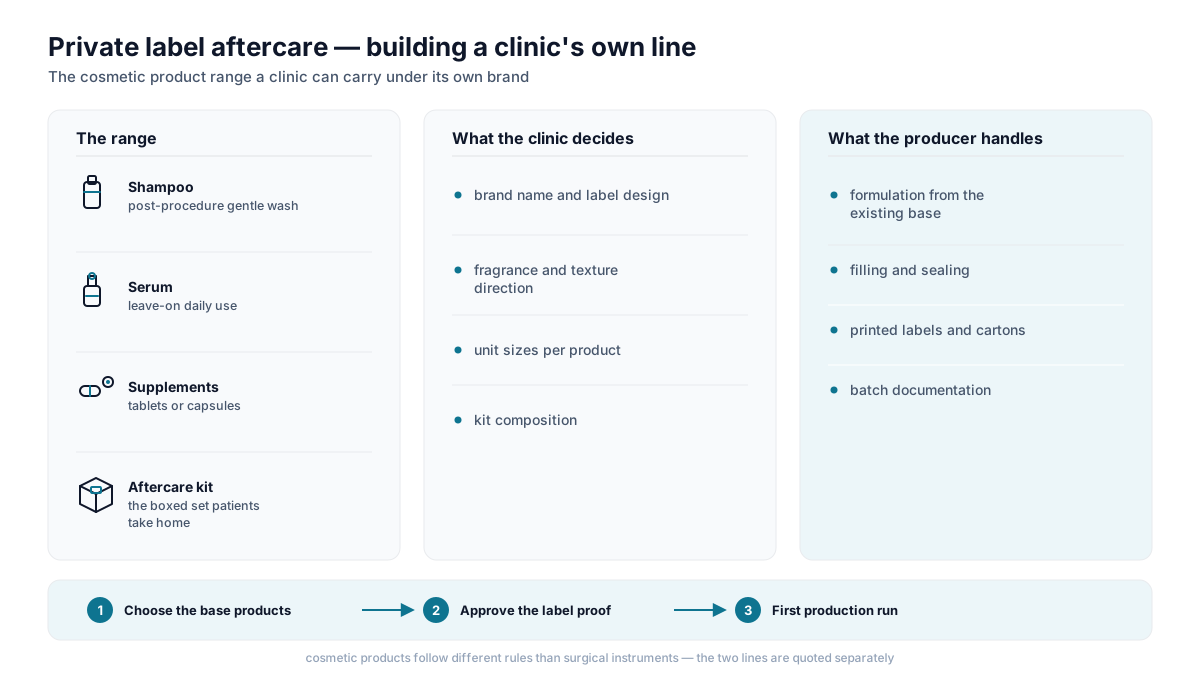
A private-label shampoo project comes down to four decisions: which base formulation carries your brand (for the hair-restoration market, almost always a sulfate-free, gentle-surfactant system), how the product smells and feels in use, which bottle and cap it ships in, and how many units the first filling run must contain to be economic. The formulation chemistry is the manufacturer's solved problem; your work is matching those four decisions to the customer you actually serve — which for clinics means a scalp that has recently been operated on, and for retail brands means a daily-use product that has to survive comparison with supermarket shelves. This guide takes the decisions in order.
Key takeaways
- Shampoo is a volume product: batches are mixed in production tanks, so filling MOQs run higher than serum MOQs and reward buyers who can forecast repeat demand.
- For post-transplant and sensitive-scalp positioning, sulfate-free surfactant systems with low fragrance loads are the default base choice, not a premium extra.
- Fragrance and pH are brand decisions with functional consequences — mild pH and restrained scent matter more to a healing scalp than any hero ingredient.
- Bottle and cap choice drives shelf presence, freight cost and filling-line compatibility; stock bottles with printed labels keep first-order minimums lowest.
- Evaluate samples in real showers over weeks: lather, rinse-out, scent at application and after drying, and how the bottle behaves with wet hands.
Why shampoo behaves differently from other private-label products
Within a clinic's branded range or an emerging brand's lineup, shampoo plays a different economic role than a serum. It is used daily in larger quantities, repurchased on a short cycle, and priced against mass-market anchors every customer knows. That has two consequences for a private-label buyer. First, the repeat-purchase economics are attractive: a customer who adopts your shampoo buys it many times a year, which is why shampoo is often the workhorse of a branded aftercare range even when the serum is the hero. Second, production runs are bigger. Shampoo is mixed in tanks and filled on lines that favour volume, so minimums sit above what buyers see on serum projects, and the unit-price curve rewards consolidation into fewer, larger runs.
Both points push the same way: shampoo suits buyers with a predictable outlet — a surgical calendar, a subscriber base, a salon chain — more than buyers testing a concept. If you are still validating demand, a smaller-format product or a kit-based launch through the aftercare kit route may be the better first step.
Choosing the base: surfactant systems in plain language
The identity of a shampoo is its surfactant system — the cleansing agents that generate lather and remove sebum. Private-label portfolios typically offer a small set of proven systems, and the trade-offs between them are functional, not marketing.
| Base direction | Cleansing character | Typical positioning | Notes for buyers |
|---|---|---|---|
| Classic sulfate-based (SLS/SLES) | Strong cleansing, abundant lather | Mass-market daily shampoo | Rarely chosen for hair-restoration brands; foam expectations are high but so is irritation potential on sensitive scalps |
| Sulfate-free, mild synthetic surfactants | Moderate, gentle cleansing; softer lather | Post-transplant, sensitive-scalp, premium daily use | The default for this market; customers must be taught that less foam is intentional |
| Ultra-mild / baby-grade systems | Minimal cleansing power, very low irritation | First-wash-after-surgery products, kit components | Often paired with a stronger daily shampoo in a staged range |
| Natural-positioned systems | Varies; plant-derived surfactants | Green and botanical branding | Check lather and rinse behaviour carefully in samples — performance varies more than in synthetic systems |
Alongside the surfactant system, stock bases differ in their supporting ingredients — conditioning agents, panthenol, botanical extracts, caffeine — which mostly serve the label story and the after-feel. The evidence caution that applies across this category applies here too: supporting ingredients justify care-oriented cosmetic language, not treatment promises, and a supplier who is careful on this point is protecting your brand, as discussed throughout the hair care and aftercare hub.
Fragrance and pH: small decisions, large consequences
Two formulation parameters deserve more attention than they usually get in briefs.
pH. Skin and scalp sit mildly acidic, and shampoos formulated in that region are the norm for sensitive-scalp positioning. For a post-transplant product this is not a refinement but the point: the customer's scalp is recovering, and a mild-pH, low-irritant wash is what the clinic's instructions require. Ask what pH range a base is buffered to and keep the answer on file with your product documentation.
Fragrance. Fragrance is simultaneously the biggest brand signal in the shower and the most common irritant class in rinse-off products. The practical options run from fragrance-free (safest for immediately post-operative use, and increasingly a positive claim in its own right) through low-load hypoallergenic-style fragrances to full signature scents for retail-facing products. Two decisions follow: the fragrance level, which is a sensitivity decision, and the scent character, which is pure branding. Clinics building a staged range often solve the tension with two products — a fragrance-free early-phase wash and a scented daily shampoo for the months after — rather than compromising on one.
Bottles and caps: the format table
Shampoo packaging is a mature component market, which is good news: stock options are plentiful, proven and cheap. The choice still shapes the product.
| Bottle format | Typical volumes | Cap options | What it signals and what to watch |
|---|---|---|---|
| Cylindrical or oval PET bottle | 200–500 ml | Flip-top, disc-top | The retail standard; wide stock availability keeps MOQs low; label area is generous |
| Tottle (inverted bottle) | 150–300 ml | Flip-top on the base | Dispenses to the last millilitre; modern shelf look; slightly higher component cost |
| HDPE pharmacy-style bottle | 100–300 ml | Screw cap, flip-top | Clinical, medical-adjacent look suited to clinic-dispensed products; less glamorous at retail |
| Pump bottle | 250–500 ml | Lockable pump | Salon and premium positioning; pumps raise per-unit cost and need pump-compatible viscosity |
| Travel / kit size | 50–100 ml | Flip-top | Kit components and trial sizes; per-millilitre economics are poor as a standalone product |
Three practical notes. Wet hands and shower shelves are the real use environment: flip-tops that open one-handed beat screw caps for daily products. Freight is priced by volume and weight, and shampoo is mostly water — bottle size directly moves your landed cost per unit. And filling lines are calibrated per bottle-and-cap combination, so an unusual component pairing adds line-setup work that shows up in the minimum. Stock bottle, stock cap, strong label design is the proven first-order recipe, exactly as it is across the wider private-label programme.
Filling MOQs: the tank is the minimum
Shampoo minimums are set by the mixing tank before anything else. A production batch is mixed as one homogeneous tank and then filled; tank sizes vary by factory, but the principle is constant — the batch must be large enough to justify mixing, heating, quality-checking and cleaning the vessel. Divide a typical production tank by a 250 ml bottle and you understand why shampoo MOQs are quoted in thousands of units, commonly landing in the mid four figures for a first run on stock components, with printed-component runs (custom bottles, silk-screen decoration, printed cartons) able to push the effective minimum higher than the liquid itself requires.
The corollary is that shampoo minimums are negotiable in structure more than in size. Useful levers include filling one base into two label variants (a clinic version and a retail version of the same liquid), aligning your order with a batch the manufacturer already mixes for others where the base is shared stock, and phasing delivery of one production run across several months so the minimum stops being a cash-flow problem. Manufacturers accept these structures routinely; the buyers who get them are the ones who ask.
Reorders change the picture again. Once a base, bottle and artwork are proven, a reorder is a scheduled fill rather than a project, and manufacturers will often hold label stock or components against a forecast, which shortens lead times on every run after the first. Buyers with steady sell-through — a clinic with a stable surgical calendar, a subscription brand with retention data — should put that predictability on the table explicitly, because forecastable demand is the one thing a tank-based production model genuinely rewards with price and priority.
What a bottle of shampoo actually costs to make
Understanding the cost structure makes every later negotiation saner. The liquid itself — water, surfactants, conditioning agents, preservative system, fragrance — is a modest share of unit cost for a standard base; formulation only becomes expensive when unusual actives or custom development enter the brief. Packaging is typically the largest physical cost block: bottle, cap, label or carton, and the filling labour that puts them together. Freight then adds a share that surprises first-time importers, because shampoo is heavy for its value and is priced by the pallet; a 500 ml bottle does not cost twice as much to make as a 250 ml one, but it costs roughly proportionally more to ship. Finally, one-time costs — artwork, plate charges for printed components, line setup — amortise across the run, which is the honest reason bigger runs are cheaper per unit and the reason quoting a shampoo without knowing the quantity is meaningless.
For pricing strategy this yields one useful rule of thumb: your gross margin is made mostly at the packaging and channel level, not the liquid level. Trading down the formulation to save cost is the wrong lever — the savings are small and the product risk is large. The right levers are bottle format, run size and channel mix.
Channel mix deserves a deliberate decision. A clinic-dispensed product can carry a pharmacy-style bottle, minimal fragrance and instruction-led labeling, and it sells at the moment of maximum trust with no retail margin stack. A retail or e-commerce product needs shelf-competitive packaging, a scent identity and pricing that survives comparison shopping. Running both from one base — different bottles, different labels, same tank — is a well-trodden structure that reaches batch minimums faster than either channel alone.
Timeline and sampling
Calendar-wise a stock-base shampoo behaves like other private-label projects: sampling and artwork measured in weeks, component procurement in weeks more, production in a scheduled slot — a few months end to end, with buyer decision speed the usual bottleneck. Sample evaluation deserves real discipline. Test in actual showers for two to three weeks across several heads, including at least one sensitive-scalp user. Judge lather against expectation (sulfate-free foams less — decide whether your customers need educating on that), rinse-out, comb-through after drying, and scent at application versus on dried hair. Then leave a filled sample in a warm bathroom for a month and check for separation, colour drift and cap seepage. A base that passes all of that is ready to carry your name; the comparison of ownership models in the OEM versus private label guide explains what changes if you later want a formulation of your own.
Get a shampoo proposal
Describe your market, your expected annual volume and the bottle format you have in mind, and the response can be concrete: recommended base, fragrance options, realistic minimum and a timeline against your launch date.
Frequently asked questions
What is the minimum order for a private-label shampoo?
Shampoo minimums are driven by the mixing tank: a batch must be mixed as one homogeneous liquid, so first runs on stock bottles are commonly quoted in the mid four-figure unit range. Custom bottles or printed cartons can raise the effective minimum further. Structural levers — two label variants on one batch, phased delivery — often matter more than negotiating the number itself.
Why do sulfate-free shampoos foam less, and does it matter?
Milder surfactant systems generate less lather by nature; cleansing still happens. It matters commercially because customers equate foam with cleaning — successful sensitive-scalp brands address this on the label or in instructions. For post-transplant use, the gentler system is the point, and the reduced foam is a fair trade.
Should a post-transplant shampoo be fragrance-free?
For the early healing phase, fragrance-free or very low fragrance is the conservative choice, since fragrance is a common irritant class in rinse-off products. Many clinics run a staged pair: a fragrance-free early wash and a lightly scented daily shampoo for the months after. For purely retail positioning, scent is a branding decision — but keep loads restrained for a sensitive-scalp claim.
Can one production batch serve both my clinic product and a retail version?
Often, yes. If the liquid is identical, one mixed batch can be filled into different bottles or labeled differently for each channel, which is one of the most effective ways to reach the batch minimum without over-ordering either version. Agree the split when the run is quoted, not after mixing.
What should I test in shampoo samples before ordering?
Use them like a customer for two to three weeks: lather and rinse behaviour, scent at application and on dried hair, after-feel and comb-through, and scalp comfort on at least one sensitive user. Add a stress test — a month in a warm bathroom — checking separation, colour and cap seepage. And confirm samples come from the production base, not a bench approximation.
How long from brief to sellable shampoo stock?
On a stock base with stock components, a few months is realistic: weeks for sampling and artwork, weeks for component procurement, then a scheduled production slot. Custom fragrance development or formulation changes extend the calendar. The most common delay is buyer-side artwork and claims sign-off, so line up your designer early.
Related articles
Hair Care & Aftercare Products: A Clinic Buyer’s Guide
What clinics hand patients after a transplant — serums, shampoos, vitamins and kits — and how to buy or brand them without overclaiming.
Private Label Hair Serum: From Base Formulation to Your Brand
A buyer's guide to launching a hair serum under your own brand: choosing a base formulation, picking packaging, handling claims responsibly, and what actually drives minimum order quantities.
Clinic-Branded Aftercare Kits: Contents, Branding and Economics
A clinic buyer's guide to putting the practice's name on the post-transplant bag: kit composition, branding depth, what a kit really costs per patient, and whether to buy pre-packed or assemble in-house.
OEM vs Private Label vs White Label for Hair Products
The three routes to selling hair care under your own brand — OEM, private label and white label — compared on control, speed, minimums, cost and IP ownership.