
Punch Gauge
Punch gauge is a legacy needle-sizing scale sometimes applied to FUE punches, where a higher number means a smaller bore — which is why millimetres are the professional unit.
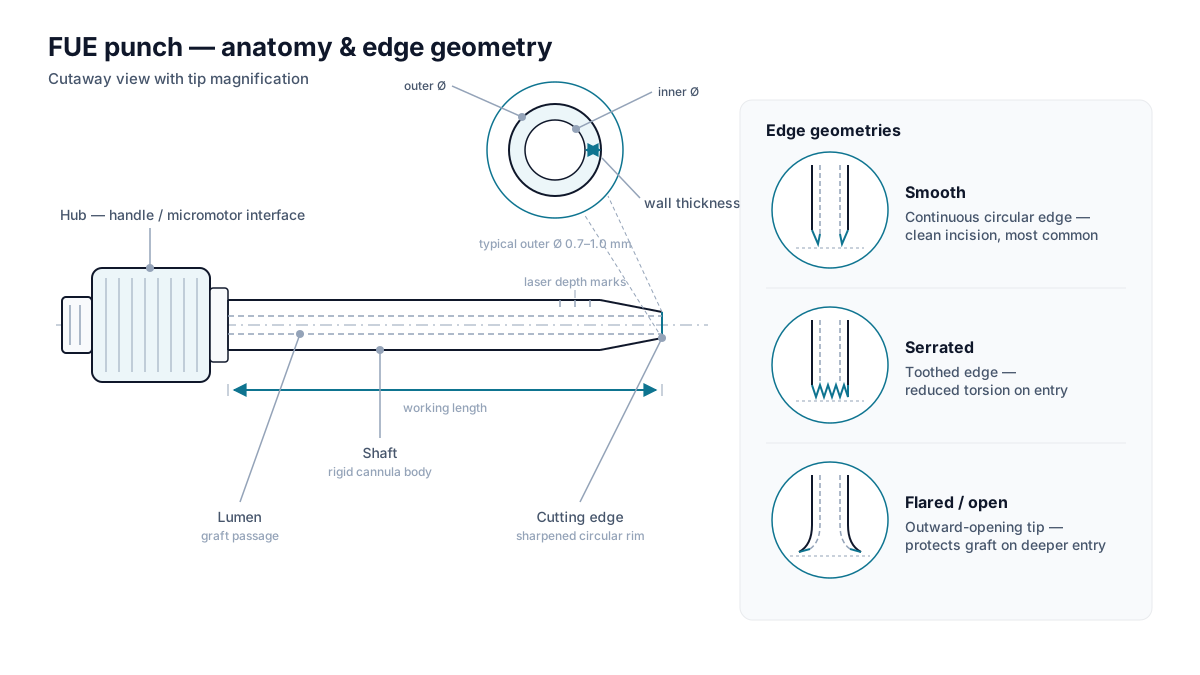
Punch gauge is a legacy needle-sizing scale that is sometimes applied to FUE punches and cannulas, in which a higher gauge number denotes a smaller bore — the exact inverse of the millimetre. The scale descends from the Birmingham and Stubs wire gauges used for hypodermic needles, where the number originally counted drawing passes through a die, not a physical dimension. Because the relationship between gauge and actual size is non-linear and differs between standards, gauge is an ambiguous way to describe a precision instrument, and millimetres are the professional unit for FUE work.
Punch gauge in practice
The trap is the reversal: a 20-gauge tube is wider than a 22-gauge tube, so the intuition that "bigger number means bigger" fails immediately. Worse, gauge steps do not map evenly onto the tenths of a millimetre that matter in FUE. Around the working band, one gauge step can span more than the 0.05 mm increment that changes wound area and graft fit, so gauge simply cannot express the resolution a punch decision needs. That is why serious specifications and this platform's charts quote diameter in millimetres and treat any gauge figure as a rough cross-reference only.
Gauge also does not, on its own, tell you which diameter it refers to. Needle gauges are historically tied to outer diameter with a nominal wall, but punch makers vary, so a gauge label leaves the inner-versus-outer-diameter question open — the same ambiguity that dogs any punch spec. Reading a gauge number without knowing its reference and its standard is reading noise.
What buyers and professionals should know
When a supplier or an older catalogue lists gauge, convert it to millimetres and confirm the conversion against the maker's own figure before comparing anything. The implanter needle gauge chart gives the gauge-to-millimetre relationship used across implanter needles and cannulas, and it makes the non-linearity visible at a glance. Never assume two suppliers mean the same physical size by the same gauge, because gauge standards diverge and wall conventions differ.
For punches specifically, insist on the actual outer and inner diameters in millimetres, plus the grinding tolerance, exactly as set out in the punch diameter guide. Gauge is acceptable shorthand in conversation and on legacy packaging; it is not an adequate basis for a purchase order or a like-for-like comparison. Treat it as a pointer toward the millimetre figure, then buy on the millimetre figure. The broader punch specification picture lives in the FUE punches hub.