
Lateral Slit
A recipient-site incision oriented parallel to the direction of natural hair growth to guide graft angle.
A lateral slit is a recipient-site incision made so that its long axis runs parallel to the direction in which the surrounding hair grows — that is, side-to-side across the line of growth, sometimes called a coronal incision. The orientation is the whole point: by seating the follicular unit in a slit aligned with natural flow, the technique aims to control the angle and direction at which the transplanted hair emerges.
In practice
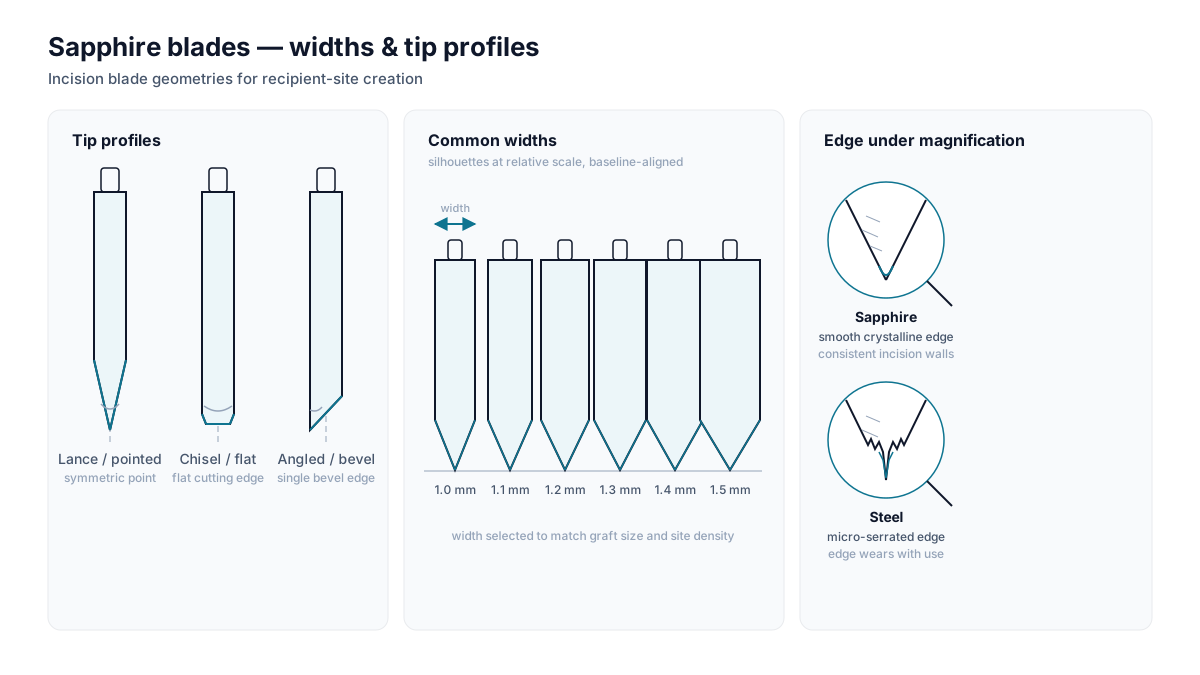
Recipient sites can be made in different orientations, and lateral (coronal) versus sagittal describes the angle of the cut relative to hair direction. A lateral slit holds the graft so its hairs fan in the growth direction, which influences how coverage and layering appear. Making these incisions consistently is a manual skill supported by the instrument: the blade's width and shape are matched to graft size so the slit is just large enough to seat the unit without excess wounding. Blade orientation at the moment of incision — how the operator holds and angles the cutting edge — is inseparable from the technique, which is why incision method and blade choice are discussed together.
What buyers and professionals should know
The instrument implication is the practical takeaway. Because a slit's dimensions must match the graft, blade width becomes a specification decision, and clinics often keep a range of blade sizes so incisions can be sized to single-, double-, and multi-hair units rather than forced to one width. Custom-cut blades and pre-made blades in graduated widths both serve this, and the material — steel or sapphire — is a separate choice affecting edge sharpness and handling. The sapphire blade angle guide covers how edge geometry meets incision technique.
Keep the framing neutral and specification-led. Lateral versus sagittal incision is a technique choice made by the operator for aesthetic and anatomical reasons, not a product feature, and no orientation is universally "better." What a buyer can act on is the hardware that supports whichever approach a clinic uses: blade material, width range, edge quality, and sterility. Evaluate those measurable properties, and treat the incision technique itself as the physician's domain that the instruments are chosen to serve.