
FUE (Follicular Unit Excision)
Follicular Unit Excision, a technique that harvests grafts individually with a small circular punch rather than a strip.
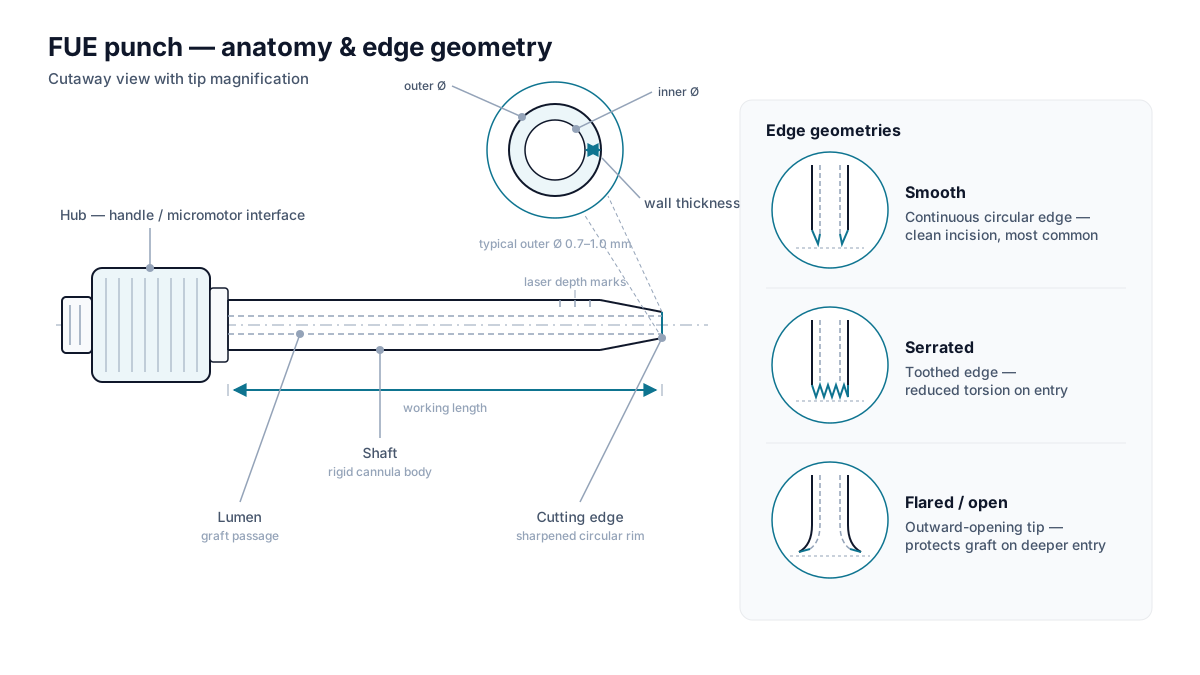
FUE, or Follicular Unit Excision (also called Follicular Unit Extraction), is a hair restoration technique in which grafts are harvested one follicular unit at a time using a small circular punch, rather than by removing a strip of scalp. Because each unit is cored out individually, the donor area heals with scattered tiny punctate marks instead of a single linear scar — the feature that most distinguishes FUE from strip harvesting.
In practice
The core instrument is the FUE punch: a fine tube, typically in the region of 0.7 to 1.0 mm outer diameter, that scores around a follicular unit so it can be lifted free. Punches may be manual, or driven by a motor or rotary handpiece, and their diameter, edge geometry, and wall thickness are all specification choices matched to the grafts being harvested. Extraction is only the first phase; the freed units are then stored and implanted, whether into pre-made incisions or with an implanter pen as in DHI. The instrument decisions that shape the harvest are collected in the FUE punches hub.
What buyers and professionals should know
FUE names a harvesting method, and the honest way to discuss it is as a technique with its own instrument demands rather than a ranked "best" option. Whether FUE or a strip approach suits a given case depends on graft numbers, donor characteristics, and patient priorities such as wearing hair short — trade-offs set out in the FUE vs DHI instruments comparison and the contrast with FUT. Avoid treating the acronym itself as a quality claim.
For procurement, FUE is instrument-intensive: it consumes punches, storage supplies, and forceps in volume, and the specifications of those instruments — diameter tolerance, sharpness retention, whether they are single-use or reusable — bear directly on cutting quality and on the transection rate. Buyers get comparable quotes by specifying measurable properties, not by asking for "FUE punches" in the abstract. The technique's economics are driven by consumable choices as much as by the method itself, since a case may run to thousands of extractions and every punch, storage container, and forceps is used at scale. Whether an instrument is single-use or reusable, and how well it holds its edge across a session, therefore shows up directly in both cost per graft and cutting quality.